A comparative analysis of the different types of sentences
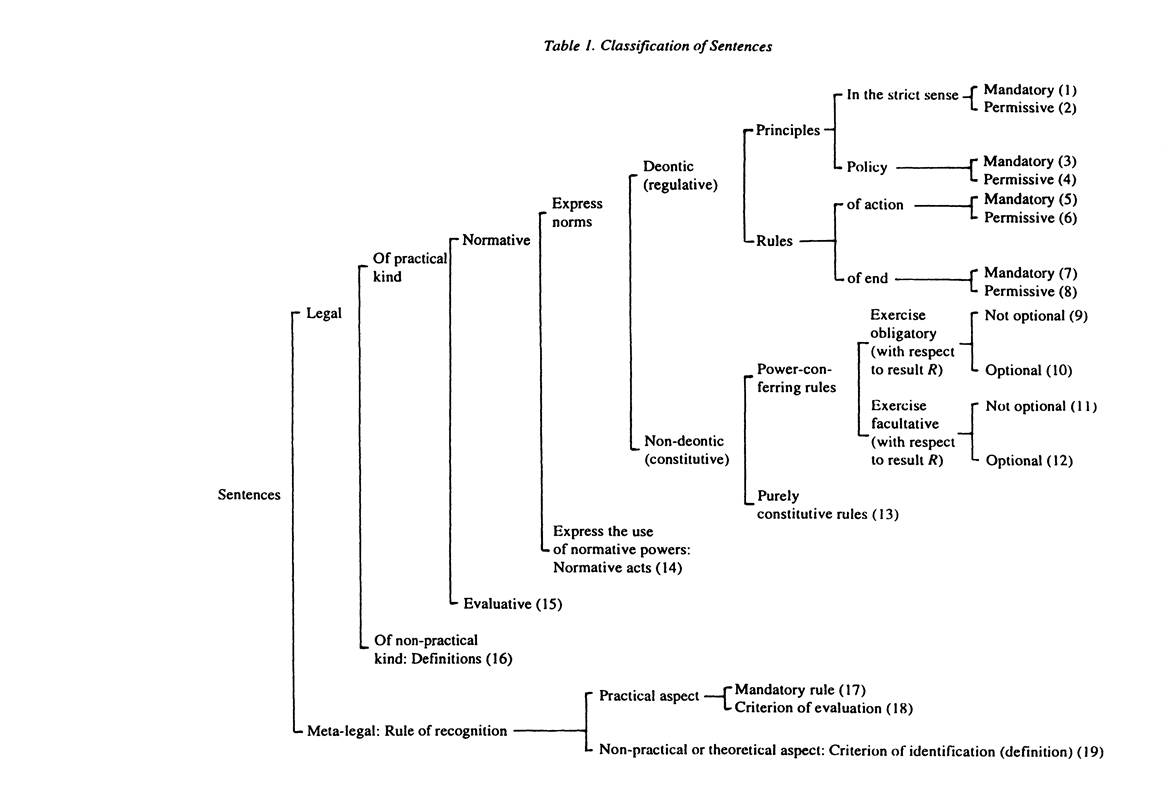
We will begin with the eight types of sentences expressing deontic norms.
From the structural point of view, they can all be reduced to a conditional form where the antecedent (the legal facts of the case or conditions of application) consists in a certain state of affairs, and the consequent (the legal consequence or normative solution) is constituted by an action (in the case of principles in the strict sense or of action rules) or a state of affairs (in the case of policies or end rules), modalized by mandatory operators — 1), 3), 5) and 7) being the four possible types of mandatory norms — or by the operator of permission.
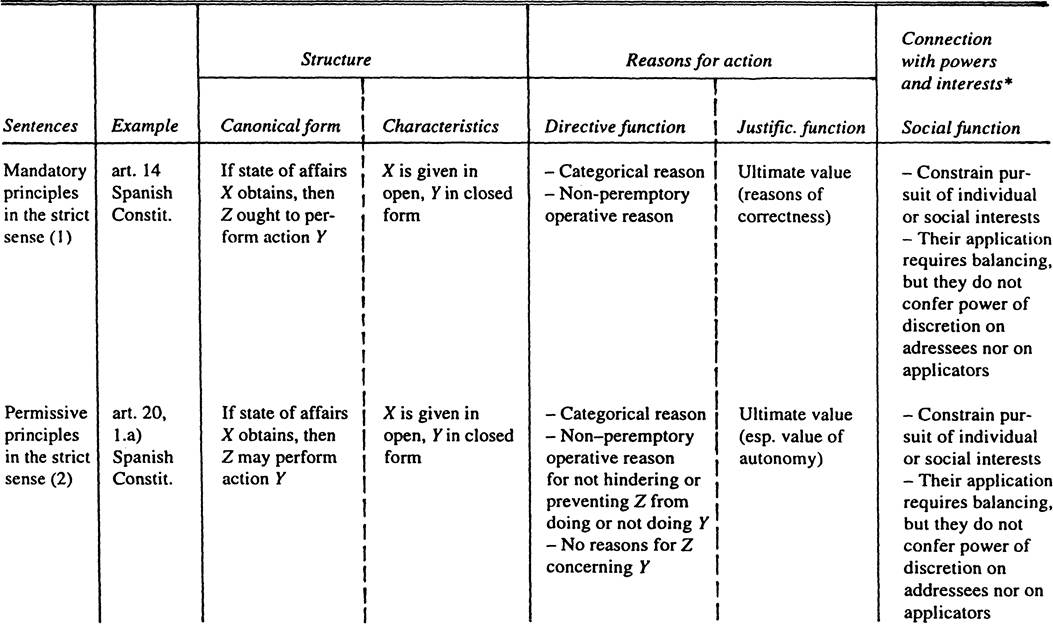
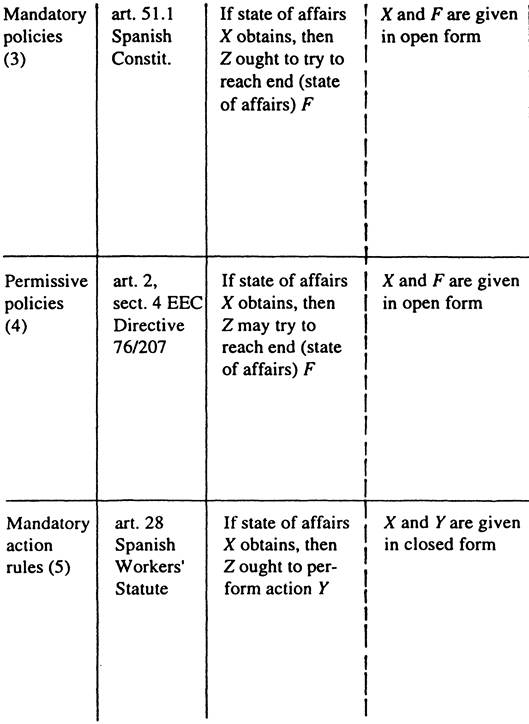
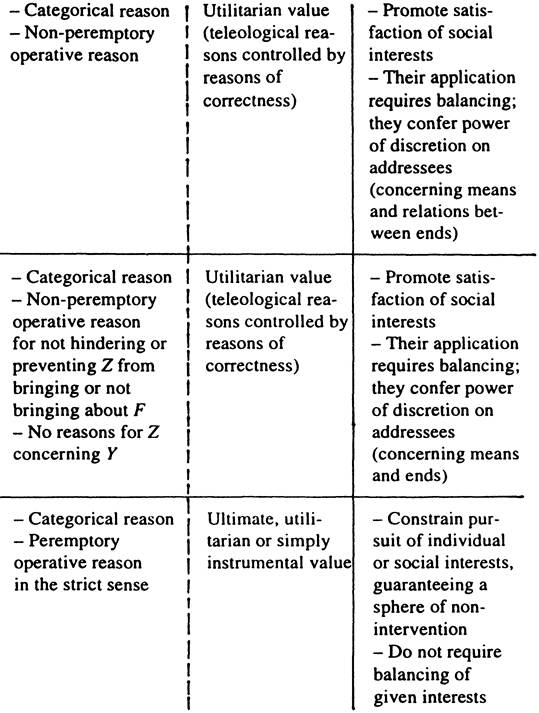
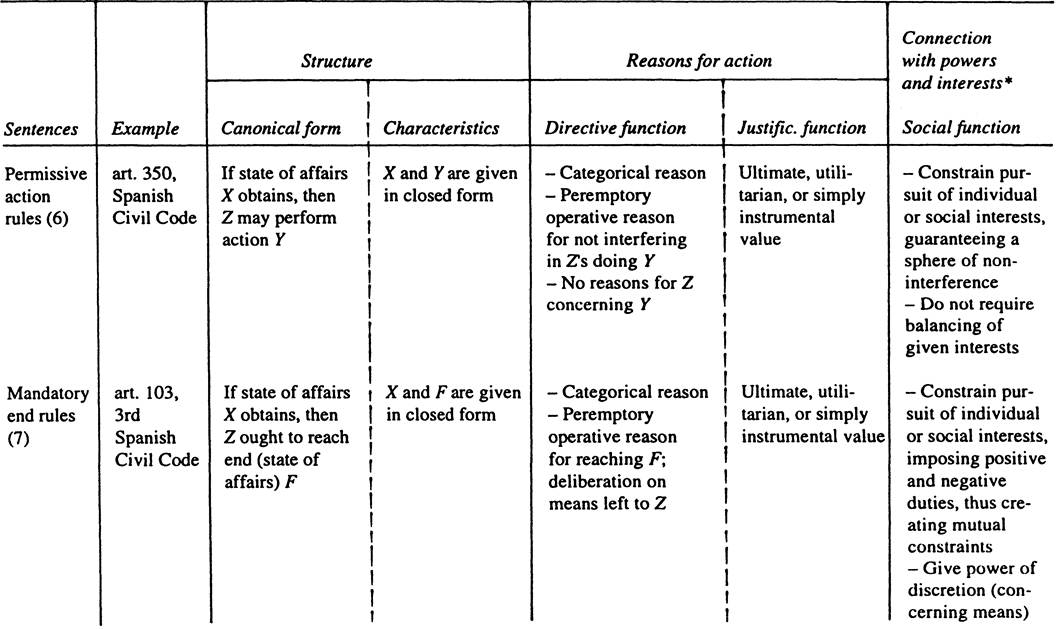
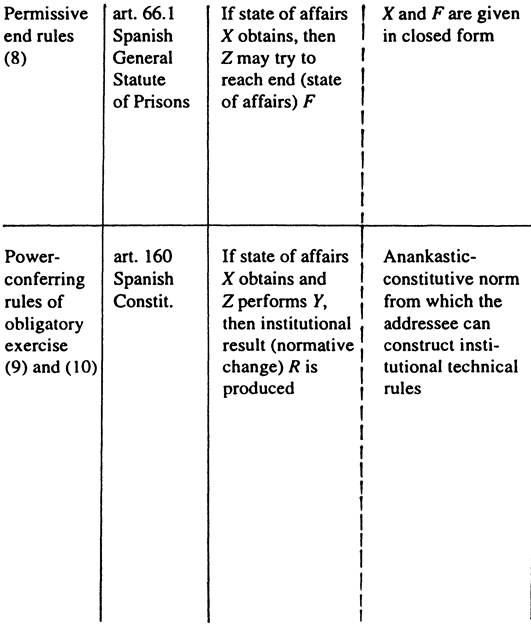
What is typical of action rules, in our view, is that they stipulate that, under certain circumstances constituting their conditions of application (which are given in closed form), a certain behaviour (which also is given in closed form) ought to, or may, be shown. End rules, in turn, are characterized by stipulating that, under the circumstances constituting their conditions of application (which are given in closed form), a certain state of affairs, which also is given in closed form, ought to, or may, be brought about. What end rules do not close is the prescribed pattern of behaviour, since they only command attainment of some state of affairs, without saying anything about the actions that are appropriate means for the purpose (which, obviously, does not mean that there may not be other normative constraints, coming from other norms of the legal order under scrutiny, concerning those actions). Principles are characterized by indicating the circumstances constituting their conditions of application in open form. The most important distinction between them is the one between principles in the strict sense and policies or program norms. The former stipulate that, except when in the case at hand there are other pertinent principles of higher weight, one must — or may — follow a certain standard of behaviour given, just as in action rules, in closed form (which implies that if there is a principle prevailing over other, possibly conflicting ones, that principle must be fully complied with). Policies, in turn, leave their conditions of application open too; but they command — or permit — to approach some state of affairs as closely as possible. Policies are similar to end rules in that they leave open the appropriate standard of behaviour for attaining the commanded state of affairs, but they differ from them in that the state of affairs also is given in open form (should be approached as closely as possible, together with other objectives whose maximization also has been ordered). Naturally, this implies that for policies, there can be different degrees of compliance.Taking the examples given in the second column of Table 2, we can thus present the following 'translations' of the corresponding norms, in terms of what we have earlier said to be their 'canonical form':
1) Article 14 of the Spanish Constitution1 (understood as a provision addressed to the law-creating and law-applying organs): "If a legal organ uses its normative powers (i. e., issues a norm in order to regulate a generic case, or applies a norm in order to solve an individual case, etc.), and if with respect to the individual or generic case in question there is an opportunity for discriminating on grounds of birth, sex, religion, opinion or any other personal or social condition, and there is no other countervailing principle of higher weight in the case at hand, then it is prohibited to that organ to discriminate on any of the grounds stated."
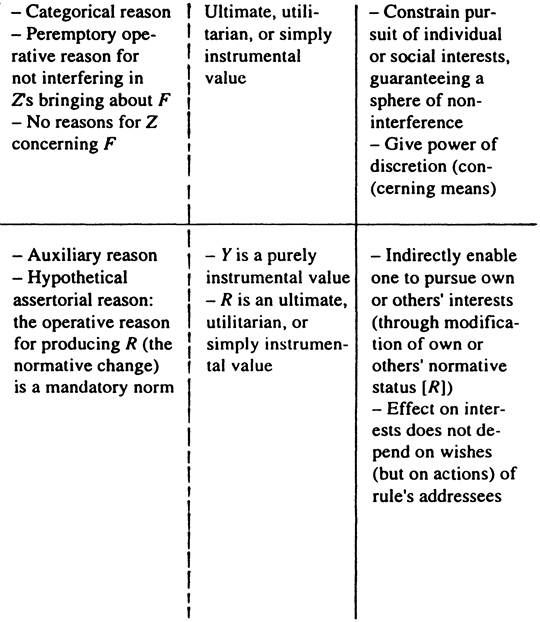
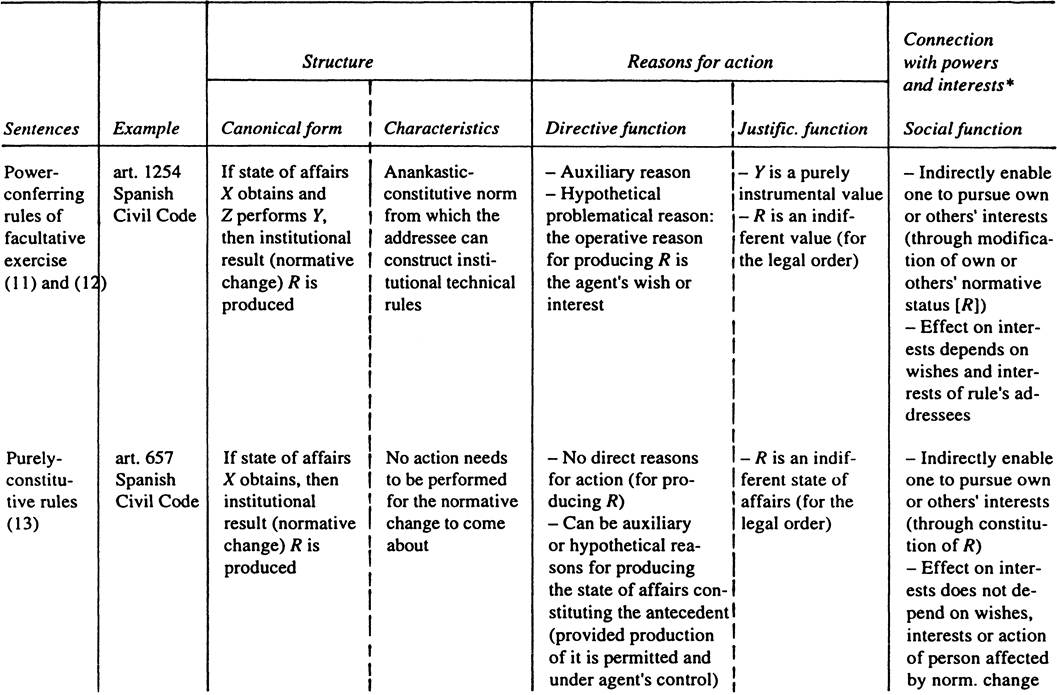
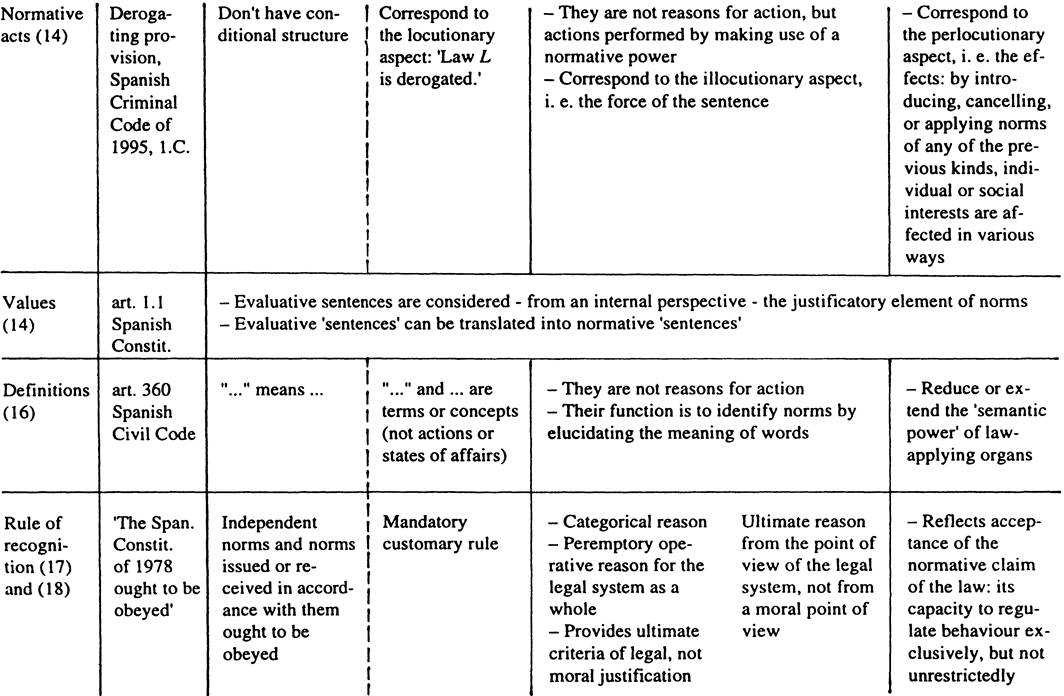
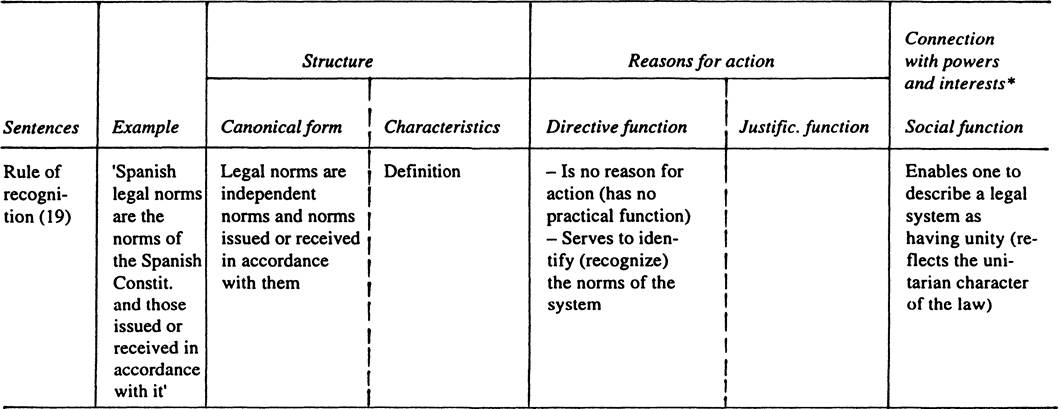
2) Article 20.1 a) of the Spanish Constitution:[82] [83] "In all (generic or individual) cases where there is an opportunity for expressing or not expressing, or for diffusing or not diffusing, any idea or opinion, all those behaviours are permitted, unless there is another countervailing principle of higher weight in the case at hand." Or, translated into a mandatory principle addressed to the lawcreating and law-applying organs: "In all (generic or individual) cases where there is an opportunity for the legislator, and for the public powers in general, to impose obligations or prohibitions concerning the behaviour consisting in expressing or not expressing, diffusing or not diffusing, any idea or opinion, or to hinder the performance of such behaviours, or to impose sanctions as a consequence of them, it is prohibited to the legislator, and to the public powers in general, to act in any of the stated ways, unless there is another countervailing principle of higher weight in the case at hand." 3) Article 51.1 of the Spanish Constitution[84]: "The public powers must adopt the appropriate measures for effectively protecting the security, health and legitimate economic interests of consumers and users, whenever there is an opportunity for it, and to the highest degree compatible with the attainment of other ends also constitutionally ordered." 4) Article 2, paragraph 4 of EEC Directive 76/207[85] [86] (on the application of the principle of equal treatment of men and women concerning access to employment, professional training and promotions as well as working conditions): the prohibitions of unequal treatment contained in the Directive "do not extend to measures designed to promote equal opportunities for men and women, especially in order to correct currently existing inequalities affecting the opportunities of women with respect to the matters considered in paragraph 1 of article 1 [access to employment, including promotions, professional training, working conditions, etc.]." 5) Article 28 of the Workers' Statute:[87] "If A, as an employer, has labour relations with several persons doing the same work, A must offer equal payment to all of them, irrespective of their sex." 6) Article 350 of the Spanish Civil Code:6 "If A is the proprietor of a piece of land that is not encumbered by any easement prohibiting it, A may carry out on it whatever construction, plantation, or excavation he wishes, within the limits set by the laws and police regulations." 7) Article 103, 3 of the Spanish Civil Code:[88] "If a petition of nullity, separation or divorce has been filed, once this has been accepted and there is no agreement between the parties, the judge must, among others, take the measure he thinks necessary (in the form of guarantees, deposits, reserves, or other convenient protective measures) for securing the effectivity of the sum one spouse must pay to the other as contribution to the burdens of the marriage." 8) Article 66.1 of the General Statute of Penitentiaries:[89] "If there are groups of inmates whose treatment requires it, the prision administration may adopt measures leading to the organization, in the corresponding centers, of programs based on the principle of a therapeutic community." In terms of reasons for action, we can distinguish between the directive and the justificatory or evaluative dimension. As for permissive regulatory norms, seen from this perspective, they express that for the addressee there are no specific reasons for or against the performance of the action in question (either saying that there actually are no such reasons, or cancelling those that may have existed before), and that for third parties there is a reason for not preventing or hindering the addressee from performing or not performing the action in question; in the case of permissive principles (principles in the strict sense or policies), that reason is a non-peremptory reason, whereas for permissive action or end rules, it is a peremptory reason. In the case of rules, permissive provisions (regulating natural behaviour, that is, behaviour not consisting in the exercise of normative powers), may be explicated entirely in terms of the clarification (through definition), exception, derogation or indirect formulation of mandatory rules (prohibiting lower-ranking authorities to introduce prohibitions, impediments or sanctions). If we now proceed to look at deontic or regulatory norms from the justificatory or evaluative dimension of reasons for action, the distinction between principles in the strict sense and policies is as follows: Principles in the strict sense are reasons of correctness that presuppose ultimate values, whereas in the case of policies we have utilitarian reasons presupposing values of that same kind. This implies that the second type of reasons can and should be evaluated — and possibly overruled — by reasons of correctness, whereas the contrary cannot legitimately occur. As for rules of any of the four types we have distinguished, they can incorporate ultimate values as well as utilitarian or simply instrumental values (or some combination thereof). Finally, from the perspective of the social function fulfilled by regulatory norms, with respect to social power and interests, the difference between principles and rules can be expressed as follows: action rules do not require one to weigh and balance the interests and values in question; end rules require such balancing only with respect to means (they concede, so to speak, a certain degree of discretion), but not to ends; principles in the strict sense require balancing when they are applied, but do not give the organ of application any power of discretion; and policies require balancing, and concede power of discretion with respect to means and ends. Let us now look at power-conferring rules. From the structural point of view, those rules link the production of an institutional result (or, what amounts to the same, a normative change) to the existence of a certain state of affairs, together with the performance of an action by some subject. Their canonical form is: 'If state of affairs X obtains, and Z performs action Y, then institutional result (normative change) R is produced'. In our opinion, such norms are an- ankastic-constitutive rules. They are constitutive because the rule itself creates the possibility for bringing about the institutional result (which does not exist independently of the rule); and they are anankastic because on the basis of such rules their addressees can construct institutional technical rules (just as on the basis of anankastic natural propositions one can construct natural technical rules). In Table 2, we analyze only power-conferring rules whose exercise is obligatory or whose exercise is facultative; we thus do not consider the possible distinction between whether or not element Y — the action of the antecedent — is optional. The two examples we give of those two main types of power-conferring rules would be expressed as follows in their canonical form: 9) and JO) Article 160 of the Spanish Constitution:[90] "If circumstances X obtain (that A is a member of the Constitutional Court and the Court's plenum proposes him for President) and if Z (the King) performs action Y (appointing A), then normative result R (that A becomes President of the Constitutional Court) is produced." 11) and 12) Article 1254 of the Spanish Civil Code:[91] "If state of affairs X obtains (there is at least one person with full legal capacity) and those persons perform action Y (agreeing to commit themselves to give something or to perform some service to some other person or persons), then normative result R (there is a contract) is produced." If we now consider power-conferring rules in terms of reasons for action, they are — in their directive aspect — auxiliary (Raz) or hypothetical (in the Kantian classification of imperatives) reasons. Seen as reasons for action, but now from the evaluative or justificatory perspective, element Y always represents a purely instrumental value, whereas R — the normative result — can be an ultimate, a utilitarian, or simply an instrumental value in the case of a power-conferring rule of obligatory exercise; when the exercise is facultative, however, R is indifferent (from the point of view of the legal order, of course, not from that of someone using the rule). As for their social function, power-conferring rules of any of the two kinds, through the modification of one's own or others' normative status, indirectly promote the pursuit of one's own or others' interests. However, that interests are thus affected does not depend — in the case of rules of obligatory exercise — on the wishes or interests (but on the action) of the addressee to whom power is conferred, in contrast to what happens in the case of powerconferring rules of facultative exercise. Besides power-conferring (anankastic-constitutive) rules, the legal system also contains purely constitutive rules which also determine the production of institutional results or normative changes. These are rules whose canonical form is: 'If state of affairs X obtains, then institutional result (or normative change) R is produced.' As can be seen from the example we have given for this kind of rules, the normative change (the transmission of rights of succession) is produced without any need for the person affected by the change to perform an action: 13) Article 657 of the Spanish Civil Code:[92] "When a person dies, her rights of succession are passed on at the moment of death." Since they do not refer to any action, such rules are not really reasons for action (for bringing about R), but they may provide auxiliary reasons for bringing about the state of affairs constituting the antecedent of the rule (provided the bringing-about of that state of affairs is permitted and is under the control of the agent). In its evaluative dimension, from the point of view of the legal order, R is an indifferent state of affairs. Purely constitutive rules affect interests, but (in contrast to what happens with power-conferring rules) that does not depend on the performance of a normative act by anyone. Normative acts can be analyzed, we think, by distinguishing their locu- tionary (what is said), their illocutionary (what is done by saying it), and their perlocutionary (what are the effects of doing it) aspects. These three levels have a certain similarity with the three perspectives we have distinguished in norms. In contrast to norm-expressing sentences, those expressing the use of normative powers — whose uttering, in the appropriate conditions, constitutes the use of a normative power — have no conditional structure, as can be seen in the following example: 14) Derogating provision of the Spanish Criminal Code of 1995, l.c): "Derogated are: [...] c) Law 16/1970 of August 4, on Dangerousness and Social Rehabilitiation, with later modifications and supplementary provisions." Such sentences do not express any reasons for action, but speech acts that are instances of the use of normative powers; by introducing, eliminating, using or applying norms of the preceding types, they affect in different ways individual and social interests. As for evaluative sentences, we have considered them, from an internal perspective, as the justificatory element contained in the preceding types of norms. What characterizes an evaluative sentence is that the emphasis is on the justificatory aspect; but we have held that they can be translated without any loss of meaning into normative sentences of one or the other of the types we have distinguished. Thus, in the case of article 1.1 of the Spanish Constitution: 15) Article 1.1.: "Spain is constituted as a social and democratic State under the rule of law, declaring as the highest values of its legal order liberty, justice, equality and political pluralism" an equivalent formulation would be: 15') "In the Spanish legal order, acts of norm-creation and norm-application must implement the principles of liberty, justice, equality and political pluralism". Definitions are sentences without any practical dimension, that is, they are neither guides nor criteria of evaluation for any behaviour. Their structure is not conditional, but has the canonical form:'"...' means where the definiendum and the definiens are terms or concepts, not actions or states of affairs. Thus: 16) Article 660 of the Spanish Civil Code:[93] "Heir" means "person entitled to inherit an estate as a whole", and "legatee" means "person entitled to a partial inheritance". Their function is to identify norms, understood as the meaning of normative sentences, by elucidating the meaning given to certain expressions used in such norms. Besides, legislative definitions not only fulfil the (explicatory) function of clarifying language, by reducing ambiguities and vagueness, but also (if you wish, by thus specifying the terms) that of restricting — or extending — the 'semantic power' of judges and legal doctrine. Finally, the rule of recognition, constituting a guide and criterion of evaluation for behaviour and decisions, on the one hand, and providing a theoretical criterion for identifying legal norms, on the other, reflects on the meta- legal level the three broad types of sentences distinguished on the level of the language of the law: the normative, the evaluative and the conceptual (defining) types. In Table 2, however, we distinguish only two of its forms: as a practical sentence, and as a theoretical or conceptual sentence: 17) and 18): "The norms contained in the Constitution of 1978 and the norms issued or received in accordance with it, ought to be obeyed"; "behaviour and decisions ought to be evaluated exclusively on the basis of the norms contained in the Constitution of 1978 and the norms issued or received in accordance with it". 19) "Norms of the Spanish legal order are those contained in the Constitution of 1978 and in the sources recognized or instituted by it." Acceptance of the rule of recognition as a guide and criterion of evaluation amounts to acceptance of the exclusionary claim of the law, that is, the assumption that when its norms apply, one ought to behave and judge on the basis of them, excluding any reasons other than those norms (or the reasons those norms possibly refer to) as a basis of action and evaluation. As a theoretical criterion of identification, the rule of recognition gives unity to the legal order, by delimiting the domain of legal norms: they are those the rule of recognition itself directly or indirectly refers to. Seen under its normative aspect, the rule of recognition is a mandatory norm which, in its directive dimension, works as a peremptory reason in favor of the legal system as a whole and which, in its justificatory dimension, provides the ultimate criterion of legal evaluation. Thus, the rule of recognition — as guide of behaviour and criterion of evaluation — is the ultimate legal norm; that is why its acceptance cannot be justified on the basis of any reason given by the law, but only on the basis of impartial and autonomous reasons — reasons, that is, whose value is in their intrinsic merits — because to accept the rule of recognition implies accepting the normative claims of the law which, obviously, are not restricted only to those who accept them, but extend to all persons under the conditions of application stipulated by the legal norms themselves. But to speak of autonomous and impartial reasons is the same as to speak of moral reasons. Table 2. Comparative Analysis of the Different Types of Sentences QO QO ♦ The analysis in terms of powers and interests is carried out from the perspective of the primary systems, not from that of the organs of application. In some cases, we have used examples of norms addressed to the judges; obviously, the interests alluded to are not those of the judges themselves, but of those affected by those norms. Besides, norms addressed to the organs of application certainly restrict their power, but this is a normative power internal to the legal order, not social power (linked to interests external to the order). Definitions - including the rule of recognition, understood as a conceptual criterion - do not affect interests and power relations directly, but through the norms whose content they help stipulate. Therefore, in the Table, in those cases we have referred to their effect on organs of application and legal doctrine.
More on the topic A comparative analysis of the different types of sentences:
- 4. Types of norms and types of values
- 2.3 Dogmatic approach and comparative method: Koschaker’s two souls?
- Comparative Conclusion
- Compound sentences
- Complex sentences
- A classification of legal sentences
- The three types of jurisdiction
- Types of people present
- Simple sentences
- 1. Introduction: Types of principles
- The distinction between types of courts
- Myths, Post-Structuralism and Power Applied in International Relations Analysis
- Chapter III Permissive Sentences
- Findings and Analysis