Implications for Structuring the Legal Function in Global Corporations
Given that the world is not flat, what are the choices available to the general counsel in charge of delivering legal services for global corporations? One way of answering this question is to attempt to be a futurologist with a foresight of a single most likely future.
Another approach, which I take here, is to adopt a scenarios planning thinking, imaging more than one plausible futures, say in 2030. There are two critical uncertainties for global legal services, one of which is the extent to which legal services markets become deregulated, for example with other countries adopting something akin to the UK Legal Services Act which permits non-lawyers to own and manage law firms in the form of Alternative Business Structures. Another critical uncertainty is the extent to which the delivery of legal services becomes truly global in part with the use of digital technology. See Fig. 2 for the four possible scenarios given these two dimensions.The two scenarios to the left present a world with limited deregulation. Starting with the top left quadrant, the Saville Row I scenario is with little deregulation and local delivery, indicating little change in the current state of play with an emphasis on bespoke advice provided by eminent lawyers supported by traditionally trained lawyers. Going to the lower quadrant, the Saville Row II scenario is similar to Saville Row I but with a difference that bespoke legal advice is supported by “legal process factories” to conduct legal research and document review, located in different parts of the world to take advantage of low-cost non-lawyer talent and digital technology.
To the right are two scenarios in a world of extensive deregulation in legal markets. In the top right quadrant scenario of Lawyers as Consultants, legal service delivery remains local, but deregulation means that lawyers compete with other professionals, such as accountants, to provide integrated advice to corporate clients.
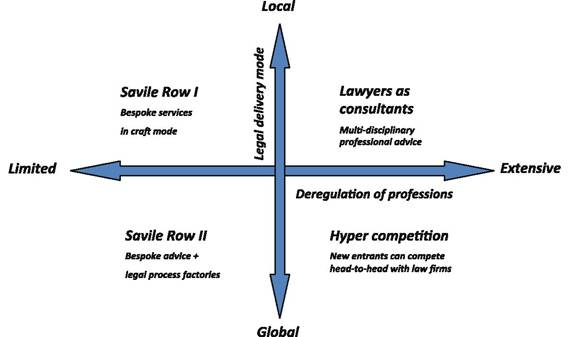
Fig. 2 Future scenarios for global legal services in 2030
The distinction between legal advice and non-legal advice becomes blurred. The lower right quadrant scenario of Hyper Competition is perhaps the most challenging, with the pressure from new entrants in global delivery of legal services adding to inter-professional rivalry due to deregulation.
From the perspective of the general counsel working for global corporations headquartered in the United States or Europe, these four scenarios present different challenges and opportunities. There are at least two implications for the legal function in global corporations which are worth noting. First, in the two scenarios Saville Row II and Hyper Competition, the general counsel might do well to exploit the availability of global legal service delivery. However, this global delivery might be carried out inside the global corporation, rather than by law firms or LPO providers, especially if the corporation exploits advantages that come from the co-specialization of legal and other expertise inside the corporation. This implies a significant growth in the size of corporate legal departments in the future. Internalizers among general counsel have a head start in preparing for this future.
Second, in the two scenarios Lawyers as Consultants and Hyper Competition, the general counsel might welcome extensive deregulation if it implies receiving legal, tax, audit, and compliance advice in an integrated manner. The key unknown in these scenarios is the extent to which the corporate legal department internalizes or externalizes compliance officers, risk managers, and other semi-professionals who come to work with, but independently of, in-house lawyers. Moreover, the world of law is likely to continue to be divided into national jurisdictions, unlike the world of other professionals such as accountants with their international standards. Therefore, company lawyers are likely to remain beholden to a world that is far from being flat.
Liquid Legal Context
by Dr. Dierk Schindler, Dr. Roger Strathausen, Kai Jacob
Sako provides an interesting perspective on what makes GC's gravitate towards keeping work in-house (internalize) or towards finding resources outside of the company (externalize). She also reveals a correlation between the degree of embracing legal technology and the need—or tendency—to localize the delivery of services. How does the change of services in the (external) legal environment influence the decision to externalize?
This question connects to Bassli's clear and convincing call to action to law firms: Provide managed legal services to retain your relevance for us! If we accept that, we find ourselves in a legal ecosystem that undergoes fundamental transformation and brings about new types of service providers, e.g. Legal Tech or LPO's. Are changing service offerings and billing practices the key to a prosperous future also for law firms?
As we all wait for final answers, another very practical question for any leader in legal arises: How do we deal with uncertainty, while simultaneously being asked to run a successful business in today's legal industry, be it as a leader in legal in-house, in legal tech or in a law firm? Mari Sako concludes by introducing a model for scenario planning which rests on two of the most impactful variables in the transformation: (1) the degree of deregulation and (2) the degree of true globalization in delivery of legal services.
How does a partner in a global law firm address these issues? In the upcoming article, Rainer Markfort opens up a fundamental dimension for the future success of “big-law”: Polycentrism, an emerging business practice that consists of networking international talent, capital, and ideas to meet global and local demands for new products and services. Networking connects well to the challenges we know from global corporate organizations as they battle for the necessary talent and competencies to remain futureready.
Is shifting the mindset of lawyers also the approach that global law-firms and in-house teams must take to succeed in transforming the industry?References
Bagley, C. E. (2008). Winning legally: The value of legal astuteness. Academy of Management Review, 33(2), 378-390.
Kurer, P. (2015). Legal and compliance risk. Oxford: Oxford University Press.
Litov, L. P., Sepe, S. M., & Whitehead, C. K. (2014). Lawyers and fools: Lawyer-directors in public corporations. Georgetown Law Journal, 102, 413-480.
Sako, M. (2011). General Counsel with Power?, Said Business School, University of Oxford, http://eureka.sbs.ox.ac.uk/4560/1/General_Counsel_with_Power.pdf
Sako, M., Chondrakis, G., & Vaaler, P. (2016, forthcoming). How do plural-sourcing firms make and buy? The impact of supplier portfolio design. Organization Science. http://pubsonline. informs.org/doi/full/10.1287/orsc.2016.1079
Veasey, E. N., & Guglielmo, C. T. D. (2012). Indispensable counsel: The chief legal officer in the new reality. New York: Oxford University Press.

Mari Sako is Professor of Management Studies, and member of the Professional Service Firm Hub at Said Business School, University of Oxford. Previously, she taught at LSE, and held visiting positions in Japan and at MIT Sloan School of Management. She holds a BA in Philosophy, Politics, and Economics (Oxford), MSc in Economics (LSE), and a PhD in Economics (London). Her research on global strategy, comparative business systems, and labour markets are published in five books and journal articles. Her most recent work is on the outsourcing and offshoring of professional services and their impact on the professions.
More on the topic Implications for Structuring the Legal Function in Global Corporations:
- Implications for Structuring the Legal Function in Global Corporations
- Conclusion
- The Future World Is VUCA[71] [72]
- 1 Introduction
- Correlation of Task, Relation and Mind Model
- The topography of the state
- 10.5 THINKING THROUGH THE INTERNATIONAL ORGANISATION
- "Win-Win" Versus "Win-Lose": The Systemic Predicament of In-House Legal Departments
- Justice, Law, and the Legal System
- Conclusion