"Win-Win" Versus "Win-Lose": The Systemic Predicament of In-House Legal Departments
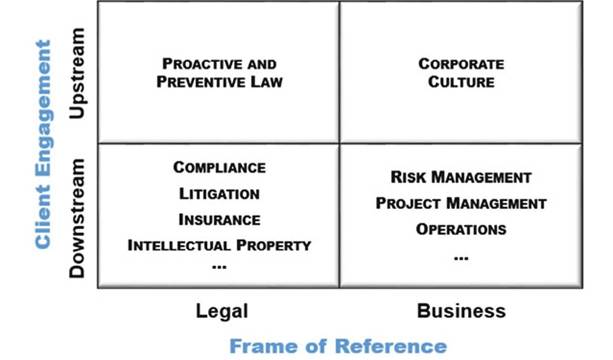
One of my friends is a corporate lawyer in a logistics enterprise. Occasionally, we have lunch together, and one time he told me about his work. [21] [22] “I love my job,” he said, “but it also stresses me. I tried helping my friend by telling him the story of The Busy Woodchoppers, a story my first manager told me when I started out in the software industry about 20 years ago. The Busy Woodchoppers A man encounters a group of feverishly working woodchoppers in the forest. “Why are you working so hard?” he asks one of them. “Well,” the woodchopper answers, “we have to cut down all these trees, and we are behind schedule.”—“Why are you behind schedule?” the man asks. “It always happens,” the woodchopper sighs, “when we work hard, our axes become blunt, and then we must work even harder to make up for the lost time.”—“So why don’t you take a break and sharpen your axes?”—“Oh no,” the woodchopper exclaims, “that would take far too much time -1 told you, we are already behind schedule!” As investors, we know it takes money to make money. As project managers, we ought to know that it takes time to make time. My friend's situation reminded me of the woodchopper story because, like these hard working men, he seemed to focus too much on the execution of single cases, and too little on creating the tools that would enable him to scale case execution. Why have legal in-house departments come under such extreme pressure to increase their performance? On the surface, the demand to “do more with less” was the result of the Great Recession in 2007/08 and the increased financial strains on business enterprises. But underlying this effect of the financial crisis is what I would like to call the systemic predicament of in-house legal departments, a conflict of two frames of references: business and legal. To illustrate the systemic difference between business and legal, recall the definition of legal as a self-referential and operationally closed system that maintains its own identity against the environment by relying on the binary code “legal or illegal.” I use the example of contracts to first of all illustrate the systemic interdependence of dissolving and creating legal ambiguity in a business enterprise.[23] While contracts are intended to express a joint desire of the contracting parties and to create a clear understanding of mutual rights and obligations, such unambiguity is, in principle, unattainable. During all phases of the contract cycle, the legal meaning of the contract and its clauses depends on contexts: on the explicit context documented in the contract itself, and on implicit contexts assumed by the parties. The diversity of such implicit contexts become apparent when claims are made, e.g. when real events reveal opposing interests of the contracting parties and create legal conflicts. Personally, I like the old-fashioned way of contracting: You look each other in the eyes and shake hands on a joint goal—and if there's a problem down the road, you take care of it then. Of course, that is the business person speaking. For lawyers, such an attitude is reckless at best and clearly contradicts the mandate to reduce the legal risks of clients. In a contractual situation, the desire to prevent such risks and to ensure maximum legal protection for each party motivates lawyers to turn implicit contexts (“What if...?”) into explicit contexts, for example by adding new clauses to the contract. The increase in government regulations and compliance laws can itself be seen as a consequence of the self-referentiality of the legal system. For public institutions like parliaments and courts, self-referentiality presents no problem because legal is their sole purpose. Financial and other restrictions may indirectly affect their activities, but they are merely means to an end. The law remains the only normative frame of reference. Law firms are in a different situation. They are commercial entities that sell legal services to external clients. As businesses, their ultimate frame of reference is financial, and legal services are only the means by which law firms achieve this financial end. But since legal is their core service, the business of law firms largely coincides with legal competence. Legal and business performance are strictly proportional in law firms and can be measured in billable hours and revenue. Such a direct connection between legal and business does not exist for in-house legal departments in complex enterprises. Legal departments are cost-centers providing an internal support function for selling non-legal products and services, and in doing so, they must observe corporate requirements and economies of scope and scale. By having to reconcile two often conflicting normative frames of reference, legal in-house departments find themselves in a predicament which can best be expressed as the conflict between two relational paradigms: win-win versus win-lose. In a market economy, business rests on the idea that all parties, e.g. seller and buyer, benefit from a transaction—otherwise the transaction would not occur. Money, the medium through which the economic system functions, is expandable[24] and allows for win-win relations, i.e. both parties can “make money” through one and the same transaction. Public corporations, for example, can simultaneously increase both their respective stock value through a merger or acquisition. The legal system, on the other hand, is characterized by adversarial relations and the binary code of “right or wrong” (legal or illegal). If one party wins a case in court, it normally means that the other party has lost. Laws, the medium through which the legal system functions, are fixed, and opposing claims cannot both be right—otherwise laws would lose their ability to govern human behavior.[26] Because the outcome of legal cases is hard to predict, rational agents such as business enterprises think twice before going to court and risking losing a case. Instead, they will try to quantify their legal risks and consider alternative means of dispute resolution. Hagel[27] provides detailed examples for how legal disputes can be translated into a business case of monetary gains and losses, and he also emphasizes the importance of communication for avoiding costly court cases. The goal in dispute management is to minimize the risks while maximizing the profit. (...) Except for rare cases, avoiding conflicts and disputes makes commercial sense. In order to effectively avoid conflicts, the main causes of disputes need to be known. Disputes are often caused by miscommunication. Parties communicate (1) on the wrong subjects, (2) in the wrong way and (3) at the wrong time. Yet even though conflicting parties seek to avoid miscommunication by collaborating and settling legal conflicts outside of court, they only do so because they fear losing the case in court. “Win-lose” is the relational paradigm in the legal system, and it contrasts sharply with the “win-win” relational paradigm of the economic system. In this systemic perspective, the increase of alternative dispute resolutions suggests that businesses prefer to remain within their own economic system of “making or losing money” and seek to avoid entering the legal system of “being right or wrong” in the first place. Lawyers are not only averse to risk but to change in general. Byberg[28] remarks: Lawyers are notoriously skeptical about change, and while there are honorable exceptions, my experience is that the general public is more right than wrong when thinking of the legal community as change-resistant. My favorite quote to this point is a Danish Supreme Court Judge allegedly having stated that he was resisting all change—including change for the better! Going forward, I structure the activities of in-house legal departments in a 2 x 2 matrix. On one axis, I distinguish two frames of reference: law (being right or wrong), and business (making or losing money). The business frame of reference includes internal rules which a company gives itself in order to advance its goals and produce positive outcomes. Such internal business rules are often expressed in corporate value and mission statements as well as internal policies and guidelines which are considered “good” for business, or else the organization would not impose these rules on itself. How a company understands and practices social responsibility, the ways it deals with diversity and other ethical norms may have no immediate connection to revenue and profit. But by investors and employees alike, these activities are increasingly seen as crucial for branding and competitive advantage, as Mucic[29] argues: For too long we have neglected the influence of Legal on how the companies they serve are perceived. On the other axis of our 2 x 2 matrix, I distinguish two kinds of client engagement in rendering legal services: By “downstream engagement” I mean that lawyers react to a request coming down from the clients, and by “upstream engagement” I mean that lawyers work pro-actively towards the clients, trying to promote “right” behavior and seeking to avoid the emergence of legal issues in the first place (Fig. 2). Fig. 2 In-house Legal Service Portfolio (own material) When we look at legal services in this 2 x 2 matrix, it becomes clear that most activities fall in the lower left quadrant: In litigation, insurance, compliance and intellectual property issues as well as in all other traditional practice areas, legal departments’ frame of reference is the law, and its normal mode of engagement is to react to ad hoc service requests (downstream). Lawyers seek to achieve their internal clients’ explicit goal by reconciling the facts of the case at hand with the law. It is less common that legal departments refer to external law in a proactive mode and deliver upstream services with the goal to prevent the emergence of legal issues or cases in the first place (upper left quadrant). Nonetheless, Proactive and Preventive Law is a growing discipline, as Haapio and Barton[30] remark: Preventive Law focuses on dysfunctional cycles that generate recurring losses. It seeks to identify and understand the conflicting elements of a system, as we have done above, that unless somehow resolved will continue to generate problems. Proactive Law adds a focus to achieving positive goals and value. Together, PPL can alter mentalities and harness tools toward smoother operations and successful outcomes. In the lower right quadrant, the frame of reference is business, so self-imposed rules supporting monetary gains, and the mode of client engagement is reactive (downstream). I have put risk management and project management here as two examples for such legal services. By assessing the likelihood and financial impact of legal risks, risk management helps convert legal issues into business issues. Meents and Allen[31] differentiates pre-engagement legal risks, referring to a company's breach of regulatory obligations, and post-engagement legal risks, referring to situations in which a company fails to carry out contractual obligations. Mascello[32] remarks on the changed role of general counsels: (T)he general counsel is now perceived as a risk manager. He is also expected to provide general problem-solving beyond legal subject-matter tasks and to act as a co-designer of the company’s strategic development. Consequently, legal strategies are being integrated into corporate strategies. Besides risk management, project management is becoming increasingly important to legal departments. As a reaction to the financial crisis, many companies have reduced internal legal staff and outsourced work to law firms. While externalizing service delivery reduces the need for subject matter expertise, it also requires corporate counsels to use proven methodology and IT tools to manage a high number of parallel projects and to deliver results on time and budget. In-house lawyers must have a good market overview and select the right law firm, get contracts in place and check invoices, set up the case strategy together with external counsel, keep deadlines in mind, validate work results, and solve all kinds of problems and operational hick-ups along the way. The upper right quadrant of the in-house legal service portfolio matrix shows corporate culture as a practice area. I use corporate culture as an umbrella term for proactive (upstream) legal activities in a business frame of reference—activities enabling and promoting internal and sometimes even tacit rules for collaboration and win-win relationships. For many enterprises, culture holds high and unrealized value potentials, and we will explore these value potentials in the last part of this article. 4