Justice, Law, and the Legal System
Law[8] is one of mankind's greatest inventions. Regardless of the structural and material differences between common law, civil law, and religious law, and independent of the specific procedures of how, when, and by whom national and international laws[9] are being created, implemented, and sanctioned—the fact that human communities and cultures of all times have given themselves rules to govern their behavior separates us from all other species on earth.
Of course, people do not always accept or adhere to the law; if they did, police, courts and prisons would be superfluous. Criminals intentionally break the law to gain a personal advantage, and even among law-abiding citizens, conflicting opinions exist within one and the same jurisdiction as to what exactly is or should be the law, and whether or not particular forms of behavior do or should constitute a legal offense.
Such conflicts are an integral part of the legal system. Laws not only refine and complement but also oppose and contradict each other. The meaning of a particular law may appear abundantly clear when looked at in isolation; but when a given law is applied to a particular case, several other laws may apply as well, and legal meanings start to shift. The individual right to freedom of speech must be balanced with personality rights and ends where other individuals are being insulted.[10] The right of an organization to enter into contracts with employees, suppliers and clients is limited by national labor laws and civil laws. If and how particular laws matter, and what exactly they mean, depends on the particular circumstances of the case, and on the relations between one law and other laws. Legal ambiguity leads to dissolution attempts via new laws, and new laws lead to ambiguity because they change the overall system of law on which the meaning of individual laws depends.[11]
Conceptually, one opposite of ambiguity is clarity; the other conceptual opposite of ambiguity is obscurity.
The ambiguity created through contexts stands between clarity and obscurity. Multiple legal meanings of a matter are only possible because contexts first of all create the possibility of legal meaning per se. Legal contexts dissolve and, at the same time, create ambiguity because they constantly shift and are ultimately contingent. Even if one assumes that the facts of a matter can be objectively established, and that laws are fairly applied, the interests of the parties will always remain unforeseeable and idiosyncratic. Law itself, as a set of rules, is dead. Law comes to live only when parties express their interests, when event and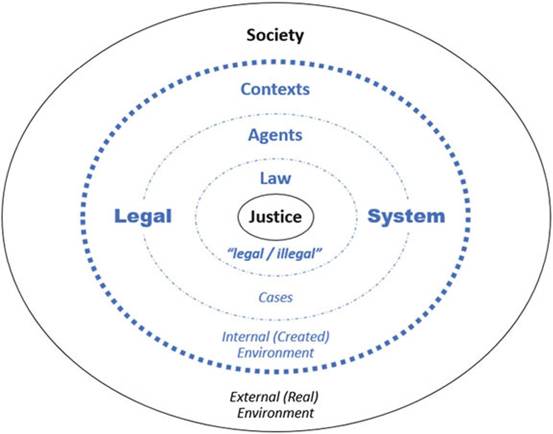
Fig. 1 The Legal System (own material)
rules, the particular and the general, are connected in a particular context and create legal meaning—when the case emerges.
Following the German sociologist Nilkas Luhmann[12] who has transferred the biological concepts of autopoiesis and self-referentiality to social systems, I regard the legal system as operationally closed and structurally open (or coupled). Like all systems, legal is “blind” towards its real environment because the distinction between itself and the environment is internally produced, “a re-entry of the form into the form,” as the English mathematician George Spencer Brown famously formulated. The environment (politics, the economy, science, etc.) stimulates the legal system and causes changes (structural openness), but such changes themselves are always the result of legal's own internal operations (operational closure), i.e. of dissolving and creating ambiguity through the continuous application of the binary code “legal or illegal” (Fig. 1).
At any given moment, law embodies different perspectives and conflicting interests which must be balanced for “the greater good.” As one of the three independent forces in modern democratic states, the judicative includes court trials and other mechanisms to resolve legal disputes and achieve justice.
Every case contains pros and cons for each position. In Western art, Justitia is represented as a goddess with three attributes: a blindfold, symbolizing the irrelevance of the wealth and status of the parties involved, a scale indicating the weighing of competing positions, and a sword showing the power of the courts. When judges deliver a verdict, not everyone, least of all those convicted, will necessarily agree that justice has, indeed, been served. Justice is an idea, a cognitive construct; yet exactly as an unattainable ideal, justice remains indispensable for the legal system to operate and to ultimately decide what should be legal or illegal. Elusive and contested, justice represents the ultimate norm which is operationalized as law and which legitimizes individual rules. Justice is a never-ending process and no fixed state. Subjectively, as individuals, each one of us may believe to be just, but collectively, as a society, we can only agree on operational procedures which we think will increase the likelihood that legal outcomes may be just. Timmer[13] [14] remarks on the relation between law and justice:Throughout the ages, the law and legal culture have hugely benefited the development of individuals, organizations and democratic societies. Although one can, even in the most advanced legal cultures, be critical of many aspects of the law, an advanced and balanced legal system raises the overall standards of justice and fairness in society. Studies also show that the efficacy and independence of a country's legal system contribute significantly to a country's economic prosperity (cf. Veld & Voigt 2003).
Laws are complex and difficult to understand for laymen. As a group of experts with special education and knowledge, and with the state-certified ability to practice law, lawyers help apply laws to social reality. Paradoxically, the self-understanding of lawyers as being “special” is one of the reasons why the legal profession has come under scrutiny in business environments, as Cummins11 remarks:
Why would senior in-house lawyers suggest that the current top job should go to the non-lawyer? The answer, in part, may rest in the term ‘non-lawyer'.
As one speaker observed: ‘We are the only profession to see the world in such simple terms - you are either a lawyer or a non-lawyer'. And in this simple depiction, he perhaps highlighted what is wrong with the legal profession today and what is threatening its future. Lawyers have a tendency to see themselves as ‘special', as an elite with unique and valuable knowledge on which business and society depends.In my view, the current crisis of in-house lawyers is primarily an identity crisis, created by uncertainty about who or what is a lawyer?[15] While having passed the bar distinguishes lawyers socially, such distinction is mostly irrelevant and, in fact, often counter-productive in a business environment. Corporate lawyers rarely represent their companies in court, and often work with external counsel instead.
Later in this article I will argue that the special skills of lawyers, the ability to see different sides of a matter and to think through ambiguity, still possesses huge value for companies—provided that it becomes increasingly embedded in a business frame of reference.
To fulfill their social function, laws, which serve as the social medium through which the ideal of justice is implemented, must themselves be coded into a communicable medium. Social rules can also be tacit and implicit, as is the case in cultural habits and norms which will play a crucial role for the arguments advanced later in this article. But only when rules are explicitly expressed somewhere, for all to see and comprehend, a society can reasonably demand of its members to follow them, and only when non-compliance of these rules is sanctioned through official social institutions such as police and courts do we commonly speak of laws.
Stating that laws must be coded does not mean that all law is codified. The codification of rules into a complete body or code of law which can only be changed through legislators is the defining characteristic of civil law jurisdictions like Germany.
In common law jurisdictions such as the UK and the US, not only legislators, but also courts can make law by setting precedents which must then be observed in later court rulings.The difference between codified civil law and non-codified common law pints to the basic operation of any legal system: the reconciliation of the particular with the general.[16] For law to govern all possible human behavior, it must consolidate similar forms of behavior into abstract categories (e.g. fraud) and define general rules of legal assessment (e.g. intent and financial gain). Social reality, on the other hand, is concrete, not abstract. The real life situations out of which legal disputes arise are always local, specific, and bound to a certain time and place. Any legal case represents a unique set of related facts, and each case demands to be looked upon as a whole, as something which is more than the sum of its part and which may ultimately differ from seemingly identical cases. Killing a person for money constitutes a very different legal case than killing a person out of self-defense.
Through their ability to adjust to the social environment and through the hierarchical structure of laws, legal systems allow for flexibility and change. The less fundamental a law, the easier it can be adjusted if public opinion shifts or political processes require it. In federal countries, state and communal laws may differ in certain practice areas, reflecting the values and beliefs of the respective constituencies, and such state and communal laws can also be changed more easily than the national constitution embodying the values and beliefs of the whole population.[17]
Of course, even constitutions do evolve over time, along with the human experience upon which they are built. The US constitution was put in effect in 1789 and has been amended 27 times, last in 1992. Throughout human history, technological advancement, most of all in the areas of transportation and telecommunication, enabled and also forced states, companies and individuals to collaborate across different jurisdictions.
The twentieth century has seen alignment of national criminal, tax and finance laws to common standards established and upheld by the United Nations, the European Union and other inter- and supranational organizations. International private law becomes increasingly important since, for example, more and more people with different nationalities get married and divorced. Technological innovation like the internet have enabled new social practices and created new legal subject areas. The high volume electronic trading of ill-rated derivatives which caused the Great Recession in 2007/08 has led to the Dodd-Frank Act and other legislation that imposes stronger regulations on financial markets.On the other hand, globalization also caused, and continues to cause, ideological counter movements insisting on regional, local and religious identities. The vote of the British people to leave the European Union (EU) is the latest example of this widespread desire to maintain a sense of national self in the face of increasing globalization and integration. In the Middle East, revolutions and warfare have led to radical changes of legal systems, a recent example being the establishment of the Sharia, the Islam religious law, by the terror organization “Islamic State” in large parts of Syria, Iraq and Libya.
But such abrupt and fundamental changes of legal systems are few and far between, and they remain restricted to times of social crisis and war. Law can claim to govern everyday life precisely because the majority of people experience the law as relatively stable during their lifetime. By providing security, fostering trust and enabling people to work together, law is both, an expression and a fundamental driver of human civilization.
Because laws must be explicit and communicable, they are usually coded in written language.[18] Philosophical attempts to define laws more abstractly, e.g. as “a particular kind of assemblage of signs” or as “signification of volition” appear to be problematic and have met widespread criticism.[19] The coding of laws in language does not mean that language is the only medium relevant to the legal professional. When lawyers practice law, for example by drafting contracts or advancing arguments in court, they do so primarily in language and with words, but not exclusively.
We all know from personal experience that it matters in which medium a “message” appears. Reading a Harry Potter book, and watching a Harry Potter movie, are two very different experiences, although both media carry the same content in terms of characters and plot. Language conveys information sequentially and creates a relative clear cognitive understanding while images convey a totality of information instantaneously through an aesthetic impression, but are also more open to interpretation and different meanings. As the Canadian media theorist Marshall McLuhan famously stated: “The medium is the message.”
A specific medium of communication can thus further or hamper legal intentions. Haapio and Barton[20] convincingly argue that the use of images can make the meaning of written contracts more intuitively understandable for laymen. However, images may also blur cognitive nuances which can matter in contracts, and Haapio and Barton thus also point out that images should only support and not replace language as the primary form of contracting. In court, the showing of video footage depicting, for example, a physical assault certainly conveys a more objective account of what happened than a verbal description by a witness (provided, of course, that the video has not been tampered with). On the other hand, the strong emotional impact of such images may cause jurors and judges to deemphasize, or even overlook, other facts of the case, perhaps making it more likely that the defendant is being convicted.
Thus in legal, there always exist uncertainties, trade-offs, and pros and cons for each position. As the seemingly least ambiguous medium, language is privileged over images and other forms of legal signification. Linguistic proficiency and good communication skills are central to the work of lawyers, and they represent important hiring criteria which companies use to assess the quality of job applicants. Also, the semantics (meaning) and pragmatics (usage) of legal language differ from everyday language. Sheila Hyatt from the University of Denver points out that the legal system creates new words like “judicata” and “mens rea,” and also gives a specific meaning to ordinary words. Legal language demands a high degree of precision, down to the use of commas, to ensure that intentions are expressed correctly.
(A) person who leaves $50,000 ‘to each of my children who took care of me,' has a different intention than a person who leaves $50,000 ‘to each of my children, who took care
18 of me.'
Finally, the meaning of many legal terms such as “resident” depends on the particular practice area (e.g. getting a driver's license, or getting a divorce) and on the nation or state in which it occurs. The German political theorist Carl Schmitt has used the Greek concept of Nomos to express this unity of location and law (in the German original: “die Einheit von Ortung und Ordnung,,).v9
To clarify the importance of context, I want to compare the functioning of legal to the functioning of language. My thesis is that both function as a systemic structure in which the context ultimately determines the meaning of single elements. Like all languages, English consists of different kinds of words (nouns, adjectives, verbs, conjunctions, prepositions, etc.) and a set of rules (grammar) prescribing how these words can be combined to sentences. In order to speak and write, and for participating in the social practice of communication, the speaker or author must know the whole system of language even though he or she only uses a very small subset of the linguistic possibilities. The reason is that words (in linguistic terms: the signifiers) have no intrinsic reference (in linguistic terms: the signified), and that linguistic meaning is an effect of formal differences. A single word alone does not mean anything. There is nothing intrinsic to the signifier “house” that signifies a house, the real object with walls and a roof that people live in. Rather, the signifier “house” can only signify a real object because it differs from other signifiers, e.g. from “louse,” “mouse” and all other words in the English language. Linguistic meaning rests on a system of difference between signifiers, and meaning, therefore, is always dependent on context.
In the following part, I will take a closer look at legal in business. If the meaning of single laws depends on the whole system of law—what happens when this whole system of law is framed by economic and financial interests?
3