The topography of the state
This section seeks to dissect the anatomy of the state in order to demonstrate the vast range of hybrid and para-statal organizations that currently exist at the national level.
Understanding this dense administrative terrain is important for a number of reasons but not least because a review of this kind will illuminate and explain the definitional debates that have tended to dominate this field and have to some extent concealed more important debates regarding the trajectory, structure and role of the state. Moreover outlining the range of organizational forms that currently exist may also add weight to the views of those who see the Westminster model (the dominant conceptual lens in countries including Australia, New Zealand, Canada and the UK), with its emphasis on departments each headed by a minister, as somewhat outdated, misleading and over-simplistic. While departments of state clearly continue to exist they form a shrinking section of an increasingly diverse administrative sphere.Providing a map, or at least a sketch, of the topography of the contemporary state facilitates understanding in relation to ideas about degrees of autonomy. It is clear that some forms of delegated governance are designed and intended to have more autonomy than other forms. Hived-in agencies (meaning they are still formally part of their parent department) are intended to have less autonomy than hived-out bodies. While it is possible to map out this spectrum of autonomy it is much harder to ascertain why certain functions have been designated to certain organizational forms. It is equally difficult to understand why certain tasks are viewed by politicians and officials as suitable for delegation whereas other apparently similar tasks are not. Another challenge relates to appreciating the difference between theoretical and actual organizational autonomy.
It would be naive to automatically assume that an organization actually enjoys the practical autonomy its status is assumed to provide. Experiences in a host of countries suggest that politicians are frequently reluctant to cede control and will often seek to develop informal control mechanisms.Clearly the degree of flexibility enjoyed by politicians in terms of delegating state functions to quasi-autonomous bodies or 3Ps also varies from country to country and is conditioned by a blend of constitutional, legal, cultural and historical factors. Taken together these factors create a path-dependency that may either facilitate or frustrate the process of delegating tasks to new tools or forms of governance. The freedom of members of the executive in the US and The Netherlands is restricted to some extent by the constitutional powers granted to their respective legislatures in relation to creating, merging or abolishing delegated public bodies. In the UK, by contrast, members of the executive enjoy great flexibility in relation to the structure of the state. However the impact of country-specific limitations on delegation and varying national pathways towards the increased use of 3Ps has to some extent been ameliorated by a broader shift in governing mentality; a shift that has generally accepted the logic of delegation and led to a general trend towards what Pollitt and Talbot (2004) refer to as ‘unbundling’ government.
The structure of the modern state at the national level can be viewed as a series of concentric circles or ripples on a pond with departments of state at the centre and a number of organizational forms, each enjoying a greater degree of autonomy as they radiate out from the centre. Figure 12.1 provides an overview of the structure of the British state at the national level as of March 2005 by way of example.
Figure 12.1 Delegated governance and PPPs: an overview
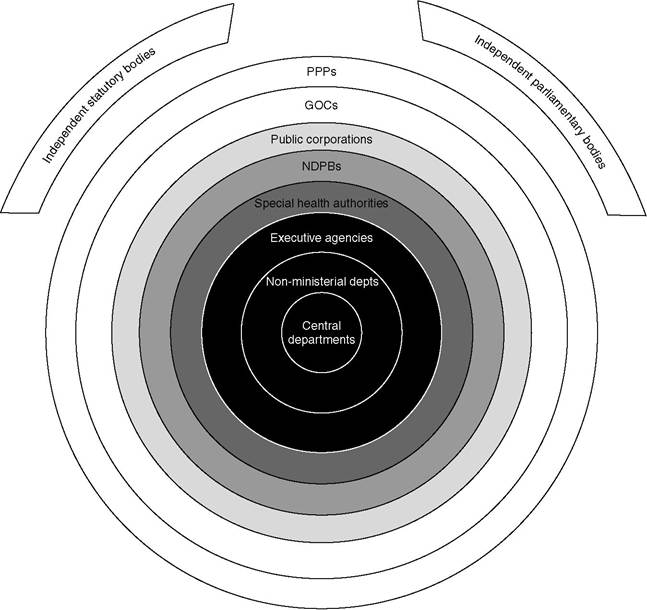
The most striking feature of this figure is the simple variety of organizations that exist beyond the twenty or so ministerial departments of state.
This includes no less than 26 non-ministerial departments, 11 public corporations, 127 executive agencies, 17 national special health authorities, 439 advisory non-departmental public bodies (NDPBs), 36 tribunal NDPBs, over 200 executive NDPBs and 147 independent monitoring boards. On the very edge of the state exist a number of government-owned companies and 3Ps. In Britain the government has entered into more than 550 private finance initiative projects, a distinct form of P3, with a total capital value of 35 billion pounds. These projects include 34 hospitals and 119 other health projects, 239 refurbished schools, 23 transport projects, 34 police and fire stations, 13 prisons and secure training centres, 12 waste and water installations and a variety of other projects involving defence, leisure, tourism, culture, housing and IT.Figure 12.1 also includes two organizational forms that are distinct and separate from the spectrum of autonomy. Independent statutory bodies generally cover professional regulatory bodies (such as the General Medical Council and Law Society). These bodies have certain regulatory roles and are usually founded in statute but they receive no public monies and are viewed as being completely distinct from the governmental framework. However, this does not prevent a government from considering amending the founding legislation where professional self-regulation is viewed as being problematic. The second disconnected organizational form on Figure 12.1 refers to independent parliamentary bodies, for example the Electoral Commission and the Church Commissioners, that are formally independent of political influence but are funded by and directly accountable to Parliament rather than to a government department.
The UK is by no means unique in having such a disaggregated administrative landscape (see Modeen and Rosas 1988). Canada, the United States, France, Germany, The Netherlands, New Zealand, Spain, Sweden and Australia, to mention but a few, have similarly complex delegated state structures (see Table 12.1).
The state in New Zealand, for example, includes around 3,000 organizations but fewer than 50 of these are departments of state, the remainder being a complex tier of quasi-autonomous Crown entities. The sheer scale of delegated governance in terms of resources, role and personnel is surprising; especially when viewed against the relative dearth of academic research in the field. Research by the OECD in 2002 found that it was by no means uncommon for more staff to be employed in what they described as ‘distributed public governance’ organizations than traditional departments of state. The implicit and increasing heterogeneity of modern state structures relates directly to the shift from government to governance that was examined by Pierre and Peters in the previous chapter. It is not that the mechanisms of governance have replaced the traditional institutions of government but that the latter now exists in and operates through an increasingly dense web or network of organizations each of which enjoys a significant degree of day-to-day autonomy from elected politicians.Analysing the existence and evolution of delegated governance within various state structures not only point to country specific variations in form and extent but also a number of evolutionary similarities or areas of convergence. First, since the mid-1980s wave after wave of reform has attempted to delegate as many functions as possible along the spectrum of autonomy from the centre outwards. Consequently the role of central departments has changed from administering public policy to co-ordinating the web of organizations, each of which enjoy different degrees of autonomy, to which implementation has now been delegated.
A second evolutionary pattern borne out through comparative research is that the process of delegating roles and responsibilities to para-statal bodies or P3s has not been undertaken in a systematic or logical manner
Table 12.1 A comparative review: examples of delegated or ‘para-statal’ bodies
| Country | Quasi-autonomous bodies (examples) |
| France | Public establishments (establissements publics Nationaux) Independent administrative authorities (autorites administratives independantes) |
| Germany | Federal agencies (unmittelbare Bundesverwaltung) Indirect federal administration (mitelbare Bundesverwaltung) Private law entities (Bundesverwaltung in Privatrechtsform) |
| The Netherlands | Independent adminstrative bodies (zelfstandige bestuursorganen, ZBOs) Agencies (agentschappen) |
| Sweden Denmark | Boards and agencies Special public agencies State-owned companies Self-governing institutions Private companies with contracts for public services. |
| Spain | Autonomous bodies (organismos autonomos) Public enitities (entitades publicas empresariales, EPE) Public bodies (organismos publicos) |
| Italy | Public establishments (enti pubblici) Independent administrative au thorities (autorite adminstrative indepdendente) Agencies (agenzie) |
| United States | Independent agencies Independent regulatory commissions Government-owned enterprises/corporations Hybrid bodies |
| Japan Thailand New Zealand | Independent administrative institutions (dokuritsu-gyoseihojn) Autonomous public organizations (ongkarn mahachon) Crown entities Semi-autonomous bodies |
| Canada | Special operating agencies Legislated service agencies Departmental agencies |
(see OECD 2002).
The delegation of tasks has largely been bereft of any coherent legal framework or even a broad statement of principles. Functions have largely been delegated on an ad hoc basis, which explains why the fringes of the state tend to be messy, confused and devoid of any underpinning rationale or logic. An awareness that delegated governance is a systemic issue in advanced liberal democracies, and of the democratic and public policy implications of this fact, has really only developed in recent years.A third general area of convergence would appear to be a trend away from delegating tasks to quasi-autonomous public bodies towards establishing P3s with the private sector, such as the private finance initiative in the UK or the privately financed projects in Australia. In some countries, such as the UK, this process has been stimulated by the fact that there are very few areas of state responsibility that have not already been delegated. However, there is a wider shift towards utilizing P3s as an innovative way to deliver certain services in partnership with but not directly by the state. Thereby constructing a ‘middle-way’ state system somewhere between corporatist models of traditional social democrats and the minimal state pro-privatization ideal of neo-liberals. This delegation of responsibilities to bodies or partnerships on the fringe of the state is not necessarily aimed at achieving a smaller state or reducing public services but it is an explicit recognition that the modern state may not be the best manager of public services and that other structures may deliver improved levels of service. It is also linked to the issue of capacity as governments are increasingly seeking to buy in capacity from the private sector to complement or improve that offered by traditional state structures.
This shift in statecraft has been nurtured and promoted by major international financial institutions, including the World Bank, International Monetary Fund and the European Bank for Reconstruction and Development (Jones 1999).
Consequently, 3Ps are an increasingly significant aspect of state structures around the world. Indeed, Bovaird (2004a) notes how 3Ps are now written into legislation in many countries (e.g. urban policy legislation in the UK and US, industrial policies in France and economic development practices in Italy and the Netherlands). However, with the possible exception of Ireland, the concept and use of 3Ps has been hotly contested in most countries. Some politicians have voiced concerns about the further diminution of direct political control, trade unions have frequently interpreted 3Ps as ‘privatization by stealth’ and public interest groups have criticized state reforms that are based upon the introduction of the profit motive. Despite these concerns and criticisms Bovaird (2004b) suggests that 3Ps have evolved from ‘contested concepts to prevalent practice’.A fourth trend indicates a common pattern of 3P development. State systems commonly begin by experimenting with construction or low-salience partnerships (road building, waste collection, etc.) which then begins an incremental process through which further areas of state activity are gradually opened up to 3Ps (care for the elderly, education provision, clinical medicine, welfare-to-work programmes, prison management, etc.). Crosscomparative research also reveals that a common underlying reason for delegating function to the boundaries of the state - constraints on spending resources combined with a public reluctance to pay higher taxes. In this context the efficiency gains suggested (but rarely delivered) by either delegating functions to independent public bodies or entering into 3Ps become attractive.
A final trend to be found across the world relates to organizational drift. It is common for functions to ‘drift’ along this spectrum of autonomy from the centre to the periphery and relatively rare, but not unknown, for a function to be drawn back in towards the department. The Forensic Science Service (FSS) in the UK is a good example of organizational ‘drift’. It used to be part of a central department (the Home Office) until it became an executive agency in 1991, a trading fund in 1999, and in 2005 the government announced its intention to establish the FSS as a government-owned company as a step towards establishing the service as a 3P at some point in the future. Not only do organizations evolve and frequently ‘drift’ but certain organizational forms of delegated governance frequently spawn sub-species which themselves enjoy further autonomy. The creation of 3Ps, for example, will frequently lead to the creation of a new independent body to oversee and regulate the relationship between the commissioning public sector authority and the private sector partner. For example, in the UK a new independent body called the Office of the Public Private Partnership Arbiter will determine disputes arising from the thirty-year 3Ps for the maintenance, renewal and upgrade of parts of the London underground tube train system. In the US 3Ps for highway construction or renewal commonly involve the creation of a semi-independent quasi-governmental entity, separate from local, state or federal government, with various degrees of increased responsibility for project development and finance (see Lockwood 1990). It is therefore possible to trace the development of a complex web of independent organizations, each of which enjoys an indirect relationship with elected politicians, each enjoying differing degrees of autonomy which further strain traditional forms of co-ordination and accountability. Appreciating the existence and impact of this multi-level aspect may add further weight to those proponents of the multi-level governance (MLG) approach as a more realistic and nuanced organizing perspective for the study of modern governing processes (for a discussion see Bache and Flinders 2004).
Indeed it is critical to appreciate that the boundaries of the state operate not only horizontally but also vertically in that delegated organizational forms exist at the sub-national, supra-national and global levels. For example, a number of arm’s-length agencies exist within the evolving architecture of what could be interpreted as a European state project (see Table 12.2).
Beyond the supra-national tier exist a number of independent global actors such as the World Bank, International Monetary Fund, International Atomic Energy Agency, International Council of Arbitration for Sport, World Anti-Doping Agency and the World Intellectual Property Organization. The delegation of tasks to quasi-autonomous actors at the supranational
Table 12.2 European quasi-autonomous agencies and independent financial institutions
| Founding basis | Agencies |
| EC Treaty | European Environment Agency European Agency for Reconstruction European Maritime Safety Agency European Food Safety Authority European Aviation Safety Agency European Railway Agency European Network and Information Security Agency Community Plant Variety Office Translation Centre for Bodies of the European Union European Agency for Safety and Health at Work Office for Harmonisation in the Internal Market European Medicines Agency European Monitoring Centre for Drugs and Drug Addiction European Training Foundation European Foundation for the Improvement of Working and Living Conditions European Monitoring Centre on Racism and Xenophobia European Centre for the Development of Vocational Training |
| Euratom Treaty Second and Third Pillars | Euratom Supply Agency European Union Institute for Security Studies European Police Office-Europol European Union Satellite Centre EuroJust European Agency for the Management of the External Borders |
| Autonomous financial institutions | European Central Bank European Investment Bank |
and global level creates a clear link with recent research on the evolving structures and processes of MLG both within and between states. Organizations that operate on the boundaries of nation states must increasingly report to and operate within an external environment dictated to some extent by similarly independent organizations at the supranational level.
For example, European regulatory agencies in particular fulfil an increasingly important role in relation to global governance by providing a clear institutional locus through which to establish links with other supranational and global bodies. The European Medicines Agency (EMA) fulfils a dual-purpose role. Firstly, it fulfils a downward regulatory and co-ordinating role in relation to a network of 42 competent independent regulatory authorities at the national level (Medicines and Healthcare Products Regulatory Agency in the UK., National Institute for Medicine and Pharmacy in Portugal, Irish Medicines Board, etc.). Secondly, the EMA performs an upwards co-ordinating and harmonization role through its relationship with other supranational and global actors in this policy field (notably the Food and Drug Administration in the US and the World Health Organization). A similar network can be identified in the sphere of banking and finance where the European Central Bank and the European Investment Bank, operating through the European System of Central Banks, fulfil a similar two-way governance function; a downward co-ordinating and regulatory role in relation to national independent central banks and an upwards role in relation to global financial actors including the World Bank, International Monetary Fund and the OECD.
It is therefore possible to identify emergent structures of MLG that exist and operate at one-remove from governmental structures. The outcome of political and managerial reforms, particularly during the later decades of the twentieth century, has led to the creation of complex matrices in which functions have been redistributed both vertically and horizontally. Consequently, the reality of contemporary state structures is that they are highly fluid and heterogeneous networks consisting of a dense or ‘thick’ layer of organizations to which specific responsibilities have been delegated towards the outer fringes. As a result the boundaries of the state have become increasingly opaque, jurisdictional boundaries have become increasingly enmeshed and overlapping and the boundary between the public and private sectors is becoming increasingly blurred. Although these delegated public bodies and 3Ps play a central and largely positive role in modern governance their existence does create a number of challenges (both administrative and democratic). These challenges will be the topic of the next section.
More on the topic The topography of the state:
- The so-called ‘new institutionalism’ is a relatively recent addition to the pantheon of theories of the state and, like some of the other perspectives considered in this volume, it is by no means only a theory of the state
- Like Henry Higgins who, through his work changed the object of his studies into something other than what it was, the purpose of the Marxist theory of the state is not just to understand the capitalist state but to aid in its destruction. (Wolfe 1974: 131)
- As previous chapters have demonstrated, ‘the state’ is an elusive and contested concept.
- What is the state?
- The concept of the state
- Beyond the state?
- Marxism and the state
- SANCTION AND THE STATE
- The state as institutional contextualization
- The genealogy of the concept of the state
- The state and problems of legitimacy
- Green critiques of the state
- The Weberian definition of the modern state
- Statism and institutionalism.· is there more focus on the state?