Obligation, Taxation, and Representation: The English Historical Record
The emphasis on obligation seems at odds with conventional narratives. Neo-institutional analyses46 and other foundational studies47 assume taxation provided a contractual basis to political progress in the remote European past.
England offers the classic instances according to two prevalent narratives, drawing either on the seventeenth-century Civil War and Glorious Revolution or on Magna Carta in 1215: in the latter, rebels gained the right to be consulted over taxation from a king weakened by war; in the 1600s, exorbitant demands by the absolutist but cashВstrapped Stuarts led to socio-political upheaval and bargaining that estabВlished Parliament as a sovereign body of government.But these historical cases do not prove a causal mechanism tying taxation demands to representative emergence. The seventeenthВcentury narrative fails on timing, as the English Parliament was already meeting for 400 years. A revolution did occur in 1688, as rights were extended to broader social groups, especially under the impact of the increasingly important Whig merchant classes[513] and sovereignty shifted from crown to Parliament. Neither the institution nor the practice of representation, however, originated then. Focusing exclusively on the early modern period is thus misguided.[514] [515]
Magna Carta, however, seems to connect taxation and first political rights. Although representation was not a demand in the charter (just the consent of the barons) nor was the institution of Parliament per se, the narrative captures well-entrenched intuitions about how these interrelate. Since Magna Carta precedes even the earliest references to Parliament after the 1220s,50 it also allows us to address the concern about endoВgeneity of royal power. It shows that royal capacity precedes Parliament; though, indeed, once formed, Parliament increased such capacity expoВnentially, as Levi noted.[516]
4.2.1 Magna Carta as a Product of State Strength
The standard narrative on Magna Carta is that in 1215 English barons rebelled against John after he lost the war against the French.
Desperate for funds, the king granted a charter of liberties - some of which established rights expanded in the seventeenth century and valid today, such as habeas corpus.52 Magna Carta thus appears to suggest a bargain exchanging taxes with consent, due to war pressures, before Parliament emerged.No taxation was exchanged in 1215, however - and the king just promised to engage in consultation, which his successor reneged on in 1225.53 Magna Carta, moreover, only resulted in a long-lasting equilibВrium because of conditions before and after the baronial rebellion, not bargaining per se. Bargaining was as common and often more radical on the Continent, as we will see, but it was in England that representation flourished on a systematic and inclusive basis. Why? First, John had already imposed on his subjects probably “the greatest level of exploitВation seen in England since the Conquest.”54 Yet that burden fell disproВportionately on the most powerful subjects holding land from the crown. Second, most articles demanded greater royal justice, not tax limits. Finally, the real changes that the charter instigated depended on subseВquent royal strength.
John taxed the whole population, towns, church and countryside, as the crown’s claims extended beyond a feudal basis to that of public authority defending the kingdom as a whole.55 When overall tax collection under
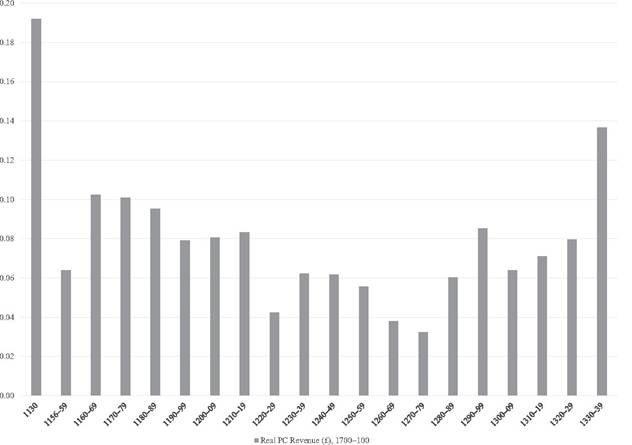
Figure 4.1 Real per capita taxation (£), 1700=100, average per decade, 1130-1339
Sources: The sources are extensively analyzed in online Appendix A (all online appendices can be found at dboucoyannis.weebly.com/ book_appendices). Briefly, for revenue: Ramsay 1925a with multiple adjustments from historians who have refined the estimates. For population and GDP deflator: Broadberry et al. 2015.
John is expressed in constant terms, however, per capita extraction does not appear as heavy as historians have assumed;[517] if anything, Henry II achieved slightly higher levels, which were not reached again until the Hundred Years War (1337-1453) (Figure 4.1).
The exactions that had skyrocketed in real terms were mostly the feudal obligations that afflicted the king’s tenants.57 Scutage, for instance, was money paid instead of military service tied to land; John raised twice the rate per year than before.58 The king’s feudal rights also included wardship over infant heirs of feudal land and fines for consent of marriage for daughters or widows of feudal tenants. The sums collected from these duties reached unprecedented, even crippling, heights compared to his predecessor, sixteen times as much in total on average per year (Figure 4.2).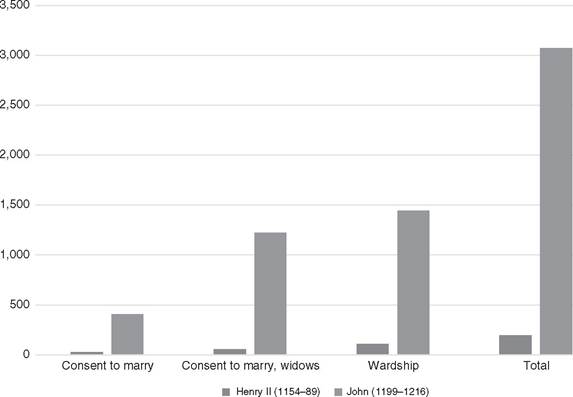
Figure 4.2 Average annual fines for wardships and consents to marry, from 1154-1216, adjusted for inflation, in pounds
Sources: Waugh 1988, 157-59 and the GDPdeflatorby Broadberry et al. 2015 extended to 1130 as described in online Appendix A.
Baronial demand for tax limits concerned these feudal land obligations. The key here is not the historically specific character of the obligation; it is that it applied to the most powerful social groups of the realm, who had ties of dependence on the center and were thus incentivized and able to act collectively. Nor is the claim here one of royal omnipotence; the crown was constantly struggling and repeatedly defeated. But even when it had to reduce knight quotas between 1190 and 1240,[518] it still did not reduce the tax burden.[519] The magnitude of the accomplishment will be seen in Chapter 6, by comparing with French revenues.
Moreover, as this argument predicts, taxation was not central to Magna Carta, as it appeared in only five out of its sixty-three articles (the main two, 12 and 14, were omitted from subsequent reissues of the charter, but remained important).61 Instead, central to the document were landВbased judicial concerns, especially on court hearings (44 percent of all articles - Figure 4.3).
In fact, the barons were requesting the same securВity in their property rights that Henry II’s reforms had provided to all free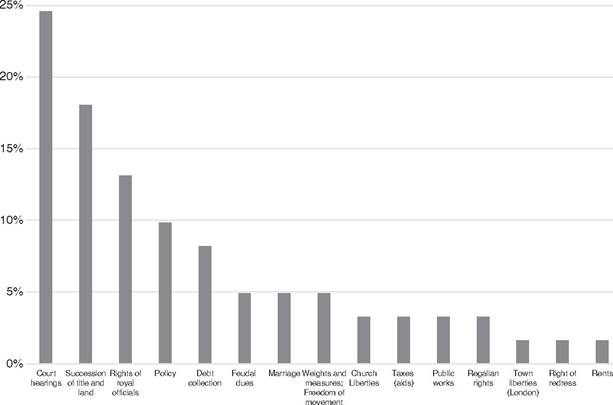
Figure 4.3 Distribution of article claims in Magna Carta Source: Stubbs 1913.
men lower down the social scale discussed in Chapter 2.62 Tenants-in- chief, holding directly from the crown, had no protection from the king’s arbitrary will. The charter’s reforms actually increased the scope of royal jurisdiction.[520] [521] For instance, they increased protections of lesser tenants- in-chief and county knights, thus ensconcing the territorial anchoring of the regime.64 The only election demanded was that of knights to assist county judges resolving property disputes (article 18).
Magna Carta did make the king less arbitrary,65 but as we shall see it eventually made him more powerful. Moreover, “the problem of the lordless lord [the king] failing to provide justice remained.”66 The charter retained a central role in Parliament’s later history, as a locus of contenВtion between the king, the nobility, and the Commons throughout the 1200s and beyond. Indeed, almost every tax grant requested was tied to a reconfirmation of the charter in the 1200s. By the 1400s, Parliament had asked the king more than forty times to reconfirm it. This recurrent pattern has encouraged the narrative, even among the best historical scholarship, of a bargaining game that played out throughout the century and slowly built up Parliament itself - contemporaries also viewed many such instances as important royal concessions.[522]
However, bargaining was not what distinguished England from other countries, as the next chapters will show; it was more intense on the Continent, even in the non-Western cases. Moreover, in England it was asymmetric: that the king was repeatedly asked to reconfirm the charter meant that social gains vis-a-vis the crown were slow and that social groups were often not exchanging taxes for rights but taxes for promises that were repeatedly broken.
The chronicler Matthew Paris gave a long list of bargaining promises when the king had “relentlessly made similar extortions from his faithful subjects.” But on how Henry III would “fulfill his promises and agreements, in return for [the taxes he received], he alone knows who is not ignorant of anything.”[523] Yet the taxes kept getting granted, eventually at per capita levels unsurpassed on the Continent.Crucially, moreover, Magna Carta nowhere requested that a regular institution be created for “general consent” to be given, only that a summons be issued. The request for three parliaments per year was made in the Provisions of Oxford in 1258, indeed under conditions of royal weakness and social unrest - this was a radical demand. But radical demands were found all over Europe. England differed in that royal strength subsequently grew, especially after the 1270s, as we will see next, enabling those changes to materialize. Moreover, these demands stemmed from judicial concerns, not taxation. In 1311, the barons famВously again demanded bi-annual parliaments not because they wanted to bargain on taxation more often but because, as they explicitly stated, redress of many wrongs could only be had there.[524]
The following section will trace this transition of Parliament from an “occasion” to an “institution” to assess the role of bargaining, especially under war pressures.[525] The analysis will show how the critical factor in retaining an institutional equilibrium over time was the relative power advantage of the crown.
4.3
More on the topic Obligation, Taxation, and Representation: The English Historical Record:
- Obligation, Taxation, and Representation: The English Historical Record
- Boucoyannis Deborah. Kings as Judges: Power, Justice, and the Origins of Parliaments. Cambridge University Press,2021. — 400 p., 2021
- The Compellence Model OfRepresentation and its Historical Foundations: Obligation before Right
- “Common pleas shall not follow our court but shall be held in some certain place.”[1]
- This book has aimed to show that justice rather than taxes was at the foundation of representative governance.
- Leon-Castile: From Feudal Centralization and Constitutionalism to Noble Immunity, Urban Dominance, and Absolutism
- The Kernel OfRepresentative Practice: Legal Representatives in the Ottoman Empire and Russia
- The Holy Roman Empire
- The Argument
- Common Responses to Ruler Control of Land: Uses and Vakifs