Leon-Castile: From Feudal Centralization and Constitutionalism to Noble Immunity, Urban Dominance, and Absolutism
The Spanish monarchy in the early modern period was the “most powerful [mercantilist empire] in the world.”[603] But it also long exemplified an absolutist ideology and intolerance to rights that suppressed growth.[604] This assessment is now qualified by historians, especially since the Castilian Cortes remained active at the height of “absolutism” in the seventeenth century.[605] Whether manifested in the control over “the administration of the millones, its attacks on the Mesta or the increasing compactualization of its relations with the Crown, the Castilian Cortes of the seventeenth century was far more important than before 1590.”[606] The Cortes had the “ability to veto tax increases and limit the issues of long-term debt.”77 It was therefore more long-lasting and effective than the French Estates-General, a feature that has not been explained.
Nonetheless, just as with the French provincial Estates, the Castilian Cortes did not shape the character of the regime, especially after the Spanish kingdoms were unified under the Catholic monarchs, Ferdinand and Isabella in 1479.78 Scholars such as van Zanden, Buringh, and Bosker speak of the “Little Divergence,” whereby countries in Southern Europe experienced constitutional decline, whilst the North (especially England and the Netherlands) saw an efflorescence that also allowed their economic takeoff. They attribute the decline to royal capacity to raise funds without consultation, which in Spain was further enabled by the discovery of American silver and the “resource curse” this entailed.[607] [608] Historians have also affirmed Guicciardini’s claim that Spanish monarchs had a dislike for “any manifestation of the representative spirit.”[609]
That was not predetermined, however.
The region had some of the earliest recorded instances of urban representation long before England, in the 1180s, as already noted.[610] The 1188 assembly at Leon summoned elected town representatives and is the first confirmed in Europe to do so.[611] The region pioneered the Church principle of plenipotentiary powers in the Cortes.[612] Towns were regularly summoned after 1250; in England, as seen, a general summons happened first in 1265, then sparingly until the 1290s and invariably only after 1327.[613] Castile further developed a thriving urban, commercial sector and regular parliaments.The following sections show how these developments unfolded over three critical stages and how the factors identified in this account - distribution of land, taxation, fusion of judicial with fiscal functions via petition-making, collective organization, and degrees of territorial anchoring - explain the outcomes observed better than alternative theories. They all have a common denominator: variation in crown strength. The first stage saw the origins of representative institutions in the late twelfth century during a period of a strong crown engaged in military conquests that extended into the thirteenth. The next major stage occurred during the dynastic conflict of the fourteenth century, which reversed some key conditions from the period of emergence. The final stage came after the fifteenth century, when the Catholic monarchs unified the different Iberian kingdoms with a weak base and the institutional framework of the kingdom took an “absolutist” direction. Royal Capacityweakened at each step. I start by mapping out the corresponding patterns of representation.
5.2.1 Patterns of Representation
In bellicist logic, constitutionalism in Castile had an “intimate connection” to war.[614] Meetings increased after 1180, especially after 1200, when the Reconquest of the peninsula from the Muslims was indeed a major endeavor (Figure 5.3).
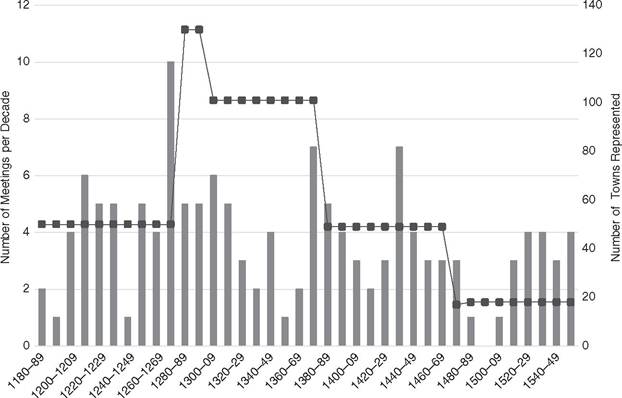
However, towns were systematically incorporated only after 1250,[615] by which point most of the Reconquest was mostly complete (except for the southernmost area of Granada, with which peace was struck by 1273).[616] So, although, as van Zanden, Buringh, and Bosker point out, the Reconquista created military pressures to co-opt fighters and merchants, this itself did not increase the presence of the third estate, on which they focus.[617] The assembly spike after 1250 instead seems related more to successive crises that afflicted the kingdom, such as rampant inflation, corruption, and taxation that was already imposed.[618]However, as we have seen, frequency alone can be misleading when the question is regime representativeness.[619] Towns represented the third estate and were the main taxpayers, already a sign of weak territorial anchoring of the regime. Town numbers moreover drastically declined over time, weakening the representative character of the Cortes by 1500 (Figure 5.4). Surviving lists suggest that towns rose from a maximum of 50 in 1188[620] to 130 by 1295,[621] then declined from 101 cities in 1315[622] to 49 in 1391[623] and just 18 by 1492,[624] the fixed number during the period of “absolutism.”[625] Military pressures increased after the 1300s, as we will see, but representativeness decreased. In England, borough representation fluctuated until the 1330s from as high as 160 to about 70-90 in practice.97 English levels thus remained far higher than in late Castile and increased under the Tudors,98 despite overall similar populations - and
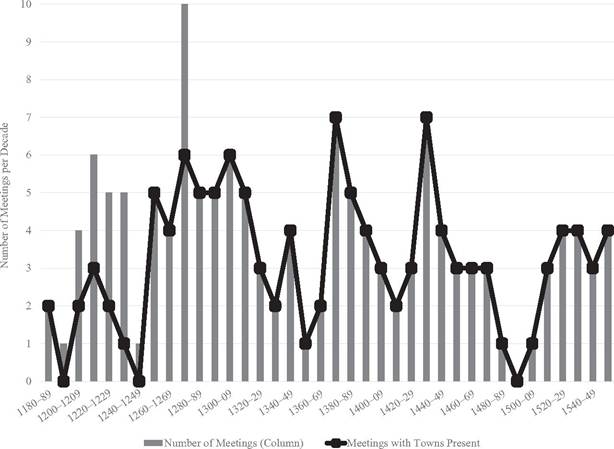
Figure5.3 Number of meetings in Leon-Castile, per decade, 1180-1559 Sources: Cortes de Castilla 1861, supplemented with dates from O’Callaghan 1989, 16 and amended by Procter 1980, 70-151.
towns were flanked by the county knights. The other Spanish kingdoms, reflecting relatively more stable representation, also retained higher numbers of towns proportionately in the assemblies: about twenty in Aragon and Navarre, eighteen in Catalonia, and about thirty in Valencia - despite a total population each of less than a tenth that of Castile.[626]
What accounts for that trend and how does it explain the trajectory of the Cortes? First, I examine how representative patterns reflected land distribution.
5.2.2 Land Distribution and Representative Scope in Castile
Both the rise and subsequent decline in representative scope in Castile depended on variation in royal strength. Castilian kings controlled the nobility less than their English counterparts. The land regime again shaped this variation. Until the 1230s, the period of early representative activity, kings distributed lands whilst retaining royal control. They
99
a Number of Meetings (Column) Number of Towns Represented (Line)
Figure 5.4 Meetings in Leon-Castile, per decade, and maximum towns represented 1180-1559
Sources: As for Figure 5.3 and footnote 96.
allocated estates to castellans (alcaide), who were “removable at the king’s pleasure,”[627] as were all public officials.[628] They avoided the “disintegration of governmental authority” that is associated with the feudalism identified with Continental models. Administrative office was not turned into a benefice nor were noble benefices hereditary.102 Consequently, administration was not too fragmented by entrenched territorial rights. The nobility was thus sufficiently incentivized to sustain royal institutions of governance, especially the Royal Council, the curia regis. The main representative institution, the Cortes, grew out of that Royal Council, as elsewhere in Europe.103 Thus, when the Cortes frequency regularized after 1250 and royal cities summoned exceeded 100, royal strength was relatively high, as corroborated by other indicators below.
However, Castilian kings were less able to compel key powerful subjects by the 1300s. The major power-holders escaped the extractive reach of the state, as they acquired jurisdictional immunities. With exempt territory increasing, the number of towns subject to taxation decreased, as did urban incentives to attend the Cortes.Some crucial differences led Castile in a different direction than England. Nobles did not have as strong ties of dependence on the crown. Military service was not part of a conditional relationship (of homage) but a paid service.[629] This weakened the crown’s relative control. By the 1300s, consequently, the military nobility and the Church appropriated large estates (latifundia) in the conquered territories, especially in the South.[630] So, although in the 1250s large estates could amount to only 12.4 percent of total area in Cordoba, by the 1350s, the large estates “accounted for 67 percent of the land surface.”[631] This unleashed long-term centrifugal trends.
City representation sharply declined from the 1380s following the succession crisis that brought the Trastamara dynasty to power after 13 69.[632] This led to a further concentration of land, as a few nobles were rewarded by the king with important privileges (mercedes) for their support. They appropriated judicial rights and collection of the sales tax, the alcabala, over territories that included large numbers of towns. Over the next three decades, about twenty families built large estates (estados) at the expense of the royal domain. Noble power had another major indicator, castles: 283 were built between 1400 and 1504, but only 12 belonged to the crown.[633]
Land was further “privatized” through a legal device that will be encountered again in the analysis of English and Ottoman land law: the mayorazgo or entail. It endowed the first-born with a continuous possession over land that was inalienable and exempt from inheritance taxation, establishing both primogeniture and fiscal immunity.[634] The mayorazgo thus removed land from royal jurisdiction, even though royal authorization was required until 1505.[635] Entailing was important especially between the reigns of Henry II and Isabella (1474-1504).
After the 1480s, it was further extended to the middle and petty nobility.[636]One hypothesis explaining the concentrations in land distribution is that they were endogenous to the high land-to-labor ratio that economists invoke to explain early economic prosperity in Spain.112 By 1300, a territory about twice the size of England was populated by similar numbers, about 4 to 5 million.113 But arguments from population density to institutional strength do not explain why political rule cannot consolidate in some compact region and expand further on an “imperial” or agglomerative basis. After all, England never secured effective control over Ireland, Scotland, or Wales, yet it still consolidated power in the south. Catalonia, as will be seen, developed robust institutions over a more limited area before becoming an empire. Low population density did not prevent the high regional institutionalization of the early United States either.[637] Moreover, the Cortes were inundated with suits showing land was still contested - the crown’s role was crucial there.[638] Even if some lands were remote, a critical mass of conditional nobles could have been sustained in some sub-region but were not.
All these trends, however, increased the size of the nobility. It was disproportionately large compared to England and more similar to Poland. Ten percent of the population were noble, as all offspring retained noble status, unlike in England.[639] However, the truly powerful nobles, controlling most of the landed resources, were not more than 2 percent, as in France.[640]
By the 1470s, when the Catholic kings came to power, the nobility, together with the Church and the military orders, controlled practically all of the land by hereditary right, completely reversing the conditions that generated parliament in England: in some estimates, they “either owned 97 per cent of the land of Spain or possessed profitable rights of jurisdiction over it. Fifty-five per cent of the land in question belonged to the great noble houses, the rest to bishoprics, abbeys, the urban oligarchy, and lesser nobles.”[641] Although Ferdinand and Isabella improved these conditions somewhat, their successors alienated extensive estates and towns to the military orders, especially from Church lands. By 1600, “about two-thirds of the 4,600 towns in Castile and one half of its 15,800 villages and hamlets were under private control (senorio),” with jurisdictional and tax immunities.[642] Regional studies confirm these patterns. In Salamanca, “over 60 per cent of the population fell under noble jurisdiction.” In Valencia, “the king has only 73 large and small towns, and over 300 are seigneurial; in Aragon the crown in 1611 had jurisdiction over only 498 of 1,183 centers of population, with nobles and the Church in roughly equal control of the remainder.”[643]
The sharp decline in city representation is related to these trends, even though the frequency of the Cortes remained fairly robust, as the final section will further discuss. The connection of limited inclusion with weak control over land and the powerful actors holding it is thus observed in Castile as in France.
5.2.3 Taxation
Given the crown’s weakness, the argument would predict that the nobility and clergy were exempt from direct taxation. Indeed, similarly to France, the nobility and clergy were exempt from direct taxation, as were the urban oligarchies that attended the Cortes.[644] Yet again, however, taxation was not central to the early meetings, confirming the pattern discerned by Wim Blockmans across European cases.[645] In Castile as well, “no evidence of any direct intervention of the curia in questions of taxation” exists before the 1250s, although records are scanty.[646] Yet representative activity was becoming regular.
Taxation begins to be a systematic concern of the Cortes only after the 1250s, i.e. after decades of representative activity and after the Reconquest pressures subsided. New taxes were raised: the direct servicios (either a capitation tax or a tax on movable property), customs duties on imports and exports, various aids, and the alcabala (fully from the 1340s).[647] These taxes mainly burdened the cities and the countryside they controlled, as their rising complaints towards the end of the thirteenth century attest.[648] The exempt nobility only occasionally consented to a direct levy on their vassals. The clergy mostly agreed to contribute, as its interests were originally closer to the crown.[649] The principle of consent was acknowledged on many occasions, but it did not imply the right to refuse taxation: “there was no specific instance during this period when a request for taxes was rejected.”[650] However, the Cortes sometimes required redress of grievances before consenting to tax, though the evidence is only suggestive.128 Castilian tax-farming, in most instances indicating weak extractive capacity, was extensive.129 In later periods, Spanish monarchs also sold towns to raise revenue, which further depleted their demesne.[651]
Systematic comparative data on rates of extraction in England and Castile are not available before 1500. Indirect evidence for comparative English fiscal strength comes from monetary data.[652] Untilthe 1540s, the English crown never debased its coinage (with one minor exception), a sign of strong fiscal control under the centralized London Royal Mint since the 1270s.[653] [654] In Castile, an extraordinary subsidy was paid every seven years by non-noble free men only to prevent debasement, the 133 134
moneda forera (as in 1202), similarly to France.
More direct evidence on extraction, by Karaman and Pamuk, suggests that in 1500, Spain (including Aragon) was raising more than twice per capita what England was (as seen in Chapter 6, English extraction declined in this period).[655] One per capita estimate posits output in Spain to be 28 percent higher than in England in 1500.136 If so, given the tax exemption of the nobility and their subjects, a far heavier tax burden was shouldered by the cities and their hinterlands and the Church137 than in England, explaining the perception of inefficient, oppressive taxation.138 This also suggests, once again, that capacity to extract determined which groups were included in institutions - the critical actor for polity-wide inclusiveness of the institution, however, was the nobility and in Castile it was eventually absent.
5.2.4 Functional Layering and Institutional Fusion at the Cortes: Towns, not Countryside Castilian constitutionalism thus needs to be explained: if it preceded fiscal bargaining, why did the Cortes begin to assemble, with both nobles and eventually towns originally present? Another feature is puzzling: a regular central institution emerged in Castile, whereas it did not in France, when both nobilities were not taxed. The argument so far has suggested that central institutions became regular when judicial and fiscal functions were fused. Unlike France, Castile also displayed this institutional fusion. Judicial functions were key, and they involved not only the nobility but primarily the towns.
Despite lacking a pressing fiscal incentive, some nobles attended the Cortes up to the middle of the fourteenth century, in particular the magnates and the king’s chief collaborators (ricos hombres). Numbers can only be loosely inferred from lists of witnesses of royal charters, which suggest comparatively far lower levels of attendance in the thirteenth century than in England, about 20 to 25 nobles[656] to England’s average of 70 over a similar population (4-5 million).[657] This was the same probable number as in France, however, that had three to four times the population. Castile is therefore in an intermediary position.
The primary incentive for the nobility, as contemporaries stressed, was “the feudal obligation to give counsel as royal vassals.”[658] Other business was also administered, for instance, witnessing donations to churches, monasteries, and individuals.[659] Nobles, as in England, attended originally out of obligation.[660] No right of attendance existed, only the de facto presence of the same families in the king’s court.[661] The nobility’s interest in the Cortes remained strong, however, because the royal court functioned as a judicial tribunal.[662] It is where nobles were tried for treason, crimes, or negligence in administration.[663] It is also where disputes among nobles, towns, and ecclesiastical institutions were presented, as well as appeals from judgments rendered by other courts in the kingdom (whilst the English royal court had extensive first-instance jurisdiction, as we have seen). Such judgments were often and upon request made by the king himself. The Cortes regularized further under Alfonso X (1252-84), who promised to hear suits three times a week, as did subsequent kings.
Another key concern for the nobility was, as in England and France, the legislation passed in the Cortes.[664] When Alfonso X passed new laws requested by the municipalities, the Fuero real, the nobles originally consented together with the prelates. But in the Cortes of 1272, the nobility demanded that their right to trial by peers be affirmed and that the king appoint two judges from their own order to hear their more routine pleas in accordance with their own fueros (customs) - a request that was granted.148 The attempt to impose a highly Romanized law code, the Especulo, and the great compilation, the Siete Partidas, also faltered due to this noble resistance.149 That different rules and different judicial personnel applied to groups according to social or regional origin suggest the relative weakness of the Castilian crown to impose judicial and legislative uniformity throughout the kingdom - a critical difference from English conditions with long-term consequences.[665] Yet, the extent of organized noble contestation suggests that royal powers were higher than in France.
Petitions were equally central in Castilian developments. Royal willingness to respond to these petitions cannot be divorced from the rising fiscal pressures due to war. But the necessary condition for this need to translate into institutional growth was the servicing of popular judicial needs, which were centralized by the crown through conditional rights, especially tied to land. Although systematic evidence is lacking, the nobility’s somewhat greater dependence on the crown than in France is attested by its petitions for exemptions; the nature and quantity of petitions could measure this relation.[666] This dependence helps explain the institutional fusion observed in Castile, as the Cortes served both judicial and fiscal functions, unlike the French Estates-General.
The towns, however, were the main drivers of institutional fusion. We have seen in Part I how the English crown’s capacity to harness supralocal collective action across the nobility, boroughs, and counties was fundamental for Parliament’s representative and inclusive character. Kings could impose collective responsibility across all social orders - presence in Parliament obligated local communities to abide by central decisions, enabling the crown’s territorial anchoring across the countryside, not just towns. In Castile, this pattern was reproduced mainly with the towns, and “only those on royal demesne.”[667] As the historian Teofilo Ruiz has argued, towns were the Crown’s main allies, seeking royal protection against magnates.[668] Spanish urbanization was between double and quadruple that of England, generating a thriving commercial sector.[669] Urban municipal structures allowed considerable selfgovernance based on councils (concejos) and separate law codes (fueros), but under royal lordship. It was with this dependent group that the key ingredient of constitutionalism developed - an instance of the secondbest constitutionalism we will observe in Hungary, Poland, Russia and elsewhere.
Judicial interaction, including by petitions, was here as well key in forging institutional relations between crown and society via representation. Royal towns pursued justice in the royal courts already from the 1180s, just as the Cortes was institutionalizing.[670] Theywere incentivized to attend, since royal courts resolved disputes relating to landholding and vassalage[671] and they had corporate representation from the 1220s.[672] So although they attended the central court rarely before 1250 for political purposes, the judicial prehistory offered a critical backbone to representative practice connecting “the representation of towns as suitors in cases tried before the king’s court, and their representation in the cortes.” By 1250, Castilian towns provided corporate powers (cartas depersoneria~) to those representing them as suitors in the king’s court and probably the Cortes too. A thirty-year precedent in judicial courts prepared for political representation.[673]
Petitions were again a vehicle for legislation. Towns protested taxation, economic problems, abuses by royal officials, and other mundane concerns, recorded in cuadernos.[674] Petitions could be presented to the itinerant king throughout the country, sometimes in oral form, but the Cortes became a major venue for their consideration. The king could disregard petitions submitted to him; nonetheless, he was sworn to uphold the posturas, understood as a “contractual agreement between the king and his people.”[675] As in England, the demands resulted in decreta, constitutiones, and ordinances, though legislation also originated in royal initiative.[676] Collective petitions soon became here too an instrument for initiating legislation that was supra-local. Town representatives collectively attending the Cortes were exposed to similar concerns from different regions.[677] As a result, “collective petitions, presented by all the towns of the kingdom, or of a province, stood a better chance of a favourable consideration than one presented on behalf of a single town.”[678]
Obligation was central to these patterns: penalties were imposed for non-attendance, reaching the large sum of 1,000 maravedis for great towns. Compensation, however, seems much lower than England’s: in 1250, the towns paid representatives one half a maravedi a day for the journey to Toledo and one maravedifor Seville.[679] English burgesses were paid 2 shillings a day, which maybe equaled 3.7 maravedi.[680]
In fact, the Castilian institution had some major differences that placed it in an intermediary position between France and England. As in France, its corporate organization did not extend to the countryside, which was not separately represented. Most of it was under noble jurisdiction and not represented at all, some was under municipal jurisdiction.[681] In England, both (rural) counties and (urban) boroughs generated collective petitions that produced bills of legislation. Broad-based incorporation is evidently a necessary condition for parliament to become a central instrument of governance polity-wide; when lacking, the different estates were not united on a common platform.
Even the town associations formed from 1282 in Castile, the herman- dades, which exercised power during minorities as “the vanguard in the cortes,” lacked unity.[682] As a result, a “principal weakness of the Cortes was the failure of the estates to join together in presenting common proposals to the king”: no sense of common interests existed.[683] Accordingly, “the Castilian assembly was unable to turn this right of petition into a right of legislation,” nor did the common petitions develop into bills, as in England.[684] The implication of this account is that this disparity flowed from the weaker powers of the ruler and more limited involvement of the groups concerned, especially the nobility. Weaker royal powers are also reflected in the rarer imposition of plenipotentiary powers, which we saw were crucial for English outcomes. Mandates were typically limited, not plenipotentiary, leaving towns greater discretion, as in France.170
Yet in developing functional layering and institutional fusion, Castilian outcomes also differed from French ones, despite a similar crown-city alliance, and resembled English ones. Castilian capacity to do so must reflect, in this book’s logic, greater relative royal power. Systematic early evidence is not available to definitively prove it, but the Karaman and Pamuk data between 1500 and 1600 (the earliest available) suggest that Spain extracted between double and three times per capita in taxes than France and equal to up to twice when adjusted for purchasing power, while output per capita is estimated as equal.171 Moreover, extraction burdened the urban groups central to the fusion (which explains why the town-based Cortes were so robust). Alternative explanations of representative differences are even less plausible, as neither geographic size nor military pressures varied between France and Spain.
5.2.5 Royal Absolutism or Pathologies of Urban Dominance?
The urban constitutionalism just described was precocious and, at the micro level, quite similar to what was observed in England. But did the gradual restriction of urban participation result from royal weakness rather than, as some narratives hold, increasing royal autonomy, especially after the discovery of American silver?[685]
Silver revenues become significant after 1540, yet urban restriction had already occurred, so they cannot explain these patterns.[686] Key indicators of royal weakness, however, have been already mentioned: noble and clerical immunity, as well as limited jurisdiction and lack of common law across social orders and regions. But the question is also answered by examining the increased urban dominance, which developed predictable pathologies. Stasavage showed how urban autonomy can lead to capture of internal institutions by oligarchies that then restrict growth.174 In Venice, it was powerful merchants seeking to secure political and economic advantage that were responsible for the closure of its political system.175
Castilian cities displayed this pattern too. They used to be seen as mercantile, progressive bulwarks against autocracy. This eighteenthcentury narrative has not withstood historical scrutiny, however. As Ruiz has argued, town leaderships increasingly operated as narrow, closed oligarchies composed of non-noble knights, the caballeros villanos.116 After the 1250s, the knights gained privileges from the crown, especially tax exemption, which helped them counter the nonurban nobility and other towns. It was this group that eventually controlled the Cortes, in which it negotiated not just judicial issues but also the taxes burdening mostly the pecheros, the tax-paying inhabitants.
Consequently, the Cortes were also transformed into an oligopoly, which indeed made participation a privilege to be jealously guarded. But this impeded broader representation due to resistance by the members of the Cortes, not the crown. By the early 1500s, the fiscal benefits from participating in the decisions in the Cortes were such that cities vigorously opposed other cities entering. For instance, in a petition to the king in the Cortes of Valladolid in 1506, the representatives of the towns said:
It is established through some laws, and by custom from time immemorial, that eighteen cities and towns of these kingdoms shall have a vote in the Cortes through their representatives, and no more; now some cities and towns are trying to obtain the right to be able to vote as well. Since this would bring great harm to those towns that already have a vote, and would cause great confusion, we supplicate your Majesties reject this petition, because all voting rights are already defined by the laws of these kingdoms.[687]
The towns’ request was upheld. The crown, faced with powerful urban groups, could no longer dictate the terms on who was summoned nor did it have the power to enforce polity-wide representation, as originally in England.[688] The decline in number of towns charted above (Figure 5.4) reflects this power shift. Urban oligopolies prevailed because of the crown’s weakened territorial control since the fourteenth century.
The increasing “absolutism” of the Castilian crown, consequently, cannot be reduced to an increasingly coercive strategy towards society as a whole. It resulted from an ever-decreasing domain over which the crown could exercise full jurisdiction - some towns were included, but the fiscal burden also burdened the poorest and weakest members of society, the satellite villages and areas of the towns. Poverty was widespread.[689] In the long run, the Spanish regime as a whole was defined by conditions in Castile: Aragon’s population was about a tenth of Castile’s around 1500. When most subjects were under private jurisdiction, the representative practices observed could not shape the whole polity. The dire picture painted by economic historians of Spain having “weak, incompetent, incoherent governance” after 1500[690] had medieval roots. This did not mean it did not have great conquering powers that enabled its imperial sprawl, but it may help explain the patterns of its colonial governing structures dissected in recent accounts.181
More on the topic Leon-Castile: From Feudal Centralization and Constitutionalism to Noble Immunity, Urban Dominance, and Absolutism:
- Leon-Castile: From Feudal Centralization and Constitutionalism to Noble Immunity, Urban Dominance, and Absolutism
- Boucoyannis Deborah. Kings as Judges: Power, Justice, and the Origins of Parliaments. Cambridge University Press,2021. — 400 p., 2021