France
According to the Tocquevillian logic, representation lapsed in France because of deliberate royal policy over weak societal interests. This logic has a venerable pedigree, that of “divide et impera, the reprobated axiom of tyranny,” as Madison called it.[558] It posits that division is a deliberate strategy of any tyrannical ruler who aims to weaken resistance by preventing collective action.
Such incentives are undoubtedly strong, and evidence can be found across cases where rulers chose to forgo assemblies, as this would concentrate social forces. Comparing the frequency of the English Parliament and the French Estates-General seems to reinforce this intuition (Figure 5.1). French frequency was zero for 21 out of 40 decades, but only in one in England.[559] Not calling parliament, however, I argue below, is the dominant strategy for rulers when they are faced with social forces that are capable of rejecting central demands.
5.1.1 Divide et Impera: “The Cunning Plan of the Romans ”
(Or the Strategy of Weak Rulers)
Assuming the king would prefer to enter into multiple negotiations and deal with his subjects separately is an intuitive prediction.[560] This Roman “cunning” was also noted by the thirteenth-century chronicler Matthew Paris.[561] But the reality, as Bates and Lien noted,19 was generally different: in a memorandum from 1439, the king preferred central negotiations.20 Otherwise, he would have to arrange multiple assemblies only for nobles (Philip V summoned seven in 1319).21
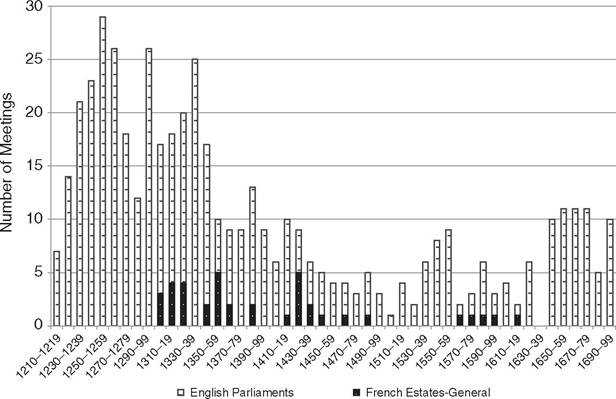
Figure 5.1 Frequency of English Parliament and French Estates- Generalperdecade, 1210-1699
Sources: See Chapter 2 for England; for France: Hervieu 1879; Soule 1968.
The king acted more efficiently when he collected everyone at the center. There, nobles (or their representatives) faced many royal agents and the king, this semi-divine figure who cured the sick and was “anointed with the holy oil of Reims,” “in all his glory and majesty.”[562] One might think that, gathered in one place, the nobles could coordinate and present a common front against the king. In practice, however, they remained divided by regional particularisms. As we saw, English nobles acted collectively only after being compelled to serve the crown under common obligations, i.e. because the king was strong.
Conversely, when the king was weaker, he couldn’t compel nobles to the center and the nobility’s first preference, local negotiations, prevailed. He thus avoided the cost of summoning deputies to the assemblies. Even the nobility was compensated for attendance costs - unlike in England, where it attended as of duty. Representatives, moreover, were compensated more dearly in France than in England. Later comparative data, from the Estates of 1484, show that municipal officials and other third estate representatives received 40-90 livres tournois, whilst in England burgesses and knights of the shire received 16 and 33 livres tournois respectively.[563]
22
Nobles therefore always preferred to defect and remain in the provinces, as the historian Fawtier also noted.[564] Locally, they just faced some royal commissioners who roamed the country to ensure compliance.[565] Divide and rule appears “cunning,” but cunning is usually born of weakness. In the long term, however, the English case shows noble interests were better served when compliance at the center was originally effectively imposed, since it solved nobles’ collective action problem.
As Tocqueville noted, division had self-reinforcing long-term effects. The more divided society is, the more effective rule is hampered.
This was the predicament of the ancien regime: “It was no small undertaking to bring together citizens who have lived for centuries as strangers or enemies and teach them to take joint responsibility for their own affairs. It was easier to divide them than it is to unite them. We have provided the world with a memorable example... Indeed, their jealousies and hatreds survive to this day.”[566]5.1.2 PlenaPotestas: Where the Ruler's Dominant Strategy Failed
The key problem in France, I argue, was that kings could not secure representatives with the power to commit their communities, as in England.[567] Moreover, taxation was only voted on by local assemblies.[568] Plenipotentiary powers were as known to the French as they were to the English. Procurations were particularly prominent in the municipalities of the south, where Roman law flourished,[569] such as Toulouse, which had advanced forms of self-government already from the 1190s.30 Towns were major political actors, using representation for business matters. Proctorial powers were also granted for assemblies convoked for specific business, for instance coinage.31
But before 1322, the crown had only asked for representatives with plenipotentiary powers three times and they were either for moral support of a royal cause (the conflict with Boniface VIII) or not actually exercised.32 Local communities were far more adept at withholding such powers, especially due to their experience with ecclesiastical negotiations. For instance, a papal legate exploited the powers granted to him by the diocese of Reims, in 1264, by tying the town to terms its citizens objected to. So, when the town was summoned to a royal assembly to approve taxation, it sent delegates with two mandates, one to hear and report back and one, as required by the king, to agree and commit, but only to a small loan.[570] By contrast, such limits on representative powers in England were the exception in a context of general compliance.[571] [572] The French “government may have tried to enforce...
a theory of procuration before 1314, but if so had given up the attempt” by 1321.35After the defeat at Crecy in 1346, deputies did arrive at Paris with full powers, to support the eviction of the English from French territory.[573] Military pressures indeed encouraged subjects to cooperate. They did not, however, result in a regular institution. The Black Death further undercut royal efforts,[574] and compliance suffered into the fifteenth century. Persuading the urban deputies “to come with full powers” to the Estates was “a triumph” for the king.38 Representatives repeatedly claimed they were unauthorized to approve the crown’s demands and needed to consult with their communities.39
The fundamental difference was that in France (as we will also see in Poland), “large representative assemblies were used only to explain the need for a tax,” whilst it was the provincial estates that “were the ultimate tax-granting institution”; only there could consent to taxation be given, reflecting the stronger local organization of the kingdom.40
5.1.3 Radical Demands and Institutional Proliferation
Demands for consent, therefore, were not unique to England. French communities asserted their local autonomy even more stridently. In fact, a paradox exists, where demands for consent were as or even more radical in absolutist cases; this will also be seen in Spain, Russia, and elsewhere. Despite strong demand, central representative institutions either failed to consolidate in a way that turned them into central organs of governance or never emerged in those cases.
French assemblies illustrate this. First of all, as community representatives arrived only with a “mandat imperatif,” an imperative mandate to report back, they retained much stronger rights to “limit” the crown, thus undercutting the Estates-General, as historians have emphasized.[575] Urban communities also made additional demands.
For instance, they demanded the right to judge whether war itself was necessary, initially attempted only by barons in England and only gradually by the Commons.[576] They also asked that tax collection cease once the cause for war ended - and the king obliged.[577] Occasionally, they demanded and obtained a refund if the threatened cause of war never materialized.[578] Cities of the Midi and North did not allow royal agents to interfere in their elections.[579] In 1355, facing military attack again, the Estates agreed to taxes but asked to participate in government, to collect and disburse tax proceeds, for estates to be held regularly, and for higher taxation on nobles than wealthy non-nobles. This was robust bargaining. But it failed to produce collective action or a regular institution.[580] So although the English Commons indeed placed constraints on royal power in the fourteenth century,[581] French demands were not weaker. They were often more radical. This did not make them less effective for subjects: the French initially conceded and paid much less, as the next chapter will show, despite central representative institutions being weak. When John Locke reported that in the 1670s the Estates of Languedoc “never do, and some say dare not, refuse whatever the king demands,”[582] he was expressing a dynamic that, if true, can’t be projected back to the period of origins.This radicalness characterized a popular movement that nineteenthcentury historiography dubbed “democratic.” Indeed, the mercantile bourgeoisie led by Etienne Marcel in the 1350s was remarkably assertive: they marched into the king’s palace to kill dignitaries, which English merchants never did.[583] Far-reaching claims continued into the late fifteenth century: a member of the third estate advanced the proto- democratic claim that “the kings were originally created by the votes of the sovereign people” in 1484.[584] The Commons only made similar claims in Parliament two centuries later.
A thirteenth-century text, The Mirror of Justices, had claimed that earls could judge royal actions, since they had elected the king to keep the peace; Edward I quickly stymied such claims.51French demands were also not confined to merchants. The crown had to concede multiple charters to provinces around the country after many confrontations, especially around 1314. Many of these charters were permeated with the language of liberty and rights expressing aristocratic privilege. For some historians, the aristocratic nature of these leagues undermined collective action, as the people found little to support in their claims.[585] Nobles were simply not capable of collective action at a supra-local level.
Such local activism, however, had clear institutional imprints. The image of absolutism as eschewing institutionalized consultation altogether has been long contested, famously by Tocqueville, who pointed to many assemblies operating locally in the provinces known as pays d'etats[586] At least forty-nine such assemblies existed, of which twenty-five, in Brittany, Burgundy, Languedoc, and elsewhere, survived until the French Revolution.[587] They survived partly because, as pathbreaking scholarship has argued, they generated important tax revenue for the crown throughout the ancien regime. Even at the local level, higher participation meant higher infrastructural control over local resources, including border military defense.[588] However, when at the Estates of 1588 “both clergy and nobility requested the transformation of all provinces into pays d’etats so that taxes could not be raised anywhere without consent,”[589] they lacked the capacity for collective action that could secure this result.
The argument of this book predicts that the pays d’etats should show early executive strength and some functional layering - such analysis at the level of constituent units is necessary for composite political units, as some comparativists have argued.[590] The early provincial evidence is too piecemeal to demonstrate this, but some key elements are there.[591] Languedoc was originally ruled by a count, and bishops wielded local authority based on land grants until the French king penetrated the region. Its parlement also considered petitions and was attended as of duty, like suit of court. Noble compellence was variable but is attested by the taxation of their urban property.59 Brittany, Burgundy, and Normandy were early on ruled by semi-sovereign dukes, who dispensed justice in aparlement that assembled the nobility as well. Brittany seems to be the one case with evidence of clear layering between judicial and political functions that assembled all social orders[592] - local histories described it as “the best regulated government in Europe.”[593] Normandy fused judicial and fiscal powers in the Exchequer, the Echiquier; both nobles and clerics were liable for taxation early on.[594] Brittany and Normandy are also the two outliers in Stasavage’s theory about the importance of distance: they met frequently despite their large size.63 Institutional fusion helps explain the anomaly.
Although we typically think of France as a regime which suppressed consent, in fact consent and its denial were ubiquitous, often via local institutions and courts. If we record all meetings, including judicial ones, convoked by the crown with different social groups in different locations, we see that consultation frequency was actually higher in France than it was in England, except in the 1330s (Figure 5.2). The Estates-General, which required not only a polity-wide assembly, but also the presence of the third estate, emerges as very restrictive category. In Chapter 6, empirical data on tax extraction show that the French interaction type succeeded in imposing greater limits on royal capacity to extract, certainly until the sixteenth century, contrary to common assumptions in the field.
What has been presented as a contrast between regime types, even ruler preferences, was initially the optical effect produced by the location where exchange occurred. England appeared as involving more consent because we observe social actors coordinated at the center and engaging in the relevant discourse; exchange was thus centralized. France appeared as eschewing consent because we don’t observe it at the center; it was dispersed in an infinite number of localities that actually succeeded better in limiting the monarch in his fiscal extractions. French exchange was decentralized - but political development was stymied. We have long labored under the (often misunderstood) Tocquevillian castigation of French “centralization” in the ancien regime and praise of English decentralization.64 At the political level, however, conditions were inverted (as Tocqueville understood).
The fundamental condition leading to this outcome was the limited incorporation of the countryside. As we have seen, the most powerful social class, the nobility, was less under the crown’s control than in England. As a result, “ [s]trictly subjected to the jurisdiction of their lord, the peasants of the countryside, isolated in the frame of the seigneurie, found themselves essentially excluded from political
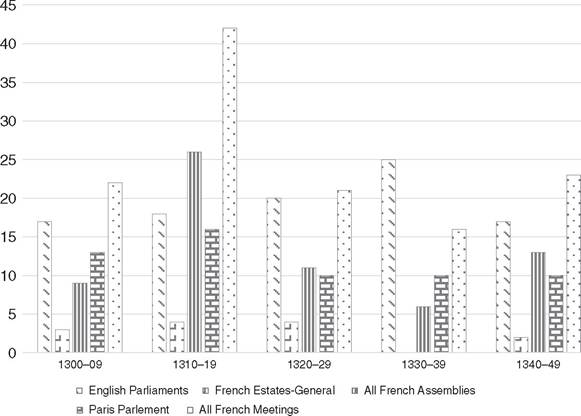
Figure 5.2 Frequency of English and French assemblies per decade, 1300-1349 Sources: Chapter 2 for England; for France, Figure 5.1 and Hervieu 1879. “All French assemblies” includes all Estates-General, as well as all assemblies that were regional or order-specific. “All French meetings” adds “All French assemblies” to Parlement meetings. Villers 1984 raised concerns about Hervieu 1879 as a source, but these are sidestepped by including all known assemblies. These figures do not include meetings with ecclesiastical representatives, so they underreport meeting frequency on both sides.
life.”[595] This is why it was mostly the towns that were summoned to the assemblies by the king to represent the third estate, whether at the polity or the local level (until 1484).[596] These towns, as mentioned, were fundamental in furthering royal policy already from the twelfth century.[597] The assemblies would have been impossible without the system of representation of chartered towns, as there “was no regular machinery for summoning procurators from the semirural areas.”[598]
Towns are central to many narratives of state emergence predicated on the political fragmentation of Europe, as we will see in Part III.[599] However, urban alliances with the crown did not secure institutionbuilding at the polity level. Urban dominance in France meant the regime was not inclusive.[600] When the countryside was not integrated through a centralized system of courts and institutions, polity-wide inclusive representative regimes were stymied. By contrast in England, towns were “small islands set in the royal sea of the shires.”[601] In Parliament, although more representatives were eventually summoned from boroughs (about 160) than counties (74), it was the county knights “who mattered most.”[602] Broader inclusion happened where rulers controlled the nobility. No compellence of the elite, no inclusive representative institutions.
The same dominance of the urban sector and decentralization of exchange applies to the other major case of “absolutism” in Europe, Spain and its antecessor, Castile. Although typically examined as an example of royal suppression of consent, such outcomes followed from a fundamental central weakness.
5.2