Representative Practice Explained, 1227-1307: Taxes and the Commons
The English Parliament has no founding moment, but its institutional coagulation begins after Henry III’s minority ended in 1227.71 The term appears in meetings between the crown and magnates in the 1230s.
By 1295, the so-called “Model Parliament” had acquired the core instituВtional and procedural form retained until 1918.[526] The role of bargaining should thus be reassessed before the 1230s.In what follows I first examine some incidents that exemplify the bargaining dynamic so often invoked in the literature, in the early period after the 1220s, and once Parliament had acquired its established form, after the 1290s. Broader groups began to be incorporated in the intervenВing period, between the 1250s and 1280s, generating representative practice. The power balance between crown and barons will be examined for that period.
4.3.1 Bargaining Under Varying Ruler Power
Narratives emphasizing consent in parliamentary emergence often focus on the period between 1227 and 1258, when the barons opposed Henry III and his military campaigns.[527] The barons refused ten grants, exempliВfying their bargaining powers. When taxes were later granted, the change is ascribed to baronial interest: the nobility deemed these later wars more “pro fitable.”[528]
But focusing on the admittedly constant battle over consent in England is misleading. Not only was bargaining as or more intense on the Continent, as later chapters will argue, but English barons refused in the 1240s because they had been already forced to grant “countless sums of money,” according to Matthew Paris. The feeling was that the king’s extractions were “a scandal to the king and the kingdom,” that he had “money untouched,” that the money spent had brought “the least increase or advantage to the kingdom,”[529] since he was claiming his patrimonial lands in southern France.
Ironically, in a pattern we will see repeated under the Stuarts, complaints became louder while real per capita taxation was comparatively low.[530]Nor had these tax grants secured greater rights: the king flouted parts of Magna Carta to recurrent complaints and Parliament did not become more representative in the 1240s: no representatives were called. On closer inspection, the first period was not so much one of “bargaining” among near-equal actors77 but rather of a period of royal weakness after prior excess, with little institutional payoff. Compared to French or Ottoman denials of taxation and non-cooperation, this was not excepВtionally radical resistance.
Bargaining also looms large between 1290 and 1307, when the crown was much stronger. Apart from the charter, a major issue was Jewish lending.[531] In 1290, Parliament demanded that Jews be expelled in exchange for Edward I’s demand for the greatest tax of his reign (£117,000;[532] notably, no war was being waged).[533] However, Jews were so weakened that their expulsion was not a costly concession. Jewish economic power had peaked in the 1240s: their wealth amounted to one third of the circulating coinage in the kingdom, making them the wealthiest per capita Jewish community in Europe.[534] By 1290, however, their power had withered. Over half of total Jewish capital had been transferred to the crown, including the queen, by 1258 and by 1270 Jewish lending was “overwhelmingly small scale, rural, and short term.” By 1290, the comВmunity was “only an impoverished shadow of its former self.”[535]
Accordingly, Jews were of little financial interest to the crown. They were expelled for the same mix of anti-Semitic and structural causes that other European rulers, unconstrained by parliaments, expelled their Jewish communities.[536] Its implementation within months contrasts sharply with the decades-long, but flouted, promises to uphold Magna Carta and other requests: unlike these, it cost the king little.
Bargaining again appears important in 1297, when the king was asked to reconfirm Magna Carta during highly adverse military conditions. Barons and especially the highest nobility, earls, were again the major protagonists. Some concessions were gained: the king did grant “the promise of вЂ?common assent’ to all future вЂ?aids, mises and prises.’”[537] Representatives were henceforth summoned to all tax-granting parliaВments. However, the promise of common assent was later broken again. After the king refused to abolish the wool tax, the maltolt, parliamentary bargaining shifted to mere “consent” over it into the 1370s: bargaining there was and concessions there were, but the king held the balance and only had to promise again to observe the charter[538] - but both the institution and extraction grew in strength. Most importantly, if the conflict had constitutional outcomes, it was because a “similarity of oppression” had brought lords and knights together to counter the crown and to represent “the community,” a point emphasized by Maddicott.[539] As the historian Caroline Burt noted, Edward I did not (generally) raise taxes arbitrarily like Henry III and John.[540] But he also collected amounts that reached levels not seen for almost a century.[541] Moreover, extraction increased even further in the century that folВlowed, to levels only matched after 1640.
Conflict at the beginning and the end of the thirteenth century was therefore similar: baronial opposition articulated around Magna Carta and, despite temporary setbacks and relentless conflict, an increasing relative advantage of the crown.
4.3.2 Representative Advances under Baronial Advantage
and Collaboration
Historical accounts accord much importance to the baronial reform movement of 1258-67, which forced the king to temporarily accept radical new forms of government, affirmed with the Provisions of Oxford of 1258 and Westminster a year later.
To counterbalance the king, the barons summoned county knights in 1254, 1261, 1264, and 1265, extending societal representation.[542] This seems to confirm the logic of a weak king forced to concede rights to surging social groups.However, these baronial conflicts did not differ much from the endless acts of contestation and resistance scattered throughout and beyond Europe, which produced charters and strident assertions of right, as seen in later chapters, yet no central parliament. The key difference, rather, was that it was the barons who called in the lower orders, due to their fear of an incipiently powerful crown.[543] In other cases, such as France, Castile, Hungary, Poland, even Russia, it was the king who turned to lower groups and gave them representation, because he faced a baronial class outside his control. As I will argue, this is to a great extent why representation faltered in those cases. Even when, as the historian Gerald Harriss pointed out, Edward I similarly incorporated the lower orders, he was responding to magnate weakness: magnates could not claim to represent underlying communities,91 not least because the crown had undercut their power, as we have seen. Moreover, nobles were still compelled to contribute and lower orders were summoned with full powers, unlike in Continental cases.
Moreover, the Commons had minimal social power in the early period. Elected knights were only present in 17 percent of the meetings and burgesses in 12 percent of meetings until 1307, the former rising to a third only after 1290 (Figure 4.4).[544] These were tax-granting meetings (except in 1283) - showing again the weak frequency and low representative impact of tax demands in the early period. The assent of the Commons was first required in the Statute of York in 1322, although it was not established practice until decades later.[545] Representatives were invariably present after 1327, but taxation was still not the main cause for summons: of about twenty-six parliaments in the next ten years, only five voted supplies.[546]
Although these episodes of community representation can be seen as a classic instance of English precocity, European equivalents were often earlier.
Elected county representatives (knights of the shire) were called once in 1254 and then from the 1260s, but town representatives appeared only in 1265. Leon, however, first elected town representatives in 1188 and Castile saw thriving urban representation.[547] Nevertheless, the sequencing observed in England had beneficial institutional effects. Paradoxically, the crown’s early strength made the early incorporation of towns less important, as the strongest actor, the nobility, could be compelled instead, including the rural countryside. Towns were incorpВorated early on the Continent because rulers were weaker and less able to tax the nobility directly. However, urban groups alone could not increase the inclusiveness of the institution; central institutions thus failed to become fully representative, as seen in the next chapter.Focusing only on the period of the baronial revolt, finally, truncates the causal flow of the processes involved. The summons of representatives was predicated both on the pre-existing network of strong royal courts consolidated under Henry II and Henry III and on the judicial reforms that followed under Edward I, as described in Part I. Local courts were crucial for the system of petitions that enabled the institutional fusion described in Chapter 2 as well as the raising of taxes. If strong royal capacity had not preceded or followed, the baronial revolt would likely
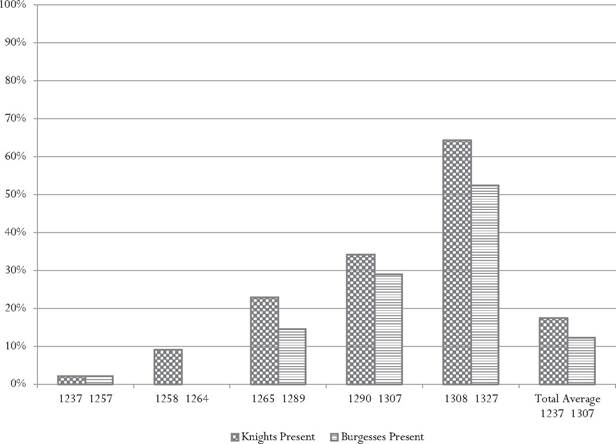
Figure 4.4 Number of English meetings with knights and burgesses present Sources: Fryde 1996; Maddicott 2010, 454-72. Both parliaments and consilia are included.
have been an abortive effort at premature constitutional reform, like many on the European Continent. Once grouped under a single institution and a common tax burden, opportunities for concerted action especially among the magnates and the county knights increased, thus strengthenВing their capacity to demand more from the crown.[548] Popular resistance grew in the fourteenth century, but only because initial conditions were originally inverted and had imposed uniform obligations.
4.4