Obligations in general
9.1.1 The nature of obligations
An obligation is a legal tie which binds us to the necessity of making some performance in accordance with the laws of our state. (Inst.3.13pr.)
The definition in the Institutes of Justinian of an obligation as a 'legal tie’ (vinculum iuris) or a legal bond between creditor and debtor, though post-classical, aptly evokes images of the concept of personal liability (seizure of the debtor's body) in archaic Roman law from which the law of obligations developed (see now Ibbetson, D.
'Obligatio in Roman Law and Society', in OHRLS, 569-80, at 569-70, and 572-4). In classical and Justinianic Roman law, this branch of law is concerned with situations where a person has incurred a personal liability for which he is answerable at law:Paul, Institutes, book 2: The essence of obligations does not consist in that it makes some property or a servitude ours, but that it binds another person to give, do, or perform something for us. (D.44.7.3pr.)
Paul's comment emphasizes that the law of obligations deals with rights and duties in personam, not in rem. However, it fails to emphasize that this area of the law is concerned with obligations arising from the acts of the parties themselves, and not from their status. We have already seen that in the law of persons a variety of duties arose from the fact that a person was of a certain status. Paul's statement could apply equally well to such duties, but they are not strictly part of the law of obligations, which focuses on obligations incurred by the parties rather than those automatically imposed on them (see Birks, Obligations, 2-5).
How were obligations incurred? Mainly either by contracts made by the parties, or through delicts committed by one against the other. That an obligation can arise from a contract can readily be appreciated as a natural consequence of the agreement between the two parties.
That a delict, essentially a unilateral act, can create an obligation is perhaps less obvious, but is understandable: a wrongful and damaging act should incur a duty to compensate the victim in a civilized legal system. There is clearly an 'obligation' in such a case. Nevertheless, there was a tendency to treat contractual liability as the principal source of obligation.An obligation had twofold consequences: a duty arose on the part of the person incurring the obligation; and there was a corresponding right in the other person to
enforce that duty by legal action (an actio in personam), which would normally result (in the developed law) in an award of damages (see Ibbetson, 'Obligatio', 576-8). Hence, from the plaintiff's point of view, an obligation was an asset, a res incorporalis·, it was thus part of the law of things in Gaius's tripartite classification of civil law (see 2.3.4.4):
Incorporeal things are things that are intangible, consisting of a right for example an inheritance, a usufruct, and an obligation however contracted. (Inst Gai.2.14.)
Since obligations were regarded as creating a personal relationship between the parties, they could not generally affect third parties. In pre-classical law, the obligation lapsed when the party subject to it died. That remained the general position as regards delictual liability but, as regards contracts, there was a gradual change towards enforcing obligations against the heirs of a deceased party.
The rendition of the Institutional scheme in Diagram 9.1 demonstrates the conceptual location of the law of obligations. For an overview of the Roman 'conceptual map' of obligations, see Birks, Obligations, 1-23.
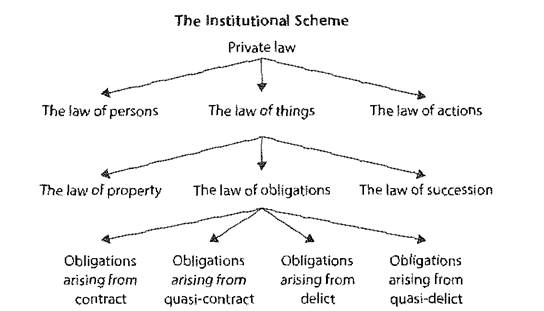
Diagram 9.1 The Institutional Scheme
9.1.2 The classification of obligations
Obligations were classified in a variety of ways, the earliest of which seems to have been the distinction between obligations arising from the ins civile and those from the ius honorarium (see Birks, Obligations, 11-16).
To this twofold division was added a third category in the classical period—natural obligations (probably in the mid-second century AD). In this period, obligations were also variously classified as unilateral or bilateral, depending on whether one or both parties were bound—in the contract of sale, obligations were clearly bilateral; in delict, they were normally unilateral. Or, obligations could be stricti iuris or bonae fidei, depending on whether the formula in the action that enforced them pointed to a strict or a discretionary applies tion of the law to the facts (a classification of great prominence in Justinianic law). This distinction between stricti iuris and bonae fidei contracts had a profound impact on the development of this branch of law and should be taken into account when studying the 'common features’ outlined later. Consequently, form was all- important in disputes concerning stricti iuris contracts, whereas in bonae fidei contracts matters such as mistake, fraud, and duress could more easily be taken into account. As a general rule, unilateral contracts were stricti iuris, bilateral ones were bonae fidei. (For a good account of the changes to the classifications of obligations attempted by the Scottish Institutional Writer, Sir James Dalrymple, First Viscount Stair, see Birks, Obligations, 20-3.)9.1.2.1 Natural obligations
These consisted mainly of agreements that were not legally enforceable, but which could have legal consequences. If a slave made an agreement with his master or some other party, it could not be enforced on manumission—the obligation of the other party was 'natural' only. But, if that other party initially kept to the promise, but later tried to resile, he could be prevented from using the argument that the initial agreement was void:
Tryphoninus, Disputations, book 7: Suppose an owner has a debt to his slave and pays it after manumission. He cannot recover, not even if he believed the other could sue him by some action; for his payment acknowledges his natural indebtedness.
For in the sense that freedom is the condition of natural tew and subjection the invention of the law of the world, so for the condictio the question whether there is or is not a debt is to be taken on the natural plane. (D.12.6.64.)Another important type of natural obligation was that which arose from agreements made between a paterfamilias and members of his family. Although the agreement had no effect while the family member was in potestas, it could have thereafter. For example, if a father 'owed' money to his son under an agreement made before the son's emancipation, and then paid the debt after the emancipation, the payment could not be recovered. In this case, as in the previous example, the natural obligation worked to the advantage of the 'creditor'—i.e. the slave or the son. But it could work to their disadvantage:
Ulpian, Edict, book 12: Those who have Incurred a change of civil status remain under a natural obligation with respect to matters which have arisen prior to such a change. (D.4.5.2.2.)
The concept of the natural obligation survives in modem law, even if in a different context. For example, the BGB recognizes the existence of nonbinding obligations, such as the promise of a fee to a marriage broker (s. 656) and obligations arising from bettingand gaming (s. 762). See Zimmermann, Obligations, 7 ff.
9.1.2.2 The source of the obligation
The most important classification of obligations was according to the causa of the obligation, i.e. its source. This classification has prompted some controversy, partly because of the seemingly inconsistent texts (see Birks, Obligations, 15-16, and Ibbetson, 'Obligatio', 571-2). Gaius states:
Gaius, Golden Words, book 2: Obligations arise either from contract or from wrongdoing or by some special right from various types of causes. (D.44.7.1pr.)
By 'wrongdoing', Gaius is referring to delict. So his classification appears to be threefold—obligations arise from contract, delict, or 'special right'.
Suspicion that this text, apparently taken from Gaius' Golden Words, might be an interpolation is strengthened by comparing it to a passage in Gaius' Institutes (Inst.Gai.3.88.) where he maintains that there are just two sources of obligation—contract and delict:; tet us now proceed to obligations. They are divided into two main species: for every obligation arises either from contract of from delict. (Inst.Gai.3.88.)
Some scholars maintain that Gaius used the term 'contract' loosely in this (earlier) text to refer to any obligation arising from lawful conduct. In classical Roman law, however, the term 'contract' acquired a narrower technical meaning. This rendered Gaius' principal division unsatisfactory and necessitated the introduction of a third category (special right form various types of causes) in D.44.7.1pr, (see Metzger, Companion, 127-8).
Justinian states in his Institutes (Inst.3.13.2.) that the sources of obligation were fourfold: contract, delict, quasi-contract, and quasi-delict. This seems, prima fade, at odds with the classification attributed to Gaius in the Digest, but it is possible to reconcile the passages by regarding quasi-contract and quasi-delict as obligations arising 'by some special right' (as per D.44,7.1pr.). Indeed, when examining the circumstances in which quasi-contract and quasi-delict applied, the picture emerges of a number of diverse cases to which Gaius' description fits well. But the difficulty with this line of argument is that Gaius regards obligations as arising exclusively from the ius civile, whereas quasi-delict was largely the product of praetorian intervention. It is thus difficult to maintain that Gaius was referring to quasi-delict in the phrase 'special right from various types of causes'.
The twofold classification of obligations—contract and delict—in Gaius’ Institutes has proved seminal in Western jurisprudence, although there has inevitably been some overlap between the categories. In English law, the overlap was partly the legacy of the development of assumpsit—which became the standard contractual remedy—from its tortious roots.
9.1.2.3 Justinian's classification
Justinian regarded obligations as stemming from four sources: contract, quasi- contract, delict, and quasi-delict.
(a) Contract A contract can be broadly defined as an agreement that is enforceable at law. Gaius classified contracts into four categories, and Justinian adopted his basic scheme. These categories were differentiated according to the source of the obligation:
(i) consensual contracts: the obligation arose simply from the agreement of the parties;
(ii)verbal contracts: the pronouncement of particular words in a set form created the obligation;
(iii) contracts re: the delivery of a res created the obligation, e.g. loan, deposit;
(iv)contracts litteris ('by written record'): originally the obligation arose from an entry written in a ledger, although by Justinian's time its source was simply a written acknowledgement of a fictitious loan.
In the consensual contracts, agreement alone sufficed, but in the other categories some extra ingredient was necessary. However, in all cases an agreement between the parties was essential:
Ulpian, Edict, book 12: Moreover, so true is it that the word 'agreement' has a general significance that Pedius neatly says that there is no contract, no obligation which does not consist of agreement, whether it is achieved by the handing over of something or by the use of certain words. (D.2.14.1.3.)
Justinian's fourfold classification of contracts is unsatisfactory, as it does not take account of other agreements that undoubtedly had a contractual effect, e.g. pacts
Obligations: Common Principles and Obligations Arising from Contracts 257 and innominate contracts. It may be that Justinian was unwilling to disturb the superficially attractive symmetry of a fourfold classification. It is a classification that recurs regularly throughout the law of obligations, not just in relation to types of contract However, Zimmermann considers that this method of arranging the law was not adopted for the sake of symmetry: 'like most people in the ancient world, he [Justinian] was influenced by the symbolism of numbers. The number four has always had a special significance, usually relating—in contrast to the sacred number three—to the more external or secular structure of the world', e.g. the four points of the compass, the four seasons, the four elements: Zimmermann, Obligations, IS. For a substantive discussion of the conceptual arrangement of the Roman law of contracts and the possible motivations behind it, see Birks, Obligations, 26-36. To this must be added the profound insights of Fiori, R., 'The Roman Conception of Contract', in Obligations in Roman Law, 40-75.
(b) Quasi-contract This category comprised a number of situations that were not strictly contractual (but were largely analogous to contract), in which liability in personam arose. It is difficult to find any common principle or link among them. An important example was negotiorum gestio, i.e. performing services for another person without their knowledge; unjust enrichment was another.
(c) Delict
Gaius, Golden Words, book 3: Obligations arise from delict, for example, theft, damage, robbery, and insult. They are all of one nature; for they consist in what is done, that is, the wrongdoing itself. (D.44,7.4.)
This category of obligations arose from the commission of civil wrongs, the broad equivalent of English torts. Delicts often had penal consequences, e.g. the damages awarded against the defendant could substantially exceed the actual loss caused to the plaintiff.
(d) Quasi-delict This was another untidy category that, as in the case of quasi- contract, lacked a unifying principle.
The Roman classification of obligations has proved to be a model for modern codes. The French Civil Code (prior to 2016), notably, followed the fourfold division (although the classification has now been revised following the implementation of the new French law of obligations in 2016, see arts. 1101-239, 1240-99, 1300-03). However, the problems inherent in determining the scope of the categories, especially quasi-contract and quasi-delict, and distinguishing between them, have Led to other approaches. The German Civil Code, for example, simply. lists twenty-five different 'particular' obligations without attempting to fit them into any overall classification. For the advisability of attempting to apply Roman classification to English law, see Birks, P., 'Obligations: One Tier or Two?', in Studies J. A. C. Thomas, 18-38. For other general aspects of obligations (such as discharge), ‘ see Buckland, Textbook, ch. 12.
9.2
More on the topic Obligations in general:
- Obligations: Common Principles and Obligations Arising from Contracts
- A fourth category of obligations referred to in the Institutes of Justinian are the obligations arising from quasi-delicts (obligationes quasi ex delicto or quasi ex maleficio).
- No general concept of agency in Roman law
- Civil, praetorian, and natural obligations
- GENERAL INTRODUCTIO
- From Cetera Bona to Independent General Pledge
- Obligations
- The general enrichment action that was
- General Historical Background
- I. GENERAL PRINCIPLES-- CIVIL LAW
- Internal Organisation: How Are Obligations Arranged?
- In General
- Sources and Classifications of Obligations
- PACTA IN GENERAL