Common features of Roman contracts
The developed Roman law of contract was a law of discrete transactions: it lacked a fundamental unifying principle other than the necessity for an agreement. In some respects, it resembled the English medieval law of contract—a set of remedies for particular
situations, each remedy containing its own distinctive rules.
But, whereas the emergence of the writ of assumpsit ('he undertook') eventually helped to give the English law of contract a considerable degree of cohesion, in Roman law the development was, if anything, the opposite. In early Rome, the law revolved largely around a single contract—the stipulatio (see 9.4.3)—but later became a law of contracts rather than a law of contract. The comparison needs to be made cautiously, however, for it is clear that, despite its unitary appearance, English law comprises a number of discrete transactions: 'Now of course the lawyer in practice knows that it really does matter what the transaction is, because different rules do apply to different transactions' (Weir, T, 'Contracts in Rome and England' (1992) 66 Tulane LR, 1615-48 at 1642). Diagram 9.2 provides a rendition of the conceptual map of the Roman law of contracts.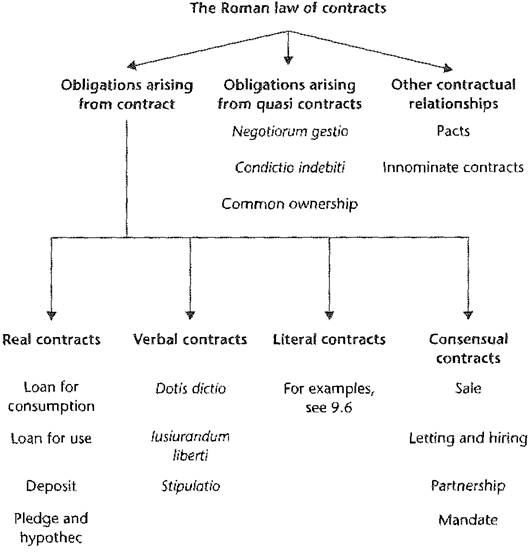
Diagram 9.2 The Roman law of contracts
All contracts in Roman law were either bonae fidei or stricti iuris, depending on whether the formula of the action empowered the index to apply his equitable discretion to the facts of the case (see 9.1.2). Stricti iuris contracts (the older category) arose from the ius civile, while bonae fidei contracts were introduced through the ius honorarium (see Fiori, R. 'Contacts, Commerce and Roman Society', in OHRLS, 581-95, at 4845). The legality of stricti iuris contracts (e.g. stipulatio), unlike bonae fidei contracts, was dictated by strict observance of the outward formalities of the act.
Most stricti iuris contracts imposed a unilateral obligation to perform on one party, whereas bonae fidei contracts generated bilateral obligations for both parties to the contract (e.g. sale). For a good recent overview, see Aubert, J. J., 'Commerce', in Cambridge Companion, 213-45.The Roman law of contracts possessed a number of common features. This should not be taken to imply that the Romans ever developed 'a general principle of contract' as is found in modern civilian systems, The general principle of contract is an invention of the early modern period. Rather, the following section sets out some of the main features (consent etc.) shared by most of the individual contracts in Roman law.
9.2.1 Consensus
Agreement between the parties was essential to the making of any contract in Roman law, though in reality consent played a more prominent role in the 'consensual contracts’ than in other types of contract. There had to be a genuine meeting of minds, a consensus ad idem ('agreement about the same thing') at the moment when the contract was made. If there was an unresolved ambiguity in the language used by the parties, the contract would be void; but a judge would strive to resolve the ambiguity by considering the conduct of the parties and the custom of the region where the contract was made. Ambiguities were interpreted so as to make the transaction as efficacious as possible. As a last resort, a judge could fall back on the rule that ambiguities were construed against the party who could be regarded as having the principal role in the formulation of the particular term in question.
For example:
Paul, Sabinus, book 5: tabeo writes that where a term of the contract is obscure, it should be construed against the vendor who stated it rather than against the purchaser, because the vendor could have declared his will more explicitly before the contract was entered into. (D.18.1.21.)
Even if the agreement was unambiguous, genuine consensus might be lacking because of factors such as mistake, duress, and fraud.
See also Procchi, F., 'Roman Contracts and the Construction of Fault in their Formation', in Obligations in Roman Law, 76-101.9.2.1.1 Mistake
What type of mistake vitiated a contract? The texts present an unclear picture, but generally the Roman judge was less reluctant than his English counterpart to nullify contracts made by mistake (see Putter & Anor v Revenue and Customs [2013] UKSC 26). The common law doctrine of mistake is of rather narrow application (although it has a partner in the rules on misrepresentation). But in Roman law, the requirement of a strict consensus, Putter &Anor v Revenue and Customs, resulted in a wider role for rules on mistake. The following types of mistake were regarded as fatal to a contract:
(a) Mistaken transaction (error in negotio) Where one or both parties were mistaken about the type of transaction intended, e.g. where A intended a sale, but B thought it was a loan.
(b) Mistaken subject matter (error in corpore). Where one or both parties were mistaken over the identity of the thing that was the central object of the contract: Ulpian, Sabinus, book 28·.... if 1 thought that I was buying the Cornelian farm and you that you were selling the Sempronian, the sale is void because we were not agreed upon the thing sold. The same is true if I intended to sell Stichus and you thought that I was selling you Pamphifus, the slave himself not being there... (D.18.1.9pr.)
If the mistake was about the identity of some accessory thing, not central to the contract, the mistake was not operative—the contract was valid.
(c) Mistaken identity (error in persona) Where one or both parties were mistaken about the identity of the other party. But the mistake was only operative in such a case if the identity of the other party was relevant, as in the contract of partnership, for example.
A fourth type of mistake appears to have been recognized, but possibly not until the post-classical period—mistakes about the quality of the subject matter of the contract (error in substantia).
Such a mistake is far less drastic than those considered previously; one can thus understand the reluctance to invalidate contracts on that ground. The position appears to have been that such mistakes were irrelevant as regards stricti iuris contracts, but could invalidate bonae fidei contracts if the mistake was fundamental—e.g. if something that was sold was in a different category from what the buyer supposed:Ulpian, Sabinas, book 28: if, however, I think that I am buying a virgin when she is, in fact, a woman, the sale is valid, there being no mistake over her sex. But if I sell you a woman and you think that you are buying a male slave, the error over sex makes the sale void. (D.18.1.11.1.)
The texts on mistakes about quality are far from clear and may have been the ob ject of some interpolation. They reveal some disagreement among the jurists, as the following passage (attributed to Ulpian) suggests:
Ulpian, Sabinus, book 28: The next question is whether there is a good sale when there is no mistake over the Identity of the thing but there is over its substance: Suppose that vinegar is sold as wine, copper as gold or lead, or something else similar to silver as silver. Marcellus,... writes that there is a sale because there is agreement on the thing despite the mistake over its substance. I would agree in the case of the wine, because the essence is much the same, that is, if the wine has gone sour; if it be not sour wine, however, but was vinegar from the beginning such as brewed vinegar, then it emerges that one thing has been sold as another. But in the other cases, 1 think that there is no sate by reason of the error over the material. (D. 18.1.9.2.)
In this text, Ulpian understandably treats 'the other cases' as error in corpore; but his apparent agreement with Marcellus concerning wine turned sour is puzzling since it denies a role for error in substantia in this case and is thus arguably inconsistent with D.18.1.11.1. (also attributed to Ulpian).
Such textual problems render it difficult to maintain categorical assertions about the role of error in substantia.The effect of an operative mistake, whatever the type, was to render a contract void, but that did not prevent legal action being taken in respect of the contract; e.g. a buyer would have an action for recovery of the price paid, while the seller could recover the thing delivered.
The Roman doctrine of error—particularly error in substantia—has provided a rich vein of law for analysis, adaptation, and application in modern systems. Article 1110 of the French Civil Code (before the 2016 revision) provided that error nullifies a transaction if it affects 'la substance meme'—the very substance of the thing; this has been interpreted, under the influence of Pothier's Traite des obligations, to include error about quality (see now the current Arts. 1132 and 1134). The BGB no longer follows the Roman classification although there is some recognition of error in substantia: rescission is possible for an error as to those characteristics of a person or thing regarded as essential in business (s. 119). The rules on mistake in English law clearly bear considerable similarity to the Roman doctrine of error, even if the process by which it was achieved was different. See particularly, Lawson, F. H., 'Error in Substantia' (1936) 52 LQR, 79-105, and Zimmermann, Obligations, 609 ff.
9.2.1.2 Duress
A contract was regarded as made under duress if a party (or members of his family) had been threatened with 'serious evil' unless he consented to the contract (see further 10.5.2). One might have expected duress to invalidate all contracts, and one can find texts that appear to support that view:
Ulpian, Edict, book 11: Nothing is so contrary to consent, which sustains cases of good faith, as force or duress; it is contrary to good behavior to approve of either of them, (p.50.17,116.)
But the position was not quite so simple: the effect of duress varied according to the type of contract.
If a party made a stricti juris contract under duress, the contract was formally valid in archaic and pre-classical law. However, the aggrieved party would hope that the praetor might prevent the enforcement of such an agreement or that he would giant restitutio. In the late Republic, the exceptio metus ('the defence of duress') was allowed against a party trying to enforce an agreement made under duress. Moreover, an actio metus was allowed to an aggrieved party who had suffered loss as the result of duress (see 10.5.2). As regards bonae fidei contracts, the most plausible view is that duress did not necessarily invalidate them, but that it was certainly a factor to be taken into account by the judge.What if actual physical force was used to compel someone to enter a contract? It seems that there was no consensus at all in such cases—a contract made through force was invalid.
9.2.1.3 Fraud
What constituted fraud?
Ulpian, Edict, book 11:... every kind of cunning, trickery or contrivance practiced in order to cheat, trick or deceive another. (D.4.3.1.2.)
Fraud was similar in legal effect to duress. A party induced by fraud to enter a stricti iuris contract had no defence or remedy as of right until the introduction of the exceptio doli and actio dolt in the late Republic (see 10.5.3). Thereafter, the exceptio doli provided a defence if specifically pleaded in the formula. The introduction of this defence brought about a considerable extension of the judge's equitable discretion, even in stricti iuris actions. It did not have to be pleaded in actions arising out of bonae fidei contracts since the formula would contain the appropriate good faith clause: thus the judge would be automatically directed in such cases to take good faith into account. Generally, if fraud induced a mistake of the sort that invalidated a contract, the ground of failure was regarded as mistake rather than fraud.
9.2.2 Causa
Not all agreements amounted to contracts, only those that were actionable at law. What made an agreement actionable? It was the existence of some ground, reason or 'cause' (causa) for enforcing the agreement:
Ulpian, Edict, book 4: But, when no ground exists, it is settled that no obligation arises from the agreement.... (D.2.14.7.4.)
If causa was the reason why an agreement was actionable, what determined whether it was present in certain types of agreement, i.e. contracts, but not in others? In some contracts, the answer was obvious—it was the form of the agreement that constituted the causa, e.g. the written entry in the contract Utteris (see 9.6.1). In the contracts re, (e.g. loan, deposit) the causa consisted of the delivery of the thing. But what of the consensual contracts, such as sale, where mere agreement sufficed to create the contract? Where was the causa there? It seems that the answer has to be sought outside the contract itself—in the socio-economic conditions of Rome. The period when the consensual contracts became fully established was the third century BC, the time when Rome was beginning to develop into a formidable economic power. These contracts developed partly because of the needs of commerce. So, it seems that the causa in these contracts lay in the commercial necessity for recognizing such agreements as actionable. However, it is difficult to generalize about causa because its meaning was not fixed but differed according to the context. For example, causa could also mean the motive for a transaction, or could signify the interdependence of promises. Indeed, it is possible that causa (in whatever form) was not essential to every Roman contract, and that medieval scholars exaggerated its importance. Zimmermann holds that the origins of the doctrine of causa lay in medieval law, influenced by the scholastic doctrine of causation whereby every effect was regarded as resulting from its cause. He considers that texts such as D.2.14.7.4. do not purport to be of general application: Obligations, 549 ff.
Causa is regarded as an essential element of contracts in some modern continental systems. For example, Article 1131 of the French Civil Code (before the 2016 revision) provided that an obligation ‘sans cause' cannot have any effect (however, the cause need not be expressed: Article 1132 prior to 2016) (see now Arts. 1162, 1169). in German law, on the other hand, causa is not required. In those systems where causa is regarded as essential, it occupies a place similar to that of the requirement of consideration in English law—a unifying factor in the law of contract. Indeed, Zimmermann identifies causa with consideration: ‘the requirement of causa became part and parcel of the English common law and survives, to this day, in the form of the doctrine of consideration' (Obligations, 554). While this can be justified as a broad generalization, the total identification of causa with consideration should be resisted. The traditional requirement of a reciprocal exchange of benefit and detriment in consideration marks it out as different from causa in at least that important respect.
9.2.3 Capacity
A contract was not valid unless the parties had capacity to make it. The rules on capacity have already been considered in relation to the law of persons (see Chs. 4 and 5).
9.2.4 Illegality and immorality
Ulpian, Sabinus, book 42: We generally recognize that immoral stipulations have no validity, IPomponius, Sabinus, book 22] [27pr.J: for instance, if a man promises to commit murder or sacrilege. Indeed, it is part of the praetor's duty to refuse an action on obligations of this kind. (D,45.1.26-27pr.)
As a general rule—at least in the Empire—an agreement to perform an illegal or immoral act was a nullity. The question of illegality could easily be tested by reference to the enactment alleged to have been breached. In the Republic, legislation was regularly passed which did not necessarily invalidate transactions made in breach of the statutory provisions, e.g. the lex Cincia on gifts (see 7.3.1). But in the early Empire, it became the invariable practice for statutes to impose the sanction of invalidity.
Whether transactions were immoral (contra boms mores) would be determined by reference to contemporary standards of morality, as determined by censors, praetors, and, later, Emperors. It is debatable whether religious or philosophical doctrines ever influenced this concept of good morals. In general, the Romans had a clear sense of right and wrong throughout their history, and one that in some respects changed little (on immorality and illegality generally, see Zimmermann, Obligations, 697 ff.).
9.2.5 Impossibility
Celsus, Digest, book 8: There is no obligation to do anything which is impossible. (D.50.17.185.) So runs one of the very last excerpts in the Digest. It is deceptively simple. A distinction has to be drawn at the outset between initial and supervening impossibility.
9.2.5.1 Initial impossibility
This occurred if the agreement was already impossible to perform at the time when it was made. Such an agreement was regarded as void. The test of impossibility was objective, as in the case of testamentary conditions (see 8.4.3.31—was the performance of the agreement impossible in the nature of things for anyone, not just for the party involved? Impossibility did not have to be physical—legal impossibility, e.g. agreements to convey things that could not be legally conveyed, sufficed to invalidate contracts;
Modestinus, Encyclopaedia, book 5: A freeman cannot be the subject of a stipulation, because it cannot be alleged that he should be conveyed, nor can his value be paid over, any more than if one were to stipulate for a dead man or for enemy land. (D.45.1.103.)
9.2.5.2 Supervening impossibility
This arose when the performance of a contract became impossible on account of events occurring after it was made. The general rule in Roman law was that the contract was valid but that it could not be enforced against a party, provided that he was not to blame for the occurrence of the frustrating event, and that he was not in mora ('in delay'). Mora signified a party's failure to satisfy his obligations properly under the contract, e.g. unjustifiable delay by the buyer in accepting delivery of purchased goods. Similar rules are commonly found in modern systems. For example, s. 275 BGB provides that a party is relieved from his obligation to perform if performance becomes impossible because of circumstances—for which he is not responsible—occurring after the creation of the obligation. The development of the common law doctrine of frustration was partly influenced by the Roman rules.
9.2.6 Privity
To what extent could a contract confer benefits or impose duties on someone who was not a party to the contract?
Paul, Edict, book 72: A contract is made between stipulator and promisor. So one promising for something to be given or done on behalf of another does not bind him; for each must promise for himself. (D.45.1.83pr.)
The Roman rule was clear: a contract could be enforced by or against the parties to a contract, and not by or against third parties. This was primarily due to the form of the stipulatio, probably the most widely used contract in archaic and pre-classical law. It consisted of a unilateral promise made by one party in response to a question put by the other in each other's presence: 'Privity is built into the form' (Weir (1992) 66 Tulane LR, 1615 cited earlier, at 1620). The rule was strictly applied, much more so than in modern English law (in which the number of exceptions has all but eroded the rule). There may have been some exceptions in later Roman law, but the texts are inconclusive. It seems, for example, that a promise to benefit or bind the heirs of the parties was enforceable by or against those heirs, a rule introduced by Justinian. Given the Roman concept of universal succession, Justinian's rule scarcely amounted to an exception. The strict Roman rule on privity is generally not followed in modern continental systems.
Were promises that benefited or bound third parties enforceable between the contracting parties themselves? If A promised B that C would do something for B, we know from the general rule of privity that C was not bound by A's promise. But was A liable if C failed to perform? He was not, it seems, unless he had agreed to pay a penal ty in the event of C's non-performance. What if A made a promise to B to do something for C? Could B enforce the promise? Again, no, unless B had an 'interest' in its performance, e.g. where A had promised B to pay C a debt owed by B to C.
9.2.7 Modalities
One final general feature of the Roman law of contract is the so-called modalities in a contract, especially dies and condiciones. These were ways in which a performance could be delayed (suspensive condition) or undone (resolutive condition) by making it subject to the occurrence of an uncertain future event. Initially, Roman law only knew the suspensive condition, but other types developed in classical and Justinianic Roman law, see Buckland, Textbook, 422-6.
9.3
More on the topic Common features of Roman contracts:
- Obligations: Common Principles and Obligations Arising from Contracts
- ROMAN CONTRACTS
- Consensual contracts (contractus consensu) were contracts constituted by the mere agreement (consensus) of the parties.
- 4. Periculum Emptoris (a) Consensual Contracts of Sale in Roman Law
- Basic features of classical societas
- Verbal contracts (contractus verbis)were contracts that were created by the use of certain formal words (verbis solemnibus).
- I. MAIN FEATURES OF THE LAW
- Some Ancillary Features
- Features of a Well-adapted Law of Real Security
- 4. Common mistake
- II. P.Yadin 18: Shelamzion' Document: Jewish vs. Hellenistic? Structure and most important features of P.Yadin 18
- 3. Common elements
- Common error in nomine
- THE RETREAT OF THE COMMON HERITAGE OF MANKIND
- I. P.Yadin 10: Babatha’s Document: A Real Ketubba? Structure and most important features of P Yadin 10
- COMMON PRACTICE
- The concept, sketched in the preceding chapter, of the obligatio as being a strictly personal bond between the two parties who had concluded the contract found highly characteristic expression in the fact that Roman law did not recognize contracts in favour of third parties, (direct) agency and the cession of rights.
- Pignus and Fiducia: Common Origin
- Protection of human rights by the common law
- the trust: a common law peculiarity?