Discovery
Mauritius is situated in the southwestern part of the Indian Ocean, roughly 800 kilometres east of Madagascar. Figure 2.1 shows its position to Africa and Asia. With 2,040 square kilometres of mainland, it is further composed of a number of smaller islands,1 as well as claiming Tromelin and more controversially the Chagos ArchipelВago as its territory.2 For ease of expression, as commonly cited, Mauritius is referred to throughout this study in singular form.
Among historians it is generally speculated that Mauritius may have been known to the Phoenicians and visited by Malay and Polynesian sailors, though
1 Agalega Islands, Saint Brandon (Cargados Carajos Shoals) and Rodrigues.
2 The island of Tromelin is administered by France, but claimed simultaneously by Mauritius and the Seychelles. The Chagos Archipelago was retained by Britain when Mauritius achieved independence in 1968 and has held the designation “British Indian Ocean Territory” ever since. Mauritius has persistently claimed sovereignty over the islands, and though this has yet to be recognized, some vindication was obtained in the recent arbitration case of The Republic of Mauritius v. United Kingdom of Great Britain and Northern Ireland, discussed below.
DOI: 10.4324/9781003313366-2
Historical background 31 there is no concrete evidence to sustain that speculation.[99] The first record of the existence of Mauritius has often been derived from Arab sources, namely an early 12th-century map of the Indian Ocean drawn by ancient Arab cartographer Al-Idrisi.[100] A link was established between the map and the 1502 Cantino planiВsphere, which seemingly shows Mauritius with the Arabic name “Dina Arobi”. There has been some dissent to these hypotheses,[101] with the idea of an early Arab discovery refuted quite emphatically in a detailed study of the period.[102] This is further supported by seminal research on sea trade routes of that epoch, which makes no mention of Mauritius.[103] [104] Accordingly, an early discovery by Arabs seems unlikely, and even if it did occur, any later connection appears to have been superВficial and closely followed by Portuguese arrival.
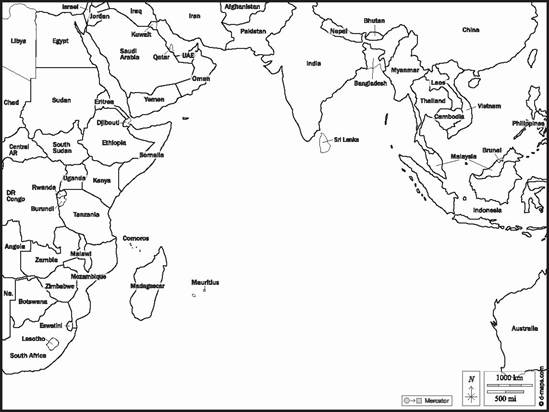
Figure 2.1 Map of the Indian Ocean8
The first concrete date, commonly cited to mark the beginning of the Portuguese period, is 1507. On 20 February of that year, Diego Fernandez Pereira sighted Mauritius, but despite his intention to disembark and explore, he was unable to do so due to a hurricane.[105] Over four years later, on 28 December 1511, Domingos Fernandez arrived, becoming the first European to set foot on the island.[106] During that period, Mauritius was known as “Cirne”,[107] or less commonly “St. Apollonia”.[108] But while Portugal retained the island until 1582, using it as a stopover during their voyages in the Indian Ocean, no permanent settlement was established during these many years.[109] An enduring heritage from the Portuguese period remains in the designation applied to the entire group of islands (comprising Mauritius, Rodrigues and Reunion) as the “Mascarenes”, after Portuguese navigator Pedro Mascarenhas.[110]
2.3
More on the topic Discovery:
- The birth of agriculture and its developments
- 2.2 HISTORY WITHIN INTERNATIONAL LAW
- EXTRA-JUDICIAL ACTS
- INTRODUCTION
- The problem of the second chapter
- CONCLUSIONS
- TABULAE - AN ANCIENT WRITING MATERIAL
- CONTENTS
- The revival of Roman law
- Excursus 3. The controuersiae