Useful Technology: Choosing and Implementing Effective Tools
Ensuring that legal teams have access to the right tools requires understanding the business or lawyer user needs, assessment and planning, selection, investment, implementation and, in some cases, experimentation.
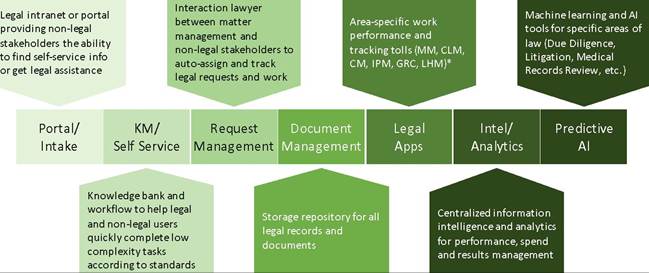
Fig. 9 Key technology elements for legal departments at the time of writing (Source: Elevate)
With the caveat that legal technologies continue to evolve rapidly, the current scope of a legal department’s technology framework typically includes the key elements shown in Fig. 9.
To assess the state of a legal department’s technology, we start with the technology dimension of the Legal Department Maturity Model to identify the opportunities. While we help GCs use a department-wide assessment to build a comprehensive technology “heat map,” we quickly dive into a more detailed technology assessment focused on a specific function or need. For example, if a legal team believes that their contract lifecycle management (CLM) tools need to be updated, they can use this methodology to focus specifically on the selection of a new CLM system:
• Define legal and business outputs or objectives
• Map those objectives to desired technologies, features and workflows
• Explore availability and assess functionality of existing tools, and identify
• Understand actual usage of current tools, barriers to adoption use or other limitations, and identify any training needs to better leverage the current investments
• Perform feature comparison and cost analysis of technology options
Build a business case, project plan and change management plan for new technology purchases, if necessary. Because the world of technology changes quickly, it is important to scan the horizon for new technologies as well as changes to existing tools, including new version releases, mergers and acquisitions of existing products, and, in some cases, “retirement” of existing tools.
Legal departments often rely on outside providers for the implementation of new technologies and training.
This gives the legal department access to additional resources and expertise. However, it is important to have people on the team with experience of having implemented that specific technology previously, and who have a crystal clear view of the process that is being automated or supported. This new breed of lawyers could be thought of as “legal engineers.” Unfortunately, we see too many legal departments buy technology, e.g. matter management or e-billing systems, which are configured by the technology provider’s professional services team without a deep understanding of the company’s unique processes—so even if the technology is great, it doesn’t ever quite do what the legal department needs it to do, leading to frustration and a misplaced future aversion to technology.On the other hand, we also see some innovative legal departments experiment with technology, leading the adoption of new versions of existing products, as well as beta testing new tools and even collaborating to design new tools from scratch. This experimentation has ushered in an explosion of legal technologies such as electronic signatures, technology assisted review (“TAR”), auto-extraction of contract metadata, legal spend analysis, and centralized dashboards. Not surprisingly, legal departments that experiment or lead the use of new technology are in the minority; most prefer to let others work out the bugs first. However, the majority can still benefit by following what their experimentally-inclined peers are doing by listening to what they have to say at industry conferences, in articles and awards focused on innovation, and in groups like the Corporate Legal Operations Consortium (“CLOC”), a knowledge-sharing group. (More about CLOC in the following section and elsewhere in this book.)
5
More on the topic Useful Technology: Choosing and Implementing Effective Tools:
- Useful Technology: Choosing and Implementing Effective Tools
- Technology vs. LPO: Compatible or Opposing Trends?
- How Can Small Companies "Run Legal as a Business”? Legal Tech!
- Big vs. Small Legal Departments or No Legal at All?
- The Next Stage
- Introduction: “Run Legal as a Business!"