Systems and Processes: Working Smarter by Design
Efficient systems and processes directly affect the legal team's ability to meet the needs of the business, and they also have a profound effect on job satisfaction and retention.
To assess and improve systems and processes, the legal sector has started to use Lean, a systematic method for increasing business value by eliminating waste, and legal project management (“LPM”), a growing trend likely to become table stakes within a few years.Originally developed by Toyota, Lean is now widely used throughout the business world as a common standard for improving operations of all sorts, including both products and services. When applied to legal work, Lean does several practical things:
• It fosters continuous improvement by leveraging the experience and talent of the individuals closest to the work.
• It focuses the team's attention on the value provided to—and perceived by— clients and stakeholders for whom matters are handled.
• It encourages the development and use of standards and best practices.
Lean is sometimes confused with Six Sigma, a quality improvement approach that was originally developed by Motorola. Both are valuable in different ways, and in fact can be used in conjunction with each other—referred to as “Lean Six Sigma”—but in the legal sector Lean is more relevant because it is focused on improving the value of the output by eliminating process waste, whereas Six Sigma is focused on reducing defects to improve quality.
Lean provides a collection of practical tools and techniques, including defining a problem, mapping the relevant processes, conducting root cause analysis, identifying and implementing solutions, and monitoring corrective actions. These techniques allow the removal of waste and inefficiency in legal work that can take the form of waiting/delays, work that is out of scope, re-work, or “overlawyering” work.
Using Lean techniques, we have helped NetApp implement systemic improvements in many areas of their legal department. One such was a new approach to client NDAs, which enabled the sales team to engage new clients more quickly, improved compliance, and reduced burden on the lawyers. Process Mapping (a Lean technique, but certainly not exclusive to the Lean approach) revealed a confusing, inefficient “As Is” process that was inherently slow, with too many hand-offs and unclear roles and responsibilities. A Lean question-asking technique called “The Five Whys” identified non-value added steps (waste) in the process. “The Fishbone Analysis” technique identified the resource and technology constraints. Using insights from these Lean techniques, we worked with the lawyers, legal ops team and sales team to simplify and automate a redesigned process whereby NDAs with no client changes—roughly 85 % of the total—can be processed on a self-serve basis using automated e-signature technology. Thus the majority of NDAs that previously took days can now be processed in minutes. The remaining 15 % of NDAs that require some legal review of client comments are routed to an Elevate legal team for review against a playbook. Less than a third of that 15 % segment actually require commercial negotiation and are escalated to the NetApp legal team. After implementing the new process, average time to NDA execution was reduced from five days to less than one hour, and the NetApp lawyer email noise was radically reduced—much to the lawyers' delight—as the new process allows them to focus on fewer than 200 NDAs per annum, compared to 4100 NDAs previously. (See Fig. 7.)
While not all examples of Lean process improvement are as dramatic as this one, substantial incremental improvements are made possible in many areas by tapping the expertise of individuals closest to the work. In addition to the improvements themselves, the Lean approach helps legal team members co-create and co-own the solution, increasing both buy-in and morale.
Improving systems and processes helps legal departments make optimal use of their people. While there are many valid approaches to improving systems and processes, we've seen the Lean approach prove to be effective in legal.
Law departments are increasingly bringing another common business discipline to the toolkit: project management. As with non-legal corporate functions, project management eliminates surprises; improving predictability of timelines, deliverables and budgets. Sophisticated legal departments now expect their law firms and other legal service providers to provide some form of legal project
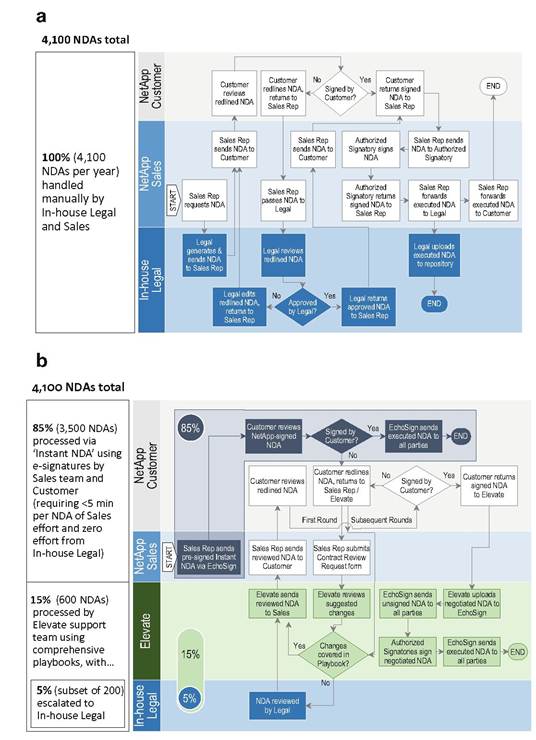
Fig. 7 System and process improvement facilitated by Lean for Legal (Source: NetApp and Elevate). (a) Before system and process redesign. (b) After system and process redesign
management (LPM), on both hourly and non-hourly fee engagements. More importantly, legal departments expect to benefit from the efficiencies and savings generated from LPM best practices.
They recognize that managing their matters more effectively requires thoughtful consideration of scope and assumptions at the outset, followed by planning and staffing the matter based on those factors, and subsequently revisiting the plan on a regular and frequent basis throughout the lifecycle of each matter. Based on our experience designing and implementing LPM frameworks—see Fig. 8 for an example—as well as providing enabling software for LPM, we expect the LPM trend to become table stakes in the legal market for both law firms and law departments within the next 3-5 years.
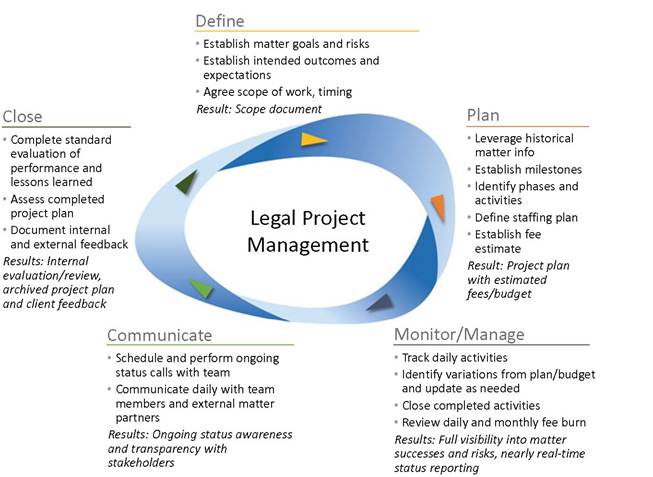
Fig. 8 Example legal project management framework (Source: Elevate)
The rise of LPM has also enabled more active and real-time collaboration on matters. Historically, lawyers in-house often had to wait until they received a monthly fee invoice to understand in detail how the law firm was spending its time and interpret what progress had been made in the previous month. That scenario was prone to surprises, often resulting in damaged trust and reactive discussions about fees and discounts as the corporate legal department sought to manage its budget. Today, a growing number of technologies enable easy, frequent monitoring of matter progress, hours spent and budgets to actuals, helping in-house teams and outside counsel stay in sync and course correct when needed, before things get out of hand.
Legal departments have begun to use sophisticated but practical approaches to working more effectively, both internally and externally with outside counsel and other providers. By embracing principles found in Lean and LPM, legal leaders are improving systems and processes, leading to better efficiency, outcomes, working relationships and job satisfaction, thus driving better business.
4