Big vs. Small Legal Departments or No Legal at All?
Challenges, risks and opportunities for the legal function are usually described for large legal departments. However, there are fundamental differences between legal departments in large corporations and legal departments in small and mid-sized enterprises.
These differences will be outlined in the following. For the purpose of this article, small legal departments are considered to be legal departments with 1-5 inhouse legal counsel.The first major difference between large and small companies is the budget available to small legal departments. Usually, budgets for small legal departments are significantly lower than for large legal departments, when looking at them in absolute terms. This does not only limit the number of inhouse lawyers that can be hired. It also affects spending on external counsel, both in the overall volume of work that can be given to external counsel and the choice of external counsel. Small legal departments are more likely to hire smaller or mid-sized firms with lower hourly rates than big law firms. Start-ups with sufficient funding in hyper-growth mode or situations when bet-the-company decisions have to be taken may be an exception. This makes it more demanding for GCs of smaller legal departments to find the right external counsel and agree on rates with them. While it is safe to say that clients, when hiring a big law firm, more often than not receive adequate quality in the legal advice for their money, this relatively safe bet becomes less likely the smaller the firm and the cheaper the rates are. Of course there are many mid-sized and small law firms in the market which provide the same or even better quality as big law firms. However, it does require more knowledge of the market and experience to find these firms. This results in a higher need for effectively managing external counsel to control the costs, a task which collides with the headcount and time limitations that small legal departments face.
A second difference between large and small companies is the degree of specialization of lawyers in small legal departments. Generally, the bigger a legal department, the higher this specialization tends to be. A bigger legal department is able to employ and also required to have a number of specialists for different fields of law, e.g. for employment law, corporate law, commercial law. In smaller legal departments, because of their limited size, inhouse lawyers tend to be generalists. This has the advantage that each member of the legal team can take on every matter that comes in, and work can be distributed efficiently between the inhouse lawyers. The disadvantage is, however, that special topics will have to be given to external experts, unless it is decided not to review a specific question in depth.
This relates to the next difference: the degree of risk-taking. Generally, smaller legal departments tend to have a higher tolerance of taking risks. This usually reflects the management style and personality of smaller companies which is often more entrepreneurial. It may also be the result of a high workload paired with a limited budget and headcount. While such higher risk tolerance is probably true for many smaller entrepreneurial and startup companies, it may not always be the case for established small family businesses (research shows that family firms are taking risk to a lesser extent than non-family firms, Zahra (2005)).
For small legal departments, communication is not only important in order to know what attitude management has towards risk-taking. The need to constantly communicate with other departments of the company may be even more important for members of small legal departments than for members of bigger legal departments. That is because small legal departments—as opposed to large legal departments—usually do not have a formalized process for alignment with other departments. Through communication, members of small legal departments can therefore detect legal issues early and prevent non-compliance instead of only reacting to legal problems after they are discovered.
By communicating with other corporate functions as business partners, legal departments of all sizes can actively shape the direction of the business, for example by providing options, by communicating legal problems early and by making sure all stakeholders are involved.Finally, there is a difference in the use of tools and processes. Due to budget restrictions, smaller legal departments are often not able to develop own IT systems like large legal departments can. Usually they are also not able to purchase powerful but expensive Enterprise Legal Management (ELM) software suites that may support them in their operations. Management may also not be willing to purchase solutions that require substantial implementation efforts. On the other hand, especially small legal departments need effective tools to manage their affairs and compensate for their limited budgets and headcount.
When discussing the functioning and operations of legal departments, irrespective of size, we usually only cover a part of all businesses because the majority of businesses do not have an inhouse legal function at all. While there are no detailed numbers on the percentage of companies with legal functions, it can be assumed that SMEs usually do not have an inhouse legal function if they have less than 250 employees, because of the relative high cost of inhouse counsel.
How many businesses belong to that category? The answer is, the absolute majority of all businesses: SMEs in the EU employ a total of about 88.8 million employees, this represents 99.8 % of all active enterprises in the EU. The following data shows how the 21.57 million SMEs in Europe can be structured (Figs. 1, 2 and 3).
In the United States in 2011, 99.7 % of the 5,68 million employer firms had less than 500 workers (which is the threshold for the SME definition in the US) and
89.8 % of these firms had less than 20 workers (US Census Bureau, http://www. census.gov/econ/susb/). When adding the nonemployer firms—22.7 million in
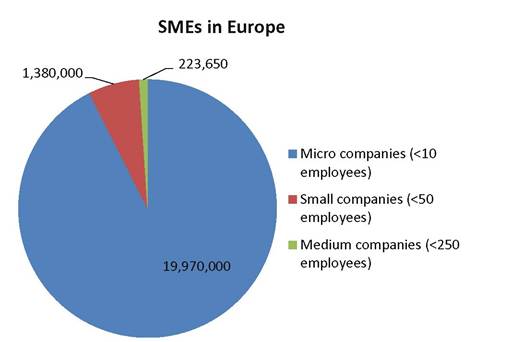
Fig.
1 SMEs in Europe. Annual report on European SMEs 2013/2014, July 2014, EuropeanCommission, http://www.ifm-bonn.org/fileadmin/data/redaktion/statistik/unternehmensbestand/ dokumente/KMU-D_2009-2013_EU-Def.pdf, Accessed July 2016
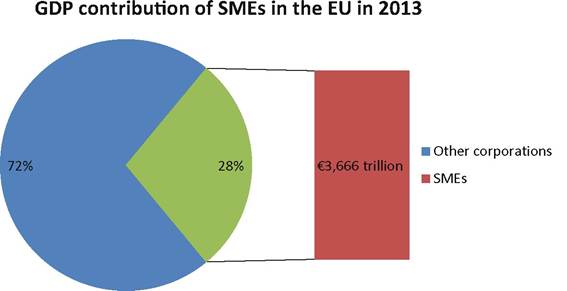
Fig. 2 GDP contribution of SMEs in the EU in 2013. Annual report on European SMEs 2013/ 2014, July 2014, European Commission, http://www.ifm-bonn.org/fileadmin/data/redaktion/ statistik/unternehmensbestand/dokumente/KMU-D_2009-2013_EU-Def.pdf, Accessed July 2016
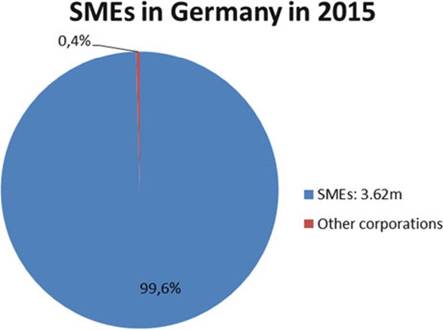
Fig. 3 SMEs in Germany in 2015. Statistisches Bundesamt: Sonderauswertung des Unternehmensregisters 2009 bis 2013 im Auftrag des IfM Bonn, Wiesbaden, 2015; Berechnungen des IfM Bonn, http://www.ifm-bonn.org/statistiken/mittelstand-im-ueberblick/#accordion=0& tab=1, Accessed July 2016
2012—, the share of U.S. businesses with less than 500 workers increases to 99.9 %, and the share of firms with less than 20 workers increases to 98 %. It can be assumed that at least the latter group of firms does not have an inhouse legal function due to its size.
Businesses without any inhouse legal function have additional challenges when dealing with legal issues. Especially the use of service providers, in the form of external counsel or legal software, is substantially different for them as opposed to SMEs with a legal department. In inhouse legal functions, the point of contact for external counsel or providers of legal technology are the inhouse counsel: they are lawyers themselves and can communicate on a level playing field. If non-lawyers communicate with external counsel or use legal technology, however, there is usually an information asymmetry which has to be taken into account. Examples of such information asymmetry include fact finding, the advice itself, the language which is used, the software interface or the invoicing and how it is communicated. Also, there is usually no dedicated budget for legal issues and no continuous dealing with legal topics. Instead, legal topics are handled when they arise and once they become pressing. This often affects the administration and management of legal documents. It is not uncommon that the legal documentation in small companies is not well organized and may even be non-compliant. Because of the only ad-hoc involvement of external counsel, legal issues are often not identified early but may become critical due to late targeting. This leads to more costs for legal advice than initially estimated.
4