The Conquest of Italy
our findings in part i raise a number of questions central to any examination of the importance of lawmaking assemblies in Roman history. How do we explain the persistence of such events over the most unsettled centuries of growth in Roman history? What role did public lawmaking assemblies play in making this expansion possible? How did ever increasing numbers of new members throughout the expanding Roman state come to share the deep understanding of Roman social order, civic structures, and political culture required to engage in lawmaking assemblies? Any comprehensive effort to identify the considerations that underlay this achievement must await the completion of a detailed history of the entire Roman experience from the widest possible range of scholarly perspectives.
Nevertheless a start must be made.In this chapter I explore the extent to which the absorption of Italian peoples was to a large degree the result of Roman settlers doing things in the usual way in a physical environment that had over time produced a level of common behavior among all inhabitants of Italy. The Roman perception of the degree to which outsiders shared these values played an important role in decisions to draw some peoples, perhaps most, into an ever expanding political unit and to annihilate others. Of the utmost importance in the absorption of outsiders, also, was the Roman genius for adapting customary ways to the exigencies of expansion and growth, which permeated down through society at all levels: it was a
rare issue, as we shall see, that Romans could not resolve without resort to customary Roman ways. And one of the most obvious examples of the Roman potential for adjusting to the most complicated demands of absorbing outsiders can be seen in their eventual resort to public lawmaking assemblies to develop and legitimize a solution to an otherwise intractable problem.
In their resort to such an all-encompassing and complicated public airing and resolution of otherwise intractable issues the Romans differed significantly from other Mediterranean peoples or indeed probably peoples anywhere in the world at the time. To understand an accomplishment of this magnitude we must go back to the beginnings of Roman settlement and expansion.ENVIRONMENT AND MOBILITY
Over three centuries before the Italian War, on the eve of the Roman expansion in the fourth century, Italy was to all appearances an impressively diverse place.1 In the north, in the area later called Cisalpine Gaul, Gauls made up most of the population, relative newcomers to Italy since 500, when tribal groups of Celts crossed the Alps to settle in the Alpine foothills and the lowlands of the Po River basin (MAP i).2 In the north also were the Veneti, at the head of the Po River, and Ligurians, along the narrow Tyrrhenian coast and inland in the valleys and mountains of the northwestern Apennine range below the Po River basin. These represented the most southerly tier of Ligurians, who inhabited an area of Europe stretching from Italy to the Pyrenees, and were divided in Italy among two chief tribal groups speaking a common, non-Italic language.3 Peninsular Italy south of the Po River basin, including the lowlands along the Tyrrhenian and Adriatic coasts and the central and south-central Apennine region, held the four largest language groups on the peninsula. Etruscans occupied the region called Etruria, lying along the central Tyrrhenian coast and inland. Adjacent were Umbrian speakers, centered primarily on the region called Umbria (Umbri) but also farther south in the Apennines bordering Etruria and Latium (Sabini, Hernici, Volsci, Aequi) and in the central Apennines (Marsi). Latins occupied southern Etruria and Latium, spreading also into the foothills of the central Apennines. The Romans in their city on the Tiber River were a smaller group within the larger body of Latins.
The culturally and linguistically diverse Oscan-speaking peoples of central and southern Italy lived in the mountain valleys, plateaus, and mountainous ridges of the Apennines (Marrucini, Vestini, Paeligni, Frentani, Pentrian Samnites); to the north in a part of the region called Picenum (Picentes, Praetutti); in the plain of Campania (Aurunci, Sidicini, Samnites); and across the wooded plains
Map i. Italy's Peoples, ca. 400
and mountains of the south (Samnites, Lucani, Bruttii).4 Along the southern coast were Italiote Greeks, whose ancestors had come as colonists in previous centuries and who lived among Oscan-speaking Italians and other peoples. The latter included the Iapyges and Messapians of southeastern Italy (in Apulia and Calabria), whose linguistic and cultural affinities lay outside Italy, in the Balkans. Nonetheless, by 91 the great majority of Italians had been absorbed into the Roman system to the point where they were prepared to die in war to claim full inclusion in the Roman state.
The development of the shared universe of common beliefs that underlay the emergence of a pan-Italian Roman state can be traced to the impact of the physical environment on organized human communities, from the first recorded settlements throughout Italy, as geography forced a common response to their surroundings by the different groups of settlers. The main features of this environment consisted of the Apennine mountain range with its high plateaus, river valleys, and ridges covering much of the peninsula south of the Po River and the lowlands along either coast.5 No more than narrow ribbons along some stretches, these lowlands also included four major plains: the Po River valley in the northeast, lying between the Alps and the Apennines and following the course of the river to the Adriatic Sea; the plain of Latium along the central Tyrrhenian coast; the plain of Campania, farther south along the same coast; and the plains of Apulia and Calabria along the Adriatic Sea in southeastern Italy.
The Apennines rimmed by coastal lowlands, sometimes widening into plains that with river valleys penetrated the foothills and high ridges of the mountains, were a dominating presence for the inhabitants of Italy. Above all, the Apennines and the lowlands, neither sufficient in themselves to allow for maximum effective exploitation of the land, as we shall see, created a reciprocal relationship between the permanent inhabitants of mountain and plain that had a profound impact on the development of communities and states.6Notwithstanding sharp regional variations in cultural, political, and economic structures, once population levels required the maximum exploitation of land resources—at different times in different places—the diverse Italian peoples came to share a common adjustment to their geographical placement. Climatic and geographic conditions throughout Italy encouraged the movement of herds, or transhumance, the seasonal migration of animals from one set of pasture lands to another. Lowlands, limited to narrow coastal strips including the three main plains and river valleys in mountainous areas, were too dry in the summer to provide adequate fodder; sheep in particular were susceptible to the arid conditions of summer in the lowlands. Conversely, highlands were snow covered in winter. Consequently it was impossible to sustain herds in permanent pastures in a mountain or lowland location, especially if animals were herded in any number. Producing fodder even for a few plow animals put an almost impossible strain on lowland farmers in the first century.7 Transhumance therefore was both critical and widespread, from the very beginnings of animal rearing during the Neolithic. Throughout Italy goats, sheep, or cattle were herded between summer pastures in the Alpine foothills or the Apennines from late spring to early autumn and winter pastures in the lowland river valleys and coastal areas, from autumn to spring.8 This age-old migration of Italians had created patterns of subsistence farming and herding, characterized by the seasonal movement of animals, long before the fourth century, after the apparently haphazard advent of agriculture that occurred initially in the fourth millennium in the lowlands east of the Apennines and next in the lowlands on the west coast.9 These patterns intensified when population levels increased in the seventh and sixth centuries, a phenomenon linked to agricultural and other changes introduced by Greek settlers.10
Accordingly, on the eve of Roman expansion, transhumance had become a way of life to one degree or another for most Italian peoples, whether lowland or plain dwellers, such as most Etruscans, Latins, Campanians or Apulians, or mountain dwellers, such as Ligurians and Gauls in the north and the Oscan- speaking peoples of central and south Italy.
But the level of engagement in seasonal migrations with herds varied somewhat from one Italian group to another. The peoples whose permanent settlements were in the mountain and lowland areas of central and southern Italy—the Paeligni, Marsi, Marrucini, and Vestini (collectively called the Abruzzi peoples after the modern name for the region) and the Samnites, Sidicini, and Lucanians—were especially dependent on transhumance for survival. Limited amounts of arable land in their regions of the Apennines, confined to narrow strips of arable land along the edges of valleys between the heavy soils of the valley bottoms, too heavy to plow, and the scant dirt of mountain ridges, made the Apennine peoples dependent on the lowlands both for winter pasture and for arable land. Far more secure than these mountain dwellers were the permanent inhabitants of arable plains along the coast, the site of the winter pastures. Nonetheless, transhumance was as much a part of life to the urbanizing populations of the plains, including the plain of Latium, as it was to the Apennine tribesmen.11 In all these regions herding continued and with it the need for moving herds between seasonal pastures. The early importance of transhumance endured, unobstructed albeit transformed, as we shall see, by the extension of Roman dominion across Italy.12 The ubiquitous shrines to Hercules, patron of herders, found along the cattle trails of Italy, are also found in the city of Rome.13 As late as 1961-62, the archeologist R. Ross Holloway reports sighting “the huts of shepherds from the mountains of the Abruzzi, who were wintering with their flocks in the Roman Campagna,” alongside the airport of Guidona east of Rome.14Thus, the distinctive regions and peoples of Italy were drawn by geography into a common world requiring the reciprocal seasonal movement of flocks of sheep, goats, or cattle. From the Alpine foothills in north Italy, Celtic herders moved cattle, sheep, and goats between winter pastures in the Po River valley lowland and summer pastures in the foothills of the Alps or higher still.
On the south side of the Po River, their herds traveled between winter pastures in the valley and summer pastures in the Apennines. The Ligurians moved herds between summer pastures in the mountains, where their permanent settlements were located, and winter pastures in the lowland coastal areas and river valleys.15 The movement of herds in central and southern Italy was similarly pervasive and widespread, covering the entire region with a network of trails, some of them in continual use from the late Neolithic to the mid-twentieth century CE.16 Herds were moved short distances at times, especially in the Alpine foothills and in the Apennines, where herds were often moved from river valley bottoms to pastures higher up. The rapid movements of Hannibal’s army from the Po River valley to Apulia, via southern Etruria, Umbria, Picenum, and the central Adriatic coast, in 218, along with the high visibility of cattle among his portable booty, attest to the ubiquitous presence of livestock trails along his route.17 It was still possible to traverse all central and southern Italy on livestock trails in the first century, when transhumance continued to be widespread.18 When Varro relates a story in his handbook on farming, written around 37, about the fidelity and perseverance of sheep dogs and involving a flock of sheep newly purchased in lower Umbria whose owner had it moved to Metapontum, many rough kilometers away in Bruttium, he incidentally records the existence of trails in his day that made such long-distance movement possible. Two centuries before, the distances covered were often equally impressive.19Not surprisingly, transhumance required interaction and cooperation between the various Italian peoples along the routes. Over centuries, the interdependence and interaction of lowland and mountainous areas were firmly established. The common practice of transhumant herding within and between the discrete regions of Italy saw the emergence of similar agricultural and social systems involving the primarily farming populations and the seasonally transhumant herders with permanent settlements in the highlands.20 Interaction between the more settled farmers—the first to adapt the more sophisticated agricultural techniques and newer crops brought by outsiders—and the transhumant herders occurred on a great many levels: the daily exchange of agricultural or animal
products and the exchange of information and ideas. Trade followed the same routes. Later, the introduction of mixed crop cultivation did not substantially diminish or alter seasonal movement of herds: Herding continued and with it transhumance. The importance of pasture land to the settled populations of the plain of Latium is evident in a range of details: the Roman tradition of Rome's foundation by Romulus, who assembled a population from Latin shepherds; the shrines or temples to Hercules in Rome; the continued existence of livestock trails, noted later in the chapter; and the wars fought between Romans and Samnites, two Italian groups experiencing particularly rapid population growth, for control of arable and pasture lands between 350 and 260.21 Over the same period, as communities expanded, the reciprocal interdependence between lowland and mountain dweller became more established and traditional patterns of migration intensified. Long before the Romans expanded across Italy a complicated network of trails and roads facilitated the movement of peoples and the interaction between them to a degree that astonishes the modern observer.
URBAN AND TRIBAL ITALY
(See MAP 2 for towns and sites referenced in this section.) On the eve of Roman expansion, Italy remained a diverse place whose peoples differed with respect to tribal or urban base, oligarchic or monarchic leadership, and subsistence agriculture or market economy.22 Especially sharp differences in social, political, and economic organization distinguished the urban Etruscans, Latins, and Campanians in particular from the tribal Italians dwelling in the central and southern Apennines, as well as the Ligurians and the migratory Celts. As we shall see, the Romans made a profound impact on and a very selective adjustment to the patterns of life found among both tribal and urban peoples. While archaeologists and historians still have a long way to go in fully uncovering the complexity of these patterns, a review of findings to date is essential to understanding the social and political organization of conquered lands and the reasons for the Romans' success in absorbing them.23 I begin in this section by sketching in broad outline the basic urban and tribal patterns found in Italy before moving to examine patterns of Roman conquest. Of particular interest is the ongoing adaptation to urban culture by one or another Italian tribal group, often in the process of expanding its territorial reach into the plain. Chief among these were the Hernici, Aequi, and Volsci along the edges of the plain of Latium and northern Campania; the Samnites, who had moved into Campania; and the Lucani, who dominated south Italy in the fourth century.24

Map 2. Select Towns and Sites in Italy, ca. 400
Patterns of life for the urban peoples of Italy were set before the fourth century. Over the centuries following the beginnings of Greek migration to Italy, roughly 800, Etruscans, Latins, and Campanians adapted and developed the urban culture of the Italiote Greeks.25 Among these coastal and lowland communities, the arrival of revolutionary ideas about markets and farming, borne by Greek traders and settlers who began to arrive in critical numbers in the eighth century, had promoted profound social and cultural changes, which were accompanied by significant agricultural changes in Italy. Mixed crop cultivation of olives, vines, and wheat was introduced, crops that, prior to the arrival of the Greeks, were seldom cultivated because of the labor investment required. The success of these crops depended on regional markets, found in towns whose proliferation in Italy was spurred by the arrival of the Greeks as well. The combination of vines, olives, and cereals grown for profit and regional markets in cities and towns came to be a dominant feature of Etruria, Latium, and Campania. Markets and mixed crop cultivation were found also in other areas with a strong Greek presence or contacts: in particular Apulia on the Adriatic. The inhabitants of these regions develop other characteristic economic, social, and political structures toward the end of the seventh century. As among the Greeks, life among the Etruscans, Latins, and Campanians centered on urban centers—often walled, beginning in the sixth century, in response to new military techniques—which controlled a surrounding hinterland. These centers provided a marketing node for the agricultural products of the immediate region, as well as for items of longer distance trade. Urban centers also formed the focus of religious and civic life, which unfolded in the public areas and sacred buildings beginning to adorn the city in the last decades of the seventh century.26
The impact of this transformation was evident in Rome in a pattern of urbanization perhaps spurred by the more sophisticated Etruscans.27 The earliest attested stone walls are sometimes dated to the first half of the sixth century, the initial draining and paving of the Forum to the end of the seventh and beginning of the sixth century, and likewise the construction of the original meeting place (Comitium) and Senate House (Curia).28 But in Rome and elsewhere, other characteristic social and political structures emerged long before.29 The first appearance of the hierarchic family structure typical of the Roman aristocracy in later centuries—clans, or gentes, in the Roman context—is linked to wider social changes throughout Etruria and Latium in the eighth century.30 These include the family ownership of land—that is, private ownership as distinct from tribal use of the land—encouraged by the increased agricultural productivity of the land and providing in turn an impetus to the stabilization of the community and the stratification of families in the community. Private landholding is associated with both the emergence of extended family groups as well as relations of dependency between large landholders and people restricted to marginal landholdings.31 The system of clientage that many scholars believe characterizes Roman social relations throughout the Republic is thought to have its origins in such developments, occurring among the Latins, Etruscans, and Campanians.32
By the mid-fourth century, towns and cities had been established for over three centuries along the coasts of southern Italy and in the lowland areas of Italy west of the Apennines: Latium, Etruria, and Campania. In each of them the everyday lives of their inhabitants were geared to the rhythms of the urbanrural environment—the seasonal demands of farm and flock meshed with the civic and religious activities happening in the public and sacred areas of the city. In most, political life was firmly directed by elite families with the equally firm commitment by ordinary citizens. In Rome, for example, the operation of a complicated tripartite political system—assemblies of male citizens, Senate members, and elected officeholders drawn from the same pool as the senators— was fueled by sensibilities attuned to the hierarchic family structure of Rome, whose great clans possessed wealth and status and claimed high office. Although the territorial limits of each city generally determined the boundaries of attachment for the citizens, among cities whose inhabitants belonged to the same language group, such as Latin, Etruscan, or Campanian, individual horizons were broader. A recognized feature of west-central Italy was its “openness to intra- and inter-regional contacts.”33 Elite families in particular formed social and economic links with elite families in other cities. These attachments sometimes transcended cultural affinity as witnessed in the well-known marriage links between elite Romans and Campanians in the third century.34 Interaction on this level between elite Latin and Etruscan families is attested as early as the seventh century.35
Similarly, while the cities of any one cultural and language group were largely independent from each other with regard to formal political linkages, they found shared venues for interaction. Common sanctuaries were a feature of life in central Italy by the sixth century. Some sanctuaries invited commercial interaction with foreign groups, including Phoenicians, Carthaginians, and Greeks.36 Furthermore, cities often formed leagues for defensive and religious purposes. The Etruscan cities, all independent, were joined in a federation. The Latin cities formed the Latin League for several purposes, among them the celebration once a year of the Latin Jupiter (Jupiter Latiaris), chief god of the Latin people, at a common sanctuary at Albanus mons.37 Moreover, the citizens of such cities shared mutual privileges: the right to change domicile, the right to intermarry, and the right to make contracts. In this way, as a member of the Latin League in the fourth century, Rome shared privileges with other Latin communities. In turn, the ordinary interaction among different cities included military conflict as cities sought to expand their territories and access to resources across a wider area. The Etruscans first imposed a kind of dominion on Italy to the north, west, and south of Etruria in the sixth century, extending as far south as Capua in Campania. In the fifth and fourth centuries, the Latin cities were seeking more land. In economic prosperity the cities of Italy matched and sometimes rivaled the cities of the Greek world. Among these urban centers, Rome, the largest city in Italy by the fourth century, provided the conditions and genius for a unique experiment in state formation.38
In sharp contrast to the urban patterns of life found among the Etruscans, Latins, and Campanians stand the transhumant patterns understood by the Apennine inhabitants of Italy, whose young men were soon to make a vital contribution to Roman military might.39 Although a similar pattern was shared by the Celts, Ligurians, and others in the Po River valley, the following discussion focuses on the Apennine Italians, who on the one hand played a key role in the success of the Roman expansion, by providing many of its most stalwart military allies, and yet presented the most formidable challenge to the survival of the Roman state by forming the nucleus of the revolt against Rome in 91-89.40 The very success of the Romans established the commonalities that underlay the desire of the Apennine Italians to win full Roman citizenship or to die in the attempt.
The linguistically diverse Apennine inhabitants occupied lands in central and southern Italy, in the rugged terrain of the Apennines. Commanding territories of varying extent, these peoples formed several distinct tribal groups, chief among them the Oscan-speaking Samnites (Pentri, Hirpini, Caraceni, Caudini, and Frentani) and including also the Oscan-speaking Aurunci, Marrucini, Paeligni, Vestini, Lucani, and Brutti and the Umbrian-speaking Praetutti and Marsi. Among these tribal groups, towns on the scale of towns in Latium, Etruria, or Campania were lacking, for the most part, and markets on the scale we find among plain dwellers were not viable. Instead, the Apennine peoples tended to live in small, mountain valley settlements (vici) that had grown up around shrines, water, or arable land or in scattered habitation across traditional lands (pagi).41 Hill forts (castella) commanding mountain passes or valleys with arable and pasture lands provided centers of refuge and defense.42 While town centers (oppida) emerge by the fourth century in areas where regional markets were viable or urban ideas current (for example, the Frentani town of Larinum near the Adriatic coast), and there are signs of rural settlement around central market towns elsewhere in central Italy (for example, in the south, at Gravinia, modern Botromagno, in the territory of the Lucani), this is not universal.43 On the west-central coast of Italy and in the coastal plains traversed by migrating herders there are few signs of urban settlement and market development before the Romans appropriated the land.44 Instead here and elsewhere, common sanctuaries located near cattle trails, often situated along rivers, at river mouths, or at the confluence of valley trails and frequented by more than one group, served as marketing nodes prompted by increased exchange with Etruscan and Greek cities after the seventh century.45 Such a sanctuary stands at the mouth of the Liris (modern Garigliano) River in northern Campania, sacred to the goddess Marica and used by the migrating Aurunci tribesmen, whose permanent settlements were near Roccamonfina and the Mons Massicus, during the winter pasturage.46 Another stands at the mouth of the Savus (modern Savone) River.47 The Paeligni situated a common sanctuary to Hercules Curinus, visited also by the Sabines who lived in the same valley, along a shared cattle trail.48 Though the Greek influence that spurred the urban development of Etruria, Latium, and Campania is also manifest in central Italy, for instance in the cult of Hercules and the assumption of the Greek deities Castor and Pollux, the Apennine peoples on the whole lived in scattered rural settlements.49 Engaged profitably in trade and in the exchange of ideas with neighboring groups as well as foreigners—modern archaeologists have expressed amazement over the unexpected levels of wealth found in sixthcentury tombs in the Molise and Abruzzo regions, given the unimposing structures associated with settlement—they nonetheless tended to endure the sparse lives of subsistence farmers and herders.50
The Apennine world was created by inhabitants reacting to the demands of periodic migration of herds. Nearly all Apennine tribal groups had engaged in a transhumant pastoral existence for centuries. The limited availability of arable or year-round pasture land in the vicinity of permanent settlements brought about an accommodation with the environment that may be termed “traditional.” In this traditional accommodation, the Apennine Italians drew their subsistence from a mix of herding and farming. The staple grain crops were emmer wheat, barley, and millet because of their hardiness, ease of cultivation, and varied growing seasons.51 Arable land was held collectively and its use allotted to individual families by the larger group. Understandably, as the allotments were merely farmed not owned, the land itself was uninheritable, although the use of it might have been. Furthermore, the limited availability of land necessitated the temporary migration of some members of the community, both to pasture lands higher up in the mountains or on the coastal plains and also to arable fields at some distance from the settlement. These treks were undertaken both by animals and their herders, usually young men. Migrating from valley bottoms and lowlands to higher pastures in the Apennines, males often spent up to six months a year with their herds. Absent from families and communities, they lived temporary lives that revolved around the supervision, care, and breeding of their animals and the production of cheese or other products.52 Where highland dwellers had to move to arable land in lowland regions in order to cultivate cere- als—typically traveling long distances, spending days en route—women and children as well as men might participate in the seasonal migration. In all cases, families had adjusted to the movement of family members away from the community and especially to the absence of young men for long periods. While part of a subsistence survival strategy, this migration also helped determine the characteristic family system of the Apennine inhabitants.
Regularly, peoples engaged in transhumant herding in other places throughout the world develop a characteristic family structure that experts have labeled “independent” to distinguish it from the “extended families” characteristic of more sedentary farming populations, which also have strong notions of private ownership of land.53 Independent families tend to be accustomed to independent action and decision within a larger group, as one might expect in a population that includes herders living temporary and solitary lives for half the year.54 Their attachment to land was based on use rather than ownership, in contrast to the settled, farming people typically inhabiting the lowlands. When land was held collectively by the tribal group rather than privately by individual families, families were less likely to accumulate wealth in the form of land at the expense of neighbors. Consequently there were probably fewer socialized attachments to community members outside the immediate family group. There were probably fewer vertical ties of dependency and responsibility characteristic of the patron-client relationship attributed by scholars to more sedentary, urbanized Italians, notably Latins. In sum, the fundamental structures of life, that is, family, community, and the relationship to land, took different directions among transhumant Apennine tribesmen and the farming and town-dwelling Etruscans, Campanians, and Latins. The Apennine peoples of central Italy nonetheless also lived in a mesh of relationships with family members, with other families, and with the tribal group at large, enjoying a strong sense of membership in a larger group. If not always a common language, Apen- nine tribesmen shared with other mountain dwellers regular patterns of seasonal movement, as well as similar customs including religious worship of the gods and goddesses Feronia, Angitia, Hercules, and Mefitis, who watered herds.55 Clustered in their permanent settlements in the mountains, nodes of habitation or defense around water, shrines, or arable land collectively held, they also formed federations for religious and defensive purposes.56 The modern identification of distinct groups notwithstanding, the groups themselves were probably less mindful of distinctive cultural differences.
Movement played a large part in the Apennine connectedness. Ranging over territories of varying extent and indeterminate limits, the Apennine tribesmen recognized territorial limits that were in all likelihood fluid, determined by use and movement along regular routes rather than by the fixed and marked boundaries characteristic of Roman territory.57 (Modern studies generally assume territorial holdings with fixed boundaries.) Thus, Paeligni, Vestini, and Sabini coexisted in the upper Aternus valley. In contrast to farmers settled permanently on arable land, the Apennine peoples described earlier exhibit a fluid sense of location. Some sense of this fluidity may be gained from the territorial range of certain tribal groups, notably the Ligurians and Gauls, for whom migration was essential for survival. This impressive level of tribal mobility obscured an even more extraordinarily high level of personal and family movement. The obvious territorial range of the misfortunate “Iceman” who succumbed, probably from wounds inflicted by attackers, in the late Neolithic to reemerge from an Alpine glacier in north Italy in the 1990s is clear indication that long treks were common. There were to be sure traditional places of settlement in traditional lands. In the territorial range of each tribal group, settlements grew up for reasons of defense, as we have seen, or for control of arable land and routes of communication, or around springs, shrines, or graves. These were villages, around them regions of scattered rural settlement. But these locations were determined by a sense of family and tribal membership and continuity.
Even in the same valley different tribes might take different directions. An idea of traditional routes may be gained by examining the adaptation of alphabets. Most Apennine groups adapted either the Etruscan or the Greek alphabets to their languages, but some used the Latin alphabet.58 The use of writing among the Marsi, for instance, was evidently tied to fourth-century Roman contact.59 Latin letter forms were in vogue also among some of the Frentani, Samnites whose traditional lands were adjacent to the lands of the Pentrian Samnites.60 But they moved on different routes than their Samnite kin, the Pentri, following instead the same routes as the Marrucini, the Paeligni, and the Marsi, who lived to the north and west. Indeed, the Frentani were never in the Samnite League but were perhaps members of the Sabellian League (with the Paeligni, Marsi, and Marrucini), which signed a treaty with Rome in 304.61 Likewise the Paeligni, Marsi, Marrucini, and the Sabini, who coexisted in the upper Aternus River valley with the Paeligni, Latinized early on.62 The Samnites of the Samnite League on the other hand moved south and west toward Apulia and Campania. They adapted the Greek, not the Etruscan, alphabet. The cultural and interest divide between two Samnite tribes, the Frentani and the Pentri, in the lower and upper Biferno (ancient Tifernus) River valley respectively confirms that each group pursued different routes in search of pasture and subsistence.
Alongside significant differences between urban and tribal Italians there are also significant commonalities. In particular, continual movement seems to have characterized the lives of the majority of Italians, whether urban or tribal, as changing patterns of resource availability led one group or another to move from place to place, some for short periods of time, others for good.63 In his narrative of Roman expansion across Italy Livy regularly notes the sequence of possessors of various locales—for instance, the Roman colony established at Luna in 177 was located on land taken from Ligurians that had previously belonged to the Etruscans.64 A Roman colony at Gravisca, in Etruscan territory, was on a site previously held by people of Tarquinii.65 Already in the sixth century, as noted, the Etruscans expanded beyond their center in the Tyrrhenian plain. In the fourth century several groups, urban and tribal, were in the process of expansion with two noteworthy corollaries. Most notable of course is the Roman conquest of all Italy. But equally important is the encounter of tribal Italians with urban culture. The movement of one group over the traditional lands of another—the Samnites, above all, into Campania but also the Volsci and Aequi into Latium and northern Campania and the Lucani across south Italy (during their expansion a secondary group formed, the Bruttii)—ongoing in different regions, had dramatic consequences for ordinary life, even before the Romans entered the picture. Inevitably the composition of a local population changed with the admixture of new members. By the mid-fourth century, the Campanians, for example, were a long-time mix of Italians indigenous to the plain, emigrating Greeks, and migrating Aurunci and Samnites. Some tribal groups began to urbanize, notably the Samnites in Campania but also the Volsci in northern Campania, whose towns were taken by the Romans, the Aequi, whose towns were destroyed by the Romans, the Sabines and the Hernici.66 But while some Samnites moved into the urban centers of Campania, becoming “hellenized” like the Etruscans and the Latins as they adapted the urban culture of the Greek, others remained in their traditional Apennine locale or in scattered rural settlements in Apulia.
In the midst of these ongoing and common social changes early in the fourth century, the Romans emerged from their corner of Latium to embark on a course of expansion across Italy. While Roman action against the Etruscan city of Veii in 396 marks a beginning of steady Roman expansion, the effort intensifies
during the wars against the Samnites and Latins between 343 and 338. From then until 218, the beginning of the Second Punic War, the Romans gradually brought most of the Italian peoples under Rome's dominion, overwhelming in turn and at times with considerable effort other Latins, Etruscans, Volsci, Aequi, Sabines, and Campanians dwelling in and around the coastal plains of western Italy, as well as the Umbrians, Picentes, Ligurians, and Celts to the north and center, the Samnites and various other tribal groups living in the central Apen- nine region and south Italy, and the Italiote Greeks in south Italy.67 Among the important changes brought by Roman conquerors as they expanded in Italy were alliances formed with other inhabitants of the peninsula. Between ca. 350 and 218, most of the peoples of Italy became allies of Rome at different times and under different circumstances.68 But the relationships that were established by treaty between Rome and the Italians always placed each Italian people in a dependent position, whether they were Italian allies (socii) or allies of the Latin Name (socii Latinis nominis).69 Defensive in aim, the alliances entailed one primary obligation: the supply of troops for service in the Roman army. While the demands and losses engendered by the Second Punic War were onerous, in particular straining the relationship between the Romans and their Italian allies, they were not so high as to prevent the Romans from consolidating their dominion in Italy in a number of ways after their victory over Hannibal in 202, including the confiscation of even more land from some of the peoples of south Italy who had assisted Hannibal. Reinforced by the common endeavor of successful conquest, the expanding Roman state on the whole flourished. The land and peoples of Italy, however, were transformed in the process.
ORGANIZING THE NEW LANDS
(See map 3 for colonies referenced in this section.) Laying claim to the productive lands of Italy, the Romans embarked at once on a systematic process of confiscation and incorporation. By 218 they had annexed territory held by near and far neighbors in an area extending south to the Silarus River at the southern edge of Campania, east across central Italy to the Adriatic Sea, and north to the Po River basin. At the end of the Second Punic War the Romans took still more land from cities in south Italy.70 As subjected Latins, Italians, and others ceded jeopardous amounts of territory over a period of 140 years, the Romans realized a tenfold increase in their own lands.71 In time this massive shift in vital resources would put the continuing survival of the peoples of Italy in question. For Rome, however, the immediate challenge was the effective transfer of these resources, many far from Latium.
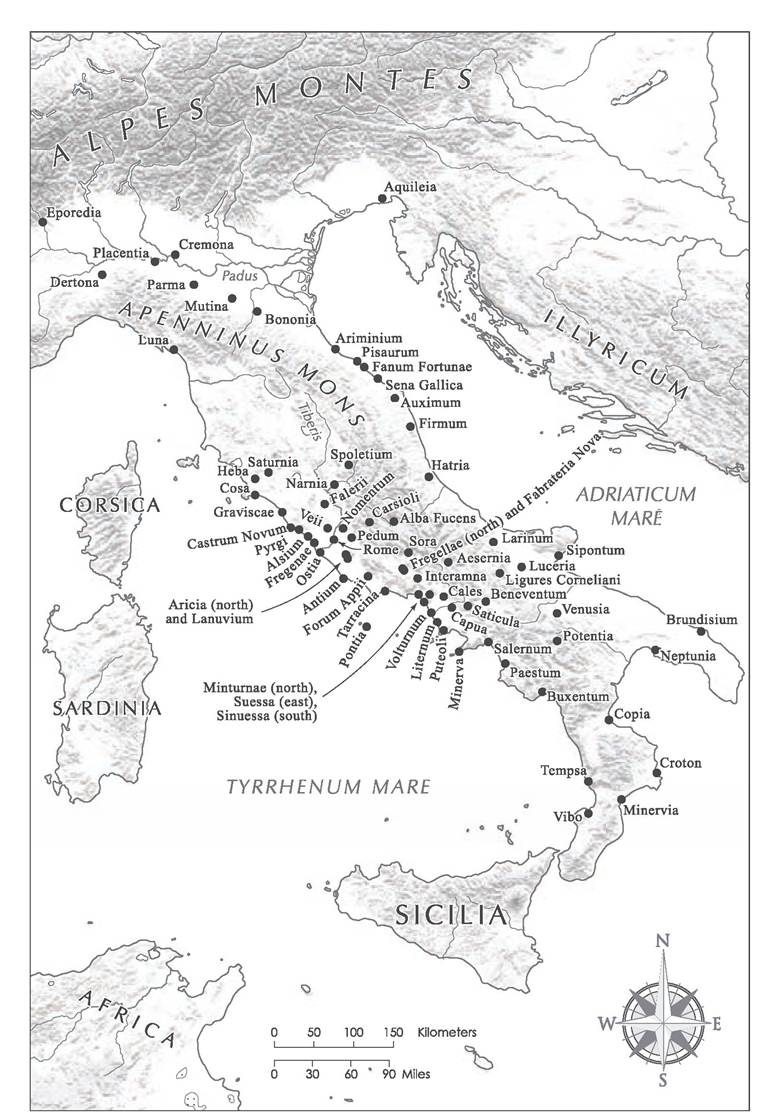
Map 3. Roman and Latin Colonies, 338—100
From the early days of conquest the principal mechanism of transfer was the distribution of parcels on newly acquired territory to settlers.72 Although land was sometimes distributed on an individual basis (viritim adsignare), land grants in colonies were more common and indeed had a long history: already in the fifth and early fourth centuries the Romans and other Latins jointly established colonies on lands in and around the plain of Latium that they reclaimed from the encroaching Aequi and Volsci.73 Following the Latin War the Romans amplifed the practice, founding colonies initially in Latium (Antium, 338, and Tarracina, 329), which were known as citizen colonies because the settlers retained the rights and privileges of Roman citizens optimo iure. But the Romans also established so-called Latin colonies, which joined Latin and Roman settlers in new foundations on annexed land outside Latium. The earliest of these were situated in the corridor along the Liris River between Latium and Campania (Cales, 334; Fregellae, 328; Luceria, 314; Suessa, Pontia, and Saticula, 313; Interamna, 312; and Sora and Alba, 303) and in the lowland valleys of the central Apennines in territory annexed from the Aequi, north of the Fucine Lake (Alba Fucens), and from the Samnites, between Samnium and Apulia (Luceria).74 More distant settlements accompanied third-century and early-second-century appropriations of Italian land, scattering Romans across the peninsula.
While the placement of colonies and the availability of land for distribution necessarily hinged on the chances of conquest, settlement was by no means haphazard. Through the agency of individual commanders, the Senate, or the Roman people, the state assigned land to selected citizens and Latins—usually veterans of recent campaigns. Specifically, the Senate might issue a decree on its own initiative, confirm by decree the arrangements made by a commander in the field, or instruct an officeholder to bring the matter to the people.75 Or an officeholder might take the initiative to present a public law proposal regarding colony foundation or land settlement to the people.76 The specific agent of a given assignment generally emerged from the circumstances of the day. Although recipients of land grants might migrate on their own initiative to individual allotments, the so-called viritane allotments, more commonly the migration of settlers to colonies, were planned and assisted by the state. Numbers involved were calculated: citizen or Roman colonies were small, including generally three hundred colonists and their families; Latin colonies, generally farther from Rome, were larger, containing anywhere from two thousand to six thousand colonists and their families.77 Although we are not provided with similar details by our sources, the number of individual grants was no doubt similarly projected.78 No matter how achieved, the settlement of conquered lands was a matter of societywide interest and obeyed a common community mandate.79
For that reason, the visual patterns of Roman land settlement across Italy are suggestive. Map 4 superimposes the areas of colonization and individual land parcels, arranged in increments by region, on a population map of preRoman Italy. Between the fourth and second centuries, an ever widening spiral of new foundations radiated from the city of Rome.80 Especially thick layers of settlement occurred between 338 and 283 (thirteen Latin and six citizen colonies), mostly in west-central Italy; between 232 and 218 (the viritane settlements of 232 and two Latin colonies) in Picenum and the Po River basin; and between 199 and 180 (fourteen citizen colonies and four Latin colonies) mostly in south Italy and the Po River basin. The pattern is testimony to the growing expanse of the ager Romanus, Roman state land, as it took in adjacent lands confiscated from defeated Volsci, Aequi, Latin, Etruscan, Sabine, and Campanian communities and discontiguous parcels appropriated from defeated Italian, Greek, and Gallic peoples all across the peninsula. More important, Roman settlement wrapped irrepressibly around the detached nations of Italy like a shoot from the sturdy honeysuckle.
Newly settled ager Romanus eventually acquired a distinctive appearance. Wherever the Romans determined to establish colonies on annexed land or to grant the land to Roman citizens, Latins, or sometimes Italians on an individual basis, teams of surveyors went out to mark the land, sent from the staffs of the colony's three men for leading out the colony (tresviri coloniae deducendae), provided for by Senate decree, edict, or enactment, or the ten commissioners associated with viritane grants.81 The surveyors first meticulously fitted the landscape to a grid pattern whose boundaries were visibly marked out by lanes, trenches, stone walls, and boundary markers (termini).82 The grid emanated from a focal intersection of two lines, the cardo maior (running north-south) and the decumanus maior (running east-west). New towns were laid out in accordance with the grid and centered on the focal intersection. The procedure, known as centuriation, imposed squares of varying size on the land—two hundred square iugera was standard although the size varied from place to place— within which settlers received their plots, also of varying size, by lot. Centuriation developed in pace with Roman expansion across Italy.83 The earliest examples accompany early settlements before the Latin War, but not all settlements were so treated. Centuriation was becoming systematized when seen at the Roman colony of Tarracina, established in 338 on the Tyrrhenian coast and on the ager Falernus of Campania, where the Romans also established settlements in the late fourth century. The procedure is more consistently developed in Cisalpine Gaul, settled by individual settlers and colonists in the third century, and likewise in south Italy, where ager publicus distributed under the lex Sempronia
Roman and Latin Colonies by Name and Date of Foundation
| Antium | 338 | Roman | Spoletium | 241 | Latin |
| Ostia | ca. 338 | Roman | Cremona | 218 | Latin |
| Cales | 334 | Latin | Placentia | 218 | Latin |
| Tarracina | 329 | Roman | Sipontum | 194 | Roman |
| Fregellae | 328 | Latin | Volturnum | 194 | Roman |
| Luceria | 314 | Latin | Puteoli | 194 | Roman |
| Pontia | 313 | Latin | Buxentum | 194 | Roman |
| Saticula | 313 | Latin | Croton | 194 | Roman |
| Suessa | 313 | Latin | Liternum | 194 | Roman |
| Interamna | 312 | Latin | Salernum | 194 | Roman |
| Sora | 303 | Latin | Tempsa | 194 | Roman |
| Alba Fucens | 303 | Latin | Copia | 193 | Latin |
| Narnia | 299 | Latin | Vibo | 192 | Latin |
| Carsioli | 298 | Latin | Bononia | 189 | Latin |
| Minturnae | 295 | Roman | Potentia | 184 | Roman |
| Sinuessa | 295 | Roman | Pisaurum | 184 | Roman |
| Venusia | 291 | Latin | Parma | 183 | Roman |
| Hatria | 290-86 | Latin | Mutina | 183 | Roman |
| Sena Gallica | 289-83 | Roman | Saturnia | 183 | Roman |
| Paestum | 273 | Latin | Aquile ia | 181 | Latin |
| Beneventum | 268 | Latin | Graviscae | 181 | Roman |
| Ariminium | 268 | Latin | Luna | 177 | Roman |
| Cosa | 264 | Latin | Auximum | 128? | Roman |
| Castrum Novum | 264 | Roman | Heba | 128? | Roman |
| Firmum | 264 | Latin | Fabrateria Nova | 124 | Roman |
| Aesernia | 263 | Latin | Minervia | 122 | Roman |
| Alsium | 247 | Roman | Neptunia | 122 | bgcolor=white>Roman|
| Pyrgi | 247 | Roman | Dertona | ca. 109 | Roman |
| Fregenae | 245 | Roman | Eporedia | 100 | Roman |
| Brundisium | 244 | Latin |
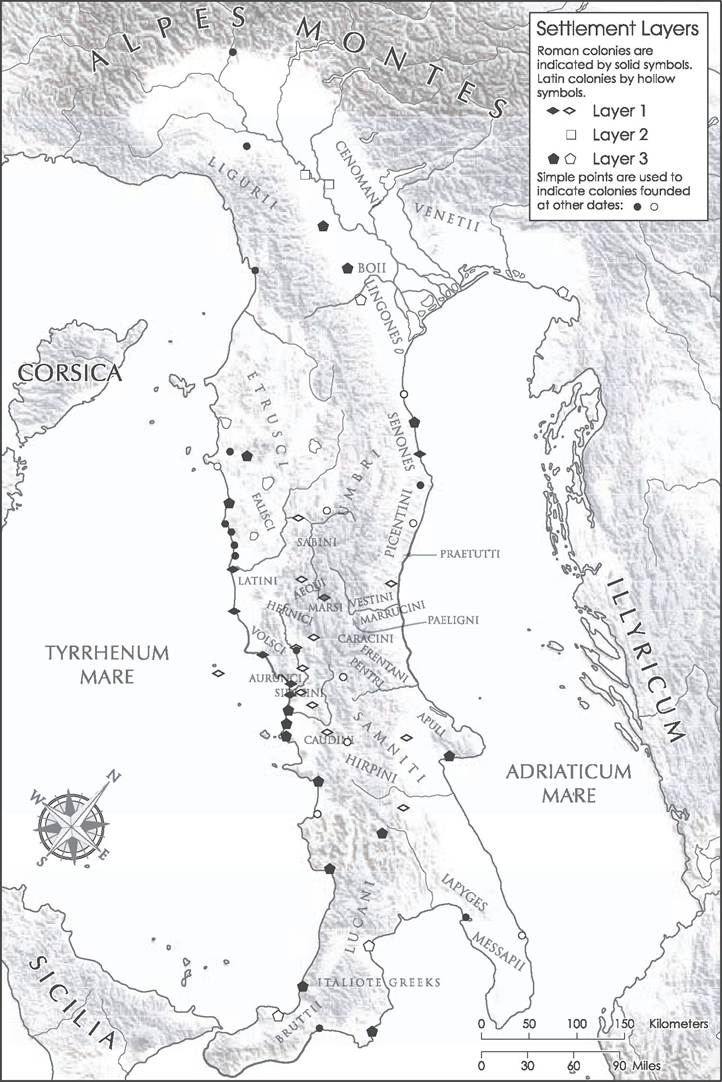
Map 4. Layers of Roman Settlement, 338—100
agraria of C. Gracchus of 123 was centuriated beforehand. Surviving boundary markers have been found at a number of locations.84 The Romans developed not only the procedure, mastered by surveyors (agrimensores), but also a highly complex system of agrarian law to which it pertained.85
It has been suggested that the Romans used centuriation deliberately to put their mark especially on land annexed from difficult enemies.86 From the Roman perspective, centuriation imposed the ritual divisions of the skies used by the Roman augurs to determine the gods' disposition on appropriate occasions on the ground, on ager Romanus.87 When seen from the air, a vantage first revealed in air reconnaissance photos taken for military purposes in 1914-18 and 1939-44, the extent of centuriation in some regions of Italy—the Tavoliere in Apulia, annexed in 200 and settled thereafter, shows the centuriation most clearly— provides striking visual testimony of the Romans' imposition of order on their physical world. Centuriation also served to standardize measurement, thus facilitating and rationalizing the process of comparing output, hence the value, of different parcels of land.88 It is relevant that the developing use and Roman production of coinage, another more obvious medium for rationalizing exchange, parallels the development of centuriation. Whatever the Roman motives prompting centuriation, a significant improvement in food output generally followed.
Much of this improvement in output was the result of improvements in drainage, which allowed the Romans to use the land more intensively than former possessors had. Drainage of flat lands along rivers and in low-lying plains, previously unproductive beyond the requirements of subsistence farming and herding, permitted the cultivation of cereals, vines, or olive trees, producing grain, wine, or olive oil for the market.89 Excavations in northern Campania, a region whose domination the Romans contested with the Samnites in the late fourth and third centuries and one of the regions earliest settled by the Romans, reveal signs of such drainage before the land was surveyed and distributed.90 At Gravinia in southern Italy (Apulia), Roman ditches were laid in before the land confiscated from the local population after the Second Punic War was surveyed, boundaries marked and colonies founded.91 These statemanaged drainage projects, undertaken before settlement, attest to the Romans' intention to increase their arable land resources by appropriating and settling the territories of conquered neighbors.92
New settlers therefore transformed patterns of land use. Above all they created a stable food supply in some areas that previously had been utilized primarily for herding and subsistence farming. Mixed crop cultivation of olives, vines, and cereals appears to have been the regular mode of farming in the areas brought under cultivation by the Romans, terrain and climate permitting, whether in the environs of Rome, in southern Etruria, Latium, the foothills of the central Apennines, or farther afield.93 The kinds of land uses envisaged by the Romans in particular areas are indicated by the size of the allotments reported for different colonies.94 In Roman colonies, colonists were usually allotted small plots—two, five, six, and eight iugera are reported and once ten iugera was reported to colonists at Saturnia, established in 183—while in Latin colonies the plots were generally larger. The size of allotments appears to be determined by the cultivation or pasturage potential of the land. Thus, allotments in regions suited to extensive polyculture—that is, arable lowland such as that found south of the Po River and in other river valleys (when drainage or irrigation was applied) as well as in broad coastal plains—tended to be much larger than allotments in regions in which farming was probably secondary to herding. This was the case in the citizen colonies along the coast, sometimes called “maritime colonies,” whose settlers had relatively small plots but probably greater access to common pasture land (ager compascuus). The range of sizes demonstrates something of the complexity of any explanation for Roman expansion: at stake in varying degrees were the necessity of securing a food supply, of defense, and of encouraging members of an expanding Latin and Roman population to migrate to new homes. In brief, a variety of measures applied when the Romans allocated use of the land and determined the size of the lots. Among them was the kind of agriculture a given area could support.
Concurrently, Roman victories brought changes in the existing urban settlement of Italy. Prior to the Roman annexations of Italian land, autonomous towns and cities were for the most part restricted to the plains and coastal regions, as we have seen. After annexation, this urban pattern was extended and transformed by the foundation, sometimes deliberate and sometimes spontaneous, of new towns (oppida). New towns were often built for settlers in colonies either because the Romans destroyed any preexisting settlement or because none was there in the first place. The Romans destroyed all the settlements of the Aequi in the fourth century, but not all those of the Volsci. One, Antium, received Roman citizen colonists in 338.95 Roman settlement in the lower Liris River valley, an important communication corridor leading out of the central Apennines, introduced urban centers for the first time.96 Excavators at Fregellae, the Latin colony founded in 328 near the juncture of the Liris and Sacco Rivers, have found no signs of settlement in the area prior to the arrival of the Romans. Indeed, throughout this important corridor between Latium and Campania, settlement of any kind was sparse before the arrival of the Romans, who not only undertook drainage projects, as noted earlier, but established three Latin colonies along the Liris River in the late fourth century, first at Fregellae (328), then downriver at Interamna (312), and finally upriver at Sora (303 ).97 Colonies were also at times imposed on existing Italian towns. The Latin colony of Luceria was established at a preexisting Samnite fortified settlement (castellum). From one oppidum, Aquileia, founded in 181 at the head of the Adriatic Gulf on the site of a briefly preexisting Gallic town (it was established in 189 ), comes a rare surviving frieze commemorating the foundation that depicts priests leading the oxen around the town site in order to plow the sacred perimeter (pomerium) encircling all Roman towns. Thus if a town was already in place, the Romans reconfigured it in Roman fashion.98
The foundation of such new or reconstituted towns regularly accompanied colonization. A less deliberate consequence of the extension of state land by confiscation and of granting parcels of state land to Roman citizens on an individual basis was to spur the creation of villages and towns, providing local market and community centers for far-flung Romans. Some, conciliabula, appeared spontaneously; others, fora, were established by magistrates along the roads linking Rome and Roman state land whose construction belongs to the same period or by conquering commanders.99 The relationship between these towns and Rome is pursued in chapter 6.
As a result of Roman settlement, the varied landscape of Italy acquired still more variety, in the third and second centuries, in the complicated mix of large and small holdings constituting rural habitation.100 The complexity of such patterns of settlement is very apparent in a sparsely inhabited region of Italy, the Biferno River (ancient Tifernus River) valley, running from the Adriatic coast to the eastern ridge of the central Apennines, for which we have somewhat detailed archeological evidence.101 The surveys and surface excavations carried out in the 1970s and later indicate that more intensive settlement of the lower valley began only in the second century, coinciding with Roman land confiscations in the area made after the Second Punic War. In an early publication, the excavator Graeme Barker speculated that intensive settlement thus is probably related to these confiscations.102 Settlement by whom? Perhaps the increased density of settlement is due to an influx of settlers, Romans or others, on confiscated land. Or perhaps settlement reflects changing settlement and life patterns among the Frentani, whose traditional lands these were, as a result of agricultural changes in the area. The increasing prosperity and market importance of the nearby Frentani town of Larinum may be associated with the same phenomenon. The fact that excavators cannot always determine with absolute certainty whether (or at what point in time) increased settlement was local or Roman, based on the excavated remnants that reveal culture, is a significant measure of the degree of absorption or assimilation experienced by the Frentani that followed Roman expansion (see chapter 5) or of the existence of a common culture.
In any event, the increased settlement is clearly owed to increased farming in a region devoted also to herding. Based on excavation data, mostly from the upper Biferno valley, home to Pentrian Samnites, which touches the edge of the Apennines, farmstead and villa sites were clustered in parts of the valley that could be easily plowed.103 The land was used primarily for cereal and legume cultivation and stock raising. There were few vines and no olives in the upper valley because the climate was not suited.104 In the lower valley, however, there is some suggestion of mixed crop cultivation of vines, olives, and cereals. Farm sites here were located close to fields, indicating a desire to maximize efforts by living close to arable land.105 There is strong evidence also for transhumant herding in the Biferno valley. Seasonal campsites were situated on the valley floors, where the soil was too heavy to plow but provided good grazing. While the owners of the villa sites identified by archeologists on the edges of these areas were presumably involved in stock rearing, the seasonal camps might also have been used by long-distance herders. Trails from Apulia to the summer pastures of the Apennines cross the Biferno valley.
A similar pattern is visible in the river valleys of west-central Italy, in the region stretching from Rome to the Silarus River to the eastern rim of the Liris River valley—that is, from the northern edge of the plain of Latium to the southern edge of Campania and inland to the foothills of the Apennines— where rural habitation had increased well before the second century. This was the first area extensively colonized by Rome as well as the location of some of the earliest urban development in Italy. Here the foundation of new towns was accompanied by a denser rural population.106 Rural habitation came to include luxurious villas, large and small farmsteads, and hovels attesting to both large- and small-scale market farming as well as subsistence agriculture.107 Villas, few in number until the late second century, obviously represent the country dwellings of the largest landowners, wealthy men whose holdings in the first century, known primarily from narrative reports, were scattered across different regions in Italy and produced cash crops of oil, grain, or vines. As in the Biferno River valley, the identity of the occupants of smaller farmsteads and hovels, lesser landholders, whose presence is amply confirmed in excavation reports, is unknown. Whether free or slave, tenants or freeholders, certainly they were people of a demonstrably lower status and level of wealth as measured in the size of their presumed habitations.
At the center of the complex networks of settlement and land use were markets, both regional and local, which built up in layers corresponding to the phases of Roman settlement.108 Rural settlement and agricultural change were always supported by changes in market conditions. In turn, the pockets of cultivation created by Roman expansion were intensified by the establishment of markets in the various new towns (oppida, conciliabula, fora) associated with settlement. There were many such regional markets, serving as nodes of commerce and exchange for Apennine Italians, we may imagine, in a similar fashion as the pre-Roman sanctuaries, which served as market centers for these mountain dwellers. By the first century, when permanent calendars were put up in town centers, markets were regularly held in different towns on different days in an effort to regularize economic life throughout Italy. To be sure, regional markets were already in existence in Italian towns, especially in Etruria, Campania, and south Italy, or were given a new impetus as a result of Roman expansion.109 Yet the new towns brought a significantly Roman dimension to the relationship between markets and land use.
SOCIAL AND ECONOMIC ADJUSTMENT
TO ROMAN EXPANSION
In their expansion across Italy, between the fourth and second centuries, the Romans conquered a wide variety of peoples, each with their own history and traditions. Following conquest, the conditions of Roman contact and the Roman perception of a group's history and traditions, in particular its amenity to Roman ways, determined patterns of absorption by the conquerors. In this process the Romans often displayed an uncanny talent for adopting courses of action that inevitably strengthened them and weakened neighboring peoples at a fundamental level.
Settling Romans on annexed Italian land is a case in point. The establishment of citizen colonies along the Tyrrhenian coast, in positions indicated by the Carthaginians' offensive and commercial domination of sea routes in the third century, enabled the Romans to set up a defensive net around the coasts of Italy. At the same time these defenses formed a military buffer between the Romans and other Italians, specifically the Samnites, and brought the arable land essential for the maintenance of their own food supply under Roman control. To these ends, colonies enabled the Romans to control both the necessary winter pasture areas used by migrating groups and the arable land on which the local population depended for existence. The establishment of Roman colonies in the foothills of the central Apennines and in mountain valleys surrounding Samnium achieved similar aims: by settling these areas the Romans controlled arable land and pastures essential both to their own expanding population and to the Samnites. Earlier in the fourth century, the Samnites had themselves encroached on the lowlands adjacent to their mountainous region, in Campania and in Latium, when the Romans intervened. The series of wars between the Samnites and the Romans, settled irresolutely by treaty, were wars for control of arable and pasture lands.110 After the establishment of colonies, seasonal migration between the lowland pastures and pastures inland was no longer the same regular movement governed by tradition and convention, entailing the mutual advantage of groups occupying winter and summer pasture areas. For the lowlands were increasingly, from the late fourth century, under new management. This was the case in the coastal colonies, which more than anything ensured Roman control of the important winter pasture areas of the central Apennine peoples.111 A corollary to the Romans strengthening their strategic position on the Italian peninsula by moving out into surrounding lands was the impact of that movement on the integrity of many allied and citizen communities.
The most extreme disruptions followed difficult wars, as the Romans destroyed towns and cities, exterminated or enslaved entire populations and confiscated their lands, or relocated the former enemies. Fairly close to Rome, some of the Aequi and Volsci were eliminated in the fourth century. By decision of the Roman people, in 319, the recently incorporated but rebellious Latin town of Satricum was punished by disenfranchisement. Several years earlier, in 323, the people had rejected a more extreme bill directed at newly Roman, rebellious Tusculum, which envisaged the extermination of the town's male population and the enslavement of its women and children.112 Also in the fourth century, the population of Falerii Veteres, situated on a defensible plateau in southern Etruria controlling a primary route running south to north across the eastern edge of Faliscan territory, ager Faliscus, was relocated to a new site on the plain that became the town of Falerii Novi.113 Roman settlement in the area followed, rendered more secure by the elimination of an Etruscan strong point.114 In the third century, in 283, the Romans established Sena Gallica near the Adriatic coast at the southern edge of the Po River basin, in the territory of the Senones, a Gallic tribal group, but not before the Romans had exterminated all male Senones and sold the women and children into slav- ery.115 Fifty years later, in 232, viritane allotments were made on the land of the Senones, too, by enactment of the Roman people (lex Flaminia).116 Meanwhile, in 269 a large portion of the Picentine population, which had rebelled against the Roman annexation of lands in the area, was relocated to a stretch of the Tyrrhenian coast between Surrentum and the Silarus River, taken earlier from the Lucani. The region was called henceforth ager Picentinus.117 Picentine land in Picenum became public property of the Roman people. In 180, the proconsular commander in Liguria, M. Baebius Tamphilus, relocated the Apuani Ligurians to Samnium, and, in 179, the consul Q. Fulvius Flaccus relocated about forty thousand Insaures Ligurians to Roman state land in Apu- lia.118 In all these areas the removals or exterminations opened the way for new settlers drawn from the Roman and Latin peoples.
While it takes little imagination to envision the impact of extermination on group cohesion and identity, considerably more is needed to envision the consequences of relocation. For all the relocated peoples of Italy, and others elsewhere similarly treated, we can imagine that forced relocation must have had a devastating effect on social organization and on individual lives and relationships, making it unlikely that they would again challenge the Romans. Determining the impact of relocation in a more detailed way is difficult. Nevertheless, the attempt must be made if we are to understand the fundamental changes that made possible the emergence of a Roman state in Italy whose inhabitants shared the most fundamental Roman beliefs. Doubtless, not only the populations directly involved were affected but also the local populations in the regions to which the Romans relocated them. As a result of Roman confiscation followed by an infusion of Roman or Latin settlers and sometimes by a local purging, the population in these regions both changed and increased, often dramatically. But what kinds of relationships were shattered for those who were forcibly moved, and what new relationships were formed?
To some degree such peoples retained a sense of group identity. While much of the town at Falerii Veteres was destroyed, the old temples and shrines continued to stand and function as the primary site of ritual for the Faliscan population, which had been relocated in Falerii Novi. As late as the first century the Faliscan population worshipped at the temples of Juno and Mercury and other shrines.119 More significantly they maintained a sense of Falis- can identity. The relocated Picentes gave support to the Carthaginians during the war with Hannibal and were punished by the Romans. Clearly they were still functioning as, and seen by the Romans as, an identifiable, viable group. We might imagine that the relocation of forty-seven thousand Ligurians near Beneventum was absolutely disruptive of the traditional customs and networks of the Ligurians. Torn from the shrines of their gods and graves of their ancestors, they were set down in a Samnite frontier.120 Yet it was a similar region in respect to the most important dimension of their previous lives: throughout Samnium, as Liguria, transhumance was the way of life. A sense of Ligurian identity continued into the second century CE, judging by the persistence of Ligurian names. Clearly cult, family, and custom persisted on some level, even when a population was forcibly moved.121 Some accommodation had been found by the relocated peoples, which permitted their survival.
The nature and extent of this accommodation in the face of severe disruption are most easily seen in the case of Rome's new Italian allies from whom the Romans simply confiscated land. Forced to relinquish their most arable lands to the dominant partner in a new alliance, the Romans, entire communities were henceforth restricted to a portion of their previous holdings. At the same time, young men of the community were obliged to leave their regular routines of farming and herding for obligatory service with the Roman army, the demands of which in terms of manpower and time increased dramatically during the Second Punic War and the century that followed.122 The adjustment resulting from these demands was nonetheless minor compared with the broadscale transformation caused by the looming presence of economic and political structures almost exclusively Roman.123 The impact of Roman and Latin settlement on the patterns of traditional life among Apennine dwellers, transhumant herders, was especially momentous, and their experiences may be seen in many ways as typical of the Roman impact on all the peoples of Italy and of the kind of transformation forced on Rome's allies.
To an extent never seen before with the territorial expansion of any earlier group in Italy, Roman settlement widely redirected the subsistence strategies of transhumant herders by choking off the traditional agricultural and pastoral system of most central Apennine peoples. Accustomed to moving seasonally from their summer pastures in the mountains to winter pastures in the lowland and accustomed also to subsistence farming on arable lowland, the central Apennines inhabitants quickly found their traditional lowland haunts closed to them as the newcomers appropriated the best land, bringing new forms of land use and economic interaction. In the lowlands, pasture areas were not open for use in the same ways they had been before. Instead, herders were liable to pay grazing taxes for the use of ager publicus, which were collected locally— usually, we think, by Roman officials in the lowland or valley towns serving as Roman administrative centers, many of which appear to have been situated near the trails used in seasonal migration of herds—and paid into the Roman treasury.124 Or the use of pasture lands and arable was mediated through individuals who leased their own land. Imagine the predicament of migrating herdsmen traversing the Liris River valley after 300 who encountered three Latin towns and much denser rural settlement along the way. Thus the continued practice of transhumant herding required the annual payment of a tax or the renting of pasture and farmland directly from private owners. Similarly when Apennine dwellers sought lowland arable for subsistence farming, new avenues of access had to be uncovered, compatible with Roman ownership and rents. The subsequent adjustment rippled through mountain villages and tribal communities, disrupting life on all levels, especially that of the family. And similar disruption undoubtedly occurred in Italy's cropland areas.
Inevitably, previous inhabitants were dispossessed and forced to withdraw to marginal land, less suited for farming, wherever confiscated land was surveyed by the Romans and allotted to settlers or rented to new possessors. The territorial boundaries of transhumant herders, which though fluid nonetheless had enclosed enough land resources needed to sustain the particular group through herding and subsistence farming, were now restricted. Where private property rights were already established, as in Etruria, Umbria, Apulia, and other urbanized areas, fixed territorial limits were drastically diminished. Previous inhabitants in brief had fewer land resources at their disposal. Of necessity some, the least powerful, retreated to marginal lands in marsh areas, on rocky slopes and ridges, and other inhospitable reaches.125 While it is difficult to find the remains of such settlements throughout all of Europe—none was built for posterity—remnants of apparent hovels have been noted in Etruria, away from the Roman roads cutting through productive lands holding the large estates that produced grapes and olives.126 Although the newcomers never seem to have deliberately imposed Roman legal standards of landholding on preexisting landholding patterns, disruption was unavoidable under the circum- stances.127 To the modern observer, the Roman impact creates a considerable dilemma that deepens over time. How in particular were the Romans able to disrupt local patterns of existence among the same groups that sent vast numbers of their young men to fight Rome's wars?
In the teeth of catastrophe, Italians developed strategies of accommodation. Mountain-dwelling herders in particular, faced with want and with restricted access to pasture lands and to tribal lands, were forced to seek out alternative means of survival. Fortuitously the arrival of the Romans created new options for livelihood as well as the necessity for seeking them out. New agricultural practices initiated by the Romans brought a stable food supply as the new Roman and Latin towns provided a focus for locals trying to confront an uncertain world. At the regional markets associated with these towns, individuals could exchange their labor for cash or produce. Some groups developed rather unpredictable occupational patterns as a result. The Marsi, Marrucini, and Paeligni living on the western slope of the Apennines, for example, volunteered to serve as oarsmen in Scipio Africanus's expedition to North Africa in 204. How had such land-locked people come by this maritime skill? Did they go from making ships' masts to working in the boats?128 The demand for rowers in Rome's serial fleets during the First Punic War, and subsequently the possibilities of a labor market in an expanding world, offers one explanation.
But military service provided the prime alternative for survival to people loosed from the land and overwhelmed by Rome. Although our sources often record the bitter objections of local Italian leaders to the military service required by treaty, they also reveal a high level of involvement by Italian males in the Roman army. In the latter part of the third century, when the Romans faced their biggest military challenge from the Carthaginians and Hannibal during the Second Punic War, the Latin and Italian allies formed nearly two-thirds of the total Roman military force. The Abruzzi tribesmen, Samnites, Lucanians, and Apulians (Messapians), called on regularly in times of military need, formed more than half of the allied contribution.129 The number of troops the Italians eventually supplied, between 218 and 91, the period for which the best evidence exists, was extraordinarily high and was the prime factor in Rome's successful conquest of the Mediterranean.
Why did so many go, voluntarily? It is only within the context of family disruption and survival accompanying the arrival of the Romans that the high level of involvement in military service becomes understandable. Roman military service provided young men with a means of family survival—like service as mercenary soldiers, a common alternative throughout the Mediter- ranean.130 Obviously, booty, through successful campaigns, and land allotments in Italy—albeit less land than Romans and Latins received—were powerful incentives to military service in hard times. Most important, to transhumant peoples military service represented an extension of traditional patterns of male departure and return and provided, therefore, a means of survival that was less disruptive of traditional family patterns than other alternatives. Seasonal migration required younger males in Apennine and Alpine communities to stay away for up to six months each year. Over time their respective societies had adjusted to such departures. The departure of youths for increasingly longer periods when called by the Roman military levy similarly required the development of a new ploy in an age-old migratory adaptation to their world. During the second century, when the Romans conquered the eastern end of the Mediterranean, terms of military service for Romans and Italians were extended to an estimated six years on average. While onerous and at times resented, the regular military service required by treaties between their communities and Rome still represented a variation on a traditional pattern of adaptation to life by younger males and their families. Eventually the variation itself became traditional: As late as the reign of Augustus (31-CE 14), the poet Vergil saw Roman legionaries in Sicilian herders (Georgies 3:339, 349). In Italy and elsewhere, Roman demands for military manpower from her allies thus meshed with the regular individual and familial patterns of adaptation of a transhumant population.
The interaction underscores one of the unique aspects of the Roman experience: the deeper potential for assimilation and growth presented to a subjugated tribal group by the new Roman system. Introducing new survival options for newly conquered peoples, the Romans initiated a process of absorption that lasted in some places for centuries. Over time the Roman impact produced a significant element of new citizens loyal to Rome, the subject of chapter 5. Yet Roman success was made possible primarily because the reciprocal manner in which such imperialism was carried out allowed both the Romans and their allies to adjust to the process within a context of beliefs and patterns of behavior that both understood.
The permanent migration of a certain number of Samnites and Paeligni— four thousand families according to their leaders—to Fregellae offers an opportunity to further explore this idea. In 187, leaders of both the Paeligni, whose territory lay in the upper valley of the Aternus River and on the slopes of the Gran Sasso where they controlled the eastern end of the main pass over the central Apennines, and the Samnites, whose territories lay farther south in and around the central Apennines, reported at Rome that some of their peoples had moved to Fregellae, on a plateau over the Liris River in west-central Italy. According to ancient report, a desire to avoid the Roman draft prompted the migration.131 Realistically, these families (whatever their actual number) had relocated in response to the fundamental changes wrought by the Roman annexation of Samnite and Paelignian lands in the fourth century and perhaps the more recent uncertainties caused by Hannibal’s progress through central Italy.132 The Samnites suffered additional losses of territory again after the Second Punic War. In the case of the Paeligni, who were customarily transhumant herders like others in the Apennines, Romans settlement had not affected their mountain lands.133 But the Romans had settled in the lowland areas all around, in the Liris River valley and the coastal plain, thus altering the traditional relationship between highlands and lowlands.134 These families appear to be responding to such a crisis or the later crisis of Hannibal’s march in familiar ways within the context of their own traditional behavior. In the case of each group, the regular patterns of seasonal movement shared by all, as well as a common language, religious rituals, and customs, understandably prompted them to migrate to the same place. Significantly, in their migrations they followed a long-established route to an area of traditional farming and herding activity in the Liris River valley and the coastal plains to which it led, now dominated by Fregellae.135 Faced with deprivation and want, they nonetheless adjusted in line with patterns traditional to their way of life. In Fregellae the four thousand migrating Paelignian and Samnite families presumably settled on marginal lands as tenants or sharecroppers and thus continued the subsistence farming with which they were familiar. Others went elsewhere—some Paeligni went to the sea, for instance, as oarsmen—but they are unlikely to have gone alone. Like seasonal migrants and allied soldiers, oarsmen departed and returned in groups or serially in a process of chain migration reminiscent of transhumance movement.
Rome's actions against her allies in the latter part of the Second Punic War provide memorable confirmation of the Romans' intuitive adoption of courses of action that inevitably strengthened themselves and weakened neighboring and other Italians at a fundamental level. Hannibal's thirteen-year campaign in Italy presented the most dangerous external threat the Romans had faced. At the end of the Second Punic War, the Romans confiscated ten thousand square kilometers in the south of Italy in Samnium, Apulia, and mostly from Lucanians, with whom a treaty had been made in 300. It was the single largest appropriation of land in Italy to date. While we may reasonably see these steps as intended to provide land for immediate and future needs, ancient recorders indicate more complex motives on the part of Rome. Specifically, the confiscations were part of a deliberate program to punish those allies who had assisted Hannibal or lagged in their support of Rome. We can well imagine that confiscations on such a scale were extraordinarily disruptive of everyday life in the affected areas. Subsequently, Roman settlers moved into the area: In 201, the Senate decreed that the land would be distributed to an estimated 40,000 veterans of Scipio Africanus's campaign against the Carthaginians in North Africa and, to this end, appointed a commission of ten men to survey lands in Samnium and Apulia and to assign lots on an individual basis.136 There is no record of land assignments on this scale again until Sulla provided land for 120,000 veterans in 81.137 In addition to this distribution, ten citizen colonies were established, some by public law, between 199 and 150, in southern Italy, mainly around the coast, significantly the largest group of foundations made in any fifty-year period before the first century.138 The locations encourage us again to suppose that the Romans gained control of winter pastures and arable land, specifically.
The punishment of faltering allies in south Italy took other forms. In some cases, adjustments were made to the military levies arranged by treaty. In 204, the Romans imposed a larger levy (plus additional tax and stricter census requirements) on Latins who had supported Hannibal, specifically the communities of Nepet, Sutrium, Ardea, Cales, Alba, Carsioli, Sora, Suessa, Setia, Circei, Narnia, and Interamna—most of them Latin colonies and all within one to three days' journey from Rome—and removed the Picentes, who had been forcibly relocated to south Italy a century before, from the lists altogether.139 The consequences of either action are comparable. Taking no soldiers from communities whose young men entered military service as an alternative to seasonal migration with herds is a hardship if the pattern of seasonal migration is already disrupted; taking more soldiers from communities whose members are primarily farmers disrupts farming life. In either case the Romans seemed to fasten on a course that was most disruptive of community cohesion at a personal level, at the level of everyday life. Significantly, the courses of action they chose were reciprocal in their impact: As the targeted communities weakened, the Romans grew stronger.
Rome's disruptive program in south Italy exhibited another dimension in the urbanized area of Campania. The fate of prosperous Capua at the end of the Hannibalic War was more decisive, and more controversial, than the earlier relocation of Etruscan Falerii Veteres. Undoubtedly, a delicate combination of factors—including the city's Roman citizen status, the economic potential of the surrounding region, and Capua's perceived rivalry with Rome—prompted the Romans to convene in a lawmaking assembly during a difficult wartime year, in 210, to advise the Senate to determine the fate of this rebellious ally. Rather than relocate Capua the Romans completely dismantled its governing apparatus. No longer an effective urban center, Capua was administered by Roman prefects (praefecti Capuam Cumas). Its fertile and flourishing lands, the ager Campanus, capable of producing four crops a year, became the jewel among the public properties of the Roman people. The systematic Roman effort to absorb the resources of Capua, whose pattern of life was shaped by regional markets, trade, and intensive production, underscores the strength of the Roman impulse to deal with rivals in ways that strengthened the Roman state.
As earlier, disruption on such a scale necessitated accommodation by the local population. In Apulia, a large indigenous settlement at Gravinia, flourishing and newly walled in the mid-third century in anticipation of Rome or Hannibal, was replaced by a private villa after the Roman confiscations at the end of the Second Punic War. Visible here is the impact of the changed legal status of the land under Roman domination, which forced the local population to seek other homes, most of them on less desirable land—proba- bly in nearby marshes and rocky foothills. Herding, their primary source of livelihood, continued on the same scale in the region based on faunal remains in the pre-Roman and Roman occupation levels.140 But whether the herdsmen are the inhabitants of the pre-Roman community continuing their traditional
migrations with herds or whether the herdsman are slave or hired herdsmen in the service of the large landowner who occupied the villa and fielded large herds for profit is unknown. Some combination of the two is probable, as the previous inhabitants reached an accommodation with the changed conditions of life they were forced to confront as a result of Roman action. And the confrontation endured. In 132, almost one hundred years after Rome's punitive confiscations in south Italy, the consul P. Popillius Laenas erected a commemorative marker lauding his new road between Rhegium and Capua and advertising, among other past achievements, that ager publicus by his efforts was finally taken from herders and given to farmers.141 In 122, C. Gracchus enacted a law distributing more ager publicus in the region to farmers. While landless Romans benefited from such land distributions, transhumant herders, now in Lucania and Bruttium, were once again, or to an even greater extent than before, cut off from traditional patterns of existence.
As ever, military service was the most promising alternative for those young men for whom it was an option. Immediately after the Second Punic War the Romans conscripted large armies for campaigns in Greece and Asia. Many conscripts must have come from the Lucanian and Apulian communities of south Italy. The presence here of a large slave workforce in the second century indicates clearly that there was by now a shortage of freemen in the area because so many had turned to military service in the Roman army. In turn, the introduction of a large slave labor force throughout south Italy reveals the extent of disruption wrought by Roman penalties. Between 196 and 186, thousands of slaves were brought into Apulia and Lucania, where they worked as herders of sheep and cattle, the property perhaps of wealthy landowners, who modern scholars believe were now beginning to move vast herds in lucrative grazing ventures as many are reported to have done in the last century, or of smaller freeholders or tenants of ager publicus who we may identify with the forty thousand recipients of land grants in 201. The willingness of Romans to employ slaves is open to question: Rome's leaders were clearly wary of slaves in such numbers. Livy reports that the consul Postumius, touring south Italy in the aftermath of the crisis surrounding the Bacchanalian crisis in 186, executed seven thousand slave adherents to the cult of Bacchus. Whether or not the cult found members among the slave herders is no more demonstrable to us than it probably was to the Romans. What is certain is that the Roman Senate reacted to a perceived threat to Roman order by massacring a large body of slaves, whose foreign origins made them obvious targets. Taken together, the confiscations, the retributions, and the imposition of Roman settlements are all actions that caused considerable turmoil for the groups involved. A more effective program of destabilization in a traditional world is hard to imagine—all the more reason to wonder therefore at the degree of accommodation manifest by conquered Italians, even to the point of accepting Roman ways of conflict resolution, including, as we shall see next, public lawmaking.
EXPANSION AND PUBLIC LAW, BETWEEN
THE FOURTH AND SECOND CENTURIES
Between the fourth and the second centuries, the Romans annexed lands amounting to nearly one-third of all Italy from conquered Italians, established many colonies on annexed land, distributed an incalculable amount to citizens in viritane grants, and created fourteen wholly new tribes as well as tribal exten- sions.142 At the same time they embarked on the unparalleled gamble of overseas expansion, whose success depended on the fighting men of all Italy. All of this was done in the ordinary course of business as the Romans extended alliances or citizen grants to most of the peoples of Italy, without resort to any systematic agenda of expansion. Often, local initiative on the part of the Roman commander, or a decision by the Roman Senate, or consular or censorial edict appears to determine what steps were taken to smooth the progress of Roman domination.143 But on some occasions, the massive transformations in life and society that accompanied this expansion were carried through by vote of the Roman people in lawmaking assemblies.144
Table 4.1 lists a number of issues that in one way or another deal with the Roman conquest, integration, or management of enemy lands and peoples. All the laws on the list are efforts to resolve some contentious matter, ranging from Roman appropriation of Italy's land resources to improper conduct by Roman officials (res repetundae), from alliances to war declarations, and from citizenship to disenfranchisement. First in frequency among the issues in table 4.I is declaring war, which accounts for I6 public lawmaking sessions during the entire period although none, significantly, after 111.145 The extension of Roman citizenship or citizen liberties to the peoples of Italy forms the next most frequent issue—to which we will turn in chapter 5—with 15 sessions, followed by the foundation of colonies (9 sessions) and land-related matters (13 sessions). The public laws relating to land resources are examined later. Smaller but significant clusters, in terms of a Roman sense of balance, are the 8 public lawmaking sessions concerned with the wrongdoing or misbehavior of Roman commanders vis-à-vis conquered peoples and the 4 sessions in which the Roman people considered the punishment of rebellious towns or cities (Tusculum, Satricum, and Capua), and of a mutinous Roman garrison (table 4.1). Given that Roman political leaders summoned the Roman people to consider at least 243 public law proposals between 350 and 100, it is noteworthy that almost one-half (109) of those proposals reported, collected in table 4.1, dealt with issues raised by the interaction between Romans and other inhabitants of Italy during the course of Roman expansion.
We can reasonably assume that these laws and proposed laws stand at the tip of a mountain of decisions by the Roman Senate, magistrates, or promagistrates with imperium, as well as Roman voting assemblies on the particular topics involved. That the number of reported declarations of war (sixteen), for example, is far less than the number of wars fought attests to the fact that at some times wars were approved through regular political and religious action.146 Only when public support for a particular war was in some doubt did Romans seem to resort to the legitimizing action of a public lawmaking assembly. The debate and vote over war with Carthage in 264, “la piu antica lex de bello indicendo che sia esteriormente attestata, al dire del Mommsen,” recorded by Polybius, as well as the contested declaration of war against Jugurtha in 111, provide obvious cases in point.147 It is also clear that communities or peoples were punished on more than the four occasions listed in table 4.1, often instantly. At times, uncompromising action against an enemy population seems to be a measure of the hardships encountered in military ventures: Rome typically took the most viciously punitive measures against those who stood against her. It is clear, too, that citizenship was granted on a small-scale basis on more than the eight listed occasions when public laws were proposed or enacted or that the citizen status of Latins or the extension of Roman civil liberties, provocatio, to allies was debated, as an alternative to citizenship, in venues other than the public lawmaking arena, on more than seven occasions (table 4.1).148 And it is clear that the large-scale expulsion of allies from Rome or Roman towns was an issue dealt with in other ways than through the successful or unsuccessful intervention of lawmaking assemblies, as in 177 and 126 (table 4.1). With few exceptions, the structure of decision making in Roman society goes unrecognized by contemporary reporters, suggesting that such structures were largely taken for granted by ancient recorders.
At the same time, the kinds of issues and the circumstances of those issues indicate that public lawmaking assemblies represented a process of particular resort. Although discordance seems to have been tolerated for some time before an issue became pressing enough to invite action beyond the usual Roman structure of decision making, inevitably such occasions arose. When critical issues achieved a certain threshold of importance or pain, an enterprising officeholder might seize the initiative and propose a law to remedy the situation at a public lawmaking assembly and thus involve individuals on all levels of society in developing a resolution. The public debate about the punishment of Capua in 210 is instructive (discussed previously). The most frequently aired issues in table 4.1—taken together with the repeated and individual sessions to pass laws to send requested military assistance (to the Mamertines), to approve treaties, to confirm peace, or to ameliorate the conditions of military service—reveal the important role of public lawmaking in creating the essential social and political consensus, which made it possible for the Romans to conquer and absorb the surrounding peoples.
Corroboration is provided by a uniquely documented progression of events in Roman efforts, at the end of the second century, to deal with conflicts arising out of a 250-year Roman effort to organize lands outside of the city of Rome. In 117, a two-man Senate commission settled a land dispute in Liguria, northwest of the Po River basin. In 111, the Roman people adopted an innovative proposal regarding the disposition of Roman public property, ager publicus, in Italy, Africa, and Greece. While both events involve disputes concerning the possession and ownership of land there are major differences not only in scale and in the number of people affected by the outcome but more important in the ramifications of any decision in the future of the Roman state. Let us look first at the Roman adjudication of a local land dispute in Liguria.
Liguria was a region inhabited mostly by transhumant herders, with a long and often difficult relationship with the Romans. As we have seen, the Romans resorted on more than one occasion to the relocation of one or another Ligurian tribe (180 and 179); one Roman commander had unlawfully enslaved another group, prompting a request from the Ligurians in question that the Roman people intervene, which they did in a public law proposal establishing a commission of inquiry. In 117, the town council of Genua, a Ligurian coastal town, sent two of its leading citizens to Rome to request intervention in their dispute with the Viturii Langenses, another Ligurian tribal group, regarding the control of the land used by the Viturii Langenses and claimed by the Genuates. Similar requests were frequently entertained by the Senate and by local Roman officials both in Italy and outside in the second century.149 The Romans were recognized far and wide as peerless experts in boundary arbitration. In this instance, two brothers, Q. and M. Minucius Rufus, were assigned by decree of the Roman Senate to render a decision.150
The complexity and sophistication of the brothers' subsequent decision, recorded in Latin and engraved on a bronze tablet, are as striking as their genius for adapting customary ways to the exigencies of expansion and growth. The boundaries of the land described as the private land of the Viturii Langenses were established. The boundaries of the land described as the public land of the Viturii Langenses were also established. The rent (vectigal) that the Viturii Lan- genses ought to pay the Genuates was established. Payment of the assigned portion by current possessors of the public land to the Viturii Langenses was established. Possessors of their public land were to be determined by vote of the Viturii Langenses. Possession and cultivation of the public land were limited to Genuates and Viturii Langenses. Use of common pasture land (ager compascuus) by the Viturii Langenses and four other Ligurian tribal groups was established, and decisions about the use of this land were placed in their hands. Finally, Viturii Langenses who were in chains as a result of the dispute or who had been fined were to be released and absolved.151
These adjustments fit a complicated, transitional world. Looking beyond the Genuates' understanding of their position in the region—which appears to be modeled on Roman practice—we see patterns of behavior and expectations that are entirely in keeping with a transhumant society. From a hilltop fortress (castellum), the Viturii Langenses farmed and herded animals. The pasture land was held in common by themselves and four other tribal groups. We may well imagine that these tribal groups and their ancestors had been engaged in farming and herding in the same region for centuries. But some of the land they occupied and used for farming and herding was claimed by the Genuates in 117.152 The arrangements eventually reached by the two Roman arbitrators are striking in several respects. First, they maintain the autonomy of the tribal groups over decisions regarding the use of traditional lands—in particular the lands described as the public property of the Viturii Langenses, over which Genua exercised control. No outsiders may cultivate traditional lands, only Viturii Langenses and Genuates; and the decision about who may hold the public property of Genua rests not with the Genuates but with the Viturii Langenses. Similarly, decisions about the common pasture lands on the public property of Genua rests with the herders: the Viturii Lan- genses, Odiates, Dectunines, Cavaturines, and Mentovines. The boundaries of land described as the private land of the castellum of the Viturii Langenses and as their ager publicus show more of the transhumant dimension of the society represented in the document. The location of the castellum, not indicated in the document, is thought to be modern Langasco.153 The private land of the castellum seems to be centered on the via Postumia, the Roman road connecting Genua on the coast with the Roman colony Dertona, established a brief three years before in the Po River valley across the Apennines. This private land also appears to be in the lowlands. The public property in contrast seems to comprise the mountainous interior.
How meaningful Roman categories and arrangements were to the Ligurians is worth considering. The notion of fixed boundaries, marked by boundary markers (termini), is out of place among a people dependent on unhampered movement in search of pastures. For such a people boundaries are necessarily more fluid and permeable when others in the region are also engaged in the same activities as they are and in search of both arable and pasture land. It is worth wondering, also, whether the land identified by the Roman adjudicators as private and qualified as land that could be sold and bequeathed was in fact the lowland area traditionally cultivated by the Viturii Langenses from their hilltop fortress, held collectively and cultivated in plots allotted to family groups by the tribal group. Are the adjudicators attempting to make sense of a Ligurian situation in Roman terms and finding that it does not quite fit? When we set aside the Roman character of the decisions themselves, the situation that gave rise to them appears to be governed by the traditional relationships and patterns of a transhumant society.
Whatever the situation, we can be sure of a tension, clearly reflected in the document, between Roman categories and agricultural change and the traditional, transhumant society on which they were superimposed. In the case of Genua, the Romans were adept at recognizing and preserving the traditional relationship between the Genuates and the Viturii Langenses and at the same time removing impediments to eventual Roman dominion, by imposing a Roman understanding of boundaries.154 Time and again across Italy, similar tensions between the Romans and subject Italians were consistently resolved in the Roman way. But only under certain conditions did the Roman way call for the intervention of public lawmaking assemblies. These conditions are clarified by the second of our two select events in Roman efforts to deal with conflicts arising out of the long Roman venture to organize conquered lands outside of the city of Rome: the enactment of the lex Agraria of 111.
In 111, the Roman people enacted a momentous statute that transformed the legal status of the public property of the Roman people (ager publicus populi Romani). Through the confirmation of individual holdings on ager publicus, all such land became private property (ager privatus). In the fifty-eight surviving clauses of this lex Agraria, as it is known, the lawmakers drafted in minute detail the provisions governing the shift of all occupied ager publicus, privately held as of 133, from possession (possessio) to ownership (dominium), in a final effort to resolve the conflict dividing the Roman community since 133 over the legitimate possession of ager publicus. Recognized in the arrangements of the lex Agraria are the claims of a comprehensive range of inhabitants of Italy, notably Roman citizen, colonist, Italian ally, and ally of the Latin Name. In the nearly three hundred years that had elapsed since the beginning of Roman expansion in Italy, the Roman people had mooted at least twentyseven laws on the subject of the colonization, settlement, and distribution of land in Italy and abroad to the inhabitants of Italy, listed in table 4.2.155 Each one, like the lex Agraria of 111, was offered at a critical moment in the Roman community. The lex Agraria is unique among other such land bills because a substantial portion—perhaps one-third of the entire law—has survived, allowing us a rare glimpse of the eventual outcome of the most consequential change introduced by the Roman conquest of Italy: the triumph of Roman notions of private land ownership over local traditions and patterns of landholding.
From the arrangements of the Sententia Minuciorum six years before it is clear that, rather than completely replacing traditional landholding patterns, the Romans usually harnessed indigenous conditions throughout the conquered lands to the Roman system. The complexity of the amalgamation is reflected in the passage in 111, after centuries of interaction and Roman dominion, of the lex Agraria to resolve complicated issues of landholding on the part not only of Romans but of conquered Italians and Latins south of the Po River. In this instance, unlike the Ligurian dispute resolved in one of the customary Roman ways, through the intercession and adjudication of a commission of senators named by the Roman Senate at the request of the parties involved, the issues required a public lawmaking assembly. From internal evidence there is no doubt that the lex Agraria was enacted in 111 or that it in general confirmed individual holdings on ager publicus by making such lands in possession, as of 133, ager privatus. Nor is there disagreement that it was the legal closing of a twenty-year controversy in Rome about the legitimate possession of ager publicus, initiated by the lex Sempronia agraria of 133 and reconsidered in a series of later proposals and enactments including the lex Sempronia agraria of 123 (table 4.2).156 Although these earlier measures were enacted they were not easily implemented—the land commission created by the law of 133 found the task of determining legal possession of ager publicus nearly impossible, according to Appian—or in the case of the law of 123, as we shall see in a later chapter, their arrangements were abrogated or altered bit by bit by later public laws, including the lex Agraria of 111 (table 4.2). For my purposes, these certainties about the generation of the lex Agraria are sufficient because I am interested here primarily in what the law reveals about the adaptation to a changed environment by both Romans and Italians and in the role of lawmaking in achieving that adaptation. In the economic and legal relationships determining access to land resources that had emerged in Italy by the end of the second century, as documented by the lex Agraria, it appears that at some level the traditional mobility characteristic of Italian life continued alongside new patterns of Roman life, including patterns of private landownership. At the same time, the document presents a snapshot of the intervention of a public lawmaking assembly in the adjustment between the Romans and the conquered peoples of Italy.
Roman acceptance of the Italians on the one hand and Italian integration into the Roman system on the other is especially apparent in changing access to land resources. Private land ownership by Romans interrupted similar previous ownership patterns among the Etruscans, Campanians, Greeks, and others, as well as the traditional systems of communal land use in the mountain regions, whose inhabitants were transhumant herders. Italians whose territories were severely reduced by Roman appropriation were required to pay rent to use lands once their own or to confine themselves to marginal lands. At the same time, however, access to land was expanded for many Romans and Italians, in particular soldiers. Ager publicus throughout Italy, acquired by right of conquest from the Italians over the period between roughly the fourth and the second centuries, was at times distributed to soldiers on their discharge from military service. Colonists were often recently discharged soldiers. In order perhaps to guarantee the stability of these grants, not only to veterans but to other Romans without land, the recipients were prevented from disposing of the land by sale or bequest. By the second half of the second century, land in conquered regions outside Italy was similarly distributed. The lex Agraria records such distributions in Greece and North Africa. In 100, the tribune L. Appuleius Saturninus unsuccessfully presented a public law proposal to distribute similar lands in Gaul to the veterans of Marius who conquered it (table 4.2).157
In addition to state distributions, the unoccupied portions of ager publicus in Italy were available for use by Romans or Italians on payment of a rent to the Roman state either for pasturage on public pasture lands or for a portion of the produce of the land they farmed. The land in question in the lex Agraria, private holdings of ager publicus, was the public property of the Roman people occupied without contract. Significantly, such ager publicus, over time, had received owners and possessors drawn not only from the ranks of the Roman conquerors but from those of the conquered—Latins and Italians who at one and the same time relinquished their claims to traditional territories yet gained access to the annexed lands of other conquered Italians (and conquered peoples outside Italy eventually) through military service in the conquerors’ army. When they returned to the land they entered a new Roman world of settled farming.
By 111, after more than two centuries of appropriation in Italy, after centuries of letting ager publicus to previous holders or to newcomers, and of allotting land in outright ownership to colonists, the Romans institutionalized the interruption of traditional movement by the imposition of boundaries and private landownership. Private land, defined in 117 as land that could be sold and bequeathed, suggests some combination of sedentary agriculture, extended families, and land-based wealth.158 At the same time, the notion of traditional use continued: For instance, the drafters of the lex Agraria recognized ager patritus, sometimes understood to be traditional lands of the Italian peoples, and exempted it from the arrangements of the law.159 Likewise the rural servitudes in Roman law—the rights of way across land, for humans by foot and for animals, and the right to draw water—attest to a world of commonly shared resources.160 Present in the Twelve Tables, servitudes are also confirmed in the lex Agraria. In this period, too, the Romans were also developing personal servitudes, in particular the idea of usufructus, the legal notion that the profits or produce of something could be utilized by someone who did not have quiritary ownership of the resource that generated them.161 We may see how this idea could emerge out of a landscape accustomed to yielding wood for charcoal, or lime, or some other necessity to a number of groups who ranged in common over the land. In brief, to a significant extent the common use of land persisted.
The underlying mobility of the Italian population, contingent on the geographic constraints of Italy, also continued. Transhumance involving small herds continued on the part of Italians through the third and second centuries and later still. The lex Agraria of 111 offers significant protections to herders with small herds in particular. People pasturing ten or fewer large animals, or an unknown number of small animals will not be subject to a renting tax on the state land in Italy reserved for pasturage.162 By this time large herds managed by slaves were typical in Apulia, Calabria, Lucania, and Bruttium.163 Nonetheless the attention to small herders is a striking recognition of the persistence of a transhumant way of life for mountain peoples.164 Significantly, these patterns that now coexisted with state and private landownership were becoming institutionalized as well, through public laws such as the lex Agraria. The institutionalizing of such relationships had probably begun much earlier. How much earlier may be indicated by the fortuitous description of legal and economic relationships on a personal level transmitted to us by M. Porcius Cato in his handbook on estate farming, ca. 160, to which we shall return in chapter 7.
While traditional mobility continued, the Romans also introduced new wrinkles. People settling along the new Roman roads occupied their land, ager publicus, under special conditions. Called “people living alongside roads” (viasiei or vicani), they appear to be responsible for road maintenance.165 Numbered among these individuals were perhaps Italians whose traditional routes were now covered by Roman roadway. They had entered into a new relationship to the route. Traditional movement from winter to summer pasture and the attachment to traditional routes and fields were interrupted by the private ownership of land assigned by the state not only in various regions of Italy but also abroad. Ex-soldiers were settled in the Balearic Islands off Spain, in North Africa, in Greece, and in southern France before 100. Thus, movement continued as before to the extent that soldiers moved from one region to another, but it was driven now by the contingencies of state settlement and military perquisite.
One of the single most persistent issues presented to the Roman people between the fourth and second centuries involved the disposition of land resources.166 The lex Agraria of iii transformed the possession of land that was public property as of 133 into private ownership. This was the culmination of social changes of monumental proportions stretching back for hundreds of years whose beginnings we considered earlier in this chapter. A noteworthy feature of the Roman solution to conflict within the community over access to land, reached in the lex Agraria of 111, is the extent to which Italians and Latins accepted the Rome-imposed conditions of relationship to land that had been taken from them. The lex Agraria provides a reminder of the level of commitment of the peoples of Italy to the state created in Italy by the Romans. However, the lex Agraria was but one of a range of proposed public laws that attempted to resolve inconsistencies with the Roman way in the conquered lands. We can hardly question that public lawmaking events, the traditional Roman mechanisms for making adjustments to the system, were crucial in resolving the social tensions surrounding Roman expansion, especially as it involved one of the most critical aspects of legitimate access to land.
CONCLUSION
As they moved beyond their boundaries, the Romans not only displayed an ability to maintain a distinct sense of themselves, but they also exercised a unique genius for bringing diverse groups of people into the Roman cultural orbit. Sometimes the Romans exterminated entire populations and confiscated their lands; sometimes a group was relocated; more often enough land was left to them to survive in their old areas or patterns of transhumance were adjusted to place conquered peoples firmly under Roman control. But in every case, the Romans displayed a remarkable talent for imposing themselves on a conquered people in such a way as to harness the indigenous productive potential and bring them firmly into the Roman structure, thus creating the basis for an expanding and prosperous society increasingly centered on the city of Rome. That wars were fought almost continuously, increasing numbers of military raised among the conquered peoples, new peoples subjugated, frightful casualties endured, taxes collected from Roman citizens throughout Italy (up to 167), extensive trade carried on, and land divided and used productively in the Roman way, all in the presence of relatively few representatives of the Roman state and the absence of any discernible agenda of empire, suggests the emergence of a Roman culture with an extraordinary potential for adaptation in the face of change and expansion. Facilitating this adaptation was the unique geography of Italy and the resiliency of Roman culture, social structure, and ways of resolving crises, especially crises that threatened the way of life within the Roman state.
Throughout the period of Roman expansion lawmaking assemblies operated within a complicated structure of Roman crises resolution that made possible the unprecedented absorption of conquered peoples during the creation of the Roman state. When the inhabitants of Italy, Roman and non-Roman, failed to resolve a conflict on the local level arising from Roman expansion, an appeal could be made to any number of Roman elected officeholders, to agents deputized by the urban praetor (praefecti), or to the Roman Senate to settle the issue. As a final resort an issue could be brought by an elected official of Rome to the attention of a public lawmaking assembly. Hence, despite evidence of a Roman genius for bringing together groups of people with diverse cultures to support a single imperial state, such an amalgamation was not achieved overnight. In many cases, hundreds of years after the initial arrival of the Romans crucial questions of the interaction were still being debated—sometimes in public lawmaking sessions in Rome.
The obvious importance of a great many of the issues involved suggests that the process served as a mechanism for the resolution of conflicts that might otherwise have sundered the Roman state, particularly during its most vulnerable years. It is difficult to imagine the continued productive and unchallenged use of conquered lands without the arrangements enshrined in the lex Agraria or for that matter the very different arrangements attempted before the lex Agraria in the long series of enacted laws and public law proposals since 133 that also dealt with the controversial issue of land resources. The Romans' continual recourse to public lawmaking assemblies to consider the issue of access to land resources in Italy underscores the importance of reaching a collective decision when attempting to resolve such a critical issue. Indeed it is fair to say that without public lawmaking assemblies the Roman experience would have been much different and far more circumscribed. A great many of the issues involved in public lawmaking sessions in Rome throughout the period of Roman expansion suggest that the process served as a mechanism of last resort for many conflicts that might otherwise have seriously impeded Roman growth.
The broad acceptance of public lawmaking assemblies throughout conquered lands as a mediating authority, to the point at times where Italians agitated for the passage of laws in Rome, provides an index of the amalgamation of outsiders. Lawmaking was one aspect of a deep process of adaptation of Roman ways by conquered peoples. Crucial to understanding the development of the knowledge and assumptions necessary for the widespread acceptance of public lawmaking assemblies is flexibility of Roman citizenship.
TABLE 4.1 Laws Relating to Roman Expansion, 350—100
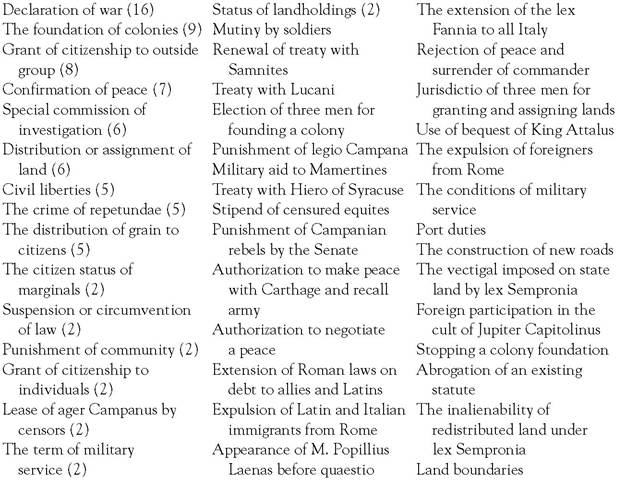
Source: See appendixes A and C.
TABLE 4.2 Laws Relating to the Appropriation, Settlement, and Distribution of Land and
Resources by Year, 350—100
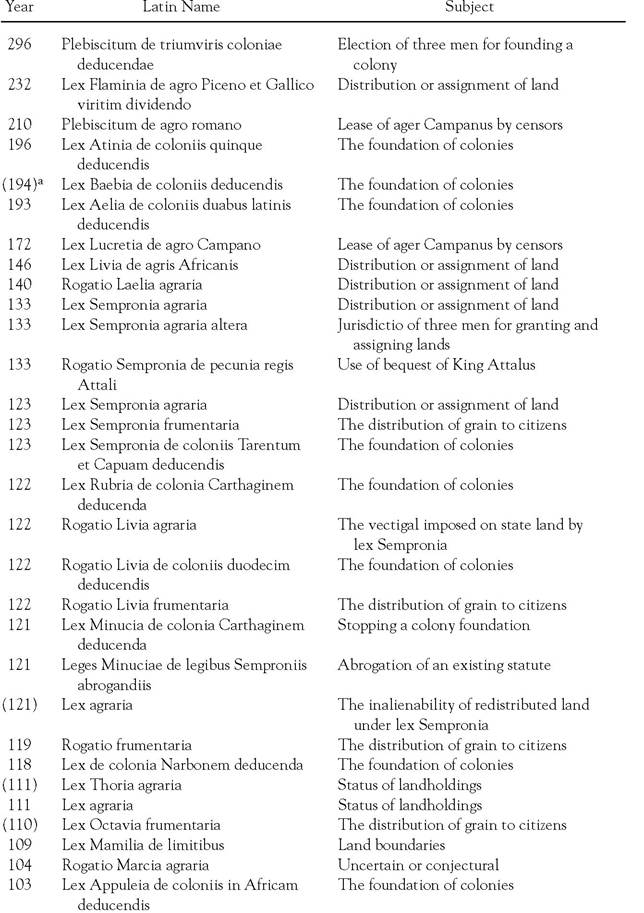
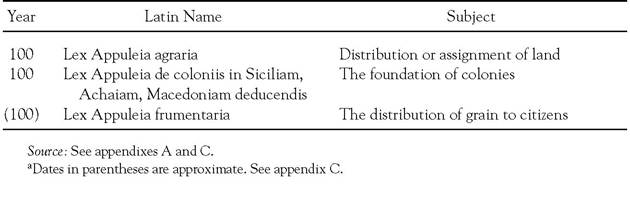
Notes
1. Pallottino 1994 provides an introduction to the history of pre-Roman Italy down to the fourth century. On the Italian peoples see also E. T. Salmon, “The iron age: The peoples of Italy,” CAH 4, 2d ed. (Cambridge, 1988), 676-719; E. T. Salmon, The making of Roman Italy (London, 1982), 1-39; and J.-M. David, The Roman conquest of Italy (Cambridge, MA, 1996), 13-34. More specialized bibliography is cited in note 23, this chapter.
2. Celts in Italy: E. Campanile, ed., I Celti d’Italia (Pisa, 1981); C. Peyre, La cisalpine gauloise du IIIe au Ier siecle av. J.C. (Paris, 1979).
3. Italic and non-Italic language groups in Italy: M. Lejeune and D. Briquel, “Lingue e scritture,” in Italia, omnium terrarum parens, 2d ed., ed. C. Ampolo et al. (Milan, 1991), 435-76. See also V. Pisani, “Le lingue preromane d’Italia. Origini e fortune,” in PCIA, ed. A. L. Prosdocimi and A. Marinetti, 6.1.15-77; and G. Battista Pellegrini, “Toponimi ed etnici nelle lingue dell’Italia antica,” in PCIA, ed. A. L. Prosdocimi and A. Marinetti, 6.1.80-127.
4. The foremost Oscans in the fifth and fourth centuries, the Samnites, were divided into five tribal groups: the Frentani, Pentri, Caudini, Hirpini, and Carriceni. Samnite areas: G. Tagliamonte, I Sanniti: Caudini, Irpini, Pentri, Carricini, Frentani (Milan, 1997), 50-116; E. T. Salmon, Samnium and the Samnites (Cambridge, 1967), 23-27.
5. Geography of Italy in antiquity: H. Nissen, Italische Landeskunde, 2 vols. (Berlin, 1883-1902). A general description of the geography of Italy in the mid-twentieth century is provided in the four large volumes on Italy prepared during World War II by the British Naval Intelligence Division as part of its Geographical Handbook series, in particular vol. 1, 187-405. Briefer but more accessible is D. S. Walker, A Geography of Italy, 2d ed. (London, 1967).
6. The classic statement on the importance of environment is F. Braudel, The Mediterranean and the Mediterranean world in the age of Philip II, trans. S. Reynolds (New York, Evanston, San Francisco, and London, 1972), part 1, “The role of the environment,” 25-352. See also P. Holden and N. Purcell, The corrupting sea: A study of Mediterranean history (Oxford, 2000), a study challenging and refining Braudel’s vision, which appeared after I wrote this chapter.
7. This is revealed indirectly in the importance placed by both Cato and Varro, in their handbooks on estate farming, on access to both winter and summer pasturage.
8. In general see G. Tibiletti, “Considerazione sulle popolazioni dell'Italia preromana,” in PCIA, ed. M. Pallottino et al., 7.33-39 (Rome, 1978); J. E. Skydsgaard, “Transhumance in ancient Italy,” Analecta Romana Instituti Danici 7 (1974): 7-36; and M. Pasquinucci, “La transumanza nell'Italia romana,” in Strutturie agrarie e allevamento transumante nell’Italia romana (III-I sec. A. C.), ed. E. Gabba and M. Pasquinucci (Pisa, 1979), 79-182.
9. I am summarizing archaeologist Graeme Barker, who addresses the early and continuing importance of transhumance. See in particular G. Barker, Landscape and society: Prehistoric central Italy (London, 1981), and G. Barker, “Stability and change,” in Roman landscapes: Archaeological survey in the Mediterranean region, ed. G. Barker and J. A. Lloyd (London, 1991). Cf. Braudel 1972, 85-95.
10. T. W. Potter, The changing landscape of southern Etruria (London, 1979), 58-79 (population increase in Etruria); cf. E. Zubrow and J. Robinson, “Chance and the human population: Population growth in the Mediterranean,” in Reconstructing past population trends in Mediterranean Europe, ed. Bintliff and Sbonias (Oxford, 1999), 133: “In this region [the Mediterranean] the transition to successful agriculture involved both a technological and a demographic revolution.” For a general discussion of causality (whether an increasing population drives agricultural and/or technological innovation or vice versa) see M. Livi-Bacci, A concise history of world population (Cambridge, MA, and Oxford, 1992), 74-99.
11. I am not here concerned with the traditional view of early Rome as a pastoral society, disputed by some scholars: C. Ampolo, “Rome archaique: Une societe pastorale?” in Pastoral economies in classical antiquity, ed. C. R. Whittaker, Cambridge Philological Society, Suppl. 14 (Cambridge, 1988), 120-33. The issue is the interdependence of plain and mountain. See, in the case of Latium, J. W. Bouma et al., “The economy of an early Latin settlement, Borgo Le Ferriere-Satricum, 800-200,” in Settlement and economy in Italy, 1500 to AD 1500: Papers of the fifth conference of Italian archaeology, ed. N. Christie, Oxbow Monograph 41 (Oxford, 1995), 185-87 (landscape presupposes a strong dependence on domestic stock raising, transhumance, or both). Pasquinucci observes that tran- shumance must have been practiced whenever animal rearing is attested, even if the regular movement of herds between summer and winter pastures is not: Pasquinucci 1979, 146.
12. The view of transhumance commonly presented by ancient historians assumes that the coming of Rome played a key role in the disruption of short-distance transhumance and the emergence of long-distance transhumance. In particular, long-distance transhumance emerged only in the second century and was entirely dependent on (a) men who could make a large capital investment in herds; (b) large regional markets for animal products; and (c) a centralized political authority that could protect the migrating herders. Such arguments reveal a fundamental misunderstanding of transhumance as a system for coping with economic constraints on survival posed by geography and climate and fail to address the variety of ways uncovered by the regional peoples of Italy, over time, to live as effectively as possible given the environmental circumstances they confronted. See, for instance, P. Garnsey, “Mountain economies in southern Europe,” in Whittaker, ed., 1988, 206: “Geographical facts do not account for long range transhumance or even for the existence of a pastoral economy at all.” Cf. P. Halstead, “Traditional and rural economy in Mediterranean Europe: Plus fa change?” JHS 107 (1987): 77-87. Instead such arguments view transhumance as a capital-eating venture akin to modern ranching. See in particular E. Gabba, “Sulle strutture agrarie dell'Italia romana fra III e I sec. a.C.,” in Pasquinucci and Gabba, eds., 1979, 15-73, reiterated in “La pastorizia nell'età tardo-imperiale in Italia,” in Whittaker, ed., 1988; cf. A. G. Toynbee, Hannibal’s legacy: The Hannibalic war’s effects on Roman life (Oxford, 1965), 2:286-95; and D. S. Spurr, Arable cultivation in Roman Italy (London, 1986), 125-26. The position is taken or assumed by others, e.g., C. Letta, I Marsi e il Fucini nell’antichità (Milan, 1972), 87-88; D. P. Kehoe, “Pastoralism and agriculture,” JRA 3 (1990): 386-98 (rev. of Whittaker, ed., 1988); E. Dench, From barbarians to new men (Oxford, 1995), 116-25; and E. Curti, E. Dench, and J. Patterson, “The archaeology of central and southern Italy,” JRS 86 (1996): 180-81.
13. Hercules in Italy: note 55, this chapter. Hercules in Rome: chapter 6.
14. R. Ross Holloway, The archaeology of early Rome and Latium (London and New York, 1994), 51.
15. Strabo 4.6.2; Cass. Dio 5.39. See S. Dyson, The creation of the Roman frontier (Princeton, 1985), 88-90.
16. Correspondence between ancient, medieval, and modern tratturi: Skydsgaard 1974, 12 with figure 1; Pasquinucci 1979, tavole 1, following 182; Barker 1981, 27 with figure 9. Transhumance in mid-twentieth century: Walker 1967, 173, 190; Skydsgaard 1974, 28 with figure 2; Barker 1981, 27-29.
17. On his route see Polyb. 3.86.8-11. Noted by R. Chevallier, Roman roads (Berkeley and Los Angeles, 1976), 131 n. 1, in terms of fodder and pasture. He had considerably more than two thousand head of cattle, the number expended on his stratagem: Polyb. 3.92.4. Sometimes Hannibal got lost.
18. This seems to be the prevailing view among geographers, archaeologists, and social historians despite those who argue that geography and climate are but weakly related to patterns of life, in particular transhumance (note 12, this chapter). A summary of the positions taken by scholars in different disciplines on long-range versus local transhumance is provided by M. Corbier, “La transhumance entre le Samnium et l'Apu- lie: Continuites entre l'epoque republicaine et l'epoque imperiale,” in La romanisation du Samnium aux Ile et ler Siècles av. J.-C. Actes du colloque organise par le Centre Jean Berard (Naples, 1991), 149-51.
19. For instance, pigs were herded to Rome from the Po River valley: Strabo 5.1.12; see Pasquinucci 1979, 164.
20. On these interactions see the work of Frederik Barth, in particular, “A general perspective on nomad-sedentary relations in the Middle East,” and “Ethnic groups and boundaries,” in F. Barth, Process and form in social life: Selected essays of Fred- erik Barth (London, Boston, and Henley, 1981), 1.187-97, 198-227.
21. Skydsgaard 1974, 26-29.
22. See note 1, this chapter.
23. As a starting point, the several volumes of Popoli e Civiltà dell’Italia Antica (PCIA) provide an essential digest of archaeological fieldwork and analysis of the various regions and peoples of pre-Roman Italy. The analyses in volume 7 are particularly valuable. Other useful collections include D. Ridgway and F. Ridgway, eds., Italy before the Romans (London and New York, 1979); C. Ampolo et al., eds., Storia della società Italiana. I. Dalla preistoria all’espansione di Roma (Milan, 1981); Ampolo et al. 1989; Crise et transformation des societes archäique de l’Italie au Ve siècle av. J.-C. (Rome, 1990).
24. Omitted from this discussion are the oppida in north Italy characteristic of the Celtic world as a whole; on these proto-cities see Peyre 1979, 56 ff.
25. A selection of the growing number of studies include Studi sulla città antica: Atti del convegno sulla città etrusca e italica preromana (Bologna, 1970); La formazione della città preromana in Emilio Romagna (Bologna, 1988); M. Frederiksen, Campania (London, 1984), 31 -33, 68-77, 85-116 (Campania); “La formazione della città in Lazio. Seminario tenuto a Roma 24-26 giugno, 1977,” Dial. di Arch (1980): 2.1-2, and P. Attema, “Notes on the urbanization of Latium vetus,” in Urbanization in the Mediterranean in the ninth to sixth Centuries, ed. H. Damgaard Andersen et al. (Copenhagen, 1997), 279-95 (Latium); Studi sulla città antica: Atti del convegno sulla città etrusca e italica preromana (Bologna, 1970), and H. Damgaard Andersen, “The archeological evidence for the origin and development of the Etruscan city in the seventh to sixth centuries,” in Anderson et al., eds., 1997, 343-82 (Etruria).
26. See M. Torelli, “Archaic Rome between Latium and Etruria,” CAH 7.2, 2d ed. (Cambridge, New York, Port Chester, Melbourne, and Sydney, 1989), 37.
27. Rome and the Etruscans: C. Smith, Early Rome and Latium. Economy and society c. 1000-500 (Oxford, 1996), and C. Ampolo, “Rome e il Latium Vetus nel VI e nel V Sec. a.C.,” PCIA, ed. C. Ampolo, A. Bottini, and P. G. Guzzo, 8.391-467. T. J. Cornell, The beginnings of Rome: Italy and Rome from the Bronze Age to the Punic Wars (c. 1000-264 BC) (London and New York, 1995), 151-72, offers a different model for the relationship between the Romans and Etruscans.
28. Urban development of Rome: Cornell 1995, 92-97. On the replacement of mound-and-ditch defense works with walls of stone block, generally in the first half of the sixth century, see Torelli 1989, 34-37; cf. Cornell 1995, 198-202.
29. For a discussion of the issues raised in the following paragraphs see Cornell 1995, 81-118, 230-31.
30. A. M. Bietti-Sestieri, “The Iron Age cemetery of Osteria dell’Osa, Rome: Evidence of social change in Lazio in the 8th c.,” in Papers in Italian Archaeology IV: The Cambridge Conference (Oxford, 1985), ed. C. Malone and S. Stoddart, 111-44. On the clans see also Cornell 1995, 81-86; and Torelli 1989, 34-35.
31. Mommsen, R.St. 3.1.22-23: “Vermogensrechtlich ist das Geschlecht wahrscheinlich für das private Bodenrecht der älteste Träger gewesen.” Essential reading is the classic study of the origins and consequences of private landholding from a sociological perspective by M. Weber, Die romische Agrargeschichte (Stuttgart, 1891; reprint Amsterdam, 1962); cf. Weber, The agrarian sociology of ancient civilizations (London, 1976), 260-305, esp. 265-72. A helpful survey of the various theories of Mommsen, Weber, and others is provided by O. Behrends, “Bodenheit und privates Bodeneigentum im Grenzewesen Roms,” in Die romische Feldmeßkunst. Interdisziplinäre Beiträge zu ihrer Bedeutung für die Zivilisationsgeschichte Roms, ed. O. Behrends and L. Capogrossi Colognesi (Gottingen, 1992), 201-13. Also useful is the discussion of Weber’s views on private landownership by J. R. Love, Antiquity and capitalism: Max Weber and the sociological foundations of Roman civilization (London and New York, 1991), 15-18.
32. Torelli 1989, 38-39. For a discussion of other modern theories about the origins of the Roman system of clientage see A. Drummond, “Early Roman clientage,” in Patronage in Ancient Society, ed. A. Wallace-Hadrill (London, 1989), 89-115. See also Brunt 1988, 382-442, with whose arguments about the flexibility of hereditary Roman patron-client ties and the “disintegration of a putative social harmony” I am in general agreement.
33. The observation, made by archaeologist Bietti-Sestieri with reference to Iron Age society, applies equally to all periods: A. M. Bietti-Sestieri, The Iron Age community of Osteria dell’Osa (Cambridge, 1992), 3, and “The role of interregional contact in the development of latial society in the early Iron Age,” in Christie, ed., 1995, 353-64.
34. F. Münzer, Romische Adelsparteien und Adelsfamilien (Stuttgart, 1920), 46-62; Scullard 1973, 10, 32.
35. See for instance C. Ampolo, “Demarato, osservazioni sulla mobilità sociale arcaica,” Dial. di Arch. 9-10 (1976-77): 333-45.
36. A convenient discussion of these is provided in Cornell 1995, 108-12.
37. On the religious foundations of the league see B. Liou-Gille, “Naissance de la ligue latine: Mythe et culte de fondation, “ RBPhil 74 (1996): 73-97.
38. Already ascendant in the sixth century: Cornell 1995, 198-214.
39. On Italian society see Tibiletti 1978 and M. Cristofani, “Società e istituzioni nell'Italia preromana,” in PCIA, ed. M. Pallotino, 7.51-112. Cf. David 1996, 22-29.
40. The focus is conventional: The peoples of central and southern Italy were generally regarded in antiquity and by modern scholars as singularly “attuned” to each other; specifically they shared a certain, common cultural outlook to which the Celts, Ligurians, and other Celticized inhabitants of the Po River valley were not privy. See the comments of David 1996, 14-18.
41. Vici and Pagi: M. W. Frederiksen, “Changes in the pattern of settlement,” in Hellenismus in Mittelitalien, ed. P. Zanker (Gottingen, 1976), 341-55 (meaning of terms); E. Gabba, Urbanizzazione e rinnovamenti urbanistici nell'Italia centro-meridionale del I sec. a.C.,” in E. Gabba, Italia Romana (Como, 1994), 68-69. Settlement patterns: David 1994, 22; Tagliamonte 1996, 156-78 (Samnites). Cf. E. Antonacci Sanpaolo, “Landscape changes: Romanization and new settlement patterns at Tiati,” in Keay and Terrenato 2001, 27, citing previous publications regarding settlement patterns at Tiati.
42. Hill forts: S. P Oakley, The hill forts of the Samnites. Archaeological Monographs of the British School at Rome, 10 (London, 1995).
43. Larinum: Salmon 1982, 21. Gravinia: A. Small, ed., Gravinia: An Iron Age and Roman republican settlement on Botromagno, Gravina di Puglia, excavations 1965-74. Archaeological Monographs of the British School at Rome, 5 (London, 1992), 1.12. See note 23, this chapter.
44. P. Arthur, Romans in northern Campania. Archaeological Monographs of the British School at Rome, 1 (London, 1991), 30.
45. Sanctuaries were located along drove trails: E. Fabbricotti, “Storia di un tratturo,” in Christie, ed., 1995, 197. On the functions of sanctuaries see Arthur 1991, 20, 29.
46. Excavated in the early part of this century. See P. Mingazzini, “Il santuario della dea Marica alle foci del Garigliano,” Mon. Ant. 37 ( 1938); P. Talamo, “L'Area aurunca nel quadro dell'Italia centromeridionale: Testimonianze archeologiche di età arcaica,” BARS 384 (Oxford, 1987); Arthur 1991, 32-33. Three settlements: Salmon 1982, 10. These shared a common shrine perhaps to Marica: Livy 8.11.11.
47. On the similarities with other sanctuaries in south Italy and their role see G. Pugliese Carratelli, “Santuari extramurani in Magna Graecia,” PP 17 (1962): 241-46; Arthur 1991, 46.
48. F. van Wonterghem, “Le culte d’Hercule chez les Paeligni,” Ant. Class. 42 (1973): 36-48. On Curinus, thought to be a Sabine name, see F. van Wonterghem, “Archäologische Zeugnisse spätrepublikanischer Zeit aus dem Gebiet der Peligner,” in Zanker, ed., 1976, 147, 151; A. La Regina,”Il Sannio,” in Zanker, ed., 1976, 242; and J.-P. Morel, “Le sanctuaire de Vastogirardi (Molise) et les influences hellenistiques en Italie centrale,” in Zanker, ed., 1976, 261 n. 18.
49. Castor and Pollux among the Marsi and Paeligni: E. Vetter, Handbuch der Italischen Dialekte (Heidelberg, 1953), no. 22. Hellenization: Zanker, ed., 1976 is still fundamental; see also the useful study of ancient and modern perspectives on the Apennine inhabitants by Dench 1995. A summary of more recent scholarship on the issue is provided by Curti, Dench, and Patterson 1996, 181-89.
50. D. Ridgway, rev. of PCIA 4 and 5 in JRS 71 (1981): 210: “Nor do such strays [rich artifacts found elsewhere] throw any light at all on the circumstances that permitted the individual or communal accumulation of reserves represented by the phenomenal quantities of bronze used in the manufacture of the receptacles, personal ornaments, arms and armour found in the Campovalono graves. The contrast between the fortunes of the Abruzzo and Molise region in ancient and modern times could hardly be more striking.”
51. Spurr 1986, 1-22, 90-96.
52. The most useful discussion is Pasquinucci 1979, 161-69.
53. R. Middleton and M. F. Nimkoff, “Types of family and types of economy,” AJS 66 (i960): 215-25.
54. Cf. Braudel 1972, 38-41.
55. See A. L. Prosdocimi, “La religioni degli Italici,” in Ampolo et al., eds. (1991), 477-595; U. Bianchi, “Gli dei delle stirpi Italiche,” PCIA, ed. M. Pallottino, 7:195-236. Hercules: Prosdocimi 1989, 529; A. De Niro, Il culto d’Ercole tra I Sanniti Pentri e Frentani (Rome, 1977).
56. Sabellian League (Paeligni, Marsi, Marrucini, Frentani): Letta 1972, 65-69. Samnite League (Pentri, Hirpini, Caudini, Carraceni): Letta 1972, 69-82 ; Salmon 1982, 14. On the designation Sabelli for Oscan-speaking peoples other than Samnites, current at the time of the Italian War, see Pallottino 1994, 154.
57. Ancient description of regions: Pliny, N.H. 3.12-110; cf. V. Cianfarani, “Culture arcaiche dell’Italia medio-adriatica,” PCIA, ed. Cianfarani et al., 5.35-39.
58. On this subject see Lejeune and Briquel 1991, 468-71. Etruscan: N. Oscan, Latini, Falisci, Sabini, Umbri, Veneti, Rieti, Liguri, Piceni. Greek: Messapii, S. Osci, Siculi, Sicani, Elini. See also M. Pandolfino and A. L. Prosdocimi, Alfabetari e insegnamento della scritture in Etruria e nell’Italia antica (1990), and J. H. W Penney in CAH 4, 2d ed. (1988), 720-38.
59. Salmon 1982, 23, 56; Cf. Crawford 1981, 158.
60. Tagliamonte 1997, 226 with references: “In area frentano si riscontra tuttavia, accanto all’impiego della scrittura epicoria, anche una precoce utilizzazione dei caratteri dell’alfabeto coloniale latino nella notazione di testi in lingua osca” (third century, Larinum, and later, Casacalenda, Montenero di Bisaccia, Torino di Sangro).
61. Salmon 1982, 24.
62. Salmon 1982, 23, 25, 55-56. See comments of Crawford 1981, 158, with reference to the unlikely, independent adaptation of Victory and Apollo by the Marsi.
63. Ballottino 1994, 99-105. These movements are part of a “fifth century crisis” that saw the expansion and sometimes urbanizing of Apennine groups and the simultaneous, economic waning of the Etruscan and Campanian urban centers.
64. Livy 41.13.5
65. Livy 40.29.1.
66. Samnites: Frederiksen 1984, 98-100, 134-57; Lucani: A. Pontrandolfo Greco, I Lucani: Etnografia e archeologia di una regione antica (Milan, 1982), 127-65; La formazione della città preromana in Emilia Romagna. Atti del convegno di studi, Convegno e Colloqui, novi serie 8, Bologna—Marzabotto 1985 (Bologna, 1988). Central Apennines: A. Campanelli, “La nascita della città in Abruzzo: Tradizioni, insediamenti e nuovi modelli (IV-I sec. A. C.), in Christie, ed., 1995, 493-98.
67. I am simplifying a very complicated process in this paragraph. K. J. Beloch, Romische Geschichte bis zum Beginn der punischen Kriege (Berlin, 1926), is essential. A. Afzelius, Die romische Eroberung Italiens (340-264 v. Chr.) (Copenhagen, 1942), 136-96, provides a detailed discussion of the course of Rome’s conquest in the fourth and third centuries. See also Cornell 1995, 322-26, 345-68.
68. For the experiences of individual communities and a list of allies (excluding Latins) in 218 see K. J. Beloch, Der italische Bund unter Roms Hegemonie (Leipzig, 1880), 158-77.
69. On the dynamics of the relationship see especially E. Badian, Foreign clientelae (264-70 ) (Oxford, 1958), 15-32.
70. Only a part taken: Appian, B.C. 1.7.26; see Brunt 1971,538. The annalists say one-third, one-half, or two-thirds. For a list of the Italians whose land was taken see Salmon 1982, 59 with n. 262.
71. Incremental growth of ager Romanus: Beloch 1926, 321, with discussion and adjustments of earlier work in Beloch 1880.
72. The mechanics of organizing the new lands are described in detail in Gargola 1995.
73. Cornell 1995, 301-4, argues that the initiative was Roman.
74. In general see E. T. Salmon, Roman colonization under the republic (London, 1969); Liris valley: F. Coarelli, “Fregellae e la colonizzazione latina nella valle del Liri,” Arch. Laz. 2 (1979): 197-204.
75. The ancient evidence, in particular Livy, does not support the idea that such projects were ever exclusively managed either by the Senate or the people, notwithstanding the report of Velleius Paterculus (1.14.1) that all colony foundations prior to 133-121 were initiated by the Senate: see Gargola 1995, 53 with nn. 3 and 4. On the involvement of the Roman Senate in the fourth century see the detailed analysis of Holkeskamp 1987, 155-56 (colony foundations) and 170-203; cf. Holkeskamp 1993, 33.
76. Gargola 1995, 51-58 and 102-6 provides a useful summary of these laws.
77. One, the colony of Venusia in Apulia, founded in 291, included twenty thousand colonists and their families, according to Dion. Hal. 16.17.5; it is so large a group that modern scholars usually reject the figure (but see Afzelius 1942, 133).
78. On the selection and numbers of settlers and mechanisms of land distribution involved in viritane and colonial allotments see Gargola 1995, 64-70 and 107-113.
79. The penalty levied against the mutinous legion in Rhegium provides a case in point.
80. See the summary of Velleius Paterculus 1.14-15, who conflates the settlements (called coloniae militariae) with grants of citizenship.
81. The creation, membership, and functions of the colonial commissions, and the commissioners set in charge of viritane distribution projects enacted by law, are addressed by Gargola 1995, 58-63 and 106-7.
82. What follows is a rough summary of a much more elaborate and developing process known from the technical writings of its practitioners and from traces of ancient surveying on the landscape. The fundamental study is now B. Campbell, The writings of the Roman land surveyors: Introduction, text, translation, and commentary (London, 2000). A summary of how the surveyors worked is provided in Gargola 1995, 39-41.
83. On this see E. Gabba, “Per un'interpretazione storica della centuriazione romana,” Ath. 63 (1985): 255-84, and “Storia e politica nei Gromatici,” in Behrends and Capogrossi Colognesi 1992, 398-409. Modern scholarship on the developing practice of land surveying and centuriation is extensive. Useful collections of the last twenty years include Misurare la terra: Centurazione e coloni nel mondo romano, 4 vols. (Modena, 1983, 1984, 1985); M. Clavel-Leveque, Cadastres et espace rurale: Approches et realites antiques. Table rond de Besanqcon, mai 1980 (Paris, 1983); G. Chouquer and F. Favory, Les paysages de l’antiquite. Terres et cadastres de l’occident romain (IVe s. avant J.-C./IIIe s. apres J.-C.) (Paris, 1991); and Behrends and Capogrossi Colognesi 1992. A comprehensive bibliography is included in Campbell 2000.
84. These are collected in Campbell 2000, 452-53, appendix 2, “List of Inscribed Cadastral Stones.”
85. See Campbell 2000, 472-74 (appendix 5, “Types of Land”), and 475-77 (appendix 6, “Surveyors and the Law”). The legal aspects as they relate to land in private ownership are well covered in Behrends 1992, 192-284. The complicated degrees of legal ownership and possession in the later period are cogently analyzed by M. Kaser, “Typen der romischen Bodenrechte in der späteren Republik,” ZRG 62 (1942): 68-73; “Eigentum und Besitz,” ZRG 68 (1948): 131 ff; and F. T. Hinrichs, Die Geschichte der groma- tischen Institutionen: Untersuchungen zu Landverteilung: Landvermessung, Bodenverwaltungund Bodenrecht im romischen Reich (Wiesbaden, 1974). See also Weber 1891.
86. N. Purcell, “The creation of provincial landscape: The Roman impact on Cisalpine Gaul,” in The early Roman empire in the west, ed. T. Blagg and M. Millett (Oxford, 1990), 7-29, esp. 14-20.
87. W. Hübner, “Himmel und Erdvermessung” in Behrends and Capogrossi Colognesi 1992, 140-71. Cf. Gargola 1995, 42-50. For other interpretations see also J.-P Vallat, “Ager publicus, colonie et territoire agraire en Campanie du nord ä lepoque republicaine,” in Clavel-Leveque 1983b, 187-98, and M. Clavel-Leveque, “Studio di un catasto nell'ager Falernus,” in Misurare la terra: Centurazione e coloni nel mondo romano (1983), 1.227-30.
88. The terms of the land lease contracts in Cato, Agr., which require different amounts of produce depending on the assessed output of the land, as well as the rents specified by the Sententia Minuciorum (discussed later in this chapter), with regard to equivalent produce, as well as the testimony of the agrimensores, for whom ubertas, productivity, is the basis of land valuation, make this clear. See further on land valuation in chapter 5.
89. Similar drainage systems are found in Latium, of uncertain date: S. Quilici- Gigli, “Sistemi di cunicoli nel territorio tra Velletri e Cisterna,” Arch. Laz. 5 (1982): 112-23; J. W. Bouma et al. 1995, 185. As late as 160, the Romans drained the Pomptine marshes: Livy, Epit. 46.
90. Arthur 1991, 60.
91. Small, ed., 1992, 14.
92. Earlier drainage projects are attested southeast of the Astura River, in the Pontine region: P Attema, An archaeological survey in the Pontine region: A contribution to the early settlement history of south Lazio 900-100 (Groningen, 1993).
93. Spurr 1986. Some scholars hesitate to assume that the Romans introduced mixed crop cultivation in the absence of explicit archeological evidence that they did so: M.H. Crawford, et al., “Excavations at Fregellae, 1978-1984,” PBSR 54 (1986): 40-68.
94. Alternatively, the size of the plot was determined by the Roman intention to create either agriculturally self-supporting Latin communities or citizen colonies, materially dependent on Rome: G. Tibiletti, “Ricerche di storia agraria romana,” Ath. 28 (1950): 183-266, endorsed by E. Gabba, CAH 7, 2d ed. (1989), 215-16. Other common explanations of Roman motivations in distributing different sized plots are examined, with reference to C. Flaminius's land law of 232, by Feig-Vishnia 1996, 25-34.
95. Salmon 1982, 8-9, sees this as an indication of the relative urbanization of the different groups.
96. Antinum, to the north, was a Volscian settlement: Letta 1972, 27-28 with n. 16.
97. The absence of previous settlement around Fregellae is reported in M. Crawford et al., “Excavations at Fregellae, 1978-1984,” PBSR 52 (1984), 23.
98. Gargola 1995, 71-101, provides a thorough discussion of the ways in which the Romans gave a familiar external shape and internal structure to new foundations.
99. See chapter 6.
100. On the density of Roman rural settlement see the comprehensive remarks and bibliography of G. Barker, “Landscape Archaeology in Italy—Goals for the 1990s,” in Christie, ed., 1995, 1-3, and J. Lloyd, “Forms of rural settlement in the early Roman empire,” in Barker and Lloyd, eds., 1991, 233-40.
101. See G. Barker, ed., A Mediterranean valley: Landscape archaeology and annales history in the Biferno Valley (London and New York, 1995).
102. G. Barker, J. Lloyd, and D. Webley, “A classical landscape in Molise,” PBSR 46 (1978): 42.
103. J. A. Lloyd, “Farming the highlands: Samnium and Arcadia in the Hellenistic and early Roman empire,” in Barker and Lloyd, eds., 1991, 180-93.
104. Barker, Lloyd, and Webley 1978, 44.
105. Barker, Lloyd, and Webley 1978, 45.
106. Surveys in the area are reported in E. Wightman, “The Lower Liri Valley: Problems, trends and peculiarities,” in Archaeology and Italian Society, ed. G. Barker and R.
Hodges. British Archaeological Reports, International Series 102 (Oxford, 1981), 275-87, and Arthur 1991.
107. Lloyd, “Forms of rural settlement,” in Barker and Lloyd, eds., 1991b, 233-40.
108. The short study by J. Frayn, markets and fairs in Romani Italy (Oxford, 1993), provides a comprehensive analysis dependent on ancient sources and modern “central place” theory. See also Spurr 1986, 143-44.
109. E. Gabba, “La colonizzazione Romana tra la guerra latina e la guerra annibalica: Aspetti militari e agrari,” Dial. di Arch. 6 (1988): 21-28; cf. Gabba 1994b, 69-70, and La città nell’Italia settentrionale in età romana (Trieste and Rome, 1990).
110. Skydsgaard 1974, 7-36.
111. Reassessment of the Roman view of colonies as military garrisons: B. Isaac, The limits of empire: The Roman army in the east (Oxford, 1992), 311-15 (they were not garrisons).
112. These two laws, enacted by the plebeian tribal assembly, are considered apocryphal by some scholars, on the grounds that only a centuriate assembly could levy such harsh punishments (as a iudicium populi): Humbert 1998, 232; Mommsen, R.St. 3.351
n.2.
113. Potter 1979, 98-101.
114. Strong point: M. W. Frederiksen and J. B. Ward Perkins, “The ancient road systems of the central and northern Ager Faliscus,” PBSR 25 (1957): 135-36. Similar destruction occurred in north Etruria in the third century: I. Attolini et al., “Political geography and productive geography between the valleys of the Albegna and the Fiora in northern Etruria,” in Barker and Lloyd, eds., 1991, 144.
115. The immediate justification was the military contribution of the Senones as mercenaries to the Etruscans. In addition, the Gauls had made common cause with the Samnites against the Romans, fighting in the Apennine region of Etruria and Umbria. App., Sam. 6.1; Hann. 11; Polyb. 2.19.5-13; Livy, Epit. 11.
116. T. Frank, Economic survey of ancient Rome (Baltimore, 1933), 1.60-61.
117. Strabo 5.4.13; U. Laffi, Asculum (Pisa, 1985), i.xvi—ii.
118. 180: Livy 40.36.7, 37.8-38.9; Nissen 1883-1902, 2.814 f.; 179: Livy 40.44.3 or 40.53.1-6. See A. Barzanò, “Il trasferimento dei Liguri Apuani nel Sannio del 180-179 BC,” in Coercizione e mobilità umana nel mondo antico, ed. M. Sordi (Milan, 1995), i77-20i.
119. Potter 1979, 99-100; Frederiksen and Ward-Perkins, 1957, 129-33.
120. Livy 40.38.6, 4i3.
121. A. Luisi, “La presenza dei ‘Ligures Baebiani' nel Sannio,” in Sordi, ed., 1995, 203-14.
122. The number of troops fluctuated with the number of Roman troops called up; generally the allies furnished the same number of infantry as the Romans but more cavalry. The consequences of the organization and deployment of Italians alongside the Romans will be discussed in chapter 5; suffice to say here that it furthered the absorption of a conquered people.
123. The impact of Roman settlement varied greatly from region to region and is revealed only through detailed archaeological investigation. On the range of possible outcomes, from disruption to cooperation, see J. R. Patterson, Review of L’ipogeo dei Vimini di Canosa (Adrians II), by E. M. de Julius, and six other books, JRS 83 (1993): 189-93 (review of recent work on the archaeology of Roman Italy). More and more studies on this topic are now appearing: see the useful collection of papers in Keay and Terrenato 2001. The work of Emilio Gabba remains important: Gabba 1989, 197-243, and Gabba 1994b, a collection of articles published in the last twenty years.
124. Supervision of the pasture areas by tax farmers, who collected directly from herders, is another possibility. On the collection of grazing taxes see Corbier 1991, 152, and Pasquinucci 1979, 137-40. The state revenues derived from pasture land are the subject of C. Trapenard, L’ager scripturarius: Contribution b l’histoire de la propriete collective (Paris, 1908); cf. C. Nicolet, Tributum: Recherches sur la fiscalite directe sous la republique romain (Bonn, 1976), 81.
125. The apparent population decrease in Etruria in the third century (based on survey and excavation), attributed to the Roman relocation or massacre (unreported), of the local population might also reflect the dispersal of the inhabitants to marginal lands. Relocation or massacre: Potter 1979, 100-101; cf. P. Perkins, “Reconstructing the population history of the Albegna Valley and Ager Cosanus, Tuscany,” in Geographical information systems and landscape archaeology, ed. M. Gillings, D. Mattingley, and J. van Dalen (Oxford, 1999), 113.
126. Potter 1979, 44. The practice of field walking and field surveys has confirmed the ubiquity of rural habitation and settlement: Barker 1995, 1.
127. See for instance W. V. Harris, Etruria and Umbria (Oxford, 1971), 147.
128. Livy 28.45.19. See Letta 1972, 93.
129. Based on the contributions of 225, recorded by Polyb. 2.24.10-17.
130. See T. Gallant, Risk and survival in ancient Greece (Stanford, CA, 1991), 135-36, 137-38; Letta 1972, 1-95, on military service and emigration. Gauls from Italy as well as Campanians and Bruttians fought as mercenaries outside Italy in the third century.
131. Livy 41.8.8-9.
132. See F. Coarelli, “I Sanniti a Fregellae,” in La Romanisation du Samnium aux lie et ier siecles av. J.-C. Actes du colloque organise par le Centre Jean Berard (Naples, 1991), 177-85 (on the episode, 179-80).
133. Only one source reports (unreliably) the annexation of Paelignian land: Cass. Dio 20.90.3. On this episode see H. Galsterer, Herrschaft und Verwaltung im republikanischen italien (Munich, 1976), 160. While the report raises a number of related questions— When and under what circumstances had they gone? How often were heads counted for the purpose of compiling a list of men for the military levy?—the crucial point it makes concerns migration. On the census see Galsterer 1976, 110-17.
134. Livy 8.22.2; 23.6.
135. Coarelli 1991, 177-85, esp. 177: “La media valle del Liri costituisce, da sempre, un luogo di transito privilegiato per la transumanza proveniente dalle zone appenniniche confinanti, e in particolare dalla Marsica, attraverso l'alta valle del fiume (Val Roveto). Vie secondarie di penetrazione corrispondono ai passi in direzione di Atina e di Casinum.”
136. Livy 31.4. 1-3; see Brunt 1971, 70 n. 1; 281.
137. The number of men receiving land is based on legions at full strength. Brunt 1971,305, proposes that eighty thousand is a more “credible maximum” on the grounds that the legions would not be at full strength.
138. Three in Campania (Volturnum, Liternum, Puteoli), six in Lucania and Bruttium (Salernum, Buxentum, Tempsa, Vibo, Croton, Copia), and one in Apulia (Sipontum).
On the colonies founded in 194—Puteoli, Volturnum, Liternum (300 each), Salernum, Buxentum on land confiscated from the Campanians, Sipontum on land taken from the Arpini, Tempsa on land taken from the Bruttii, and Croton on Greek land—see Livy 34.45.1-5.
139. Latin towns: Livy 29.15.5-10.
140. Small, ed. 1992, 15-16.
141. ILS 23 = ILLRP 454. Most scholars agree that this consul built the road, although Wiseman has argued cogently that T. Annius built it, as praetor, propraetor, and consul between 131 and 128: T. P Wiseman, “Viae Anniae,” PBSR 32 (1964): 21-37, and “Viae Anniae Again” PBSR 37 (1969): 82-91.
142. See chapter 5.
143. See the useful discussion by Gargola 1995, 12-24, and note 75, this chapter.
144. I leave aside declarations of war and peace. The frequency of laws on issues of war and peace in the fourth century and their relative infrequency in later centuries does not, in my view, bear out the contention of many scholars that the Senate came into “control of the government” late in the fourth century, as a result probably of the lex Ovinia of ca. 339-332. See Cornell 1995, 370: “before the late fourth century government appears to have been conducted by the magistrates acting in concert with the popular assemblies.” On the pattern of lawmaking in the fourth century see chapter 1.
145. Table 1. 3 (chapter 1) and appendix A.
146. J. Rich, Declaring war in the Roman republic in the period of the transmarine expansion. Collection Latomus 149 ( Brussels, 1976); see also W V. Harris, War and imperialism in republican Rome, 327-70 (Oxford, 1979), 166-74 (fetial law), 263 (war votes in the centuriate assembly).
147. Polyb. 1.11.3; LPPR 244.
148. Citizenship and citizen grants will be discussed more fully in chapter 5.
149. Foreign requests for intervention in boundary disputes came from North Africa, Greece, and Spain. Within Italy Roman expertise was tapped by peoples of Cisalpine Gaul, north of the Po River. Cases: 168: quinqueviri finibus cognoscendis statuendisque in a boundary dispute between the town of Pisa and the colony of Luna (Livy 45.13.10-11); 164: dispute between Sparta and Megalopolis in Greece; 153 and 151: dispute between Carthage and King Massinisa; 135: Sex. Atilius Serranus as proconsul of Gaul regulates boundaries of Vicetia and Ateste (ILS 5945); 141 or 116: the proconsul of Gaul, L. Caecilius Metellus (Diadematus?), regulated boundaries between Patavium and Areste (CIL 12.2.633; 634; 2501); ca. 86: tabula Contrebiensis from Spain. See Campbell 2000, 454-67, which collects evidence from both the Republic and Empire.
150. CIL 12.584, 5.7749; T. Mommsen, Gesammelte Schriften (1903), 1.383-91 ( = CIL 1.199); Kaser 1942, 68-73.
151.See discussion of this document in the context of legal Latin by Crawford, RS 1.16-19.
152. An alternative explanation of the relationship between the Genuates and the other Ligurians is offered by E. Sereni, History of the Italian agricultural landscape (Princeton, 1997 [1962]).
153. Mommsen 1903, 390.
154. For an explanation of the relationship in legal terms see Mommsen 1903, 389.
155. The lex Flaminia, 232, public laws arranging for lease of ager Campanus in 210 and 172; a proposed land redistribution law in 140, never enacted; the lex Sempronia in 133 and a related law concerning the jurisdiction of the Illviri; the lex Sempronia of 123; at least two laws changing certain provisions of the lex Sempronia in 122 and 121; and ten colony foundation laws, between 350 and 111.
156. See the recent discussion of the date and identity of the law in Lintott 1992, 282-86; cf. 48-49.
157. Whether or not the intention was to benefit allies by “providing for the participation of Italians on a large scale” is discussed in Brunt 1988, 131.
158. Sententia Minuciorum: Bruns7 no. 184, ll. 5-6.
159. Lintott 1992, 231-33, commentary to lex Agraria l. 28. Crawford does not think there is “an entity known as ager patritus” and takes patritum to be a “hereditary contract”: RS 1.166.
160. On servitudes see M. Kaser, Das romische Privatrecht (Munich, 1955), 370-75.
161. Current legal scholarship places the origins of usufructus in the necessity of providing for widows in a marriage without manus, after ca. 150: A. Watson, The law of property in the later Roman republic (Oxford, 1968), 203 (Watson stresses that the arguments for this connection are weak); J. A. C. Thomas, Textbook of Roman law (Amsterdam, New York, and Oxford, 1976), 202-3 with n. 70.
162. RS i No. 2, ll. 14-15 (ager compascuus) and 25-26 (ager publicus).
163. “Organized transhumance”: Barker, Lloyd, and Webley 1978, 47.
164. Transhumance in lex Agraria: Pasquinucci 1979, 102-6.
165. There are problems associated with this interpretation: RS 1.160.
166. Chapter i.
More on the topic The Conquest of Italy:
- The Administration of Italy and the Provinces
- The administrative organisation of Italy
- This chapter investigates in what way papyri refer to the applicable law and whether the manner of referring to law changes after the Roman conquest.
- The Organisation of Italy and the Provinces
- Italy
- 7.7.3 The Ius Commune in Italy, the Iberian Peninsula and the Netherlands
- A Case-Study of Sovereignty and Autonomy in Italy
- The Roman Expansion in Italy
- THE NEW LEARNING OUTSIDE ITALY
- INTRODUCTION
- Contents
- CHAPTER FIVE Incorporation: Citizenship and Military Service
- The Greeks
- Humanitas and punishment: exile
- Economic conditions
- 7.3.1 The Glossators
- INTRODUCTION