2.5 Koschaker’s final years in Leipzig and the road to Berlin in 1936
The years in Leipzig were very important and fruitful to Koschaker’s career.[209] He spent twenty-one years there, becoming one of the most prominent scholars in the field of cuneiform law and establishing solid connections with the professors at the Faculty of Law, as well as the Semitisches Institut and, later, the Seminar fur orientalische Rechtsgeschichte.
During his time at Leipzig, he was appointed Dean of the Law Faculty on no less than three occasions, in 1917-1918, in 1923-1924 and then in 1932-1933.[210] His reputation also grew in the field of Roman law, and he became one of the prominent personalities during the twenties and the beginning of the thirties, despite the small number of publications he had produced on this subject matter at the time.[211] His prestige was due, above all, to the eminent role that he had achieved in the study of cuneiform law and Ancient Near Eastern laws,[212] but he was also revered among Romanists as well: after all, he always considered himself a Romanist. At the same time, he was able to create linkswith colleagues from different countries, and in particular from Italy,[213] France,[214] but also the UK with de Zulueta,[215] and Arthur Schiller in the United States.[216]
In any case, an unpublished manuscript written by Koschaker in 1933, conserved at the library of the Max-Planck-Institut für europäische Rechtsgeschichte, in Frankfurt am Main, and entitled System des rГ¶mischen Privatrechts, shows that he had decided to again focus on Roman law at the time and, in particular, on the teaching of Roman law.[217] The document reports the draft - with handwritten remarks and amendments - of a work that seems to be a textbook on Roman law in the style of the textbooks (Lehrbücher) of the pandectists.[218] A text thus conceived to offer a systematic depiction of Roman private law which would be was useful for his teaching purposes.
In this respect, the manuscript offers a very traditional textbook on Roman law and further proof of the influence that the pandectistic method had on Koschaker, since the years of his studies at the University of Graz.On reading this manuscript, it can also be inferred that some of Koschaker’s ideas on Roman law teaching, as expressed from the publication of Die Krise des römischen Rechts onwards,[219] and, in particular, his emphasis on the dogmatic approach towards the subject matter, were still present at least at the beginning of the thirties. The same introduction of the manuscript, devoted to a historical depiction of Roman law reception in Germany, already elucidated, albeit very briefly, some of the topics Koschaker would later devote his attention to in Die Krise des römischen Rechts. It is reasonable to affirm that from the 1920s Koschaker began to intensify his research on Roman law, given the death of Mitteis a few years before (in 1921) and the increasing numbers of publications on this subject matter.
Even though the situation was apparently still more than favourable for Koschaker in Leipzig at the time, with the advent of the Nazi regime in 1933 things began to change. Studies in the field of cuneiform law faced an imminent demise, as many of the scholars dealing with the topic were Jewish. Martin David, one of Koschaker and Landsberger’s puils, and lecturer (Privatdozent) at the Faculty of Law at the time, went to the Netherlands in 1933 after losing his position at the university.[220] In 1935, Weißach and Koschaker’s most important colleague at the Semitisches Institut, Landsberger, were ousted from their respective chairs too.[221] In just a few years Koschaker lost friends, colleagues and pupils, who were forced to leave the country to survive the violence of the regime, as he increasingly began to feel the results of Nazifizierung at the University of Leipzig.
Koschaker wrote in his autobiography, with regard to his last period in Leipzig, about the ousting of Landsberger and the call to Berlin:
Der Nationalsozialismus hat das alles zerstört.
1935 wurde Landsberger durch Verfügung des sächsischen Reichsstatthalters Mutschmann zugleich mit manchen anderen Professoren entlassen. Ich fuhr nach Berlin, um mich beim Reichsministerium zu beschweren, und fand eine relative günstige Atmosphäre vor. Denn man war dort über Mutschmann wütend, natürlich nicht wegen der betroffenen jüdischen Professoren, sondern deshalb, weil nicht er, sondern bereits das Reichsministerium zu jenen Verfügungen zuständig war. [...] Dafür bot man mir den vakanten romanistischen Lehrstuhl in Berlin an und stellte mir in Aussicht, Landsberger bei den vorderasiatischen Museen in Berlin unterzubringen, wo er in verhältnismäßiger Verbogenheit unbehelligt bleiben würde. Ich gestehe, daß dies ein sehr wesentlicher Grund für mich war, Berlin anzunehmen. Glücklicherweise erhielt Landsberger bald darauf den Ruf nach Ankara und tat weise, ihn anzunehmen.[222]Thus in 1935, the negotiation for Koschaker’s call to Berlin began. It was probably not easy to reach an agreement with Koschaker, but the process reveal, in any case, the high consideration the members of the Ministry had of him. Moreover, there was an impelling need to find an eminent professor for the Chair in Roman law at the Friedrich-Wilhelms- Universität now that Rabel had been ousted.[223]
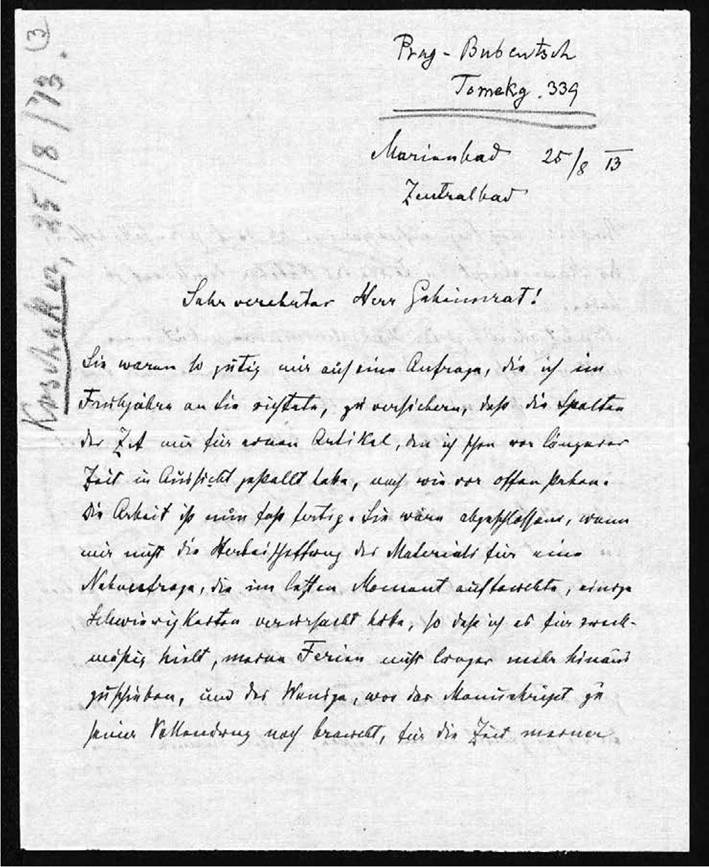
Picture nr. 1: Letter by Koschaker to Carl Bezold, 25th August 1913 First page (UAH, 1501-113)
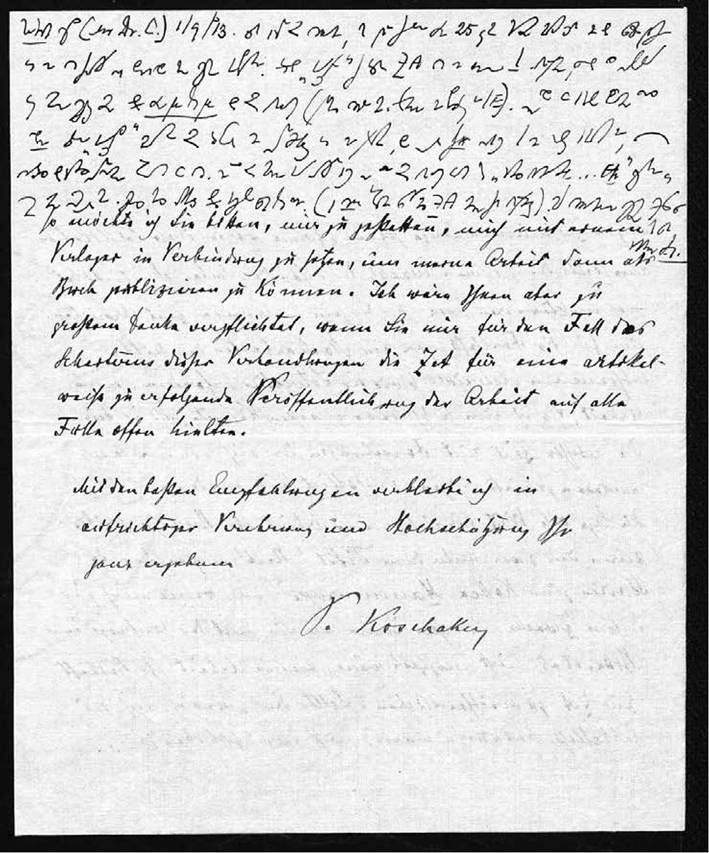
Picture nr. 2: Letter by Koschaker to Carl Bezold, 25th August 1913 Fourth page (UAH, 1501-113)
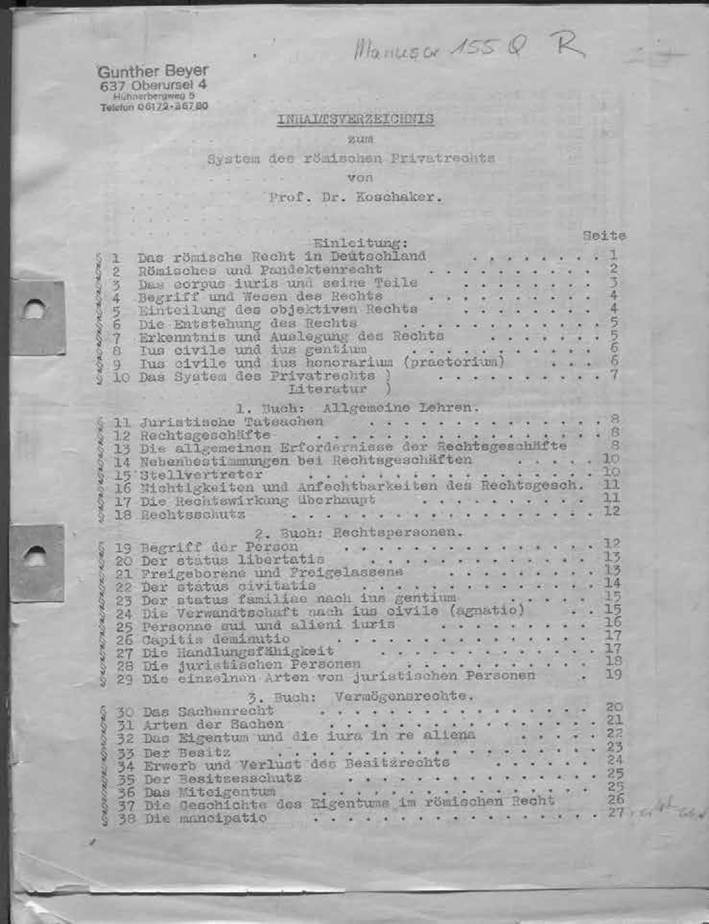
Picture nr. 3: Koschaker: System des rГ¶mischen Privatrechts (library of the Max-Planck-Institut für europäische Rechtsgeschichte,
Manuscr. 155 Q R). First page of the Table of Contents.
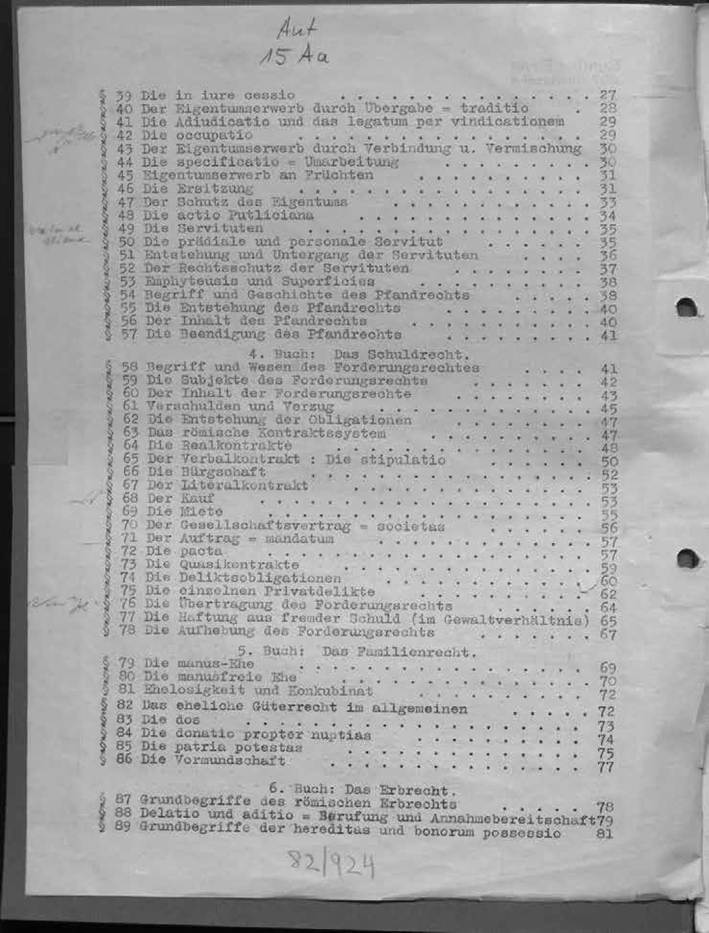
Picture nr. 4: Koschaker: System des rГ¶mischen Privatrechts (library of the Max-Planck-Institut für europäische Rechtsgeschichte, Manuscr. 155 Q R). Second page of the Table of Contents
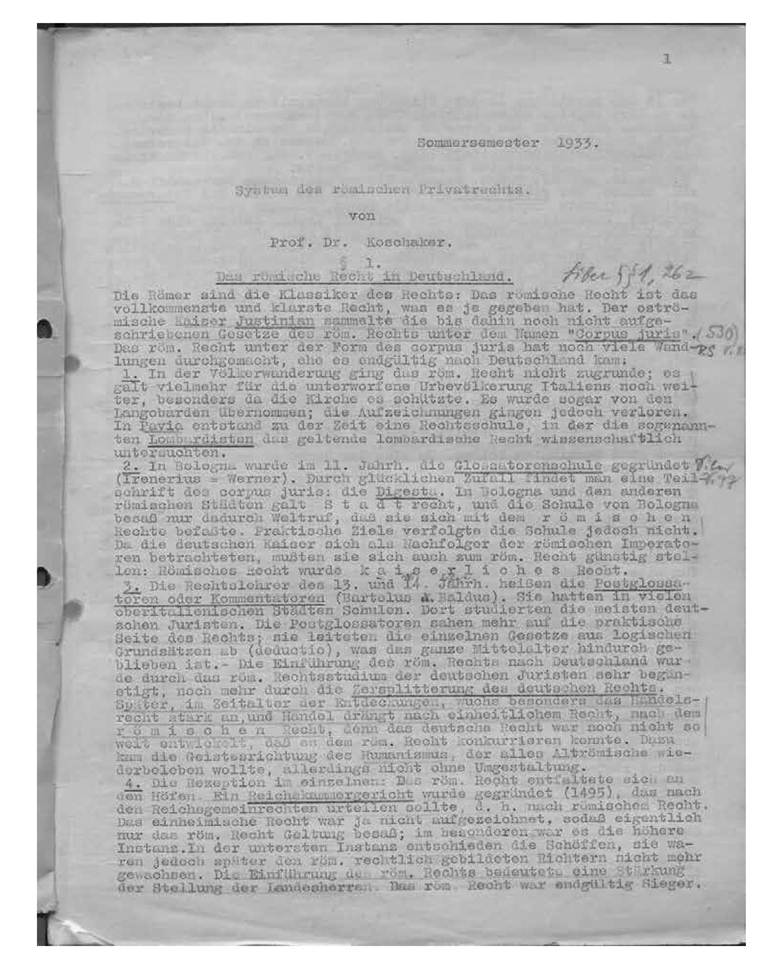
Picture nr. 5: Koschaker: System des rГ¶mischen Privatrechts (library of the Max-Planck-Institut für europäische Rechtsgeschichte, Manuscr. 155 Q R). Page number 1 of the manuscript
3
More on the topic 2.5 Koschaker’s final years in Leipzig and the road to Berlin in 1936:
- From Graz to Leipzig (1897-1936)
- Koschaker in Berlin (1936-1941)
- 2.2 The call to Leipzig
- The unpleasant period in Berlin
- 3.2 Savigny’s Chair in Berlin
- The road to total war
- 3.8 Leaving Berlin
- 2.3 Dogmatic approach and comparative method: Koschaker’s two souls?
- 4.6 The last years in Tübingen and the Emeritierung
- 4.5 Koschaker’s pupils in Tübingen: Below, Wesenberg and Pescatore
- FINAL SETTLEMENT
- Hume’s Position Considered for the Final Time
- Life at the University in Berlin
- 1941-1951: the years in T übingen and after WWII
- 5.10 Koschaker’s masterpiece: Europa und das römische Recht
- 5.6 Final remarks on Die Krise des römischen Rechts und die romanistische Rechtswissenschaft
- 5.4 Koschaker’s proposal
- 5.3 Koschaker’s criticism of the Historisierung of Roman law