Conclusion
Contrary to widely held stereotypes, the medieval English state thus had an extractive capacity that exceeded that of its most prominent adversary, France. This is not surprising, however, since “the country with the largest number of taxpayers in Western Europe, France, also had, until
o.so
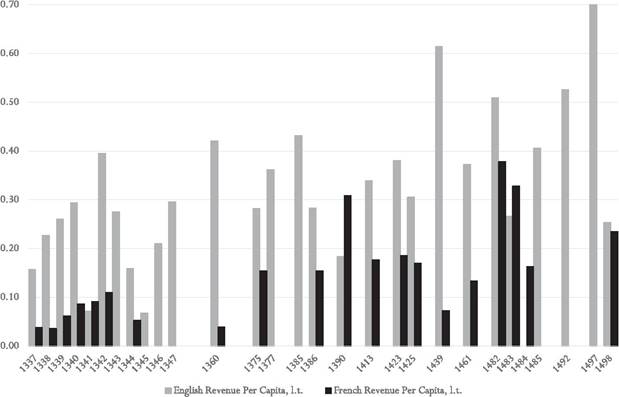
Figure 6.7 English and French per capita taxation, in livres tournois, 1337-1498
Sources: See Figure 6.2 and Figure 6.6.
1790, the largest number and highest proportion of fiscal exemptions,” according to historian Richard Bonney.82 One key to this divergence, I have argued, lay in the ruler’s power to tax the nobility, which had “trickle-down” effects on the population.
Taxation of the nobility, the most powerful social group in any preВmodern polity, helped enable a representative institution to become an inclusive organ of governance. It is not taxation alone that generates this outcome, but the royal capacity to compel powerful actors. Where the nobility was not compelled or taxed, as in most Continental states and most prominently France and Castile, few incentives existed for that group to seek a regular presence in such institutions or to counteract the power of the crown. Opposition to royal power happened mostly locally and in a decentralized way. By contrast, once the nobility was collectively organized within Parliament, it could overcome its collective action probВlem. This did not limit extraction, however.
The bargaining logic, which has long dominated accounts of instituВtional emergence, thus arises at a secondary level. It follows an antecedent stage, predicated on state capacity, in which noble judicial service meant a regular presence in Parliament - the dynamics explored in Part I. In Durkheimian fashion, the “contractual” exchange on taxes had instituВtional results where norms already imposed obligations on the actors most capable of eventually exercising resistance to the crown and demanding accountability. “No compellence of elites, no representative institutions” could well be the motto of the European historical precedent. When taxation declined from the 1550s, the most “despotic” period of English history ensued.
82
Bonney 2012, 93.
More on the topic Conclusion:
- Not a Conclusion, But a Step on an On-Going Journey
- Conclusion
- Conclusion
- In Conclusion
- Conclusion
- Conclusion
- Conclusion
- 4.11 Conclusion
- Conclusion
- Conclusion