Comparative Extractive Capacity of England and France
Throughout the book, I have argued that the English crown’s precocious capacity to compel its subjects, especially the most powerful ones, increased its per capita extraction, even before Parliament made its beginВnings in the 1220s.
In this section, I present data to support this claim.As noted in earlier chapters, the extractive strength of the English state has been highlighted by historians, but it has typically been placed after the fifteenth century.[740] Only Michael Mann’s pivotal study on the early English state went back to the period of origins examined here, strikingly demonstrating both the early fiscal capacity of the English crown, espeВcially since the 1300s, and its increase during times of war.[741]
In this section, I expand on Mann’s findings by setting English extractive capacity in a broader framework. Medieval historians have long emphaВsized English superiority in both fiscal and military extraction. On revenue, Joseph Strayer noted that the English could match the French “man for man” and “pound for pound” already in the 1290s, despite having less than a fifth of their population and “much less” than a fourth of its wealth.[742] On military extraction, the historian Michael Prestwich remarked that in the fourteenth century, during the Hundred Years War, English armies were “the most formidable in Europe, and achieved astonВishing success at Crecy in 1346 and at Poitiers ten years later.”[743] The data below show that these points were part of a systematic pattern.
First, on the military front, through an original dataset compiling eviВdence from a broad array of historical sources[744] between 1200 and 1800, I show the remarkable advantage that England had compared to the French.
To assess state capacity, per capita number of troops is the approВpriate measure;[745] the absolute sizes of armies are relevant for questions of international relations. Except for a period in the seventeenth century (which frequently forms the basis of comparison about military strength), England consistently outnumbered French armies on a per capita basis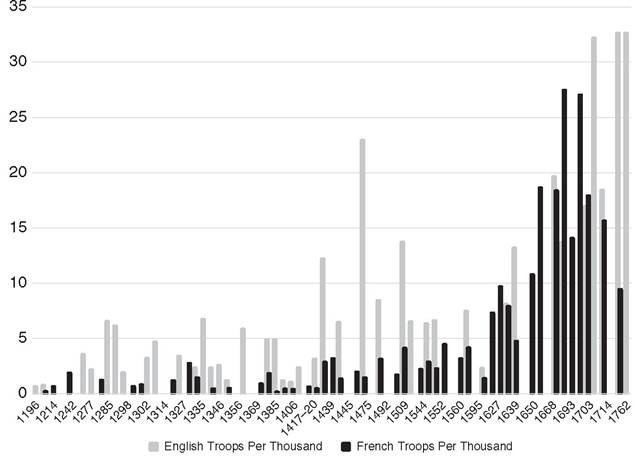
Figure 6.1 Number of troops raised, England and France, per thousand of population, 1200s-1700s
Sources: Armies: Online Appendix D. Population: McEvedy and Jones 1978 for France and Broadberry et al. 2015, 20 for England.
(Figure 6.1). It raised three times more per capita between 1200 and 1400 and 60 percent more over the whole period. Such mobilizational power explains the disproportionate role England was to play during the premodВern period on the Continental military arena and beyond.
Fiscal extraction displays the same pattern. Comparing revenues for the period before 1500 is a very hazardous task, given data quality. No continuous series exist for France, though some do for England; separatВing central collection from local expenditures is mostly impossible; and actual yield mostly cannot be deduced from amounts expected. Figures can occasionally be supplemented by detailed historical studies of expenditures in individual wars, but these figures too are far from unprobВlematic, since spending may reflect the importance of the specific battle, which need not be identical for both sides.75 Readers interested in a detailed discussion of the sources used and adjustments made should consult online Appendix A. All premodern figures are provisional.
75
Barratt 1999b.
First, I examine English extraction. Figure 6.2 shows that in the later twelfth century, when the judicial infrastructure was being systematized, extraction was not much less than at the turn of the seventeenth century! Moreover, extraction doubled in the 1280s before Parliament acquired its “model” form with full representation, reflecting strong royal powers.
Taxation increased drastically after 1300, but this reflects the inclusion of indirect taxation, which in Chapter 9 will be shown to originally have tenuous connections to Parliament. Nonetheless, this period of parliaВmentary consolidation saw extraction reach peaks that were not matched until after the Civil War. Parliament certainly did not limit extraction. Instead, extraction declined when the regime underwent its most “desВpotic” phase, during the late sixteenth and seventeenth centuries under the Tudors and Stuarts - as this argument predicts. Ironically, this irregular period has served as the baseline for assessments of English capacity.Further, novel estimates by economic historians Broadberry, Campbell, Klein, Overton, and van Leeuwen allow us to challenge an intuitive assumption about this increase, that it reflects rising wealth due to trade. These new estimates show that real per capita taxation grew quite independently of real GDP growth per capita (Figure 6.3).[746] They also confirm that per capita taxation as a percentage of per capita GDP was higher in the 1300s than at any point until the 1660s (about 2.3 perВcent), as Mark Ormrod argued,[747] to an average of 1.9 percent from 1130 to 1640 (Figure 6.4).
English capacity emerges more clearly in the next graphs, which compare with per capita extraction in France. They show that the English extractive advantage preceded the formation of Parliament. Figure 6.5 shows an estimate of the “disposable war revenue” of John and Philip Augustus in 1202/3 and 1210-14. English revenue was more than double, even triple French resources at a per capita level. The advantage was amplified as the daily cost of troops was lower for the English. As until 1205 John controlled much French territory and extracted revenue from Normandy, per capita extraction is also reported without Norman revenues (which amounted to only 19 perВcent of disposable war revenue); the English advantage remains.
Technically, however, that revenue belonged to the French king as0.400
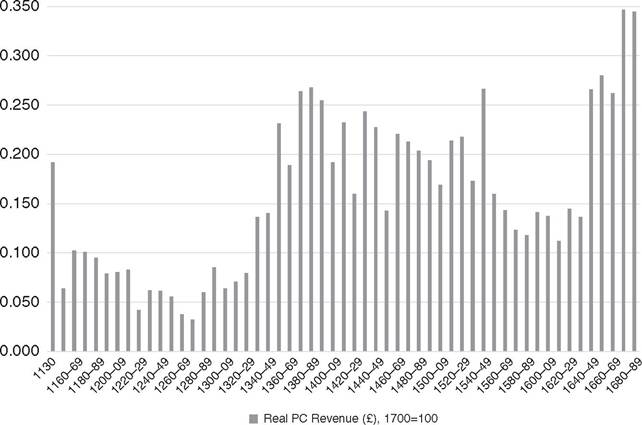
Figure 6.2 Real English taxation per capita (1154-1689), in 1700 £.
Sources: See discussion in Figure 4.1 and online Appendix A. Here supplemented by Steel 1954 for 1377-1455, Ormrod 1994 for 1462-85, and O’Brien 1993 between 1485 and 1688. Forpopulation: Broadberry et al. 2015, 20 until 1541, and Wrigley et al. 1997 after 1541.
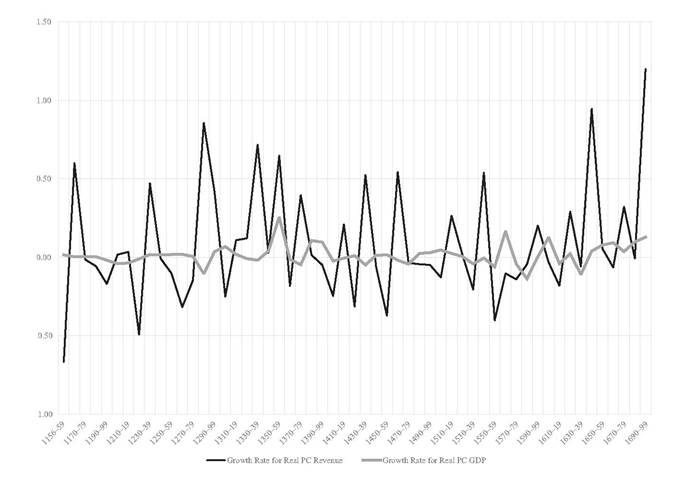
Figure 6.3 Real English per capita growth rates for taxation and GDP, 1154-1689
Sources: See Figure 6.2. For GDP after 1270, Broadberry et al. 2015 and for 1130-1270 Walker 2010.
John’s feudal overlord. That John could appropriate it against him reflects the weakness of the French crown.[748]
The same ratio emerges from overall taxation estimates. Between 1200 and 1250, when Parliament was emerging, the average ratio of English to Frenchper capita revenue was 2:1. Between 1300 and 1500, the average ratio was 3:1. When we exclude four very high, though well- sourced, ratios, the ratio is still 2:1 (see Figure 6.6 and Figure 6.7).[749] That the exchange rates used may be, if anything, under-reporting the English advantage is suggested by the ratio based on revenue figures expressed in silver for the period between 1322 and 1345: it reaches up
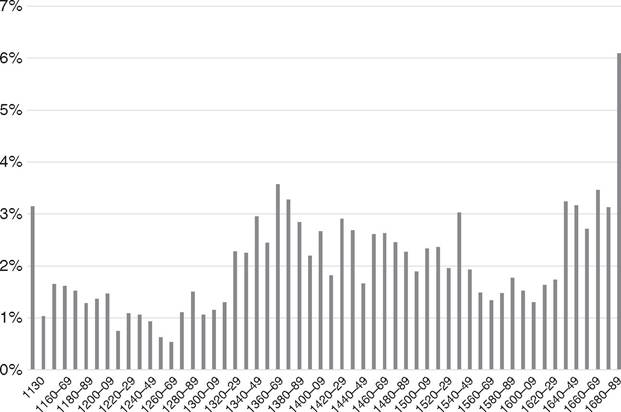
Figure 6.4 Ratio of English per capita taxation to per capita GDP, 1130-1689
Sources: See Figure 6.3.
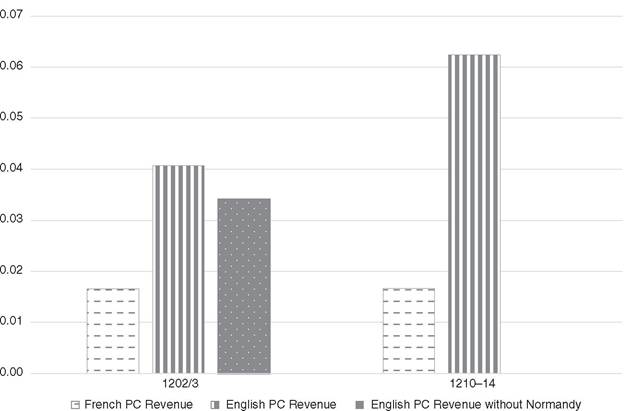
Figure 6.5 English and French per capita war revenue, 1202/3,1210-1214 Source: Barratt 1999b, 93, 97.
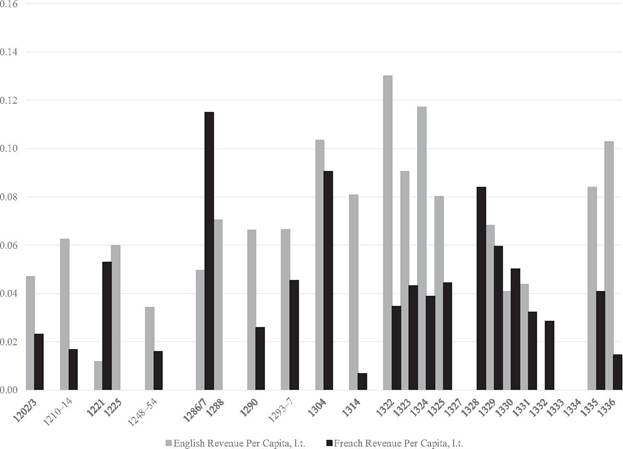
Figure 6.6 English and French per capita taxation, in livres tournois, 1202-1336
Sources: Online Appendix A. Exchange rates between the English pound and the French livre tournois are derived mainly from Spufford 1996 in ways described in online Appendix A.
to six to seven times French levels and has an average of 3.6:1 (a discrepВancy that suggests caution with all these figures).[750] It is only in the 1500s that France was able to catch up and exceed English extraction, as the data in Karaman and Pamuk suggest - and that was reversed by 1700.[751] Figure
6.2 has shown how the sixteenth and early seventeenth centuries were a low point for England compared to the two previous centuries.
6.4