Appendix A: Jury Selection in the Wounded Knee Trial
Attention was drawn to the Wounded Knee trial not only for its well-known defendants and striking issues but also because a team of social scientists assisted the defense in jury selection.
Jay Schulman and Richard Christie, who served as similar consultants for the defense in the Harrisburg Seven, Camden Twenty-Five, and Gainesville Eight trials, began to work two months before the trial opened, aided by some fifty volunteers. They developed a sociological profile of the community from which the potential jurors would be drawn by phoning 576 people at random with questions about attitudes toward, among others, Indians. Each of the 133 on the full panel was investigated, and ten observers during the voir dire questioning watched for emotional cues displayed by potential jurors through such signals as their body language and responses to authority by attention to the judge or by responding “Yes, sir” (Time, January 28,1973, p. 60; Gordon Germant, “The Notion of Conspiracy Is Not Tasty to Americans: An Interview with June L. Tapp,” Psychology Today, May, 1975, pp. 60–65).To begin with, the full panel of 133 was a random sample of the voter registration lists and was representative of the community. These 133, as table A.1 shows, were equally divided between men and women and had an average age of 42. Judge Nichol asked questions of them which would, first, establish who among them could serve on the jury without hardship and second, based on questions from the attorneys, who could serve without bias. Of the 87 who were excused because of a hardship or dismissed because of a possible bias, 24 (28 percent) had family reasons and 26 (30 percent) had job reasons, while 20 (23 percent) were dismissed for cause, 7 by the judge, 11 after defense challenges, and 2 from prosecution challenges. (See table A.2.)
The hardship excuses included 2 women who were expecting babies and the husband of an expectant mother, 10 people who were responsible for the care of small children, 4 who took care of spouses or elderly relatives, 3 who ran farms, 4 who were either self-employed or
TABLE A.1
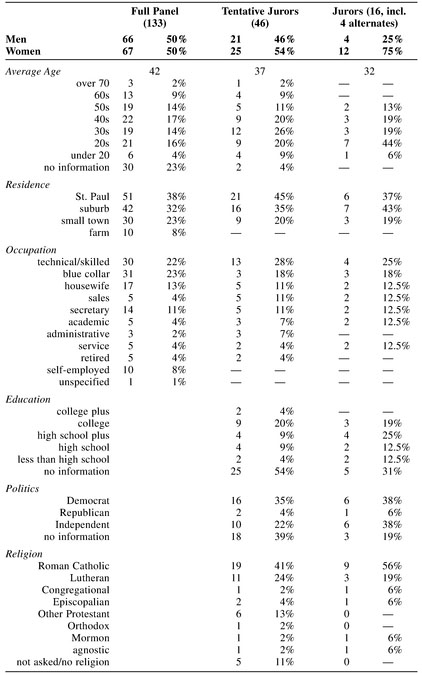
TABLE A.2
| I Excused by Judge Nichol | 74 | |||
| A. Hardship | 67 | |||
| Family (24) | ||||
| general | 7 | |||
| expecting or wife expecting | 3 | |||
| care of small children | 10 | |||
| care of other relative | 4 | |||
| Job (26) | ||||
| general | 8 | |||
| farm | 3 | |||
| self-employed or working on a commission | 4 | |||
| essential to employer | 3 | |||
| jury duty will jeopardize job | 4 | |||
| will miss opportunity for promotion | 1 | |||
| financial hardship, e.g. house payments | 3 | |||
| Health (4) | ||||
| Age (2) | ||||
| Other Hardships (11) | ||||
| nervous | 3 | |||
| sequestering would be a problem | 3 | |||
| a trip is pending | 2 | |||
| live further than 75 miles from St. Paul | 3 | |||
| B. Cause | 7 | |||
| Conflict of Interest (1) | ||||
| Bias (6) | ||||
| believes defendant must prove innocence | 4 | |||
| cannot lay aside views | 2 | |||
| II Defense Challenges for Cause | 11 | |||
| accepted | denied | |||
| believes defendant must prove innocence | 4 | 1 | ||
| believes defendant should testify | 3 | |||
| will believe police because they are police | 1 | 1 | ||
| strong opinions | 1 | |||
| lied in voir dire | 1 | |||
| other | 1 | 3 | ||
| III Porsecution Challenges for Cause | 2 | |||
| Total excused or dismissed for cause from full panel of 133 | 87 |
worked on a commission income, 7 who were essential to the employer or would jeopardize their job by serving on the jury, 3 who were visibly nervous, and 2 who were excused because of age (80 and 70).
One spry woman of 81 who was active in civic affairs and well-read (she had read Dee Brown’s Bury My Heart at Wounded Knee and subscribed to Progressive) was asked if she wanted to be excused, and replied that she would not, that she would serve if passed. After a long bench conference, during which Hurd expressed concern for the reading she had done, especially Brown’s book, she was accepted as a potential juror without challenge (trial transcript, Vol. 4, pp. 660–698). Perhaps the most unusual hardship claim was made by the wife of a prominent St. Paul businessman who said that her son was soon to be married, her daughter was returning from a long voyage, she and her husband were planning a thirty-fifth anniversary vacation, and finally that her husband was “a brilliant person, but he doesn’t know how to cook, and this, in itself, would be difficult for me.” The Court: “Well, that sounds like there’s some reason behind that. How about counsel?” Hurd for the prosecution requested that the judge inquire whether or not she preferred to be excused. She did. Kunstler said the defense had no objections. She was excused (trial transcript, Vol. 9, pp. 1539–1544).Seven members of the panel of 133 were dismissed by Judge Nichol because they might prejudge the case, and he granted eleven challenges for cause by the defense and two by the prosecution. In most instances the prospective juror could not accept that the defendants did not have to prove their innocence. “Well, if they are entirely innocent they probably wouldn’t even be here,” replied a 37-year-old radar repair foreman (trial transcript, Vol. 16, p. 2906). Judge Nichol asked a 67-year-old semiretired farmer: “If your view of the law totally conflicted with what I instructed you the law was, would you still follow my view of the law?” He replied, “That is a hard one to answer, Your Honor.” Court: “It is an important question. We need to know.” Answer: “Your Honor, I wish you would reject me before I give you an answer on that one.” He was excused (trial transcript, Vol.
10, p. 1888). A small-town police chief and a secretary for a law firm of prosecuting attorneys were both excused because they would be unable to set aside their prejudice in favor of the prosecution.The extensive investigation by the defense team into the background of the prospective jurors revealed itself when a 46-year-old housewife and mother of three claimed that she attended the Methodist church regularly. Kenneth Tilsen told the judge at the bench that he had information that she had not been to church for two years because the minister was active in antiwar activities and race relations. When faced with her attendance record, she claimed that she had stopped going because “our church services have turned more into a civic meeting where the name of God was never mentioned.” The challenge for cause by the defense was granted (trial transcript, Vol. 3, pp. 353–361).
After the 87 were excused for hardship or disqualified for cause, the remaining 46 constituted the tentative jurors. They were somewhat younger, more urban and suburban, and less small-town and rural than the full panel of 133. (See table A.1.) The 46 were composed of 38 possible jurors and 8 possible alternates who would be cut by the preemptory challenges by the attorneys (20 cuts by the defense and 6 by the prosecution; there was a similar proportion, 3 and 1, for the alternates).
The 12 jurors and 4 alternates selected to hear the case did not differ markedly from the tentative group of 46 except that all but 4 were women. Of the 16 people, the average age was 32. Eight were under 30, including one 19-year-old, and 5 were over 40, including two in their mid-50s. The 16 chosen for the jury box were slightly younger than the group of 46 over which the lawyers exercised their preemptory strikes. They were also more suburban and more Roman Catholic. (See table A.1.)
The 16 sworn in as the jury and alternates can be grouped into several occupational categories:
1. Technically Skilled
John K.
(age 27). Chosen jury foreman; tool grinder from Red Wing (50 miles South of St. Paul); father of two small girls; Irish-German; 10th grade education; Democrat; president of his local machinists’ union (for a term that included a 16-week strike); Vietnam naval veteran; married to an active Mormon, although not active himself; never reads newspapers and seldom watches the TV news, “just the weather report”; said about Wounded Knee: “I just knew it was happening, but I don’t know anything about it. I didn’t really pay attention to it” (trial transcript, Vol. 10, p. 2073).Nancy C. (age 31). Degree in electrical engineering from the University of Wisconsin; both she and her husband work for Control Data; lives in suburb of White Bear Lake; German; Lutheran; Independent; reads National Observer but no other newspapers or magazines; does not watch TV news; never heard of Means, Banks, Kunstler, or Lane, the BIA or AIM, and did not recall much about Wounded Knee.
Theola D. (age 53). Research analyst for the Minnesota Highway Department; degree in Sociology from the University of Minnesota; single, lives in St. Paul with mother and sister; English; agnostic; Independent; avid reader including both St. Paul newspapers and news magazines; had been a juror in two prostitution cases with one conviction and one acquittal.
Fran A. (age 20). Technical illustrator with Honeywell; two years of vocational school; single, lives with parents in close-in suburb of Falcon Heights; father a Bell engineer; Scottish; Roman Catholic; not a union member; does not watch TV news; did not know who Means and Banks were and was not familiar with Indian history.
2. Blue Collar
Therese C. (age 53). Employed by the St. Paul Post Office; five children, two at home; three husbands, all in World War II, first died in war, divorced second; lives in suburb of Mahtomedi; Roman Catholic; Democrat; had been contacted in the random survey by the defense but declined to answer any questions about Wounded Knee because she had been called for jury duty.
Richard G. (age 32). Phone installer; father of five children aged 4 to 13; Mexican-American, married a Mexican-American; lives in St. Paul; Roman Catholic; Independent; reads only St. Paul Sunday paper, no magazines; went to school with Indians.
Patrick A. (age 24, alternate juror). Dockman for a trucking company; single; lives in St. Paul; grew up in the San Francisco area but attended school throughout California and also in Libya because his father was an engineer and his stepmother worked as a secretary in the embassy; nominal Roman Catholic; Independent; had been in air force but was released on a general discharge after going AWOL; college dropout; interested in motorcycles and science fiction; reads Minneapolis newspaper, Time, Newsweek, and Psychology Today.
3. Housewives
Geraldine N. (age 42). Housewife with four children, including a married daughter and a son in his freshman year at Augsburg College; lives in St. Paul; Swedish; Lutheran; Independent with leanings toward Democrats; husband works as a maintenance supervisor at a refining plant; has heard of Kunstler, Means, Banks, and Wounded Knee; reads the St. Paul newspaper and U.S. News.
Linda L. (age 26, alternate juror). Housewife and a night waitress at a pancake house where her boss is an Indian; mother of two, aged 3 and 5, who could be cared for by her mother; lives in Falcon Heights; Scandinavian; Congregational; member of Eastern Star; active Republican; was a delegate to the state convention; husband works at a garden center; reads St. Paul newspapers.
4. Sales
Susan 0. (age 19). Department store clerk; plans to return to college as a sophomore with a criminal justice major; lives in St. Paul with parents; father works at UNIVAC and mother is a high-school teacher; Roman Catholic; read part of Bury My Heart at Wounded Knee.
Elaine G. (age 40, alternate juror). Clerk at Wards; mother of three (21, 20, and 14); husband an engineer at Control Data and World War II veteran; lives in White Bear Lake; French; Democrat; active in Missouri Lutheran Church; 10th grade education; reads the St. Paul newspaper.
5. Secretarial
Louanne B. (age 42). Secretary in the Personnel Department of a manufacturing firm in Owatonna, 70 miles South of St. Paul; divorced and has custody of her five children, aged 13 to 22; German; Roman Catholic; Democrat; first cousin married an Indian; reads both Minneapolis and St. Paul newspapers and Time, but watches very little TV; recognized Kunstler as involved with the Chicago Seven trial.
6. Academic
Maureen C. (age 22). Librarian in West St. Paul; when a student at St. Catherine’s College took a class in Indian culture and religion from a teacher who was an AIM member, but she said it did not deal with the BIA or treaties; “The only thing I can really remember discussing to any extent with anyone was the sweat lodge” (trial transcript, Vol. 7, p.1164); lives in Mendota Heights, a suburb, with parents; father is a bank officer and brother a doctor; Scottish; Roman Catholic; Independent.
James P. (age 22). Student at Winona State College, arranged with the dean to make up classes missed; home is Rochester; works in Rochester State Hospital with mentally retarded during summers; Episcopalian; English; father a hotel bellman; mother active Republican; Eagle Scout; heard Kunstler speak two years earlier about Chicago Seven trial; “I shouldn’t say I agreed with him, but I kind of felt that he was kind of right, in a way” (trial transcript, Vol. 9, p. 1554).
7. Service
Katherine V. (age 20). Nurse’s aide in a nursing home; plans to enter convent; one year at junior college; lives with parents in suburb of Burnsville; father in sales at Honeywell; Independent; Roman Catholic but did not know who the Berrigan brothers were; does not read newspapers; did not know about Wounded Knee; brother killed in Vietnam three years earlier; when asked if she felt her brother’s death had been a waste, she replied: “No, I don’t think it was a waste. I think we have to trust that the government is right just because, like in Vietnam…they were right in being in the war. But to complain and try to criticize the government isn’t the way…to go about changing…making it better” (trial transcript, Vol. 14, p. 2693); challenged by the defense for cause but Judge Nichol denied the challenge.
Joyce S. (age 33, alternate juror). Safety officer at Macalester College (not a police position); lives in St. Paul; divorced, recently remarried; husband a machinist at Ford plant; five children (9 to 15); two years at junior college; Irish; Roman Catholic; Democrat; reads St. Paul newspapers and Time; recalls seeing Kunstler, Means, and Banks on TV.
More on the topic Appendix A: Jury Selection in the Wounded Knee Trial:
- Appendix A: Jury Selection in the Wounded Knee Trial
- Christenson Ron. Political Trials: Gordian Knots in the Law. Routledge,2011. — 357 p., 2011