Spend and Supplier Management: Applying Business Savvy to Buying Legal Services
Law firms and other suppliers of legal services constitute the majority of legal department spend, therefore effective legal spend management requires effective supplier management, which has several aspects: systematic use of a panel of law firms and non-law firm legal service providers, an effective engagement letter and billing guidelines, electronic billing tools, a formal program for outside counsel selection and management, and a framework for “legal spend under management.”
Buying legal services cost effectively begins with having a range of sound choices in the legal department’s panel of providers, then ensuring that work is assigned appropriately depending on the profile of the work.
The most effective legal operations use a systematic approach to match matters to appropriate firms and alternative providers based on type of matter, complexity, risk, business impact, and other factors, balancing priorities and outcomes required against cost. Such a system can also facilitate effective alternative fee arrangements.Implementing an effective engagement letter enables the legal department to reset expectations and terms of engagement across all prior relationships, both formal and informal, with panel firms. When we help clients develop engagement letters and billing guidelines, we recommend a concise charter for working together with outside counsel, including:
• A statement of purpose
• Partnership expectations
• Technology and information security requirements
• Matter and timekeeper procedures
• Billing and invoice submission rules (including resolutions and penalties)
• Budgeting, forecasting and accrual rules
• Staffing guidelines
Also, CLOC has defined a set of standard billing guidelines for use by legal departments across a wide range of industries. These guidelines are publicly available on the CLOC website at cloc.org.
Electronic billing was once seen by legal departments as a nice-to-have technology, but now it is viewed as an essential tool for effective spend management, streamlining the invoice review and approval process, enabling automated rules to help enforce billing guidelines, and making possible sophisticated legal spend analysis and management.
E-billing also increases the efficiency of expert invoice review. Professional invoice review services typically identify 5-10 % savings on legal bills while also reducing the amount of in-house time and resources spent on invoice review. An effective review methodology will check compliance to guidelines, reasonableness of charges, and billing accuracy. In-house lawyers who rarely look forward to checking invoices and negotiating with outside counsel are often relieved to have this responsibility taken up by the legal ops team or a third party service, escalating to them only when necessary. While e-billing and expert invoice review can be used independently of one another, they are substantially more effective when used together.
In addition to cost containment, legal departments can use expert invoice review to gain insights into what lawyers are actually doing, and then use those insights to more efficiently approach certain practices of law. For example, one of our clients used this analysis to identify and selectively assign specific activities to firms that were especially efficient in those areas. Another client used our analysis of invoice line items to calculate benchmarks for flat fee structures, making cost more predictable for certain kinds of matters. In other words, expert invoice review can reveal insights from the massive volume of billing data, which can deliver targeted opportunities to reduce budget uncertainty.
Handling billing data electronically also enables other valuable business practices. For example, we helped the NetApp legal department use their billing data to create an automated system for verifying whether proposed hourly rates for outside counsel lawyers are “fair market value.” The system benchmarks proposed rates entered in the e-billing platform against NetApp's historical spend data as well as industry-wide legal spend data.
The legal operations team uses this information to set systematically approved rates in the e-billing system, and they respond to the outside counsel firm with an auto-generated letter informing them of the rates approved by NetApp, advising the firm to respond to NetApp within 14 days if the approved rates pose any concern. This shifts the management burden of initiating any renegotiation from the legal department to outside counsel. The legal department openly invites their outside counsel firms to collaboratively use this benchmarking system with them so firms can proactively determine rates that fall within the objectively determined, approved ranges. With this new approach, the legal department has solved a typical cost management challenge of receiving annual rate increase letters from law firms. Made possible by an e-billing platform, this sophisticated business strategy has lowered costs by an average of 7 %, while helping NetApp legal reward outside counsel firms that propose market-appropriate rates (Fig. 11).
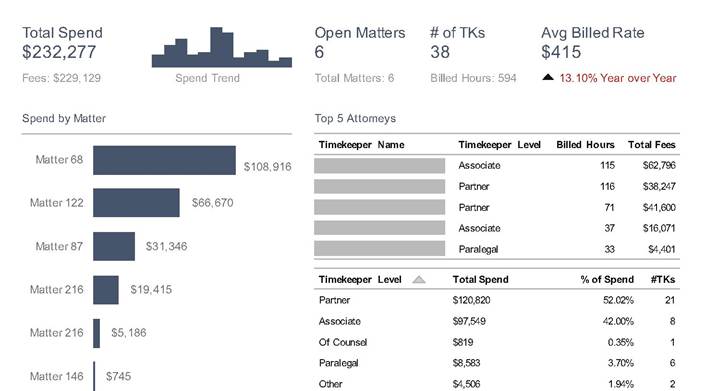
Fig. 11 Example of spend analytics benchmarking for a law firm, with timekeeper names redacted for confidentiality (Source: Elevate)
Business everywhere understands that spend management is most effective when coupled with relationship management for a holistic Supplier Relationship Management (SRM) program. This is especially applicable in the legal market, given the nuances, complexity and quality expectations inherent in legal work. In our experience, the best legal department programs for outside counsel management involve an investment of time in a regular rhythm of scheduled business reviews, supported by balanced scorecards (see Fig. 12 for an example used by the NetApp legal department), which measure and report performance across a range of criteria that the legal department values. Such investment delivers high ROI, including: improving the value of legal services delivered, increasing budget transparency and predictability, enabling successful alternative fee arrangements, fostering more objective discussions about law firm performance relative to law department needs, and generally improving working relationships with outside counsel.
Legal departments often wonder how deep to go with SRM.
In our experience, it varies depending on the size of the company, the legal department, and the size of panel firm relationships, but we often advise clients to apply an 80/20 rule: the bottom 80 % of spend should be passively managed through analytics, reporting, engagement letters, billing guidelines and bill review, but the top 20 % of spend| QualitativeAnalysis | ||
| Category | Score | |
| Subject Matter Expertise | 3.5 | |
| BusinessAlignment | 4 | |
| Responsiveness/Accessibility | 3.5 | |
| Project Management | 4 | |
| Budgeting Accuracy | 2.5 | |
| Creativity | 3.5 | |
| Proactive Execution | 3 | |
| Aggressiveness to Resolve | 1 | |
| Communication | 3 | |
| Partnership/ Trustworthiness | 3 | |
| Quality and Presentation | 3.5 | |
| Results/Outcomes | 3 | |
| QuantitativeAnalysis | ||
| Category | Performance Details | Score |
| Staffing Models | • High Partner-leverage (65%) for compliance and products matters • Overall, high partner leverage across all matters (47%) | 2 |
| Staffing Efficiency | • 55 Unique TKs used to provide 1.73 FTEsworthof work(32TK/FTE); 52% higher than firm portfolio average (21 TKs/FTE) • Legal research activities are being performed by high-level resources at very high rates ($404 WABR); | 1 |
| Fees/ Costs | • Partner-level rates higher than portfolio averages for compliance and products area ($652/hr. vs. $561/hr.) • Associate-level rates generally in line with Client portfolio averages | 2 |
| Compliance | • Paralegal rates well above allowed averages ($246 vs. $100) • Billing precision score is 3.55/5; Ranked 49/77 Firms • Timely, accurate and consistent submission of invoices problematic. | 3 |
Fig. 12 Balanced scorecard example used in outside counsel management by NetApp for one of their law firms (Source: NetApp and Elevate)
should be actively managed using regular business reviews, balanced scorecards, alternative fees, etc. In general, focusing on the firms and matters that account for the largest amounts of spend will achieve the largest impact.
These same SRM principles apply to non-law firm legal service providers, including, discovery and document review providers, traditional LPO and other “NewLaw” type providers. As a non-law firm provider of legal services, we actively encourage clients to participate in quarterly and annual business reviews of our performance, using a balanced scorecard.
We have seen law departments realize annual savings of 5-15 % in outside legal spend using SRM programs, which have led to lawyers at both the law firm and the legal department working more effectively and efficiently. It takes time, but by working with outside counsel methodically, an SRM program provides the continuous improvement framework and roadmap to implement other business disciplines, such as better budgeting, project management, alternative fee arrangements, and unbundling or right sourcing legal work.
At a macro level, it is valuable to monitor “legal spend under management,” a concept adapted from sourcing organizations, which originally developed the idea of “spend under management” to gauge how much control and effectiveness they have in managing cost. The premise is that the most effective management of spend and service provider performance uses a blend of passive, active and collaborative measures, with increasing levels focus for spend associated with strategic or critical matters.
The model we use to advise clients on legal spend under management is shown in Fig. 13.Within this framework, legal departments should strive to manage almost all spend at the Visible level or better. The Not Managed category should include only a small percentage of spend, comprised of mostly of one-off spend items or spend controlled by another department. Beyond that threshold, a legal department’s passive, active, and collaborative strategies will be influenced by the department’s size, scope, and goals. Achieving the ideal state typically takes several years (see Fig. 13c), and we advise legal departments to build this into their strategic plan.
Legal spend management and supplier relationship management go hand in hand, applying business discipline to the business of law. Key elements of this include spend analytics, managed use of a panel of legal service providers (including law firms and others), an effective engagement letter, billing guidelines, electronic billing tools and expert invoice review, and a systematic approach to outside counsel management—all of which can be monitored at a macro level by applying the “legal spend under management” framework. Integrating these disciplines typically delivers 15-35 % savings per annum.
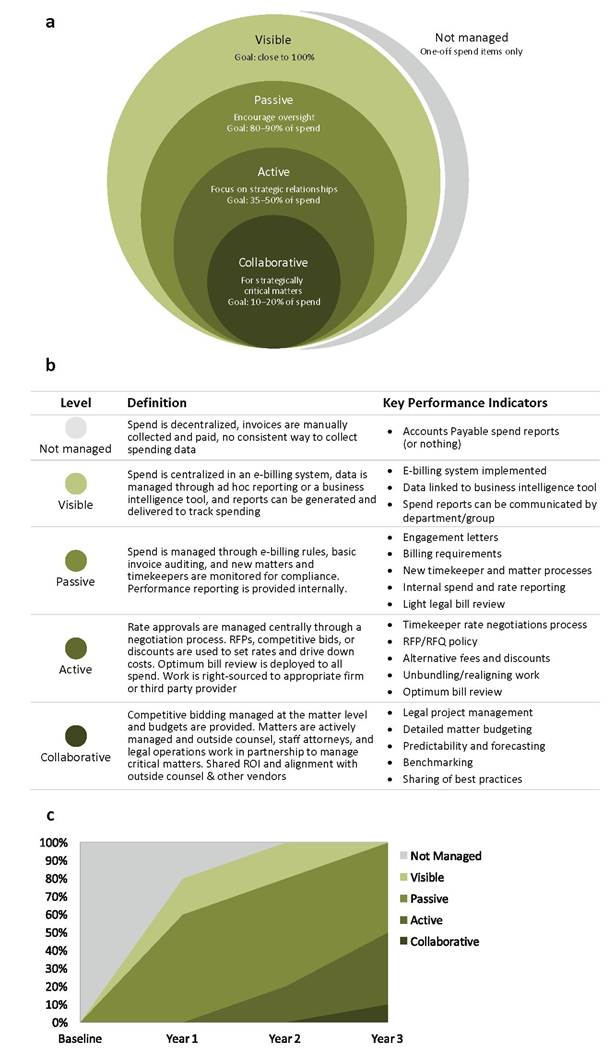
Fig. 13 Legal spend under management model (Source: Elevate). (a) Legal spend under management: conceptual framework. (b) Legal spend under management: definitions and key performance indicators. (c) Legal spend under management: example of multi-year progress
7