Right-Sourcing: Dividing (i.e., Unbundling) and Conquering
GCs are developing frameworks to decide what legal work to eliminate, automate, outsource, or retain in-house. Whether a legal department’s people work in-house or as an extension of the department via law firms or other legal service providers, “right-sourcing” makes the best possible use of those resources, ensuring they are engaged in their “highest and best use” by assigning them the work that is most appropriate to their capabilities and cost.
Right-sourcing results in improved levels of service to the business, operational efficiency and savings for the legal department, as well as job satisfaction and lawyer retention.Right-sourcing ties strategic planning, organizational design, and supplier management together. To make right-sourcing decisions, legal departments must assess the factors that impact the appropriate profile and location of the resource. Examples include:
• Whether the work is tied to the competitive advantage of the business
• Risk
• Regulatory considerations, such as cross-border data restrictions
• Specific jurisdiction or practice area knowledge requirements
• Level of knowledge of the business required
• Requirement to interact in-person or during same office hours with the business
• Turnaround time requirements and expectations
• Other dependencies, such as availability of talent or access to proprietary systems required
• Opportunity to automate
• Cost
• Project management and tying the work together
Legal departments now realize that some legal matters are divisible and assign each component of a legal case or transaction to a resource or provider whose capabilities, cost or business model are best suited to that specific task. By “unbundling” legal work, legal departments ensure that lower level work is delegated to more junior resources, freeing up more senior in-house lawyers for work that is more valuable to the business, or more complex work that would ordinarily be sent to outside counsel.
This improves the development of junior team members while managing risk appropriately, and it reduces the amount of lower level work being done by senior lawyers, increasing their job satisfaction. In some cases, right-sourcing identifies some work that doesn't need to be done by lawyers and reassigns that work to paralegals or administrators—or doesn't need to be done at all.Over the last decade legal departments have successfully unbundled litigation matters into value-added, bespoke advisory work, which is sourced from law firms; and repeatable, systematized document review and e-discovery, which is now handled efficiently by a non-law firm provider. With that large spend under control, many legal operations are now applying similar efficiency strategies to due diligence and contracts, including: streamlining processes, implementing technologies for automation, delegating repeatable work to lower cost resources, etc. In addition to significant cost savings and freeing up valuable in-house resources, this also provides several strategic advantages. Robust contract lifecycle management can improve service to the business, increase visibility, reduce risk, and improve compliance. It has enabled a global banking client of ours to support ring-fencing requirements and has enabled a global technology client to shorten speed to revenue by 14 days.
To ensure that work is methodically and efficiently delegated to appropriate resources, we work with our clients to implement formal systems for assigning work requests based on relevant factors of risk/impact and complexity. We have found that it is helpful to designate a “Legal Front Gate” that is the point of contact for stakeholders requesting support. As outlined in Fig. 10, this role uses a pre-defined complexity matrix to assess and assign work to a range of experience levels, as well as collecting metrics on turnaround time, work volumes, SLA compliance and other operational KPIs. In addition to enabling operational reporting, this creates a built-in feedback loop that helps the Legal Front Gate continuously improve criteria and processes for assigning work.
One of our clients, a global metals and mining company, has used this “Legal Front Gate” support model to manage a significant volume of in-house work in both English and French, tapping resources (provided by Elevate) based in the U.S., U.K. and India to support their legal offices in 11 countries worldwide.
Many GCs and Legal Ops leaders leverage non-law firm legal service providers to “extend and enable” their department, supporting a wide variety of day-to-day activities such as contract management, litigation investigatory document review, due diligence, and project management. This enables in-house lawyers to focus on
Legal Front Gate assesses work and tabulates complexity score based on work/task type, transaction complexity, and monetary value of underlying transaction
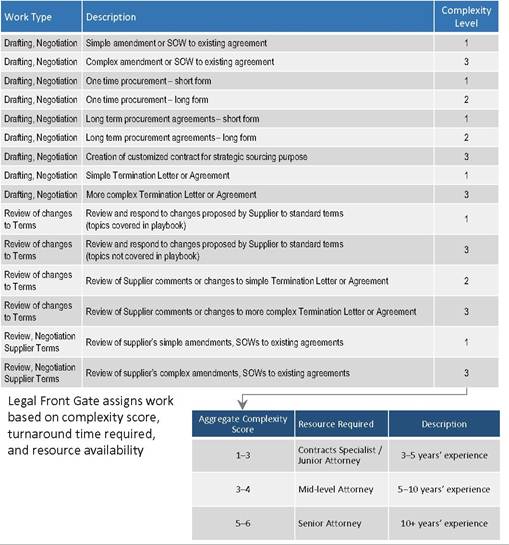
Fig. 10 Legal Front Gate assigning work using complexity matrix (Source: Elevate)
providing the business with exceptional legal services. It also enriches the careers of the in-house team, allowing them to take on more fulfilling challenges while providing hands-on experience delegating and managing work to others—a skill set that will be useful to their future careers.
7