Legal Sourcing
3.1 Procurement of Legal Services as an Operational Task
The mandate of a legal department ideally includes the responsibility for the complete delivery of services with respect to legal issues in the company.
Various options are available to a company to cover its demands for legal services. From a company's point of view, it is basically irrelevant whether these services are rendered through internal (make) or external resources (buy). It is only relevant that the company obtains a legally correct and adequate solution for the required purposes, which is sufficiently customized, customer-oriented and cost-efficient.Accordingly, an essential component of operating a legal department is the purchase of legal services and the management of outside counsel. The general counsel has become the actual buyer and an informed customer of the outside counsel. In this way, the otherwise existing information asymmetry between non-lawyers and outside counsel can be reduced or avoided. The involvement of external consultants is often connected to the fact that the related costs are associated with the legal department and therefore these expenses are allocated internally to this function. Because these costs typically account for a share of the annual legal department's cost, the related impact on the budget ought not to be underestimated. These costs appear regularly on the CFO's radar, and the general counsel is required to provide the necessary information and explanations. Thus, a policy that regulates, in particular, the provision of legal services by the legal department and the integration of these services into the value chain of the company, can significantly increase the efficiency and effectiveness as well as the standing of a legal department.
3.2 Options to Procure Legal Services
Whether and how someone should do a job does not only depend on whether or not he can actually do it.
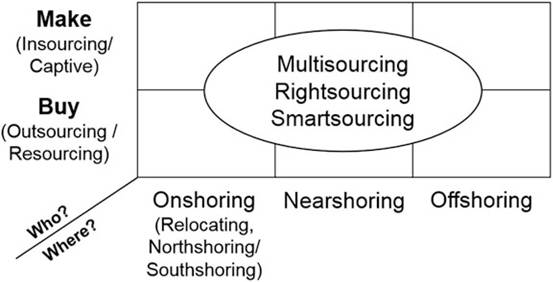
Rather, the question is whether or not it is efficient to perform the task. Since there are various ways of doing a job, there is the desire to do it as optimally as possible—depending on the specific needs on an individual basis. Consequently, the various service providers must be carefully selected and coordinated in order to ensure smooth cooperation. The need for coordination is also reflected in the many terms used to describe the various methods of legal sourcing. In order to reduce the confusion around these terms, it may make sense to organize and define the key terms as suggested in Fig. 2. It can mainly be distinguished by the service provider (make or buy) and the place of provision (out-, near- or offshoring). In my view, “rightsourcing” seems to be the proper generic umbrella term, since it addresses in the best and most neutral way possible both “make” and “buy” variants, including the sub-varieties and also the decision-making process for the most efficient and effective way and place of service provision, i.e. in terms of personnel, financials and time.3.3 Legal Department vs. Other Legal Services Providers
An organized legal department will first carefully analyze the overall legal services a company may need, and then identify the tasks and core competencies that should stay in-house and not be outsourced. Then it must assess whether a particular activity is of high strategic importance for a company and could have a significant financial impact on the balance sheet. Consequently, this activity may comprise a relevant threat to the company's reputation, represent an important competitive advantage, or could, in general, have a major impact on the company with respect to other risk aspects.
Further, an increasing number of innovative customers do not only consider traditional law firms but also any other legal service providers that have become
available in the market by now.
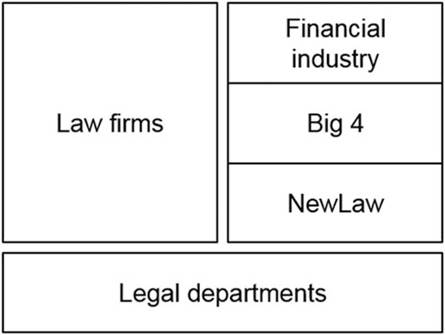
The decision may depend on the question as to which core activities need to be performed by qualified lawyers only. When considering the entire value chain to produce legal services, it is not necessary for all steps to be performed by qualified lawyers alone. The competitors of the big external law firms (“Big Law”) that offer the same or similar services as law firms, but at more favorable terms, include the legal branches of the big audit and accounting firms (the so-called “Big Four”) on the one hand, and all other providers in the financial sector on the other hand. These providers also cover all those providers that offer their customers certain selected legal services only (e.g., banking institutions, legal protection insurance and fiduciary companies).In addition to these alternative legal service providers, a next level of development is evolving. Third parties only perform certain parts of the entire value chain for the creation of legal services by offering new concepts and business models. These suppliers complement the legal market with new competition—initially mainly in the low-price segment, i.e. the consumer/retail legal services market— and are designated as “New Law”.
Numerous and different drivers and reasons exist for deciding in favor of “make” or “buy” on the one hand, as well as for mandating a law firm or an alternative legal service provider on the other hand. The decision will depend on the respective company, legal department and individual situation. In any event, an attentive external legal service provider should make sure that he understands the customer’s analysis and motivation when offering his services, since the customer defines the playground for business. It may be relevant for all outside service providers to note that there seems to exist a tendency in different countries to increasingly insource tasks which are associated with the expansion of the in-house legal department. The interest in doing more with internal resources particularly also concerns tasks in connection with transactions (e.g.
M&A). This is also cost-driven, considering that an hour of an outside counsel may cost up to three times as much as an hour of an in-house counsel (Fig. 3).Fig. 3 Provider of legal services (author’s own material)
3.4 Relevance of Project Management
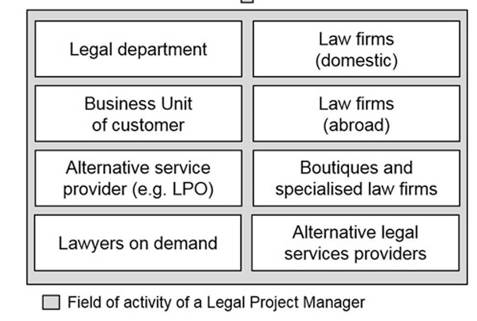
The disaggregation of the value chain and the consideration of various service providers require one key skill: project management. Neither legal departments nor law firms usually address the important question determining success, namely, who will assume the procurement of the various individual components of work and who will coordinate them with each other to form a logical and functioning whole at the end. Securing functioning interfaces and the perfect co-ordination and integration of the single pieces into an overall solution, which is certainly facilitated significantly through the utilization of IT, will ultimately decide whether and to what extent the efficiency and quality gains envisaged by the unbundling of services will be achieved. The designation “one-stop shop” will therefore no longer only apply to a full range supplier from a technical perspective, i.e. covering all legal subjectmatters; rather, this will now also include related services of a non-legal nature, with which someone—for example, a law firm—assumes responsibility for delivering and supporting work and projects from a single source. This includes in particular the responsibility for the selection, coordination and the reassembly of all partial services into a whole, single result, no matter who provided or produced the individual services. However, such a service requires knowledge and experience in project management, which may create new job profiles like those of a legal project manager (Fig. 4).
Fig. 4 Field of activities of a Company / Customer
legal p∣o∣ec∣ manag√∣ Ge∩era∣ Counsel
(author's own material) / ∖
4