Professional Procurement Process
4.1 Drivers
Nowadays, a customer procures external legal services in a much more professional way. In doing so, several objectives are being pursued: the customer ensures, among other things, a detailed analysis of the legal market, an improvement of the purchasing terms and a reduction of process-related costs, and as a further result, a reduction of total expenditures (i.e.
total cost of ownership). Improved information gathering and reduction of the number of suppliers provides increased transparency of the framework agreements and cost structure, which in turn allows the customer to achieve more efficient supplier evaluation and control. Moreover, legal departments are required to explain why they still outsource work and why external resources cannot be procured more cheaply. CFOs then often refer to the business consulting industry, which already suffered from and adapted to the new procurement principles earlier.4.2 Procurement Process in Ten Steps
The purchase of legal services features a few special facets. It is therefore necessary to separately address the underlying steps a customer typically faces in this particular procurement process. Outside counsel claim that the procurement of legal services cannot be compared with the purchase of simple commodities like screws. They then often refer to the key elements of the relationship such as trust, independence and the attorney-client-privilege. However, there is no sensible reason why the procurement of legal services should escape—even tough—price discussions, as long as this does not materially affect the performance. A customer may reasonably assume to be informed by its suppliers when and how such a consequence is linked to the expected and agreed performance.
It does not matter how large a customer is, whether it has its own legal department, how many people are employed and how big the available budget is for the procurement of external legal services.
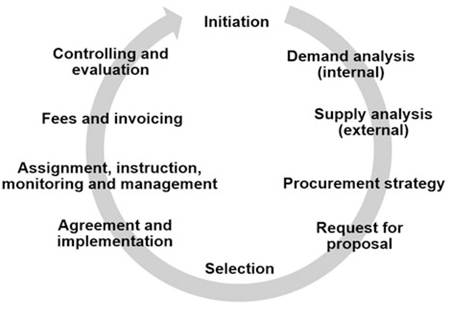
During procurement and when dealing with outside law firms, every customer will regularly be confronted with the same or similar questions and problems, which will become relevant to a greater or lesser extent, depending on the individual situation. Therefore, customers follow an organized procurement process, which can be divided into ten steps encompassing the entire cycle, starting from initiating the process and ending with the evaluation as set out in Fig. 5.It is important for legal service providers, in particular outside counsel, to know and to understand this process and to realize that most of it is handled behind customers’ closed doors without their involvement. Therefore, it becomes even more important for potential suppliers that customers are able to identify them as prospective participants in the procurement process at all. Once a supplier has received a request for proposal, he must understand which time window is available
Fig. 5 Professional procurement process in ten steps (author's own material)
and what is required for a successful pitch. A customer, being part of defining the very procurement strategy, may also decide to install a so-called “legal panel” with preferred law firm providers. The same may be established for alternative providers.
4.3 Role of the Procurement Department
In order to execute a project for the procurement of legal services, identifying dedicated resources, setting up a company-wide project team and finding and making available the right people with the required knowledge, experience and skills should be considered. Tasks, competencies and responsibilities must be defined for and allocated to each role. Trust and loyalty are of great importance here. The team has to draw up a detailed project plan with timelines, milestones and deliverables. Measurement criteria, as well as the process, have to be defined.
Further, the extent of involvement of any existing procurement department should be determined. In companies, the bundling of supplier management by the purchasing or procurement department has long been accepted as standard and is considered best practice.
By now, however, there is already talk of the electronically supported procurement of legal services (e-sourcing). Legal departments have often been spared from the usual cost-cutting exercises; on the contrary, often they could even expand their resources. In the eyes of CEOs and CFOs, their general counsel—and in this respect not particularly actively supported by their outside counsel—have demonstrated far too little seriousness in dealing with their own cost-saving measures. As a consequence, general counsel are now seconded by the procurement department. This is not a discussion about procurement now becoming the decision-maker when it comes to mandating outside counsel. Rather, in my view, general counsel should welcome cooperation with these new partners, recognize their expertise and specifically use them to improve their overall efficiency. This ranges from tasks associated with the processing of a mandate (e.g., payment, accounting and controlling activities) to logistical support (e.g., in the planning of the process or the preparation of tender documents) and covers the analysis and evaluation of different data and numbers (e.g. for KPI).For outside counsel and their newly established so-called business development departments, understanding the customer’s internal procurement process is paramount. This fosters a better understanding of the potential points of contact (touch points) on the one hand, and the timing and the extent of any involvement with the customer on the other hand. If suppliers are organizing themselves, customers should in fact rapidly get a team ready as well, i.e. one that includes specialists like procurement people, to negotiate with their suppliers on an equal footing.
4.3 Gender Diversity
Similarly to the question as to whether the procurement department should play a role in buying legal services, a gender-related factor needs also to be taken into consideration. Large and international companies have already been facing the obligation to pay attention to diversity requirements, for example, in connection with the requirements related to Corporate Social Responsibility programs.
This plays a particularly important role when recruiting employees in order to avoid any unjustified discrimination. In this respect, however, gender represents merely one of the many elements of diversity.There are three good reasons why it should be in the best interest of a law firm to take the “gender factor” seriously into account. First, there are direct economic reasons for the importance of the requirement for a gender-mixed composition of the workforce. It could be shown that mixed teams are more innovative, successful and profitable. Second, a gender-mixed composition of a law firm (gender diversity) plays an important role for customers when it comes to assigning mandates. The large law firms’ up-or-out model and the fact that today only a few women have achieved partner status in law firms inevitably leads to the conclusion that many female outside counsel leave the law firms before reaching the partnership level. By going in-house and switching to the other side of the table, they now become informed buyers. Third, gender-related differences in behavior exist when outside counsel are selected; i.e. when procuring legal services, female general counsel do not rank the same criteria as important as their male counterparts do. For male general counsel reputation, personal relationships and trust are important; female general counsel, however, put more emphasis on the requirement that outside counsel understand their business and their needs, respond quickly and communicate effectively and efficiently.
5