A Changing Legal Market
2.1 General Remarks
The financial crisis of 2008 served as a game-changer in the legal market. Many of the law firms hoped—and some still do today—that the negative effects that were unleashed would represent an interim economic lull only, that the effect of this recession would soon abate and the “golden age” return.
This financial crisis, however, has also caused structural, irreversible changes in the legal market. It has especially raised sensitivity and awareness with respect to the relationship between law firms and their customers. This in turn affects how companies organize themselves for the purpose of obtaining the necessary legal services. The processes set in motion by the market changes are thus not only temporary in nature; rather, they will remain and may even become more profound. These processes represent a “new normal” that has to be understood and to be adjusted to.2.2 ComplexTrendPyramid
Changes have always affected the legal services market. The situation today, however, is in many ways different: the changes are more diverse, occurring on many fronts and simultaneously, showing greater dynamism and intensity, and are characterized by a structural rather than a cyclical nature. In order to understand these complex changes, it is imperative to outline the various trends in a more simplified way by making use of the trend pyramid as set out in Fig. 1.
Looking at the legal market in a strict sense, this is characterized by the following three major changes: liberalization, globalization and increasing application of technology. The legal market shows only a slow but continuous trend towards liberalization: for example, consulting bans and the lawyers' monopoly are being further relaxed, and barriers to entering the market are being eliminated. The economy is growing and expanding, the markets are becoming more global, and customers' business operations are becoming increasingly more international, particularly as they are entering more and more new markets (especially also SME).
In connection with this, regulation and complexity of legal issues are also expanding. Technology is playing an increasingly important role for the efficient provision of legal services, and the technological possibilities are already much more advanced. This helps with the rising cost pressure, the fragmentation of the value chain in the production of legal services (disaggregation), and the improvement of knowledge management.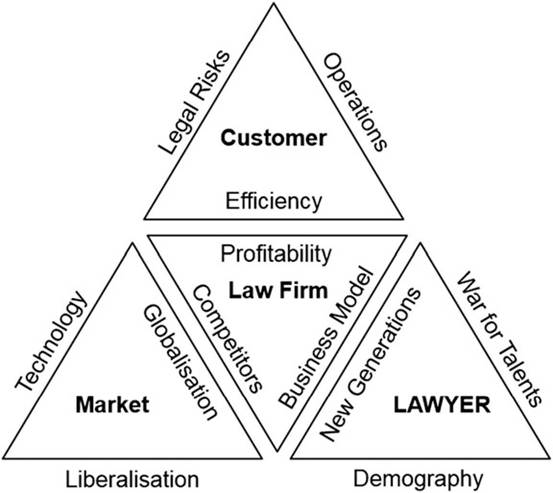
Fig. 1 Complex trend pyramid in the legal market (author's own material)
Since legal staff comprise—at least for now—the most important resource for the creation of legal services, the changes in the labour market for lawyers are of great importance. These are mainly characterized by the following three criteria: demography, a shortage of talent (war for talents) and a new generation of employees. With the demographic shift in the age pyramid—compared to the baby boomer generation—fewer and fewer workers will be available to future labour markets. With this quantitative change, circumstances will be accentuated in the future. Not only will outstanding talents continue to be rare and sought after, but less qualified staff will become less available, too. The migration of foreign workers will not really contribute to relieving the situation. Considering that soon, the majority of the employees will come from the so-called Generation Y, it would be advisable to deal with their needs and motivation at an early stage. For members of that generation, for example, the so-called “work-life balance” has a higher priority; they want more flexible and interactive work and ask for different working time models, alternative career models as well as training and education.
The law firms today are challenged on three important fronts: changing and increasing competition in the legal market, declining profitability and the question of finding the right business model.
The number of lawyers is increasing steadily, which—from a mere quantitative perspective—is already leading to increased competition among lawyers. Further, the competitive environment has become more varied and more complex, e.g. by the appearance of alternative legal service providers, which are not considered traditional law firms. In addition, to achieve or exceed profitability targets, law firms will be forced to organize themselves more professionally across the board by applying best practices when running an enterprise. Further, the current business model of large business law firms, which are organized like a pyramid and take advantage of the so-called leverage rate, is being called into question. Previous work and working time models seem to have lost their appeal for recent generations, and the broadly applied “up-or-out” career model is not as promising and accepted any more as it may have been in the past.2.3 Trends with Customers
One of the biggest changes will take place at the customer level. This is relevant since ultimately they are the source that triggers the demand for legal services in the legal market. Customers are facing the following challenges, the resolution of which they may pass on, in one form or another, to outside counsel and to other service providers: the continuous increase in legal risks, a compulsory increase in efficiency and the need for the optimization of operations.
The growing juridification of business life and the rise in regulatory efforts calls, on the one hand, for legal advisers with a sense for the whole (generalists), and, on the other hand, for the processing of vast amounts of information, which requires an increased use of specialists. New topics are emerging and are becoming more important (e.g. compliance, corporate governance, regulatory issues and, in my opinion, also risk management). The globalization of business is accompanied by other hazards (e.g. penalties) which require better control of the legal framework.
Hence, customers have an interest in externalizing these legal risks, which especially affects all legal service providers directly. This may lead to growing legal budgets in companies.Despite the corresponding growing budget for legal expenses, however, both cost-savings pressure and the need to increase efficiency are also on the rise for general counsel, hence their growing demand for effective cost management. This means that legal departments have to deliver more than before (“more for less”), and even more efficiently than before, that is: “better, faster and cheaper”. Finally, legal departments have to demonstrate how they contribute to the execution of the corporate strategy and how they generate added value (including applying suitable KPI). All these new demands will be passed on to their legal service providers.
Despite the increasing demands in substantive terms, the management of a legal department today requires much more than simply being able to answer internal customers’ legal questions. The criteria for an optimal management of the legal function have become more varied, in particular from an operational point of view. As a result of requesting efficiency improvements in the legal department, the operational issues with respect to the provision of legal services are increasingly coming into focus. The required back office operations are being structured in a more professional way, they are being reorganized and made more efficient. The organization is carried out along the value chain and the relevant processes of the company. Moreover, the purchase of services is becoming more professional (e.g. involvement of the procurement department, tender processes and requests for proposals, focusing on preferred suppliers, considering suppliers with lower rates), and alternatives to law firms are being considered (e.g. LPOs). The previously applied hourly fee model for outside counsel will increasingly be called into question, and alternative compensation models may increasingly be taken into account.
Today, moreover, other trends are noticeable. For instance, the work previously outsourced to law firms is increasingly being taken back again and dealt with by internal resources (insourcing). The composition of the law firms mandated by the companies is being rearranged or their number is being reduced (convergence or panel). Further, smaller and less expensive law firms are increasingly being considered. Dealing with law firms is becoming more professional and institutionalized, compensations are being negotiated in a new and harder way (alternative fee arrangements) and new legal service providers, i.e. providers that are not traditional law firms, are also being considered (legal process outsourcing).
2.4 Positioning of the Legal Department
The roles of the general counsel and in-house counsel are also subject to constant change. On the one hand, the growing legalization and regulation in each industry means that the legal department is playing an increasingly important role in the company. On the other hand, legal is losing the status of a singular function and must, similarly to other business units and functions, constantly prove to be an efficient and cost-effective service provider.
Today, the legal department has a more prominent position in the company. In particular, the general counsel is now perceived as a risk manager. He is also expected to provide general problem-solving beyond legal subject-matter tasks and to act as a co-designer of the company's strategic development. Consequently, legal strategies are being integrated into corporate strategies. The presence of outside counsel in the business is being reduced and, to the extent possible, the provision of legal services is being lowered to the level of a commodity.
The importance of a legal department and thus the value of legal advice provided within a company can be determined by the position of its general counsel in the leadership hierarchy. There are different views on whether and how a general counsel should be represented, or be present, at the (extended) executive level or in board meetings. There seems to be a trend in different countries that the general counsel should participate as an advisor in board meetings and have a “seat at the table” of the executive management of the company. This ensures a systematic and timely involvement of the general counsel and ties him into the business responsibility.
3