ALLEGORIZING WITH SPECIFICITY
As an allegory of the Second World War The Fall distills into one man - who does nothing to prevent a nameless faceless woman from taking her own life - the broad category of the bystander The narrative to be sure encourages this sort of generalized reading from its outset, announcing its broad sweep in an epigraph from Lermontov: ‘‘A Hero of Our Time, generally is in fact a portrait, but not of an individual; it is the aggregate of the vices of our whole generation in their fullest expression” (Camus, 1991a) As a collective vision of the ills of his time Camus’s narrative bears witness or rather utters its postwar “J’accuse,” not simply to Clamence’s own pash but to the history common to everyone who has survived the war.
‘‘Every man testifies to the crime of all the others - that is my faith and my hope’’ (Camus 1991a p 110) the narrator declares For if he bears a bystander’s guilt, he will not bear it alone insisting that ‘‘I have no more friends; I have nothing but accomplices To make up for this their number has increased; they are the whole human race’’ (Camus 1991a p- 73).The generalized categories of bystander and accomplice that Camus appears to invoke is linked with another seemingly generalized category - that of the victim symbolized by the stark figure of the woman a persona stripped of historical referentiality or specificity As a representation of Jewish victims of the Holocaust, the woman invites a meditation on culpability and on the possibilities of penance in postwar France (and more generally Europe) for those who like Clamence, did nothing in the face of Nazi atrocities Yet Camus’s choice of the woman as the tragic figure through which to allegorize the Jews is an odd one: it seems to deflect blame and drain the narrative of historical precision The woman after all is not identifiably Jewish and is not murdered but takes her own life The deflection and abstraction produced by this non-referential figure facilitate a reading of Camus in which the focus on the generic bystander threatens to undercut the historical force of The Fall's accusations But I intend to argue in this essay that Camus’s focus on the bystander as a former lawyer is in fact quite specific, connecting issues of complicity to particular professions - above all to doctors and lawyers The fact that the novella was published in the decade following the Nuremberg trials adds a crucial context to Camus’s postwar imagination providing historical specificity to The Fall's allegory I would like to read this work in light of its legal context, and thus to articulate in precise terms how the juridical imagination Camus explores in his novel confronts a traumatic past
In spite of the fact that the woman on the bridge bears no outright resemblance to a Holocaust victim references to the Holocaust abound in Camus’s narrative Most notably the area in which Clamence lives is the site of the former Jewish quarter While he inhabits the space of what he calls ‘‘one of the greatest crimes in history’’ Camus’s narrator advises his companion to return to his hotel by going around the quarter:
Thence, by going around the Jewish quarter you’ll find those fine avenues with their parade of streetcars full of flowers and thundering sounds..I live in the Jewish quarter or what was called so until our Hitlerian brethren made room What a cleanup!
Seventy-five thousand Jews deported or assassinated; that's real vacuum cleaning I admire that diligence that methodical patience When one has no character one has to apply a method and I am living on the site of one of the greatest crimes in history.
(Camus 1991a pp. 10-11)Clamence's comments call up the darker side of the area's history - for soon after the Nazi occupation of the Netherlands in 1940, anti-Jewish laws were passed forbidding Jews from living anywhere in Holland but Amsterdam, and the Jewish quarter of the city soon became a ghetto The journalist Janet Flanner known for her essays in The New Yorker (for which she also covered the first Nuremberg trial), reflected on the facility with which the Nazis created Amsterdam's ghetto following the German occupation of Holland:
Before the Nazi war there were a hundred thousand Jews living in Amsterdam Today, there are five thousand Catching Jews here was easy The Gestapo merely cut the bridges of the canals leading to the Jewish neighborhoods they called ghettos flushed the inmates out of their little eighteenth-century houses shot those who tried to swim the canals to escape from what had suddenly become fatal racial islands tagged the marooned remainder with yellow Stars of David and carted them off in cattle cars to the Fatherland's concentration camps (Flanner 1980, p. 122)
Amsterdam's architecture - like that of the ghettos in Warsaw or Lodz - illustrates how Nazi urban planning reinforced the Third Reich's political ideology Bernard Goldstein a member of the Jewish Fighting Organization described the racially driven landscape of the Warsaw ghetto in his memoir: ‘‘At the corner of Chlodna and Zelazna the ghetto was divided by a ‘Polish corridor' through Chlodna Street The bridge on Zelazna connected the two parts Under the bridge on the holy Aryan soil, were the Christians; and here at the ghetto gate the German guards would direct little scenes of hell'' (Friedman 1954, p. 38) The Jews in Lvov were forced to enter that city's ghetto by what they named the ‘‘bridge of the dead'' (Corni 2002 p. 55) a crossing which made them easy targets for German and Ukrainian violence and looting which left 5,000 dead The pedestrian bridges that characterized these ghettos - calling to mind the bridges over Amsterdam's canals - were constructed not with a view to crossing over but precisely in order to avoid certain crossings to prevent movement between the spheres of Aryan and Jew (Fig 1) 2
An analogous desire for separation characterizes Clamence's own move from Paris to Amsterdam a departure that severs two distinct eras in his life one before the woman's suicide and the other after it In this sense of before and after we might think about the trajectory of Camus's novels to consider The Fall’s relation to its predecessor The Plague (1947) The latter
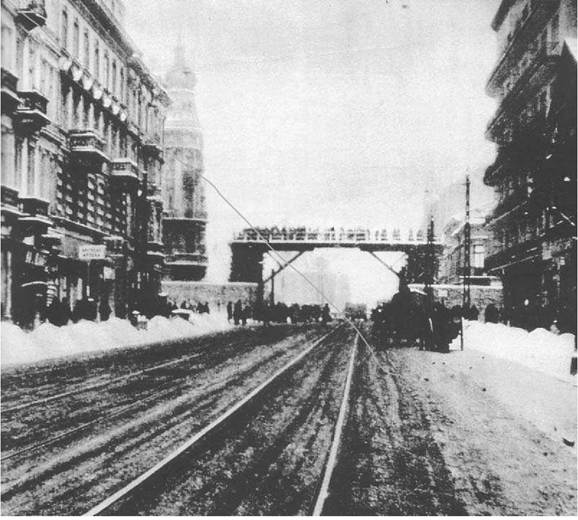
Fig.
1 The Warsaw Ghetto Bridge.novel tells the same kind of story as the earlier one a story of evil, or of the war; The Fall, however separates itself resolutely from its precursor by offering a different explanatory model for history Shoshana Felman has argued that the movement between the novels is one that complicates the act of witnessing wresting from it the redemptive possibilities of salvation or cure For Felman the doctor who narrates The Plague and the lawyer in The Fall are figures for two distinct discursive responses to the Holocaust - one medical, the other juridical. ‘‘Unlike the narrative of the physician whose testimony is ‘the record of what had to be done’ (The Plague, 287)’’ she argues ‘‘the lawyer’s story is the history of what failed to be done...the lawyer does not speak by virtue of his presence to events but by virtue on the contrary of his skill to mediate events through language and thus to manipulate their plausibility” (Felman 1992, p 197) I propose to connect this failure more precisely to specific professions whose complicity and possible penance were dramatically interrogated in the Nuremberg trials of the Nazi doctors and lawyers3 In doing so I aim to embed the discursive strategies that Felman illuminates within the institutional and professional context of judgment (rendered in specific legal terms) rather than of witnessing (cast in broad moral terms).
This move toward specificity offers a counterpoint to accounts of the Holocaust that insist upon ordinariness drawing out the ‘‘banality of evil” that Hannah Arendt observed in her report on the Eichmann Trial· The emphasis on this banality has meant that, as Andrew Stuart Bergerson observed ‘‘it has become commonplace to refer to the perpetrators of the Holocaust as ‘ordinary Germans’” (Bergerson 2002, p. 107) Postwar justice however emphasized not this ordinariness but rather the particularity of atrocity and the way in which specific institutions participated in the machinery of genocide Rather than compartmentalizing the professions along the lines of the Nuremberg trials or emphasizing a shift from medical to legal discourse I intend to explore the complex relationship - the complicity - between the two What, in the context of Nuremberg does the shift from medicine to law say about the relationship between them? What does it mean in other words to judge the past in professional terms?
As Felman points out, Camus’s first literary response to World War II was cast in medical terms which provided the foundation for imagining atrocity (or more specifically the Nazi occupation of France) as a contagion an infectious disease that demands a cure In the metaphor of the plague itself Camus mirrors and reverses the medical analogies deployed by Nazi ideologues In Nazi Germany it was a medically inflected politics that shaped the conception of undesirables - of the Jews who threatened to contaminate the German body politic In a speech before senior SS officers in Poznan on October 4 1943, Reich SS leader Himmler insisted ‘‘If the Jews were still lodged in the body of the German nation we would probably by now have reached the stage of 1916-17...We do not want, in the end, because we destroyed a bacillus to be infected by this bacillus and to die’’ (Arad Gutman & Margaliot, 1981 p.
345).4Several months later Roosevelt would harness a similar metaphor to reinforce the United States’ commitment to the war effort In one of his most famous press conferences in December 1943, Roosevelt spoke of America after the Great Depression as an ‘‘awfully sick patient suffering from a grave internal disorder ’’ an illness which was finally cured by the good Dr New Deal· Turning from domestic issues to the ongoing World Way he continues:
But since then two year ago, the patient had a very bad accident - not an internal trouble Two years ago, on the seventh of December [the date of the attack on Pearl Harbor], he was in a pretty bad smashup - broke his hip broke his leg in two or three places broke a wrist and an arm and some ribs; and they didn't think he would live for a while (...) Old Dr New Deal didn't know ‘‘nothing'' about legs and arms (...) so he got his partner who was an orthopedic surgeon Dr Win-the-War, to take care of this fellow who had been in this bad accident And the result is that the patient is back on his feet He isn't wholly well yet, and he won't be until he wins the war (Roosevelt, 1950, vol. 12 pp. 570-571)
Roosevelt's words carry the weight of medicine's optimism the reassurance that symptoms can be diagnosed illnesses cured and injuries healed But even as ‘‘the patient'' ultimately won the war he found himself confronting a less than reassuring reality: in a horrific ironic undoing of Dr Win-the- War's bravado the victorious armies found themselves liberating camps full of diseased and dead bodies that no amount of literal medicine could treat 5
We might imagine that the language of medicine - which was to a significant degree a central discourse invoked to represent the war - was superceded by the language of law The law itself exemplified by the Nuremberg trials, might have seemed to promise a discursive refuge from the atrocities of the war Robert Jackson's opening statement at Nuremberg underscores this belief in law a conviction that legal means can balance the scales of justice at a time when the call for retribution might have yielded far more violent ends ‘‘That four great nations flushed with victory and stung with injury stay the hand of vengeance and voluntarily submit their captive enemies to the judgment of the law is one of the most significant tributes that Power has ever paid to Reason'' Jackson affirmed (International Military Tribunal, 1947, vol.
2 p. 98) While medical analogies may have proved powerful for talking about war - and in the case of The Plague, for allegorizing it - it was thus law which came to occupy a central position in the story of the recovery after World War II Given this discursive shift one might imagine that the aim of the Nuremberg trials was less to achieve a sense of healing than to provide a sense of justiceCamus himself seemed to acknowledge the inadequacy of medical metaphors in November 1946, one month after the conclusion of the first Nuremberg trial of the major war criminals:
One cannot end a plague with the same remedies used for a headache A crisis that tears the whole world apart must be met on a world scale Order for all so that the weight of misery and fear will be lessened for each is our logical objective today But that calls for action and sacrifices that is for human beings And if there are many today who within their hearts detest violence and killing there are not many who are willing to reconsider their actions and thoughts For those who do make this effort, however in so doing they will find a reasonable hope and the habit of action (Camus 1991d p 135)
In emphasizing the pain of collective accountability over more immediate and domestic palliatives Camus reinforces the transition from healing to judging This transition however does not constitute a clean break; Camus, after all, does not relinquish his commitment to depicting evil as a plague. Rather than jettisoning this metaphor he combines it with the force of judgment - and specifically self-judgment.
The insistence on self-judgment, on people’s willingness ‘‘to reconsider their actions and thoughts,’’ becomes particularly important in a time when the official duty to judge has been conferred on a select few as it was at Nuremberg6
It is also clear from the language used by the Nuremberg prosecutors themselves that the narrative possibilities afforded by legal and medical discourse were not entirely separate that it was not necessary to choose between the story of a cure and the story of justice Indeed in taking responsibility for the past, one mixes narratives as one might mix metaphors - an integration that draws upon the force of each The prosecution at Nuremberg thus extended the rhetoric of disease and medicine in articulating the Tribunal’s historic task Telford Taylor Chief of Counsel for the prosecution in the medical trial, declared in his opening statement:
The perverse thoughts and distorted concepts which brought about these savageries are not dead They cannot be killed by force of arms They must not become a spreading cancer in the breast of humanity They must be cut out and exposed for the reason so well stated by Mr Justice Jackson in this courtroom a year ago - “The wrongs which we seek to condemn and punish have been so calculated so malignant and so devastating that civilization cannot tolerate their being ignored because it cannot survive their being repeated.” (Trials of War Criminals before the Nuremberg Military Tribunals, 1949-1953, vol.
1 p. 28)Taylor’s depiction of the Tribunal’s task harnesses the power - and fear - of contagion The atrocities committed by Nazi doctors cannot be treated solely by military victory Rather they must be exposed explained and eradicated by juridical remedies - by a kind of legal ‘‘talking cure’’ which brings the traumatic past to light so as to understand and consequently overcome it Taylor extended the metaphor of contagion from humanity to Germany’s political fate insisting ‘‘A nation which deliberately infects itself with poison will inevitably sicken and die’’ (Trials of War Criminals before the Nuremberg Military Tribunals, 1949-1953, vol. 1, p. 29).
More on the topic ALLEGORIZING WITH SPECIFICITY:
- Having studied this chapter you should be able to explain:
- APPENDIX V. MANUMISSION VINDICTA BY A FILIUSFAMILIAS.
- Chapter 4 Public Choice
- Creating a State for the Purpose of Imperial Rivalry: The Great Game and Afghanistan as ‘Graveyard of Empires’
- DATING
- The state and environment: spatial dysfunctions
- The inhabitants of Rome lived with the reality of legal courts scattered throughout the public and private spaces of the city, and perhaps even came to resent, on occasion, the impact such courts made on traffic flow during the busy hours of the day.
- CHAPTER 13 Myths of the Near Future: Paris, Busan, and Tales of Aid Effectiveness
- P J du Plessis
- Discourses
- THE ADVOCATE’S ROLE OUTSIDE AND IN THE COURTROOM
- 1.5 CONCLUSION
- O F Robinson
- Conclusion
- Humanus: Terence and universalism
- INTELLECTUAL FORMATION: WHAT'S ON THE LAWYER'S MIND
- CHAPTER I The Function of Advocacy
- Clementia Caesaris: Seneca and Nero
- 9.4 A POWER CONVERGENCE FOR THE POOR IN EUROPE AND THE AMERINDIANS IN AMERICA