CHAPTER SIX Convergence: The City of Rome
toward the end of the civil war of the 80s, a tribune revealed the secret name of Rome. Soon thereafter the tribune died, to the satisfaction of his contemporaries, expiating his transgression with death.
The episode draws attention to the importance of the many unspoken associations and attachments that Rome held for her people. This sometimes mystical respect for Rome probably explains much of the power and functioning of the Romans' most fundamental institutions, whose integrity was inextricably bound up with an intense focus on Rome. Citizens throughout Italy looked to Rome for the central events of community life. Statewide religious ritual, civic performances, and decisions affecting the entire state transpired chiefly in Rome. Among these was the passage of laws in public lawmaking assemblies. The fate of the loquacious tribune suggests that the image of Rome shared by many Romans went far beyond what can be explained by any general discussion of changing patterns of economic, ritual, social, and political life of the city. Nevertheless such a discussion does provide, in however overly simplified a manner, an appreciation of the importance of the structure and function of the city to a Roman population totaling in the millions, by 50, and the central role it played in the strength of Roman institutions. The legitimacy of all Roman institutions, particularly public lawmaking assemblies, is related to the degree to which they were embedded in the life of the city of Rome. An understanding of the manner in which Rome functioned within the Roman system and the attractions of Rome to Romans, Italians, and foreigners is essential to any effort at understanding the vital role of public lawmaking assemblies in that same system.1The patterns of economic, social, and religious life in the city of Rome during the fourth century, as the Romans begin the process of expanding throughout Italy, form my starting point in this chapter.
The unique conditions of Roman expansion, in place by the third century, and the developing attractions of the city of Rome produced a city population that ebbed and flowed with the movement of citizens and foreigners. At this time the city's chief attraction was its role as the hub of an imperial system of religion, administration, and justice. In the second and first centuries, the special attractions of Rome combined with the breakdown in traditional ties and access to resources to produce permanent and nonpermanent migration to Rome. The result was a city whose population was at least three times larger than the total population of the next largest city in the ancient Mediterranean basin. The role that public lawmaking played in the growth of Rome concludes my examination.ROME, ca. 300
Boasting walls unmatched by any fortifications in Italy at the time, Rome in 300 was well on the way to becoming an urban center on a unique scale. Living and working within the walls was a large and cosmopolitan population. Romans and Latins dwelled cheek-by-jowl with slaves, drawn at this point mostly from defeated neighbors, and with indeterminate numbers of other Italians, attracted willingly to the city. The diversity of this population was increased further by the immigration of people from outside Italy. The topography of Rome's neighborhoods (vici) and archaeology confirm the extent of foreign habitation.2 The vicus Tuscus, “Etruscan Way,” a street running between the Forum and the Circus Maximus, was home to Etruscans at an early date (fifth century).3 The presence of a shrine to Carna on the Caelian hill supports Etruscan settlement here, too.4 Greeks may have lived on vicus Sandalarius, “Sandal Makers' Row,” and Carthaginians in several locations.5 To some extent Rome's diverse population reflects the customary movement among regions and towns in Italy, particularly that between Etruria and Latium. It is also clear, however, that the high visibility of resident foreigners, in particular Carthaginians and Greeks, reflects the city's extensive trading connections both within and outside Italy.
Indeed, Rome's primary attraction at this time was its function as the hub of a wheel of trade and movement in all directions.6 The Tiber River and the wide plains of southern Etruria and Latium provided the chief means of access from the sea to the mountainous interior of Italy and from north to south. Although Rome was not a seaport, her location on the Tiber made her the most important trading city in Italy.7 From an early date, Rome boasted the staging areas necessary for such a movement of goods and produce. These were the markets whose presence in Rome was so prominent. Chief among them was the cattle market (Forum Boarium), situated along the Tiber, which appears to have been the central market area for livestock, salt, and olive oil. Adjacent to the market were the salt magazines (salinae), serving as a storage facility for salt from the pans at the mouth of the Tiber. The city of Rome in 300 resembled a nineteenth-century U.S. frontier settlement. Like St. Louis on the Mississippi River, Rome on the Tiber was a gateway through which goods and people were funneled to an expanding interior hinterland.8
Many of the goods traded in Rome were manufactured there as well. Roman neighborhoods located manufacture as well as the presence of foreigners: In addition to Sandal Makers' Row there was the vicus Iugarius, where animal yokes were made, and the vicus Lorarius, whose residents produced harnesses, saddles, and whips. Some areas of the city of Rome were named according to the specific items marketed there: inter lignarios, inter falcarios, inter vitores, and inter figulos were areas within the perimeter of the city where timber (firewood?), scythes and pruning hooks, baskets, and pots were sold.9 To produce these and other goods Rome needed specialized craftsmen, provided by slaves, whose importance as a skilled labor force was long established by 300, and by other foreigners as well, such as the stonemasons from Greek Syracuse engaged to construct Rome's defensive circuit in 378.
So the city population grew, replenished by the migration of Italian and foreign craftsmen and traders; Etruscans and Sabines; as well as Greeks, Carthaginians, Phoenicians, and many others from all sections of the Mediterranean who came to Rome by choice to live and work permanently or temporarily.Romans in turn migrated temporarily or permanently to other cities, primarily as traders. Inevitably, this complementary movement between Rome and other cities changed all of them. Most noticeably in the case of Rome, it deepened the ongoing adaptation of various Greek institutions and skills. Enmeshed long before 300 in the money economy of the Greek cities of southern Italy, the Romans began to mint coins regularly themselves not long after, around the beginning of the First Punic War in 264. Greeks from southern Italy and Sicily formed a significant presence in Rome, before 300, including not only such men as the stonemasons referred to previously, skilled workers recruited for a major building project, but high-ranking Greek priestesses, invited to Rome to tend to the cult of Ceres. Few arenas were untouched by the continuous interaction between Romans and non-Romans, as manifest in the city of Rome.
Cults provide a useful index of migration into the city. At an early date Etruscan and Sabine cults were present in Rome, as well as Greek and other foreign deities and rituals. The shrine to Carna provides a case in point. While not all these cults came with migrating Etruscans, Italians, or Greeks, even cults that were deliberately moved to Rome underscore the prevalence of migration to and from the region of origin of the particular god: the Romans appropriated gods much as they did land.10 The gods or goddesses deliberately sought out were usually Italian or Greek. The goddess Ceres was both: already present in Rome, she was given a new temple on the Aventine hill, early in the fourth century, and “Greek rites,” whose performance required the Greek priestesses already referred to.11 But the arrival of many other foreign divinities took place in a more gradual and personal way, arriving through the spontaneous efforts of individuals rather than state initiative.
So it was with Hercules, whose popular cult, linked both to Carthaginian traders and the migrating herdsmen of Italy, was important in the lives of ordinary working men. Initially managed by one of Rome's prominent families, the earliest cult of Hercules, situated at the main altar known as the ara maxima in the Forum Boarium (because of the close relationship between Hercules and cattle), was transferred to state control in 312.12 The wide variety of gods, resident also in one or another area of Roman settlement in Italy and popular for one reason or another with the larger society, meant that a newcomer often found that his local gods had arrived in Rome before him. The shared panoply of gods facilitated the process of integration. Already by the fourth century, Rome was attracting and absorbing Latins, Etruscans, Sabines, and other Italians by a process of religious and cultural acculturation.13Over the next century, as Rome was increasingly at war, more gods and goddesses entered for the first time or underwent modification in Rome.14 In this period, for instance, Rome's political leaders expanded the cult of Hercules. More temples and shrines to Hercules, constructed at state expense, mushroomed in Rome in the third and early second centuries, often in or near the Forum Boarium.15 The evidence suggests a connection between the state's intervention and Roman victories over the Samnites, for whom Hercules was a tutelary god. Other foreign gods were newly introduced, among them Greek Apollo and the Phrygian Great Mother, a phenomenon explained in part by the Romans' practice of celebrating or placating the gods of their enemies, now quite numerous.16 In part, too, the introduction of so many foreign gods to Rome is explained by the use of ritual as a vehicle of consensus. New gods (di novales) and festivals to celebrate them provided a focus for people who had come to share a common identity as Romans.
Thus by the beginnings of Roman expansion in Italy, the city of Rome was the product of a long-term process of migration, economic growth, and regional expansion as a religious and market center. Rome attracted people as well as trade by virtue of its location, which made it a gateway to central Italy and a staging area for a wide range of goods and products from Italy and abroad. The result of this migration was a varied and shifting population. How large we cannot say for sure, although colonization efforts in the fifth and fourth centuries provide evidence of population pressures on local arable land. Over time, foreigners integrated with Romans and Latins in a process of adaptation and accretion, to form by the end of the fourth century a distinctly cosmopolitan Rome. The mechanisms for even greater integration and growth were in place. This organic regional growth of Rome was modified by two new and singular factors that emerged from historical developments in the third and second centuries: the demands of civic and ritual obligation and the influx of grain, riches, and other products from an expanding empire. Both factors enhanced and strengthened the development of a society centered on Rome in a manner unique in world history.
THE FURTHER DEVELOPMENT OF
ROME AS CIVIC AND RITUAL HUB
In 114, Publius Elvius was returning with his family to their home in Apulia after attending the Roman Games (ludi Romani) in Rome. While crossing the ager Stellas near Cales, along the via Latina, his young daughter was struck by lightning, an incident so portentous that the head priest (pontifex maximus) in Rome had it entered in the priestly record of annual prodigies.17 The circumstances may have loaded the girl's death with more meaning than the lightning itself. For the set of games from which she had just come in Rome was one of the most important religious events of the year, celebrating the chief god of the Roman people, Jupiter Best and Greatest. Every year in Rome half of the month of September was devoted to sacrifice, horse races, and athletic competitions in honor of Jupiter Best and Greatest. The festivities began on 5 September with a huge procession from the Capitoline temple, the ritual center of Rome, to the Circus Maximus, led by the consuls followed by the athletes and other competitors. Next in line were the gods resident in Rome, carried on floats, while the sacrificial animals brought up the rear of the procession. On 13 September the college of priests called epulones, created by law in 196, organized a grand dinner party for Jupiter and the goddesses Juno and Minerva, who shared his temple on the Capitoline hill. The ritual banquet in the temple was attended only by Roman senators and magistrates, as well as the Capitoline triad, but celebratory meals were laid out on plank tables in all the neighborhoods of Rome so everyone in the city could participate. When the games finally ended on 19 September, several days more were designated on the calendar for markets in Rome. For the duration of the games and the markets the city must have been crowded with tourists, including pious Romans like P. Elvius and his family, who made the journey of more than three hundred kilometers between Apulia, in the south of Italy, and Rome.
Once the conquest of Italy had begun an already mobile city population expanded and became still more transient. The dissemination of Roman citizens across Italy accompanied by an increase in numbers was a significant factor in this growth and movement. The state-sponsored or individual migration of Romans and Latins away from the city and its environs to fill the colonies, towns, and villages established on Roman state land was balanced by a return movement, sometimes of new colonists dissatisfied with settlement life. For these people, the focus of their world after migration continued to be Rome. Not surprisingly they maintained close ties with families in Rome: the family and state cult of the Lares presumes a concern with the graves of dead ancestors. Some even abandoned the colonies and returned permanently to Rome. In 186, one of the consuls who was in south Italy restoring order after the religious outburst among the population that the Roman Senate found so dangerous, the Bacchanalian conspiracy, discovered that Buxentum, a colony established in 194, was now deserted. Where had the settlers gone? Unless we suppose that a hostile, local population had exterminated them, and there is no record of such an event, it is reasonable to assume that they had simply gone home.18 Such a mass departure is probably the exception. For most Romans living outside Rome the return movement was temporary, a periodic feature of life in Roman Italy.
In pace with Latin and Roman settlement in Italy the population of Rome ebbed and flowed. With the creation of new tribes and tribal extensions on conquered and newly annexed Italian land, as well as municipia of restricted citizens (cives sine suffragio) and Latin colonies, the Romans brought the diverse and scattered members of the Roman community into the civic orbit. The tribes and tribal extensions in particular were firmly attached to Rome through an extended system of roads and depots. The tribal extensions spurred the establishment of communities, providing local market and community centers for the far-flung Roman tribesmen. Some, called conciliabula, appear to spring up spontaneously, in step with Roman settlement, as communities of Roman citizens on or near newly conquered lands. Modern scholars believe they came to function as markets and regional headquarters in the tribal extensions necessitated by the territorial discontinuity now experienced by the tribes.19 Other communities, fora, were deliberately established by magistrates along the roads linking Rome and Roman state land, whose construction belongs to the same period, or by conquering commanders.20 Like conciliabula, fora were established for a variety of purposes related to the implications of scattering Romans far and wide across the Italian landscape. In some intangible way they may have served as way stations, physical and emotional, on the way to Rome. Among more tangible uses, the fora served as markets, like conciliabula, and as locales for the adjudication of disputes, thus providing a base of operations for legal services. Thus, both conciliabula and fora were communities that originated for the ordinary market and communal needs of the Roman inhabitants of the tribes. Significantly, Rome remained the center of all administrative and judicial activity for all inhabitants of the rural tribes. From Rome came messengers to announce assemblies, decrees, proposed and approved bills; recruiting officers; and other officials. From Rome came justice dispensed by itinerant prefects, praefecti iure dicundo, appointed by the urban praetor and deriving their jurisdiction from him, who visited the fora on a regular basis to hear cases. The system was used also in the administration of Roman colonies.21 Citizens traveled to Rome for the resolution of more complex legal problems. In the operational links between the city of Rome and the scattered conciliabula and fora, the Romans adapted a traditional system of management focused on Rome to new conditions in which they found themselves stretched over a much larger area.
The Roman colonies, the conciliabula and the fora inhabited by full Roman citizens, situated on the far-flung ager Romanus, organized in thirty-one rural tribes by 241 and looking to Rome for administration, were altogether distinct and distinguishable from the municipia. These were communities of men who were citizens in all respects, save their ability to vote or hold office, or Latin colonies with territories of their own. Yet the citizen, partial citizen, and Latin tracts, forming large and small pockets in the peninsula of Italy at varying distances from Rome, shared one thing in common. They all had a fixed orientation toward Rome. Striking to the modern observer, and presumably as obvious to the Italian tribesmen, is the close association between the towns and Rome that grew up in the small pockets of Roman and Latin territory by the second century.
Most important therefore in explaining the return movement to Rome is that the obligations and activities of citizenship continued to be uncompromisingly bound to the city of Rome. Out-migrants returned regularly to Rome to perform civic and ritual responsibilities. Despite the scattering of citizens on distant Roman lands, most essential of these obligations was the annual military draft. The only citizens exempt from the draft were settlers in the small citizen colonies established before the second century. Rome was also the venue for other tribal matters. All thirty-five tribes maintained tribal headquarters and tribal burial grounds in Rome.22 Central tribal rituals occurred only in Rome, specifically the lustrum, crucial to the well-being of the city. Fleeting reference is made in the ancient testimony to other tribal rituals performed annually in Rome.23 Similarly, several times a year men, women, and children celebrated their gods with sacrifices, games, and other festivities that eventually, after the third century, could last up to fifteen days.24 Every year in July citizens elected their chief magistrates and priests in the centuriate assembly and their lesser magistrates and priests in the tribal assemblies. Every five years, citizens from the various parts of Italy, where Rome's far-flung territory extended, made their way to Rome to present themselves before the censors in the Campus Martius and to give an accounting of their holdings and families. The city of Rome also provided the only venue in Italy for Roman public lawmaking sessions, attended by citizens who returned to Rome at random intervals to participate. Participation was not invariably restricted to citizens optimo iure: Latins, too, by the second century could vote in electoral and legislative assemblies. In summary, both the central events that constituted citizen life, such as registration on the tribal rolls, declarations of property, enrollment in a legion, voting, and festivals, and the prosaic affairs of daily life, such as the conduct of legal business, transpired in the presence of the proper officials and their assistants in their designated locations in Rome. Mobility was built into the lives of the settlers as the conditions of Roman life and citizenship spurred a continual movement back to Rome. It was impossible for any Roman to participate fully without traveling to events in Rome.
In turn, Romans were highly resourceful in meshing state ritual and civic performances with the routines of everyday life. Consider the celebration of festivals, which drew significant numbers of citizens away from their homes and farms.25 While festivals were prominent and regular occurrences, they were only one among many such recurrent events drawing large crowds to Rome. The religious calendar of the Romans was full of festivals, cults, and other activities honoring the gods.26 The performance of the religious obligations these activities represented was an urgent part of daily life.27 For the security of Rome hinged on the benign demeanor of the gods toward the city, which could only be maintained by the constituent parts of festivals and other cult activities, ritual, sacrifice, and prayer. While the performance of many of these activities was located in a specifically individual or family context, or could unfold in a Roman town or colony, others were tied to the heart of the Roman community and occurred only in Rome. This was the case with the great state games, a special form of recurring festival. In 300, the Romans celebrated three sets of major games during the year: the Games of Ceres (ludi Cereales) on 19 April; the Roman or Great Games (ludi Romani or Magni) in honor of the Roman's chief god, Jupiter Best and Greatest, on 13 September; and the Plebeian Games (ludi Plebeii), also in honor of Jupiter Best and Greatest, on 14 November.28 Over the next two centuries the number of days devoted to these games steadily expanded and other games were added, sometimes by public law.29 By 70, the Roman Games lasted fifteen days. The Romans gradually devoted so many days to ritual activity throughout the year that their success in other arenas is a genuine credit to the Roman aptitude for manufacturing the conditions they believed necessary for the growth of Rome.
One visible measure of the importance of state festivals from an early date to the elite members of Roman society who organized and staged them is provided by the regulation of festival management.30 An initial function of the curule aedile, for instance, a new elective office established in 367 by public law, was festival related. The curule aedileship was the single new administrative office created in Rome in the fourth century and the last new office for another one hundred years. The two curule aediles administered the markets, temples, and city streets, supplementing the two existing plebeian aediles. They also initially staged the Greek-style dramatic productions, recently introduced in the games honoring Ceres in order to mitigate the effects of the plague and other ills, which from now on were to become an essential part of the great festivals. Similarly, in 196, a public law of the tribune C. Licinius Lucullus instituted the new priesthood mentioned previously, the epulones, three men responsible for orchestrating Jupiter's annual dinner party on 14 November.31 The concern and outlay associated with festival activities on the part of Rome's political leaders mirror their significance to all Romans.
Although we have little evidence about the individual obligations entailed on these occasions, attendance was high.32 People flocked to Rome in large numbers and as a matter of course, several times a year, in order to attend the great state games and festivals. As is clearly revealed by the story about the misfortunes of the family of P. Elvius, citizens residing in pockets of Roman and Latin territory across Italy routinely made regular trips to Rome for festivals. Not all in attendance at festivals, however, were Roman: souvenirs of these and lesser festivals, in the form of mass-produced cups (poculi) inscribed with the names of new gods and goddesses, have turned up in Etruscan as well as Latin towns and as far away as Aleria on Sardinia.33 Other motivations must have brought some of these visitors to Rome, specialized markets to name the most obvious.
From a Roman perspective, however, the regular ritual and civic performances in Rome were central acts of citizenship. Membership in the Roman community presumed common obligations to the gods of the state: All Romans shared responsibility for sustaining the goodwill of the gods of the state. Membership obliged men who owned land in Roman tribes to declare their holdings and family members at the quinquennial census and, if eligible, to appear for the regular tribal military levy in January. Membership involved participation in voting assemblies, for the primary way of expressing power as a full citizen member of the Roman state was through voting. Thus, citizens went to Rome not only for state festivals and games but for the military levy, the census, and the various voting assemblies. But for all who did come, in particular citizens, for whom such regular treks were tied up with their sense of being Roman, we must wonder how they incorporated this level of movement in their lives.
Doubtless, Romans sensed little conflict between the performance on the one hand and the time or energy investment required for the performance on the other.34 The time spent was simply part of whatever process the Romans were engaged in, whether the census, military conscription, festivals, or the more random public lawmaking assemblies. Life unfolded at a very different pace than in the modern world. As a result it is not surprising that the establishment of Roman settlements across Italy was accompanied by the institutionalization of mobility to and from Rome. Yet the distances that Romans and others were required to travel, as well as the investment in time, spurred significant adjustments in traditional routines over time simply to ensure the continuation of those routines.35
For instance, the major state festivals, the regular voting assemblies, and the military levy tended to occur at relatively slow times in the Italian agricultural year, usually winter and summer. In these seasons the military levy and elections were scheduled, similarly many of the most important state festivals. It appears then that Romans had developed patterns of work on the farm and with their herds that allowed them to leave and return for citizen performances in Rome, as they did for military service. As long as the customary campaign season occupied the summer months, as was the case until the great overseas expansion of the second century, these performances were generally not impeded by military service itself. Moreover, civic and ritual performances were often combined with markets. The days on which public lawmaking assemblies or judicial assemblies were scheduled, the only randomly scheduled civic events, had to be announced over a period of three market days, three nundinae or trinundinum, roughly equivalent to twenty-seven or more days, in order to let as many know as possible. Given that such assemblies were announced by herald in the fora and conciliabula throughout the Roman territories in Italy, the requirement of a trinundinum presumes the customary movement of outlying rural inhabitants to Rome for weekly markets.36 The assemblies themselves were then frequently convened on an appropriate market day. By the end of the Republic the three biggest sets of games, the Roman Games in September, the Plebeian Games in November, and the Games to Apollo in July, were followed by three, three, and six days of market, respectively. In the calendars these blocks of days in September, November, and July were marked “market” (mercatus). The July electoral assemblies were usually held during this period. Thus, while markets were regular occurrences, at eight-day intervals in Rome as elsewhere, on occasions when exceptionally large numbers of citizens were in Rome, the market days were extended and electoral assemblies were held in the same period. These combinations and piling on of events show the Romans scheduling performances in a practical way to take advantage of the greatest number of visitors to the city. By a glance at the public calendar, a Roman in Apulia would know which days were fas and nefas, dies comitiales, and so determine his journey. In this fashion a solid relationship emerged between commercial attractions on the one hand and ritual and civic attractions on the other. In turn these attractions inspired a massive flow of people at regular times during the year. Not surprisingly the peak month for such mobility, July, was also the renewal date for leases on city apartments. Thousands were now on the move to and from Rome.
The city's central role in managing the resources of Italy further intensified and redirected the mobile population of Italy. When, for example, Roman ager publicus was rented, leases were drawn up and renewed only in Rome by the censors. Contracts for building projects, for supplying the armies or the city (until the Second Punic War), or for collecting taxes in Italy (prior to 167) were also tied to Rome. The censors again handled these. Justice was in some respects centralized in the jurisdiction of the city praetor or peregrine praetor in Rome, notwithstanding the deputies or prefects sent to outlying communities whose jurisdiction derived from the former. Only in Rome could iudicia legitima be held.37 In all other locations beyond the first milestone, verdicts in trials presided over by prefects or others were delivered within the time limits of the justice giver's office (iudicia quae in imperio continentur). Most consequential, the city assembled and exported thousands of troops annually, drawn from all Italy, on brutal campaigns of conquest. Another draw was added to the many attractions of Rome.
Enhancing the civic and ritual attractions that Rome held for Romans and Latins were the attractions that Rome, the imperial city, held for all the inhabitants of Italy. By the end of the third century huge external supplies of oil, grain, wax, and other supplies as well as slaves, coins, and luxury items poured into Rome. Rome was thus the focus of commerce, the premiere market especially for luxury items and slaves and a labor market involving men of all classes and economic means. The import of huge amounts of external supplies as well as the export of thousands of troops annually required an intensification of record-keeping efforts as well as the archives to keep and maintain records. The Romans began to develop the resources and apparatus needed to manage an overseas empire. The Aerarium at the Temple of Saturn, long the repository for Senate decrees and state treasures, came also to be the central archives in Rome for records relating to the financial management of the provinces, as well as other legal documents. Record keeping, in turn, called for a body of workers both to produce and manage records, at their source in the provinces, with the Roman commander; or at the ports of entry, with the quaestor supervising imports; or at the assemblies or meetings held in Rome—that is, wherever costs and expenditures were tallied or decisions were made. This body of workers was formed by the now emerging corps of clerks and copyists, men generally of lower status than the political leaders of Rome, often new citizens. The control center of the empire, Rome provided the sole arena in which most administrative matters pertaining to this management could be resolved. As a result, Italians joined the Romans and Latins who regularly made their way to the city, their customary mobility redirected as an outgrowth of Roman expansion. Already a civic and ritual hub for the thousands of Romans and Latins settled in distant regions, Rome as the center for the control and allocation of resources exerted a commensurate pull on citizen and noncitizen inhabitants of Italy alike by the third century.
Soon after the beginning of their expansion across Italy, the Romans commenced building the infrastructure necessary to support such a movement to Rome, beginning with roads. Roman roads, built by military engineers, regularized and improved travel on the already extensive network of routes across Italy.38 Most Roman roads followed the course of existing roads or routes by which the Romans like other Italians had been for centuries firmly connected to the various regions and peoples of Italy. Existing roads leading out from Rome in the fourth century included routes to nearby Etruscan and Latin towns and longer ranging routes to the northeast and south. The sophistication and extent of the graded routes across the urbanized regions of Italy are indicated by the road systems of the Faliscan territory (ager Faliscus) in southern Etruria, connecting towns of the area and providing routes between the mountains and the low- lands.39 Predating Roman conquest, these routes formed the basis of Roman road building after the fourth century.
Many routes also were drove trails, criss-crossing the entire peninsula of Italy.40 The via Salaria (Salt Road), in particular, was a drove trail used continuously from the Neolithic leading from the salt marshes at the mouth of the Tiber through Rome northeast to Reate in the territory of the Sabines, Asculum in that of the Picentes, and the Adriatic coast. Thus the via Salaria connected the winter coastal pastures with the highlands and in turn served as the primary route by which salt, one of the fundamental necessities of life, reached the transhumant herders of the central Apennines.41 We should hardly wonder that the middle portion of Italy, stretching from the Tyrrhenian to the Adriatic coast, came earliest under Roman domination. By 218, the via Cornelia (later Aurelia), once a drove trail, extended about 150 miles up the coast to Populonia. This was one of the longest roads in Italy before the Second Punic War, together with the via Appia to Brundisium (by 244) and the via Flaminia, built in 220, to Fanum Fortunae, in Roman territory on the Adriatic coast, and on to Ariminium.42 In short, starting at Rome, the Romans gradually pulled their holdings into them by grading, extending, and paving the roads that led out from Rome.
The earliest paved roads in Italy, extending south from Rome, facilitated the movement of citizens and allies to and from Rome. The via Appia, planned in 312 on the course of an existing road to the Latin town of Norba, passed through Roman territory (Forum Appi was on the road) to the citizen colony at Ter- racina founded in 329, before reaching its initial destination, Capua. In 296, citizen colonies were established along the route in existing towns, which were renamed Minturnae and Sinuessa. Paving of the via Appia began in 295. The via Tiburtina, begun in 307, led through Roman and allied territory to the town of Tibur on the Anio River. The road was extended soon after across Latin and allied territory to the Paelignian town of Corfinium. All these roads, and all roads generally, were planned and constructed under the supervision of Rome's highest magistrates in their military command capacity; most road builders were consuls and proconsuls. The exceptions are roads established or improved by public law: a law of C. Sempronius Gracchus in 123 or122 ordained the construction of new roads, and a law proposal and law of the first century addressed road maintenance, the rogatio Scribonia of 50 and a lex Visellia (see table 6.1).43 Eventually, Roman territory was linked to Rome by an ever expanding network of roads, drawn out by the establishment of colonies or assignment of individual allotments. Road builders provided stopovers (tabellaria) on the way for travelers.44 The fora built along roads, serving as markets and administrative centers for Romans, also provided Roman nodes for Romans en route between larger Roman towns and Rome. Roads confirmed the orientation of the Latin and Roman pockets in Italy toward Rome.45 In this way the regular mobility of Roman citizens, into which the people of Italy were drawn, was facilitated and reinforced by a network of roads.
Construction in the city over the second century also met the needs of a mobile people. Insofar as we can discern large-scale building projects, as well as the funds used for construction, priority was given to an infrastructure supporting the large crowds visiting Rome for both civic and ritual performances and for markets. We happen to have a detailed record of building programs in Rome between 194 and 168, reported by Livy. These were managed by the Roman censors, drawing funds from state income derived from property taxes (tributum; ceasing in 167 by enactment of the Roman people), from taxes on salt (instituted in 204 by enactment of the Roman people), on inheritance and on manumission (the latter instituted by enactment of the Roman people in 304), from taxes on provincials, from booty, and to a small extent from rents on state land. The censors elected in the first half of the second century let contracts on a variety of projects intended to expand or improve the structures of city life. Roads formed one project: In 189, the Appian Way was repaved to the third milestone, and in 174 the city streets were graded, paved, and given curbs, and all dirt roads leading into the city were for the first time graveled. Another project was the water and sewer system: In 184, the censors cleaned and paved the main holding tank as well as the sewer system, which they extended to the Aventine hill. These censors also corrected abuses by levying fines on wealthy Romans in Rome and farmers along the route of the existing aqueducts (the aqua Appia and the aqua Anio vetus, both underground until they entered the city) who were wrongly diverting public water. Again in 179, the censors undertook to expand the water system in unknown ways.
The most impressive projects undertaken by Rome's censors involved the city's market, ritual, and civic facilities. In 179, the censors M. Aemilius Lepidus and M. Fulvius Nobilior let a flurry of contracts, embracing all three areas. They constructed a wooden bridge (pons Aemilius) across the Tiber to carry traffic going west, toward Etruscan Caere. Alongside they constructed port facilities for the river traffic, which was now so heavy that the riverbanks provided insufficient space to handle the movement of goods. As aedile in 193, with his brother, Aemilius Lepidus had already built a proto-warehouse there, the Porticus Aemilia. The censors also contracted for rebuilding the old Forum Piscarium, thought to be the fish market, an area that had burned in 210, adjoining the large market (Macellum) erected after the fire, northeast of the Forum.46 The additions to the water system undertaken by these censors may have been related to these refurbishments in the market facilities along the Tiber. In addition, Aemilius Lepidus and Fulvius Nobilior built a basilica (Basilica Fulvia et Aemilia), post argentarias novas, used for court cases. The censors also concerned themselves with ritual facilities, building collapsible seats and a permanent stage at the Temple of Apollo in the Field of Mars (Campus Martius) near the Forum Boarium, where the Games of Apollo were celebrated every July. Nearby they constructed a portico so that the crowds at the festival could come in out of the sun.47 To date these efforts were the biggest seen in Rome. Of course the censors of 179 also let contracts for similar projects in Roman colonies. Nevertheless most of their attention, and that of later censors, was focused on Rome, where they built facilities unmatched by the facilities of any other Roman town, serving crowds seen nowhere else.48
The army of workers and managers required for these and similar projects has gone unreported.49 So, too, has the precise original impetus for such building. Did the censors act on their own initiative or the Roman Senate's? Were they responding to public demand? If so, the demand rarely found expression in a lawmaking assembly. Clearly we see in the furbishment and embellishment of Rome a resolute concern on the part of Roman political leaders to associate themselves, particularly their reputations, with projects that were of primary benefit to the Roman people. The development of an infrastructure to support the games became a priority of the state, in particular of Roman censors and other leaders, over the course of the third and second centuries. While selfaggrandizement clearly plays a role in such efforts, of greater consequence seems to be the desire to ameliorate city conditions for the majority population. An interdependent relationship had to exist between the elite members of Roman society and ordinary Romans to encourage such behavior.
It is useful to survey the manner in which the city's infrastructure expanded as a result of these and other building efforts. By the second century there were no fewer than four specialized market areas in Rome: the fish market (Forum Piscarium), the vegetable market (Forum Holitorum), the cattle market (Forum Boarium), and the Roman Forum, the civic center of Rome that also served as the venue for money lending and where vendors sold a wide variety of manufactured goods. Port and storage facilities supplemented the market districts. As grain and oil arriving as tax (tributum) from the provinces were becoming the staple diet of the city population and the legions, more and more storage was needed. And, in the mid-second century, more storage facilities for oil from Spain and North Africa were constructed near the Forum Boarium, supplementing those built twenty years before. The Temple of Hercules Victor ad portam Trigeminam (called also Olivarius, Hercules of the Olive Traders), constructed in the second century in the port area just beyond the Forum Boarium and the oldest surviving temple in Rome, is testimony both to the prominent place of oil among other commodities and to the importance of Hercules to traders. Elite Romans also built warehouses to store grain and oil, purchased abroad and handed out to the population at their own expense. Transportation networks were refined and refurbished. All the streets in the city were paved and the roads leading into the city paved or graveled. Bridges connected the right and left banks of the Tiber at a number of points. Several times between 184 and 125 projects were begun to improve and expand the city water supply. Markets and access routes to the city were clearly of primary concern to the sponsors of such projects. Water, too, was a fundamental priority in Rome.
Other building projects served Rome's civic and ritual events. In the first half of the second century three law courts, or basilicae, were constructed on the perimeter of Rome's market districts. Many temples were constructed between 300 and 100, vowed by commanders on the field of battle for the most part. Porticos provided shade in those regions where ritual and civic activity was most intense: near the Temple of Apollo on the Campus Martius, along the ascent to the Capitoline hill. The settings for dramatic productions as well as games and races were in place. Stages were built and collapsible wooden bleachers for theatergoers provided. A censor in 159 even contracted to build a permanent stone theater, but this was scratched by the Senate, which regarded such places as potentially destabilizing. No permanent theater was constructed in Rome until 59, built by Pompey. The Circus Maximus was transformed from a simple grassy flat to an arena equipped for chariot races or animal hunts.50 Another circus was built, the Circus Flaminius. In the ancient Mediterranean context, Rome was not only a modern city, but by 100 the largest and most sophisticated modern city in the Mediterranean. Overall we have the impression of careful attention on the part of the rulers of Rome to the structures that supported Rome's preeminence as the trading center of Italy and the civic and ritual center of a dense and highly mobile population.
LEVELS OF MIGRATION
A high level of movement in and out of Rome was the order of the day. The Roman experience of such movement in the period of greatest territorial expansion, from the end of the Second Punic War to the conquest of Gaul, roughly 200 to 50, was unique in contrast both to Rome's own past experience and to that of other cities precisely because of the high rate of growth attested in the city population and the complexity and strength of the networks connecting it to the countryside. From an estimated two hundred thousand in 200, the city population had swollen to one million by 50, it is believed, due primarily to inmigration.51 In this section I propose to examine the dynamics of migration throughout this period and its implications for the persistence and increasing frequency of public lawmaking. The migration of citizens, Latins, Italians, and foreigners to the city tended to be of short duration, mirroring the movement of citizens to Rome described previously. Although the number of city residents was increasing, the population of Rome remained fundamentally unstable as people migrated, often on a short-term basis, joining those who simply visited the city, and then left again. In brief, the rough modern estimate of the population in Rome in 50, approximately one million people, obscures a far more important demographic phenomenon, the movement of millions of people who came to the city and left again in the years between 200 and 50. Movement underlay the Roman system.
While the personal motivations spurring such movement are irretrievable, we do know that migration in ancient Italy, like migration generally, followed established patterns and involved selected groups. Some of these select groups of migrants to Rome and the circumstances of their migration between 200 and 50 are distinguishable. Foreign slaves form one such group, specifically skilled slaves whose provenance, between 200 and 146, was mostly the Greek East and whose import from abroad may be viewed under the rubric of in-migration although their entry into Rome was forced. Working as craftsmen, teachers, performers, and other professionals before they were freed, these individuals apparently stayed in Rome to continue working as before. Since a manumission tax of 5 percent that was instituted by public law as early as 304, before the great influx of slaves, and payable by the slave, turned manumission into a lucrative prospect for the state and slaveholders, such slaves must have been quite often freed. A public law of this kind, setting up the conditions for the continued prosperity of Rome, again demonstrates the Roman talent for taking optimum advantage of a new situation. In this case, the slaves contributed skills the Romans wanted. Yet the numbers of skilled slaves and hence ex-slaves in Rome itself were doubtless few in relation to the total urban population.52 Indeed, the impassioned opposition by many Romans to the registration of ex-slaves in rural tribes suggests that many had property outside the city or that they were registered in their previous owner's tribe. Another group was formed of foreign traders and craftsmen, artists, and teachers who followed the influx of wealth into Rome especially in the first half of the second century. Periodically they come to our attention in the occasional decrees of the Roman Senate expelling them from Rome, in times of dearth. Although an obvious focus for the Roman Senate, their numbers, like the numbers of slaves, were insignificant in proportion to the whole. Instead it is the peoples of Italy, Roman and non-Roman, who furnished migrants in numbers large enough to sustain the expansion of the population of Rome.
Unfortunately our sources provide few details that explain which Italians and Romans migrated to Rome and the circumstances surrounding their decisions. Why and how had they come? How long did they stay or intend to stay? How did they survive in the city? It seems reasonable to suppose that many migrants to the city were attracted by economic incentives. Their movement thus reflected the ebb and flow of the economic expansion of Rome: they were part of that growth and at the same time contributed to further growth. But regardless of motivation, Rome like all cities doubtless attracted many who stayed a short period, particularly in view of the cyclical patterns of life throughout the year in Rome. Personal motivations for migration were bound to be complex. What all migrants have in common is that they generally belong to self-selecting groups and represent a Roman version of chain migration. Such a chain undoubtedly led many more than the twelve thousand Latins, for instance, expelled from Rome ini8p to the city over the following generations. The twelve thousand were the fortunate few who were able to survive in the city. Millions more came and went, a lost horde of migrants.53
Among the rural migrants to Rome, three sometimes overlapping groups tend to emerge more than any others from the shadows: (1) military veterans, both soldiers who were recently demobilized and others; (2) Italians and Latin allies, before the Italian War; and (3) men who were dispossessed of their land, in particular sons and families of the more than four thousand men who were proscribed by Sulla in 8i. Soldiers form a special group among migrants to Rome because of both the composition of the Roman army and the accustomed recompense for military service. Before the Italian War the core soldiers of Rome, infantrymen, were both Roman and allies; afterward, at least by 70, all were Roman. Thus as a group soldiers were more diverse in respect to citizen status or ethnic identification than other self-selecting immigrant groups. Furthermore, their migration to Rome was often directly tied to the conditions and rewards of their military service, transformed by successful Roman expansion. Soldiers might for instance march to Rome at the end of a campaign, still under arms, to participate in the triumph of their commander, camping outside the sacred perimeter in the Campus Martius until they entered the city in triumphal procession. Unless a triumph was decreed by the Senate or voted by the people, it appears that soldiers generally returned home at the end of a campaign, in the period before the midsecond century, taking with them their formal share of the booty determined by the generosity of the commander and anything else carried away from successful conquest. The question of course is, Where was home? Before 167, when the tributum required of citizens was canceled, Roman soldiers also received their stipendium at the end of a campaign from tribal officials, who hand-delivered pay to the soldier's front door, to the man directly or to his survivors if he had been unlucky. As the Romans expanded across Italy between the fourth and the second centuries, Roman soldiers were frequently settled in their service units in colonies throughout Italy, most commonly by Senate decree, sometimes by public law. We have the impression that most of these were from Rome and the surrounding region in Latium. The experience of Italian soldiers was roughly similar except that their share of the booty was less, and they received no stipendium from Rome. The Roman state supported allies in the field with monthly allotments of food but no more. The rest came from the allied communities themselves.
Specific notice of the presence of soldiers or ex-soldiers in the vicinity of Rome in any numbers, that is, soldiers who saw military service in the same campaign serving under the same commander, occurs from 133 onward and is generally tied to public lawmaking assemblies or civil war conditions. By this time the average length of service is believed to be six years and military campaigns were usually outside Italy. On returning from such campaigns, did soldiers decamp as soon as they arrived in Italy and return to their homes? Did they march directly to Rome in anticipation of recompense, which more and more meant land and money allotments? Clear only is that more soldiers were in Rome during the first century—usually in relation to specific campaigns—than at any time before. The passage of certain kinds of public laws is a direct outcome of that circumstance.
Some particulars surrounding the migration of Italians and Romans who had been dispossessed of their landholdings surface in 63, in connection with the plan engineered by L. Sergius Catilina (Catiline). Catiline's supporters among the city population of Rome included men for whom farming had become impossible for any number of reasons.54 Perhaps they had no land and were moreover without any other local alternative; they may have been veterans young or old who were unable to make it on the allotments assigned them at the end of their military service. Many Sullan veterans in Etruria were indebted in 63, for a variety of reasons, including the poor quality of the land assigned to them. They were also men who had been dispossessed twenty years before by Sulla. Migration was an alternative pursued by people who had suffered economic ruin, sometimes accompanied by disfranchisement. In this case citizens were the victims of Sulla's proscriptions, who numbered, according to Appian, forty senators and sixteen hundred equestrians.55 Valerius Maximus gives a total figure of forty-seven hundred men proscribed by Sulla, probably including men below equestrian rank who were nonetheless wealthy men.56 Thus many in Class 1 suffered losses. Undoubtedly they went to Rome with wives, children, and other family members. These individuals with their collective misfortune are readily identifiable in the ancient sources. Arguably, the disasters they experienced represent the singular disasters of others that go unreported. But they were probably not marginal people in the Roman system. Indeed they were citizens and at one time, if no longer, assidui.
It is clear that, for most rural immigrants in the second and first centuries, the city of Rome presented a special set of attractions whose pull, over time, grew more intense in pace with successful Roman military expansion in the Mediterranean region. One such deepening attraction in the second and first centuries was the growing labor market in Rome. As the censors and others contracted for more and more extensive building projects, the need for construction workers in Rome skyrocketed. As the market, warehouse, and port facilities expanded so too did the need for porters, stevedores, and a more specialized work force. Workers were hired and paid in cash, with which they purchased essential supplies. Rome offered the largest and most stable labor market in Italy. A more immediate attraction was the availability of food supplies. Before the late third century, the size of the city population was directly related to the ability of Rome's hinterland to feed it. But once the Romans had established external markets for the city food supply the relationship of dependency with the farms of Latium and all Italy was broken. Rome in the second and first centuries was Italy's super-warehouse, filled to overflowing with the produce of Spain, Sardinia, Sicily, and North Africa, as well as Italy itself.
To all the peoples of Italy, Roman and non-Roman, the existence of one city where food was always available must have been a tremendous reassurance and a powerful attraction. Certainly the people of Italy saw Rome as an accessible food supply point, especially after 123, when C. Gracchus carried the first bill establishing a fixed, low grain price for all citizens. Over the next one hundred years the state-funded store of inexpensive and eventually free grain for citizens was modified time and again and was even briefly terminated by Sulla. But the understanding that Rome was a dependable source of food continued. Witness, for instance, the response of local towns when Julius Caesar crossed into Italy with his legions in 50, precipitating civil war. From across Italy townspeople fled to Rome, where they felt they could be more certain of food.57 After 200, Rome provided the most reliable food market in Italy as well as the steadiest and largest labor market. All the markets of Rome exerted an inestimable pull on the people of Italy.
Moreover, access to the labor markets and dependable food supplies in Rome was certain. Rome was easily reached by land across an extensive network of the best-graded and best-paved roads in the Western world. For all inhabitants of Italy, Rome was readily accessible through a sophisticated road system promoting transport to and from the city. When rivers were undependable for travel and transport, these roads provided the ready means of traveling to Italy's warehouse and of transporting grain away from the city.58 This complex and mutually reinforcing network of roads and rivers centered on Rome was unique: nothing like it existed anywhere else in the Mediterranean basin. Indeed, the need for a work force, the quantities of grain and olive oil regularly imported into Rome, and the advanced road system leading into the city from all parts of Italy were unparalleled in the ancient Mediterranean region.59
Equally unparalleled over time was the special attraction of public lawmaking, one of many vital events occurring only in Rome, the civic and ritual hub of the Roman state in Italy. As we have seen, inhabitants across Italy converged on Rome for various reasons and varying lengths of stay with the result that many citizens were regularly on hand to vote, whether temporary migrants or permanent city residents. Voting in lawmaking assemblies came to exert a unique pull on citizen and noncitizen alike as rural conditions in Italy deteriorated for small landholders over the second century. After the Italian War of 91-89 and the Sullan restoration of 82-80, when many immigrants had experienced adversity in civil war, participation in public lawmaking sessions held a powerful attraction for citizens with particular needs or grievances as long as there were elected officials to address them. Many immigrants to Rome came in hopes of getting land, which they might reasonably expect to be allocated by decision of the Roman people, that is, by their own decision, as Roman tribesmen and voters. Thus former soldiers and rural tribesmen attended the public lawmaking assembly convened by Ti. Gracchus in 133 to enact the bill redistributing ager publicus in Italy, roused perhaps by the sponsor's concern for the dwindling numbers of rural citizens eligible for infantry service. The soldiers of Marius who fought the Gauls attended the assemblies convened by L. Appuleius Saturninus in 103 and 100, occasions marked by considerable violence—testimony to the division in the Roman community about the grants. In 81, Sulla settled as many as 120,000 veterans in about twenty colonies in central and southern Italy.60 At other times soldiers might be discharged abroad and rewarded with land abroad, by decree of the Senate or commander's fiat. Thus some of Pompey's troops received land grants in Asia in the late 60s. But others had to wait until Julius Caesar as consul successfully enacted a land distribution scheme in Italy that included them. Among their number were family men, given priority by Caesar in 59, who proposed to allot land to citizens with at least three children.61 Land typically was allotted on the basis of need as well as status and service. In this case, men with children—an individual’s primary contribution to the Roman state’s chief asset, namely, its population—were taken care of first. Always, public lawmaking sessions were scheduled only in Rome to address vexed issues of communitywide interest, sometimes involving the disposition of resources and affecting all the inhabitants of Italy.
Accordingly, in the second and first centuries, an important reason why dispossessed or landless citizens migrated to Rome rather than to one of an estimated four hundred other towns of Italy was precisely in order to participate in assemblies. People went to Rome to vote or simply to be present on lawmaking occasions because it meant so much within the framework of the Roman system. This was one of the primary ways of sharing in the benefits of empire. In fact, of all public law issues between 133 and 44, almost 20 percent involved resources.62 The expectation that wrongs may be righted, that rewards may be had, that shares in the profits of empire may be available in Rome seems to have been strongly held by the majority population of Italy.
The expectation, moreover, was shared by political leaders, whose successful leadership rested on their ability to effectively recognize and facilitate the needs and wishes of the people expressed in Rome. Consider public laws addressing city food supplies, specifically the many grain laws. From the third century onward, Romans with political aspirations encouraged votes through gifts of oil, grain, and cash handouts to tribesmen. The election of P Cornelius Scipio Africanus and his brother as aediles in 213 was secured by the gift of Spanish oil sent by their father from Spain and distributed to the population. Warehouses were built by elite Romans to store grain or oil imported at private expense for distribution.63 Every tribe had its officials for handing out perquisites, underscoring the political potential of distributions, which were customary at the tribal level. Selling such essential supplies to citizens at a stably low price, or giving it to citizens free of charge, diminished the utility of distributions of food. Thus C. Gracchus’s public law fixing a low price for grain removed that particular avenue of political advantage for ambitious, competitive Romans. In turn Gracchus reaped credit as lawmaker for the same benefaction his bill denied individual patrons.64 Indirectly, the law introduced predictability and stability in the city food supply at a time when a new level of migration brought an untold number of citizens and outsiders to Rome. That the statute subsidized the cost of grain up to a stated amount for citizens reflects a common Roman
perspective on the importance of being Roman. But from the codification, so to speak, of an existing situation, doubtless the bill subsequently encouraged even more movement to Rome, where grain once only predictable was now also predictably cheap. It is not coincidental that Gracchus purportedly carried another bill to improve the road system in Italy.
For outsiders, particularly Latins and Italians, citizenship itself presented a strong pull to Rome. By the second century, Italians were migrating at times some distance across Italy in order to claim or confirm their citizen status, legitimately or fraudulently, in order to exercise the prerogatives of Roman citizenship. Many Italians became permanent residents of Rome, and many tried (and clearly succeeded) in registering on the citizen lists in Rome. Since registration on the tribal rolls required a man to make a declaration to the censor in Rome, in a face-to face encounter that involved tribal leaders, reputable men who would vouch for his identity, these Italians passed muster: someone accepted them as citizens. Given that confirmation of an individual’s status and identity for the purposes of registration depended on the personal affirmation of a man of repute, probably a tribal official, we are entitled to wonder about the complicity of Roman tribal leaders in the questionable registration of outsiders.65 Even more extraordinary is the inherent permeability of the Roman tribes and property classes. Roman citizenship was inextricably tied to the city. Latins could claim full Roman citizenship by registering in a Roman tribe that initially required residency in Rome.66 Only in Rome could men register themselves and their families at the quinquennial census. Even after citizenship was gradually detached from Rome the relationship between Rome and Roman citizenship continued. Rome’s Italian allies formed another large group of migrants to the city, drawn by the possibility of entering the conquering state via the quinquennial census. The expulsion of thousands of irregular citizens over the period confirms the value of Roman citizenship to all members of Italian communities—and the expectation of survival in the city if not the possibility of registration.
Underlying the attractions of Roman citizenship to the Italians who migrated to the city was access to resources and participation in assemblies that made decisions about the allocation of resources on a hierarchical scale: citizens and Latins received more land and more booty than Italian allies, in particular. Registration in a Roman tribe was the gateway to participation in the privileges of Roman citizenship. After 167, when the riches of the Macedonian kings flooded Rome, the tribes no longer collected tributum for the state treasury. The removal of this civic burden was seen as a privilege shared by all tribe members. Empire paid off on a directly personal level but always through the mediation of citizenship and tribal registration.
Such a constellation of attractions intensified as rural conditions in Italy steadily deteriorated from the second half of the second century onward. Sallust's description of Catiline's supporters among the urban population in 63 provides a case in point. Now, when food sources for many rural inhabitants were increasingly undependable in the face of tenuous landholdings and growing indebtedness, migration is thought to have become a more common solution in the effort to ensure survival. But migration in the first century was an option not for people at the very lowest levels of society but rather for those whose lives were redirected as a result of military service or shattered by disaster. It is reasonable to suppose, as ancient authors have indeed implied, that the simultaneously increasing frequency of lawmaking activity after 133, increasing level of rural migration, and new concern for fixed, low grain prices for citizens in Rome were no coincidence.
THE INTEGRATION OF NEWCOMERS:
SOCIAL NETWORKS, TRIBES, AND VICI
In response to a formal request in 177 from the councils of several Latin towns, the consul Claudius Pulcher promulgated a bill requiring all Latins and allies as of the census of 189 who had migrated to Rome to return to their home communities. The Roman people duly accepted the proposal as law, and the consul, in implementation, gave one of the praetors the task of investigating Latins and allies who failed to comply.67 While this is the only known occasion when the Roman people enacted a law at the request of outsiders, in this case Latins, to return immigrants to their hometowns, it is not the first or only time that the Romans expelled immigrants from Rome. In 187, the Senate set up a commission of inquiry that expelled twelve thousand Latin and Italian allies.68 In 95, the consuls carried a bill establishing a procedure for challenging the citizenship claimed by allies; ten thousand allies resident in the city were expelled.69 A similar measure in 65 sent allied Transpadani home.70 In a society lacking modern means of verifying personal identification, the detection of so many Latins and Italians through the investigations of courts of inquiry is unexpected. The modern historian wonders at the low level of internal order in a city population as large and diverse as Rome's and still more at the Roman achievement in maintaining that order when so many people were moving in and out of the city. Central to any explanation are the structures of accommodation to city life encountered by migrants to Rome.
Of the millions who migrated annually to the city, how many stayed to join the ranks of permanent city residents? The most cursory inquiry into the exigencies of life in Rome that had developed by the last two centuries of the Republic shows the extent of the challenge facing newcomers. At this time the city held a permanent population of men, women, and children numbering in the tens of thousands and including Romans, Italians, and foreigners, citizens and allies, the freeborn, freed slaves, and slaves, rich and poor. For all of them the essential medium of daily life was cash, and to all appearances most of them had a marketable skill or calling that enabled them to exchange goods or services for cash. With cash, city dwellers bought grain and other comestibles; with cash, they paid millers to grind their grain and bakers to bake their bread and other food; with cash, they paid their entry fee at the baths, bought sacrificial victims and dedicatory offerings, and paid the itinerant teachers of grammar and arithmetic who taught their children. In short, cash enabled city dwellers to procure all the necessities and advantages of life in an urban setting. Above all, city residents paid rents, the most burdensome requirement of city life as attested by the struggle over rents during the civil war years from 49 to 46.71 Under the circumstances, some lived better than others in the city of Rome. Newcomers especially must have found the immediate prospects for survival daunting.
Crucial, therefore, to understanding the adaptation of a highly mobile population to the order of city life is the potential for survival in Rome that developed over the centuries. Undoubtedly migrants found opportunities to work for wages on arrival in Rome, even those migrants whose metiers extended no further than farming, herding, or soldiering and who are presumed to form the majority of immigrants in the late second and first centuries. In a city undergoing so much expansion and importing such a quantity of goods by sea, river, and land, workers were needed to haul, lift, and carry as we have seen. There was a need as well for laborers to undertake the projects of building and repair in the city that fell within the purview of elected officeholders as well as private initiative. With only his labor to sell, however, and no guarantees of regular work, the unskilled migrant's prospects of survival by exchanging labor for cash were most likely temporary. Far more important was his ability to enter a social network in Rome, which cushioned the shock of entry, opened ready access to the means of support, and facilitated the process of acclimatization.
The numerous inhabitants of Rome found themselves inextricably bound to each other in complicated layers of networks that, insofar as they are manifested in the city, derived from a variety of fundamental relationships and social ties prevalent in the larger society. City residents with a common origin, or from the same region, town, or village within Italy or outside, or in the same occupation, shared ties of family, regional, cultural, or occupational loyalties that formed the basis of reciprocal support systems located first and foremost in the neighborhoods (vici) of Rome. Some of the earliest neighborhoods were the vicus Tuscus, vicus Argentarius, and vicus Sandalarius, the names, as we saw earlier, testimony to the tendency for the constituent members of the city population to cluster in self-selecting groups by origin or occupation. During the imperial period, boatmen, fishermen, divers, dock workers, and Jews lived in tenements built below the Janiculan hill, along the other side of the Tiber River bank, marginal groups by reason of low-status occupation or foreign origins.72 If not precisely these, then other clusters probably lived here as early as the settlement of the left bank in the third century, group following group in the regular pattern of serial migration.
While the clustering by ethnicity or occupation might have provided the original logic behind Rome's earliest neighborhoods, in later centuries they accommodated a more diverse population. By the late Republic, city neighborhoods hosted a mix of professions and occupations as well as culture and status groups. A shoemaker, an ironworker, a seller of wool, and a herald, all freeborn Romans or Italians, are attested among the occupants of the long and bustling Subura in the first century.73 Julius Caesar lived in modest quarters here, too, until he was elected pontifex maximus in 63, some measure of the neighborhood's attractiveness to an up-and-coming political leader.74 Despite significant neighborhood clustering on the basis of origin, occupation, or status, all inhabitants of the city of Rome experienced a great deal of contact and interaction with each other in all periods. But despite their growing internal diversity, the various neighborhoods continued to provide varied harbors for newcomers with common ties to earlier arrivals. We may well imagine that select groups among Rome's countless immigrants in every period were drawn to particular vici where they found relatives or members of their native regions or home communities and, increasingly in the late second and first centuries, even Roman rural tribes.
If in general then the migrants who stayed in Rome were those who succeeded in broaching the human network necessary for survival, that network for citizens in particular centered on the tribes. Membership in one of Rome's thirty-one rural and four urban tribes entailed a range of vertical and horizontal ties with fellow tribesmen of differing statuses, maintained through the corporate organization and various functions of the tribe, the most important occurring in Rome. Predicated originally on residency in a rural or urban tribe, that is, a specific geographic location, tribal networks had become far more pervasive by the first century. A man's tribe was the tribe of his father, even if his property lay in a different tribe. In particular, immigrant rural tribesmen had transported the networks of rural tribes to Rome itself. Very little is known about the circumstances of Romans from rural tribes in Rome or their links with fellow tribesmen in the city, but their presence in Rome for particular events and occasions is known. For most, migration was probably temporary. That at least some rural tribesmen of all stations and means resided in Rome, however, is certain. Roman aristocrats provide the best known case in point. The group of city residents who served as Clodius's cadres in the late 60s and early 50s included two new citizens, one Samnite and another Marsi, who belonged presumably to rural tribes.
The strength of tribal networks in Rome itself is suggested by the practice of ambitus, electoral bribery whose political efficacy, in the final analysis, was an outgrowth of both the need for cash and the limited amounts of cash during the last two centuries. Not only were the divisores of each tribe and the clearinghouses for the monies of the various candidates, established before each election at the home of various middlemen (sequestres) between candidates and divisores, concentrated in Rome, but more significantly the distributions themselves occurred only there. When money in hand was an essential condition of life in Rome, what better boon for down-and-out Romans from rural tribes? Overall, it is easy to picture a newcomer to the city, aggrieved but Roman, making his first stop on arrival a neighborhood where he knew fellow tribesmen (tribules) lived, from whom he might expect immediate relief and assistance. Arguably Caesar, a member of the rural Fufia tribe, lived in the Subura precisely because this district housed a clustering of fellow tribesmen who had migrated to Rome. Embracing rich men and poor, the powerful and the powerless, the tribes in all periods provided a support system for citizens in Rome, whether temporary migrants or city residents.
At the same time, newly arrived migrants found it expedient to reinforce or recast their prior, traditional relationships of family and community in comprehensible ways. New networks took shape not only in the neighborhoods but also in the associations called collegia, whose members generally shared a common calling or trade and included citizens as well as slaves and former slaves.75 Such associations are characteristic of a mobile population whose members have migrated away from a home community to relocate elsewhere.76 Associations emerge from the interdependency of interest, resources, and needs characterizing a particular group, whether the group members are joined by common origins in a village; common profession, craft, or skill; or common aim such as burial. In Rome most collegia overlap with the city neighborhood insofar as their membership conforms to the majority population of a given neighborhood, defined by occupation. The collegia both replace and supplement the more familiar groupings and built-in social networks of home, especially for foreigners, former slaves, and Italian allies but also for poorer citizens. Notwithstanding their prior ties, these newcomers from other parts of Italy as well as abroad were quickly integrated into the social fabric of Rome through these associations. The striking incidence of associations in Roman social and political life attests to the role of such networks in absorbing and sustaining migrants to the city.
These networks supplemented, and to some extent transcended, the traditional Roman hierarchic relations of dependency, the patron-client nexus, associated with the elite members of Roman society. How much more the associations were out of the control of the Roman leadership than the traditional social networks is indicated in the Senate decree of 64 dissolving them and in the lex Clodia of 58 restoring them. By the first century, the Roman Senate viewed the membership of the collegia as dangerously independent.77 Even outside the patron-client nexus, elite Romans believed that they and the majority population should exist in a symbiotic relationship. Later still, under the emperors, all collegia were required to have an elite Roman as patronus, a reliable way of attaching them firmly to the traditional Roman hierarchy.
High levels of migration notwithstanding, the city population found a basic structure of order in the vici of Rome. Habitation in Rome was confined primarily to the hills and the edges of the market areas, where people lived in tenements on streets that, from one intersection to another, formed neighborhoods. From the earliest days, these neighborhoods formed discrete organizational units in the expanding city whose cohesion was ensured by the shared interests or common background of the inhabitants. What we must suppose is a core group of residents in each neighborhood whose own coherence, especially if they were foreigners, was not inimical to the Romans' need for order and control in the city. Residents of each neighborhood elected one of their number to perform local administrative and ritual functions as headman (vicomagister).78 Each neighborhood maintained a shrine at the intersection to the Lares Compitales, whose regular worship was managed by the headman. In matters regarding the order and stability of the city, the headman of each vicus mediated affairs between his neighborhood and the elected city officials responsible for the five regions (regiones) into which the city of Rome was divided, especially the marketplaces in those regions, namely the four aediles and the five-man commission called the “five men for this and that side of the Tiber” (quinqueviri cis uls Tiberim). Hence the headman appears to be the next lower level of management. Below him were the inhabitants of his vicus on whose behalf the headman performed the divine and secular obligations of the collective. With their corporate structures, headmen, and voting members, these neighborhood associations were fundamental units of daily life in Rome.
The neighborhoods also played an important role in the unfolding religious life of the city, providing in particular the venue for many of the activities and rituals of the state cult as well as the neighborhood shrines. In 46, Julius Caesar provided dinner for the city residents as part of the festival celebrating his triumph, for which he set out twenty-two thousand dinner couches, each holding several reclining diners, in the neighborhoods of Rome. He also staged plays in the various neighborhoods in the Latin language as well as other Italian languages and Greek. Most local rituals and celebrations were more regular, including the daily worship of the Lares Compitales and the all-important Compitalia celebrated in January. The persistence of such ancient rituals as well as the general level of participation in the complex religious life of Rome in the first century confirm the successful integration of newcomers of different backgrounds at the level of the Roman neighborhoods. All residents were drawn into citywide, and indeed Roman territorywide, patterns of ritual observance at the neighborhood shrines as well as at the myriad cult centers sprinkled thickly throughout the city.
In the common experience of city life, in the necessity of forging connections with other city residents, and in the relationships and structures of neighborhood, cult, association, and, in particular, tribe, lie the bases for the remarkable order in the city of Rome. But how it was regulated and by whom is a subject of some discussion among modern historians.79 For instance, how was it possible for courts of inquiry in 177 and 95 to determine who should be expelled as an illegal resident? The neighborhood officials (vicomagistri) spring to mind as repositories of information about neighborhood residents. Above the neighborhood level, all city residents were managed on a similarly personal level by various strata of elected and appointed officials, drawn from the elite members of society. It is apparent that issues of law and order were generally maintained in the city initially through family (or patronage) networks and next at a fairly local level by officeholders whose primary purview was the mar- kets.8° But their management was relatively loose, until the elite members of Rome detected a threat to the system.
PUBLIC LAW AND THE PROSPERITY OF ROME
Vitally important in creating the conditions that the Romans believed had made their city grow and prosper was the public lawmaking process. Table 6.1 lists the issues brought to public law assemblies that smoothed the progress of urban achievement. The listing reflects the haphazard pattern of development of Rome: Romans had no urban plan or agenda for expanding the city. But many of these laws clearly removed impediments to Rome's continued central position in an expanding empire. It is easiest to detect the impact and scope of public laws in the arena of actions seemingly inspired by an economic motive. To be sure, all of these actions had rather more complex motivations.
Overall, we need not impose a modern conception of an economy on the Romans to recognize that they viewed their city and the conquered lands as a common region where considerably more than the simple exchange of goods took place. The range of issues with economic implications passed at lawmaking assemblies and applicable to the entire Roman state is listed in table 6.1. Although the issues vary in their motivation and their direct applicability to market concerns, the listing suggests a desire to establish standards and to bring a certain amount of predictability to areas where there was little agreement or where confusion would impede the operation of a market common to Rome and the conquered lands. Through the passage of public laws in Rome, which affected life throughout Italy, currency was adjusted and the value of coins was fixed, debts were regulated, rules were established for specified leases, port duties were controlled, and new roads were constructed, as noted in table 6.1. Among such laws, one-time issues emerge from time to time that are to all appearances politically or personally motivated, even though they impinge on the commercial life of Rome—for example, the attempt in 168 to annul all state leases and contracts entered into by the current censors. A significant block of laws in table 6.1, involving the city's food supply, appears only from 123 onward. More significant, however, is the consistency of issues in table 6.1 over time.
One such regular concern throughout the roughly two-hundred-year period between the First Punic War, when the Romans began to mint coins on a regular basis, and the end of the Republic was state control of Rome's money supply, as reflected in laws altering the basic money standard (four), limiting individual outlay on luxury goods and activities as well as gifts (fourteen), or placing restrictions on gambling (three). Equally constant were efforts to accommodate the negative and widespread effects of owing money, seen in laws on debt (eleven) and suretyship (six). Public lawmaking assemblies also addressed specific issues of private law that appear fundamental to the regularization of relationships involving the transfer and ownership of property across Italy. At least twentyseven in number, these include suretyships, the creation of actions at law (legis actiones) for specific circumstances involving the recovery of money or property, fraud perpetrated against minors, the appointment of guardians, the ownership of stolen property, the wrongful ownership of a citizen or citizen's slave, the capacity of women to inherit property, and other matters involving inheritance. Fundamental in recognizing the vastly more complicated world of grievance and restitution, and the need for more streamlined procedures, was the public law carried sometime between 149 and 125 that established the formulary procedure.81
While the Romans paid careful attention to the scheduling of events throughout the year, to permit the uninterrupted flow of economic life and legal business, they did not often do so in lawmaking assemblies. In 287, a lex Hortensia allowed the conduct of legal business, including lawmaking assemblies, on market days.82 Perhaps in 191, a lawmaking assembly assigned to a knowledgeable senator the occasional task of bringing the calendar, which periodically fell behind, in line with the solar year. In 98, the consuls carried a public law requiring that public law sponsors observe the trinundinum in scheduling their voting assemblies. For the first time, in 58, the tribune P. Clodius Pulcher enacted that public lawmaking assemblies could be scheduled on any dies fasti, thus increasing the number of days during a year when such events were permissible. While the political aspects of most of these laws are better known, each has implications as well for a smoothly running economic life, given the relationship between markets and days when legal business or assemblies were viable. Rather than any attempt to intentionally further an agenda of economic growth, however, these efforts were inspired by the same motives as Roman actions in other arenas of life. The Romans were seeking to recreate throughout all of their possessions the conditions that they believed allowed the growth of their city.
So also with the remarkably high number of public laws concerned with the officeholders, on whose judgments or functions the regularization of economic life often depended, listed in table 6.2. The number and kinds of offices, as well as the responsibilities of the officeholders, came under frequent revision due to the increasing pressures on office resulting from greater numbers of elite Romans.83 But need, obviously, played a role as well. Such was the size and increasing complexity of the city population of Rome beginning in the fourth century that an impressive expansion in the number of new offices and officials took place in the third and second centuries. More lesser officeholders, magistratus minores, were created or modified in the collective that modern scholars call the Vigin- tisexvirate, originally the Vigintivirate.84 The first new magistracies since the office of curule aedile in 367 appeared between 272 and 218, when the Romans established four lesser offices both to carry the increasing administrative burden of the higher offices—those of praetor, aediles, and censors—and to perform once random tasks on a perennial basis. One office, the “three men for casting and striking bronze, silver, and gold” (tresviri monetales), reveals the Romans at last minting coins on a regular rather than ad hoc basis for daily rather than exceptional needs.85 Others were the “three men for night-time crime” (tresviri nocturni, later capitales), selected by the praetor, and “five men for this and that side of the Tiber” (quinqueviri cis uls Tiberim). The new offices of the third century reflect predictable areas of concern to a flourishing trade center with a burgeoning population.
A more powerful and prestigious office created in this period confirms that this burgeoning city population included a significantly foreign element. The office of the “praetor for resolving disputes between Romans and foreigners” (praetor inter peregrinos or peregrine praetor) was established, perhaps by enactment of the Roman people, around 242 to handle legal cases involving foreigners in Rome.86 The office attests both to an increase in litigation in Rome, especially involving property, with the result that the existing praetor (from now on called the city praetor) was overworked, as well as to an increasing number of foreigners in Rome, temporarily or permanently, who had the right of making contracts with Romans. Such foreigners included Latins and Italian allies, first and foremost, and also any other people with whom the Romans had trading agreements at this time, such as Greeks, Carthaginians, and others. Like the five men (quinqueviri) concerned with order in the market places, the peregrine praetor is testimony to a commercial pull in the movement of noncitizens to Rome.
Attesting to the growing complexity of Roman society and an increased need for administration as well as adjudication in pace with Roman expansion, existing offices were also expanded or modified over the next two centuries. The tribune Papirius, sometime between 241 and 123 (Festus p. 347), carried a bill enacting that the people elect the tresviri capitales in a tribal assembly convened by the peregrine (?) praetor and that the tresviri capitales, in addition to their regular duties, be responsible for collecting the money fines exacted in the legis actio sacramento process (table 6.2). The perceived need for low-level administrators with a wider range of responsibilities doubtless arises from contemporary recognition of a more complex, rapidly expanding city population. In this period and later the number of praetors was gradually increased.87 Two more praetorships were added after 227, and two more again after 197, to command armies and administer Roman justice in the growing expanse of Roman overseas territories. These praetors, like the urban and peregrine praetors who were the chief legal officers in the Roman state, had both power of command (imperium) and investigative authority (jurisdictio) by grant of the Roman people. In 81, a further two praetors were created, to make a total of eight praetors, six of whom headed up the newly developing criminal courts (table 6.2). Likewise the number of quaestors, the first rung in the cursus honorum and from 81 the office of entry into the Roman Senate, expanded from two to six in 267 to even more thereafter in order to manage abundant state resources in Italy and the provinces. In 81, a lex Cornelia created twenty quaestors (table 6.2). Public law proposals addressed other administrative offices or commissions. The ad hoc nature of many of these is apparent, particularly the creation of one-time extraordinary boards during the Second Punic War (table 6.2). Some positions were inevitably political, notably the creation of an extraordinary command against the pirates in 67, whose powers and scope were modeled on the command the Senate established for M. Antonius in 102. Another ad hoc office was the official designated by public law to oversee the grain supply in 57 (table 6.2).88 Nonetheless, such positions at all times filled a genuine need.
So too did the special commissions of inquiry. When matters arose that were not accommodated automatically within the existing system of justice, a more frequent occurrence after the Second Punic War, the Romans instituted commissions of investigation. Sometimes these commissions were set up by Senate decree, in response to outside request or inside concern, appointing consuls, praetors, or senators without office to head up the inquiry. Sometimes, too, the commissions were instituted by public law, as listed in table 6.2. Special commissions of investigation form one of the single most commonly recurring public law issue between 338 and 44. Products of the inherent flexibility in the Roman system, these commissions were a key mechanism allowing the Romans to modulate the unanticipated grievances and conflicts accompanying Roman expansion.
Over time, other arbiters and courts became part of the regular administrative and legal apparatus of the Roman state. These, too, were subject to creation, regulation, or attempted regulation by public lawmaking assemblies, listed in table 6.2. The quattuorviri praefecti Capuam Cumas, who administered justice in the ten districts of Campania, were created by the Senate following a public law in 210 instructing that body to impose penalties on Capua. From 124, the tribal assembly elected these administrators; before that the praetor selected them.89 More enduring than the special commissions of inquiry were the permanent courts (quaestiones) (addressed more fully in chapter 7), also products of Rome's lawmaking process, beginning with the lex Calpurnia de repetundis of 149. The court established by the lex Calpurnia was followed by courts concerned with treason (maiestas), in 103 and 90, and thereafter by a range of others. All were initially created and subsequently revised and revised again in regard to their scope, procedure, and jury composition by decision of the Roman people. These courts to a large extent replaced the special commissions as well as the selective use of popular assemblies as “popular courts” (iudicia publica) in adjudicating state crimes involving elite Romans.90 Like the commissions of inquiry, the courts provide further demonstration of the resiliency of the process of public law in responding to continually new situations.
Strikingly absent from our listings in tables 6.1 and 6.2, given the obvious concern for the regularization of economic life, is evidence of any overt agenda of city management as found in municipal laws of the Late Republic, exemplified in the Tabula Heracleensis. The city's water supply provides a case in point. Given the size and pattern of growth of Rome, water understandably was a major concern. Indeed the lex Quinctia de aquaeductibus of 9 established a massive fine on purloiners of public water. Yet this public law from the reign of Augustus is the only law regulating the water supply known today in any detail. While there may have been others—a lex Sulpicia of unknown date is identified as such a law (RS 2 No. 42)—it appears more likely that, just as aqueduct maintenance and water use were left entirely to the oversight of the aediles and censors, such rules as developed were issued entirely by order of these magistrates or Senate decree.91 Some lawmakers attempted to regularize areas of everyday life, for instance, the sponsor of the lex Silia, a third-century measure establishing the aediles' oversight over weights and measures, and the tribune Scribonius in 50, whose proposals also addressed the oversight over weights and measures and roads. For the most part, however, a somewhat personal management was the order of the day, until some crisis or other prompted action. The regulation of religious life by public laws presents such a situation. Many gods and their cults arrived somewhat spontaneously in Rome. Only when ritual observance was elevated to the level of state cult, as it was in the institution of regular state festivals in the third century on set days of the year, or when it became necessary to regulate the management of ritual by political leaders and the necessary adjustments could not be made by a consensus among the leadership, was recourse had to public lawmaking sessions. Laws addressing, among other related matters, the number and qualifications of augurs and priests, the creation of the epulones, a board of three priests responsible for Jupiter's dinner party at the Roman games, the selection of Vestals, and the co-optation or election of priests are collected in table 6.2.
In the circumstances, surprisingly few rules generated by elected officeholders, the Senate, or people regulated the internal order of the city. Public lawmaking assemblies in particular played a very small role in shaping various facets of city life, and then only when city disorder disturbed the order of the entire Roman state. The Bacchanalian conspiracy provides a case in point. To a remarkable degree Rome was unmanaged, the city's many and varied inhabitants coming to share a common base of customary relationships and customary ways of interaction. Overall, the continuing basis for the formal regulation of order in Rome as much as order itself was provided fundamentally by a strong sense of the underlying relationships among different groups of people. Belonging to family and kin groups, patronage networks, neighborhoods, tribes, associations, and other groups, the people of Rome were firmly attached from top to bottom. The strength of the bonds uniting Romans of all levels made possible the fairly loose control of public order by elite Romans. While the increase in the number of low-level administrators over time is hardly surprising given the increasing scale and complexity of Roman society, it is noteworthy that the formal apparatus of justice thereby created always relied heavily on the individual judgment of elected officials and their deputies. Accordingly, the regulation of order at the lower levels was not often directly facilitated by public law. Only when issues of justice directly affected elite Romans, or disrupted or threatened to disrupt statewide community order, that is, when the potential disruption transcended the city of Rome itself, were issues involving public order taken to public lawmaking assemblies.
CONCLUSION
The city of Rome as it appeared by the end of the Republic, the product of a process of population movement, adjustment, and settlement stretching back hundreds of years, served as the focal point in Italy for activities encompassing the most important spheres of Roman community life: economic, political, and religious. Rome was the imperial center of empire, the focus of the administration of colonies and of provinces. Rome was the ritual center of the wide-flung Roman population, staging the chief festivals and celebrations required by Roman religious life and building temples to house a growing pantheon of gods. Rome was likewise the civic center of empire, the sole venue for voting, for citizen registration, and for the performance in brief of the central obligations and activities of citizenship. Public lawmaking belonged among the most important of the attractions Rome presented to citizens. Expansion resulted in a city of phenomenal size and kaleidoscopic movement while Romans struggled to manage in a traditional Roman way. Nevertheless, the infrastructure and mechanisms allowing massive overseas expansion were in place.
The importance of the regular civic and ritual performances in Rome, central to life in the Roman community, was intensified by the role of Rome in managing the resources of Italy. Specialized regional markets attracted buyers and sellers from throughout Italy. By the second century huge external supplies of grain, slaves, coins, and luxury items poured into Rome. In turn the city assembled and exported thousands of troops, drawn from all Italy, on brutal campaigns of conquest. In these movements, we catch a glimpse of the fundamental motive force behind the Romans' expansion of empire: the striking mobility of all kinds among people on all levels and the degree to which customary networks expanded to accommodate this mobility and growth and helped create a city remarkable in the ancient Mediterranean by virtue both of its size and the role it played in a vast hinterland peopled by citizens and others sharing an increasingly common outlook.
The rapid movement of individuals in and out of the city of Rome provides an index of the extent to which the Romans succeeded in redirecting traditional patterns of life throughout Italy to center on Rome in a manner unprecedented in the ancient world. The more we examine the details of this movement, the more we confront this question: How did the city of Rome not only stay together but also grow so impressively over the period? Within the city of Rome diverse groups lived in a loose relationship to central authority—Rome's political leaders. As the city expanded and the population grew more diverse, the chief elected officeholders and the Senate relied on small-scale structures to help maintain order. Romans lived in proximity to others like themselves, sharing customary relationships and customary ways of interacting with others. Like their rural countrymen, permanent urban residents were joined to the system by their rights and duties as citizens and by their membership in a tribe. City residents were joined also to one another by a series of reciprocal ongoing contacts involving the search for food, land, jobs, and survival. The Roman way of life was a group experience.
Surprisingly few formal regulations of any kind were necessary in such a system, and surprisingly few were decreed by the Senate (senatus consulta) or dictated by elected officials (edicta). Even fewer public laws were presented in lawmaking assemblies to address issues of order in the city. In general, individual or family wrongs were dealt with through family, kin, or patronage networks. The behavior of both rural and urban populations was controlled by somewhat autonomous local authorities, who in turn were responsible to a diffuse layer of elite Romans serving in various public offices. When this diverse resilient system proved incapable of dealing with a larger challenge, enterprising political leaders often proposed a public law to restore the balance. Similarly, officeholders paid attention to ensuring, often through public law, a balanced mesh of the many ritual, market, and civic events essential to the functioning of the city.
Thus, public law played an infrequent but crucial role in maintaining the vitality of the structures underlying Rome's preeminence as the trading center of Italy and the civic and ritual center of a dense and highly mobile population. Attendance at voting assemblies in Rome reflected the rapid movement characterizing the Roman world. Recourse was had to lawmaking assemblies primarily when issues affected Rome as center of Roman state and empire. Then, public law served to develop and maintain a collective voice on the fundamental institutions that allowed the city to prosper, specifically the festivals, assemblies, courts, and markets. While day-to-day workings of city life were managed by low-level and high-level officials, public laws regulated the details of life that transcended the city itself, especially in regard to state cult, grain distribution, offices, and courts and crimes involving elite Romans. The viability of this Roman system rested on deeply held assumptions that permeated all levels of society at lawmaking assemblies. All Romans understood the necessity for resolving potentially disruptive issues in lawmaking assemblies, which represented in microcosm the balance of forces in the city of Rome. Within Rome and throughout the Roman state, public lawmaking assemblies were deeply embedded in a system of economic, ritual, social, and political institutions centered on Rome. The smooth and effective functioning of public lawmaking assemblies reflected the legitimacy of those institutions. When Rome's institutions began to buckle under the impact of the great influx of new citizens into the Roman state after the end of the Italian War, the result was obvious in the disruptions at public lawmaking assemblies. In part 3 of this study on the decline of the Roman Republic we shall explore further the extent to which the public lawmaking process both reflected the balance of forces in Rome and helped maintain that balance.
TABLE 6.1 Laws Advancing the Prosperity of Rome by Topic, 350—44
The distribution of grain to citizens (9)
Settlement or remission of debts (6)
Regulation of suretyship (5)
Modification or extension of legis actiones (4) Creation of extraordinary commission (3) Permissible gambling (3)
Cost of food at dinner parties (3)
Food and guests at dinner parties (3)
Remission of rents in Rome (2)
Port duties (2)
Assignment of oversight over grain supply (2) Oversight over weights and measures (2) Dissolution of debt bondage
Legal business on market days
Damage to property
The election and responsibilities of Illviri capitales
Expensive clothing
Carrying weight of boats owned by senators The value of bronze coinage
Women’s clothing and jewelry, horse-drawn carriages
Gift giving by clients on the Saturnalia
Gifts from defendants in law cases, value of gifts
The size of legacies
Abrogation of the lex Oppia
Extension of Roman laws on debt to allies and Latins
Money lending
Assignment of responsibility for intercalation
Assignment of guardians by urban praetor and tribunes
The number of guests at dinner parties
The capacity of women to inherit
The annulment of state leases and contracts made by censors
The return of a widow’s dowry
The ownership of stolen property
Fraud perpetrated against minors
The formulary procedure
The extension of the lex Fannia to all Italy Lease of state contracts in Asia by censors The construction of new roads
Victory on a coinage issue
Remedy of manus iniectio against creditors Wrongful ownership of a citizen or his slave Abrogation of the lex Licinia
The addition of bronze to silver coinage
The introduction of the semiuncial as (coin) Interest payments on the principal of debts A ceiling on senators’ debts
Limitations on suretyship
Confirmation of heirs
The crime of falsa
The crime of peculatus
Responsibility for letting state contracts Debt and land distribution
Comitial days and their interruption Personal expenditures by senators
Cost of travel equipment
Supervision of roads
Acquisition of servitudes through usucapio List of eligible grain recipients
Extending the pomerium of the city
Source: See appendixes A and C.
TABLE 6.2 Regular Offices, Extraordinary Boards, and Special Commissions of Inquiry, ca. 350-44
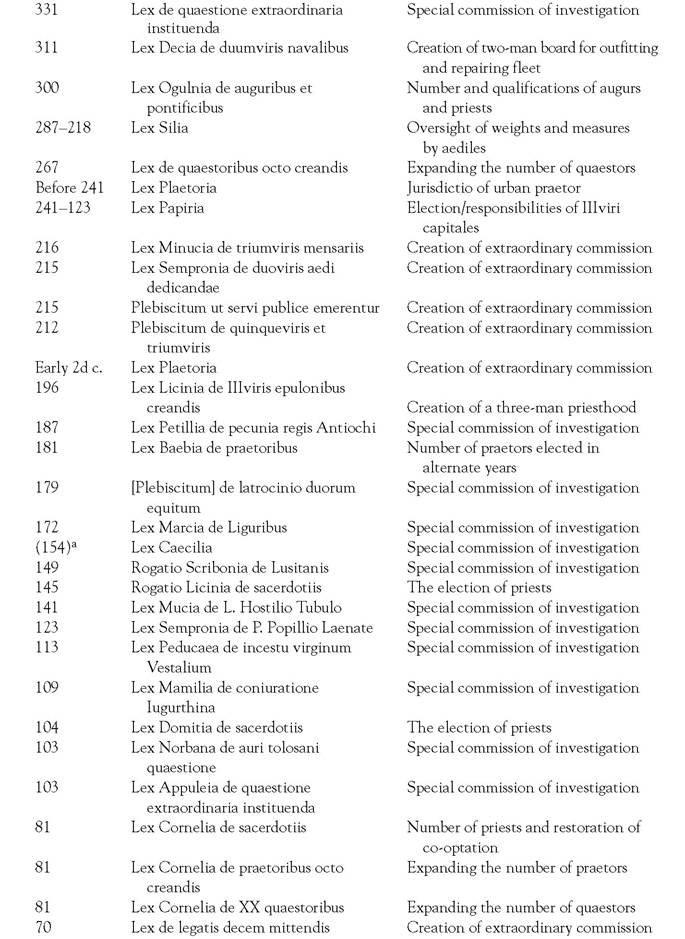
TABLE 6.2. (continued)
| 67 | Lex Gabinia de bello piratico | Creation of command against pirates |
| (65) | Lex Papia de vestalium lectione | The selection of Vestals |
| 63 | Lex Atia de sacerdotiis | The election of priests |
| 62 | Rogatio Iulia de cura Capitolii | Reassignment of oversight over |
| restituendi | temple reconstruction | |
| 61 | Lex Pupia Valeria de incestu Clodii | Special commission of investigation |
| 61 | Lex Fufia de religione | Special commission of investigation |
| 61 | Rogatio de repetundis | Special commission of investigation |
| 59 | Lex Vatinia de Vettii iudicio | Special commission of investigation |
| 57 | Rogatio Messia de cura annonae | Assignment of oversight over |
| Cn. Pompeio mandanda | grain supply | |
| 57 | Lex Cornelia Caecilia de cura | Assignment of oversight over grain |
| annonae Cn. Pompeio mandanda | supply | |
| 56 | Rogatio Porcia de quaestione extraordinaria instituenda | Special commission of investigation |
| 54 | Rogatio de tacito iudicio | Special commission of investigation |
| 50 | Rogatio Scribonia alimentaria | Assignment of oversight over weights and measures |
| 50 | Rogatio Scribonia viaria | Supervision of roads |
| (46) | Lex Iulia de sacerdotiis | Eligibility for selection to priesthood |
Source: See appendixes A and C.
aDates in parentheses are approximate. See appendix C.
Notes
1. I am not concerned in this chapter with any particular model of an ancient city. However, theoretical supports for the many-layered view of Rome presented here may be found in two insightful studies, D. Engels, Roman Corinth: An alternative model for the classical city (Chicago and London, 1990); and N. Morley, Metropolis and Hinterland: The City of Rome and the Italian Economy, 200 BC-AD 200 (Cambridge, 1996).
2. On vici see further in this chapter.
3. So the Romans believed. A modern explanation of the derivation of the name attributes it to the fact that the vicus Tuscus was a main road to Etruria, beyond the Tiber: Richardson 1992, 429. However, an ancient statue of the Etruscan god Vortum- nus here reinforces the idea of an Etruscan neighborhood: Varro, Ling. 5.46; Cic., Verr. 2.1.154; Propertius, 4.2.1-10. Location of statue: M. C. J. Putnam, “Vortumnus,” AJA 71 (1967): 177-79.
4. An inscription ca. 300 provides the names of an apparently Etruscan couple living on the vicus Longus: CIL 6.i00023.
5. Greeks: (inscriptional evidence from the reign of Augustus) CIL 6. 761 = ILS 3308; Carthaginians in Rome: R. E. A Palmer, Rome and Carthage at peace. Vol. 113 of Historia Einzelschriften (Wiesbaden, 1997).
6. On the geographic importance of the site see Walker 1958, 21.
7. In the late third and second centuries, Puteoli in Campania on the Bay of Naples (modern Pozzuoli) becomes the major port serving Rome: Frederiksen 1984, 46. No adequate port facilities existed at Ostia until the reign of Claudius: see R. Meiggs, Roman Ostia, 2d ed. (Oxford, 1973), 54-57.
8. A comparison made also by Holloway 1994, 165.
9. Inter lignarios: Livy 35.41.10; inter falcarios: Cic., Cat. 1.8; Sull. 52; inter vitores: CIL 14.4535.3; and inter figulos: Varro. Ling. 5.154.
10. Appropriating gods: R. E. A. Palmer, Roman religion and Roman empire: Five essays (Philadelphia, 1974), 3-56; M. Beard, J. North, and S. Price, Religions of Rome (Cambridge, 1998), 1.73-87.
11. Beard, North, and Price 1998, 1.70.
12. Livy 9.29.9-11.
13. The openness of Rome to new cults: North 1976; Beard, North, and Price 1998, i:63, 75.
14. Beard, North, and Price 1998, 1.79-87.
15. Hercules: R. E. A. Palmer, “Cults of Hercules, Apollo Caelispex and Fortuna in and around the Roman cattle market,” JRA 3 (1990): 234-44, esp. 236-40; F. Coarelli, Il foro boario dalle origine alia fine della repubblica (Rome, 1988), 75.
16. See further in this chapter.
17. Julius Obsequens 37.
18. Such was also the case with Placentia, established in 218 and refilled in 190: Livy 37.46.9-47.2.
19. Taylor i960, 49, and Sherwin-White 1973, 74-75, both following Beloch 1880, i°3-4.
20. Fora: R. Laurence, The roads of Roman Italy: Mobility and cultural change (London and New York, 1999), 29-38; E. Ruoff-Vanaanan, Studies on the Italian fora (Wiesbaden, 1978). The best discussion on conciliabula and fora remains Beloch 1880, 102-16. See also Gargola 1995, 109-11.
21. Sherwin-White 1973, 52-53; Humbert 1978, 382-90.
22. Taylor i960, 69. Burial grounds for the Pollia tribe were uncovered along the via Salaria: Taylor i960, i4-i5.
23. Argei: Taylor i960, 75.
24. Festivals: W Ward Fowler, The Roman festivals (London, 1899); Scullard, 1981.
25. General discussion of the place of these festivals in city life: Beard, North, and Price 1998, 1.40-41; J. E. Stambaugh, The ancient Roman city (Baltimore, 1988), 22i-33.
26. Calendar: Michels i967. Calendar of festivals: Scullard i98i.
27. Performance: Beard, North, and Price i998, i.42-54.
28. ludi Romani and Plebeii: Beard, North, and Price i998, i.40-4i, 66-67.
29. In the third century, the Games of Apollo (ludi Apollinares) were instituted. First staged in 2i2 on the occasion of a plague, during the Second Punic War, these games were made annual in 208 by a public law brought by the praetor P. Licinius Varus (Livy 27.23.7). By 190, the games lasted four days, from 13 to 16 July, and by the 40s they extended over eight days. In the second century, two more sets of games were instituted on an annual basis: the Megalesia, in honor of the Great Mother (Magna Mater), from 4 to io April, became annual in 194; and the Games of Flora (ludi Florales), from 28 April to 3 May, became annual in 173.
30. Beard, North, and Price 1998, 1.101.
31. Epulum Iovis: Warde Fowler 1899, 216-34; Scullard 1981, 186-87.
32. Individuals and festivals: Beard, North, and Price 1998, 1.48-51.
33. The cups include elephant cups as well as cups with a cupid, inscribed with the names of Laverna, Vesta, Fortuna, Ceres, Juno, Minerva, Vulcan, Saturn, Aesculapius, Concordia, Salus, Bellona, and Venus. They have been found (many in graves) in Clusium, Vulci, Tarquinii, Capena, Lanuvium, Aleria, Teanum, and Carsioli.
34. Notwithstanding the tendency of modern scholars to doubt the regular movement of citizens (except wealthy ones) to Rome. On this basis Brunt raises objections to the feasibility of filling the legions in Rome: Brunt 1971,625-35. Rawson effectively counters this position: E. Rawson, “The literary sources for the pre-Marian army,” PBSR 39 (i97i): 37-39.
35. Time and distance: Laurence 1999, 78-94.
36. Macr., Sat. 1.16.34.
37. The term appears first in the leges luliae iudiciariae: Gaius 4.104, 107; Kaser 1955, i.545; Thomas 1976, 92-93.
38. Road building: Laurence i999, ii-26; T. P. Wiseman, “Roman republican roadbuilding,” PBSR 38 (1970): 122-52.
39. Potter 1979, 79-87; Frederikson and Ward-Perkins 1957, 67-198.
40. The via Cornelia, later named Aurelia, was most likely in origin a drove trail along the coast: Potter 1979, 80. J. Andre, “Les noms latins du chemin et de la rue,” REL 28 (1950): 105-8 (calles).
41. Via Salaria: Chevallier 1976, 66-67, 131, 134· The salt trade along this route was controlled by Rome from early in the fourth century, who took it over from the Latin town of Fidenae, near Rome, located on the route.
42. Chevallier i976, 30.
43. Road building of C. Gracchus: Laurence 1999, 49-51.
44. CIL i2.638.
45. Cf. Laurence 1999, 27-38; Purcell 1990, 12-14. General discussion of roads: Chevallier 1976, 132-37. Roads were built for strategic reasons, in pace with military conquests; they came in the “wake of conquest and subsequent political unification and economic development.”
46. This was constructed with funds derived from penalties exacted from two equites who defrauded the state in the exercise of wartime contracts. The ancient sources are collected in Richardson 1992, 169, s.v. Forum Piscarium.
47. On these projects see Livy 40.51.
48. Discussion of the current state of knowledge about urban growth of Rome: J. R. Patterson, “The city of Rome: From republic to empire,” JRS 82 (1992): 186-215.
49. Labor force: P. Brunt, “Free labour and public works at Rome,” JRS 70 (1980): 8i-i00.
50. Lexicon Topographicum Urbis Romae (Rome, 1993), vol. i, s.v. “Circus Maximus.”
51. It is based on the city's water supply, its land area, and in particular a handful of references to the number of permanent city residents receiving free grain. For discussion of these issues see Morley i996, 33-39.
52. Although many scholars have assumed the opposite: see, for instance, Brunt 1971, 69, 386.
53. The most systematic work on the “effectiveness” of migration—the ratio of those who stayed in a city to those who moved there for a short time—to urban areas in preindustrial society seems to have been done in the United States and shows that only about one in fifteen migrants to a city stayed permanently: Stephan Thernstrom, The Other Bostonians (Cambridge, MA, 1973).
54. Sall., Cat. 37.8-9. See chapter 3.
55. Appian, B.C. 1.95 with commentary in Gabba 1958. See Brunt 1971, 301-2.
56. Val. Max. 9.2.1, with Brunt 1971, 302.
57. Cass. Dio 40.59-66. Regrettably, the refugees from civil war were wrong. Food supplies to the city were severely cut between 50 and 46 with the result that not only the newcomers but the permanent city residents melted away. When Caesar held a census of the city population in 46, taken neighborhood by neighborhood, 150,000 men were counted, down from 320,000 in 50. In the absence of a steady food supply, the population had dropped from roughly one million to half a million, in four years, based on the enumeration of citizens eligible for the grain handout: Livy, Epit. 115; Suet., lul. 41.3; Plut., Caes. 55.3; Cass. Dio 43.21.4, 25.2; Appian, B.C. 2.14.102. How many died and how many left cannot be determined.
58. Rivers undependable for transporting goods and produce: Walker 1967, 14.
59. The relationship was established by Mommsen, R.St. 2.2.1029-33.
60. Brunt 1971, 305-9; the figure is Brunt's estimate. Half the colonies can be named although the locations of only four are certain, Arretium, Faesulae, Pompeii, and Praeneste. The colonies were established on state land and in towns on the losing side, whose cultivated lands were appropriated, divided, and assigned to the victors: Appian, B.C. 1.96, 100.
61. The ancient sources are collected in MRR 2.188.
62. See tables 1.9 and 1.10 in chapter 1.
63. G. Rickman, Roman granaries and store-buildings (Cambridge, 1971).
64. When Sulla in 81 annulled the previous grain law he opened the field up again.
65. The complex human as well as political dimensions emerge in a few well-known episodes: Marius and Mamertine cohorts; the work of the censors of 97. On these see E. Badian, “Caepio and Norbanus,” in Badian 1964a, 34-70 (= Badian 1964b), esp. 47-49.
66. While this appears to have been recognized practice after the Second Punic War, by the time of the Italian War the privilege is no longer commonly claimed: Sherwin-White 1973, IIO-II.
67. Livy 41.9.9-12. The praetor was L. Mummius, who had been assigned the province of Sardinia.
68. Livy 39.3.4-6.
69. Figure from Diod. Sic. 37.I3, who reports that Poppaedius Silo marched on Rome with ten thousand allies who had left, fearing the outcome of a judicial inquiry. Cic., Corn. fr. 10 and Asc., 67-68C; Cic., De Or. 2.257; Sest. 30; Balb. 48 and 54; Off. 3.47; Brut. 63; Sall., Hist. 1.20M; Schol. Bob. 129 Stangl. On the episode see Badian I964, 48 with nn. I30 and I3I, and 49, and Brunt I988, 99-I0I.
70. The lex Papia: Cic., Leg. Agr. 1.13; Arch. 10; Balb. 52; Att. 4.18.4; Off. 3.47; Cass. Dio 37.9.5; Schol. Bob. I75 Stangl; Val. Max. 3.4.5.
71. See chapter 9.
72. R. Lanciani, The ruins and excavations of ancient Rome (Boston and London, 1967 [1897]), 544.
73. Lanciani 1897, 389. CIL 6.1953 (1956), 9284, 9399, 9491,9526. All appear to be Roman or Italian.
74. Suet., lul. 46.
75. See J.-M Flambard, “Collegia compitalicia: Phenomene associatif, cadres terri- toriaux et cadres civiques dans le monde romain ä l'epoque republicaine,” Ktema 6 (1981): 144-66; and Vanderbroeck 1987, 52-66. More generally see S. G. Wilson, “Voluntary associations: An Overview,” in Voluntary associations in the Greco-Roman World, ed. J. S. Kloppenburg and S. G. Wilson (London and New York, 1996), 1-15. The classic study of the types, organization, and membership of the various collegia, though outdated with respect to twentieth-century anthropological and sociological literature on their significance as a measure of individual mobility, is J.-P. Waltzing, Etude historique sur les corporations professionnelles chez les Romains (Paris, 1895-1900, reprint 1970), 4 vols.
76. In Italy, they are found in all towns of any size, symptomatic of the high level of mobility throughout Roman Italy. On the phenomenon, characteristic also of the towns and cities of ancient China, see L. A. Fallers, ed., Immigrants and associations (The Hague and Paris, 1967).
77. See chapter 9.
78. The organization described here was revived by Augustus. Its operation earlier is not directly attested but is probable, given, for example, the customary organizational role of vicomagistri in the Compitalia: Cic., Pis. 8.23; Livy 34.7.2.
79. W Nippel, Public order in ancient Rome (Cambridge, 1995).
80. Nippel 1995, 4-46.
81. Formulary procedure: A. Watson, “Development of the praetor's edict,” JRS 60 (1970): 105-19.
82. Macrob., Sat. 1.16.30.
83. Chapter 7.
84. Minor magistrates: Lintott 1999, 137-44.
85. Crawford thinks the censors minted coins before this, but the length of tenure and five-year gap between censorships made it impossible to anticipate needs. Consequently, the coinage minted (generally outside Rome) prior to the creation of the tresviri monetales was used only outside Rome, to pay for the fleet: Crawford 1985, 25-27.
86. This is conventional. Brennan 2000, 85-89, offers a different hypothesis (a second praetorship needed for the province of Sicily).
87. Brennan 2000.
88. On the extraordinary boards during the Second Punic War see chapter 1, and on Pompey's command against the pirates see chapter 9.
89. M. Kaser, Das romische Zivilprozessrecht (Munich, 1966), 127. Whether their jurisdictio was restricted is unknown, as is the date of their disappearance after the Italian War.
90. See P Birks, “New light on the Roman legal system: The appointment of judges,” Cambridge Law Journal 47.1 (1988): 36-60.
91. The former were thus leges datae: RS 2.43.
More on the topic CHAPTER SIX Convergence: The City of Rome:
- As a large city and the heart of an empire, Rome was full of courts.
- A. CITY ROME LAW
- THE LOCATION OF LEGAL ACTIVITIES IN THE CITY OF ROME
- The inhabitants of Rome lived with the reality of legal courts scattered throughout the public and private spaces of the city, and perhaps even came to resent, on occasion, the impact such courts made on traffic flow during the busy hours of the day.
- part two the expansion of rome chapter four
- Changing theories of the state: has there been a convergence?
- 9.4 A POWER CONVERGENCE FOR THE POOR IN EUROPE AND THE AMERINDIANS IN AMERICA
- City-states
- Elite governance at the city level: the case of urban regimes
- Adjudication of public crimes by the people may have been efficacious in the context of a small city-state composed of conservative farmers and middle-class citizens.
- The beginnings of Rome
- Foundation of Rome: the monarchy
- Living conditions in Rome
- Early Rome: ius humanum
- THE JURISTS AND THE LAWS IN ROME