CHAPTER NINE The Demise of Public Law, 69-44
before the start of an ill-fated assembly in 47, during the turbulent civil war years at the end of the Roman Republic, the “master of the horse” (magister equitum), M. Antonius, ordered his soldiers into the Forum to tear down the notice boards advertising a proposal to remit all debts and rents promulgated three weeks earlier by the tribune P.
Cornelius Dolabella.1 The removal of the boards precipitated a bloody confrontation between the soldiers and the Roman voters in support of Dolabella's measure, who had barricaded themselves in the Forum overnight to await the scheduled voting assembly. The determined fury displayed by these voters in 47 is a barometer of the extent to which the Roman people now accepted more immediate political uses of public lawmaking assemblies. But the implications for Roman public lawmaking activity of the Senate-sanctioned violence are far more significant.Three years earlier, in 50, the Roman world had erupted in the final civil war that would eventually usher in a new Roman order under the rule of emperors. Crossing into Italy at the head of a Roman army in 50 Julius Caesar carried to its penultimate stage the final solution to uncontrolled competition among the leadership, challenging the cohesion of Roman society by attempting to set himself up as the single, all-powerful leader in Rome within the parameters of traditional Roman offices. Some measure of the initial acquiescence in his role by other Romans came on the heels of M. Antonius's slaughter of Roman citizens in the Roman Forum in 47: the Senate decreed no new laws in Rome until the return of Julius Caesar. Public lawmaking as the uncoerced expression of the people's will was for all practical purposes over.
In this chapter we continue to explore some of the developments leading to this point. Roman leaders worked hard to ensure the continued functioning of the traditional public lawmaking system.
These efforts, however, were futile in face of an explosion in the citizen population, the vast changes in the pool that had traditionally provided leadership, and the growing politicization of lawmaking that culminated in the portentous lawmaking activity of the civil war years, 49 to 44. After 44, this most remarkable burst of lawmaking activity in Roman history is followed by dramatic changes in the format and focus of lawmaking assemblies. The failure of public lawmaking assemblies to reduce the level of disruption was followed by the emergence, with the ascendancy of Octavian in 31, of the first Roman emperor. Lawmaking assemblies, although not yet moribund, never again assumed the form, frequency, or function that they had held for over half a millennium.PUBLIC LAWMAKING, 69-5O
The consequences of the revisions consummated in 70 were far-reaching. As measured by the density of public laws and proposals down to 50, it is clear that Romans in the more numerous groups now constituting the Roman voting population still viewed the lawmaking process as a regular means of establishing consensus in a diverse society. Unfortunately, the emphasis of the ancient narratives on the political alliances and personal ambitions of a small number of Romans—senators, nobiles, and political newcomers competing for office—as laid bare in the lawmaking arena, masks the degree to which public lawmaking activity as well as the concerns of law sponsors reflect a communitywide interest in changing or restoring the Roman state through the traditional avenue, public law. But it was this communitywide engagement (and only this) that made possible the emergence of a new political dimension in public lawmaking activity. In particular, a more varied and irregular leadership, brought about by the diverse society Rome had become, began to use the process to advance special interests—or interests undoubtedly appearing special to other Romans for the reason that the ruptures among groups were becoming irreparable.
Although the details of the politicization of public lawmaking are visible in many of the events of the next twenty years, in the following analysis I propose to focus on events in 67, 59, and 58 that prompted unusually high levels of lawmaking activity. The various issues addressed by law sponsors in the ten or more public law proposals mooted in each of these years confirm that 70 was the climacteric of Roman public law. Henceforth, the uses of lawmaking were changed forever.THE LAWMAKING OF 67
In 68, the proconsul in Bithynia, Pontus, and Cilicia, L. Licinius Lucullus, ordered out the Roman legion XX stationed in Pontus. The soldiers mutinied because, according to report, they had already served long enough. Without them Lucullus marched into Armenia, where he won a battle and withdrew to Nisibis for the winter. There his troops were roused to air their resentment for Lucullus by one of his staff, the young P. Clodius Pulcher, now aged twenty- four, later tribune in 58.2 Back in Rome the praetor L. Quinctius orated on the necessity of replacing Lucullus in the command against Mithridates. In these rancorous episodes, the growing dissatisfaction of Romans on all levels of society with the way Lucullus was conducting the long campaign against Mithridates is unmistakable. As a Roman leader under scrutiny Lucullus was by no means alone: since 70, the leadership of Rome had been coming under particularly close inspection and revision from many quarters. However, the situation in the east was particularly dangerous because of Lucullus's failure not only to vanquish Mithridates—indeed, the king's vitality was growing— but to control the menace of piracy in the regions assigned to his command. The organization and capability of the pirates based in Crete and Cilicia had deepened. Pirates intercepted grain ships traveling to Rome from Sardinia, Sicily, and North Africa. Among city dwellers, the fear of famine was high. Going ashore in Italy itself, pirates plundered villas and snatched wealthy Romans for ransom.
In 68, pirates even captured two Roman praetors complete with insignia of office and attendants.3 In past years the Roman commanders sent to Crete and Cilicia had failed to stop them; now Lucullus was failing too. Catastrophe was in the air. Then, in 67, Mithridates destroyed the Roman army in Pontus, commanded by a legate during the commander's absence in Armenia. Among the great many casualties were 7,000 Roman dead, including 150 centurions and 24 military tribunes. No single battle since the Second Punic War had touched so many senatorial and equestrian families in Rome and in the municipalities of Italy with the death of fathers, sons, or brothers. Mithridates, with his son-in-law Tigranes, proceeded to regain Pontus and Armenia while the Romans remained stunned, their commander, Lucullus, paralyzed by the disintegrating morale of his troops and the defeat of his legate, C. Valerius Triarius.In the same year, a consul and three tribunes presented at least thirteen laws to the people for their approval, listed with their sponsors in table 9.1. Despite the different issues addressed by these proposals, their primary thrust was leadership: military command in the eastern wars and more broadly the overall responsibility and privilege of Rome's leaders. The most critical measures of the year, carried by the tribune A. Gabinius, a longtime associate of Pompey and recent entrant to office, involved military commands.4 Gabinius first sponsored a bill that gave to the consul M'. Acilius Glabrio the province of Bithynia and Pontus and some of the legions currently commanded by Lucullus. Thus the proconsul, who had gone out to Asia after his consulship in 74, came to share the command against Mithridates. Gabinius next presented a highly controversial bill creating an extraordinary command for Pompey against the pirates, similar to one held between 102 and 100 by the proconsul M. Antonius.5 This law designated a special province, the entire Mediterranean sea and its shores, extending fifty miles inland, for a period of three years.
The bill also gave Pompey the authority to draw directly on state funds and a fleet of two hundred ships, full authority to conscript rowers and soldiers, and the authority to choose fifteen legates from the Senate. Never had one man held as much power as Pompey would under the terms of the rogatio Gabinia.The public lawmaking sessions convened to debate the tribune's bill were agitated. Reportedly the people who attended the preliminary meeting at which the Gabinius promulgated his measure were wildly enthusiastic when the terms of the law were read aloud6—all but the senators, who, with the exception of Caesar, were solidly opposed to the measure because of the authority it vested in one man. When the consul M'. Acilius Glabrio advised Pompey in a public oration not to accept the command he was nearly lynched. When the “first man” in the Senate (princeps senatus), Q. Lutatius Catulus, consul in 78, argued in a public oration about the danger of giving one man so much power— what if something should happen to him?—his listeners respectfully roared that they would replace Pompey with Catulus himself. When the tribune L. Roscius Otho tried to orate about the wisdom of selecting at least two commanders for this special province the people refused to let him be heard. At this critical moment when pirates blocked vital food supplies, only one strong leader, so far as the Roman people were concerned, Pompey, could restore Rome.
Thanks to the Senate, the people's sovereign will was expressed on this occasion with difficulty. Despite communitywide support for the proposal, outside a cluster of leading senators, when Gabinius convened the voting assembly one of his colleagues, L. Trebellius, vetoed the measure. In turn, Gabinius proposed a measure on the spot to remove Trebellius from office, as Ti. Gracchus had done in 133 in the course of a lawmaking session involving another popular bill. When it looked like the voters would unanimously approve the measure to depose him, Trebellius withdrew his veto.
The voters at length cast their votes to accept the measure as law. Even then, the Senate obstructed the implementation of the bill. When the consul C. Calpurnius Piso discharged sailors conscripted by Pompey and impeded the equipment of his ships, the tribune Gabinius drafted another measure to depose the consul from office.7 Tensions between Pompey and the Senate are apparent.A leadership in conflict within itself and with the people emerges in other bills of 67 shown in table 9.1, in particular those of the tribune C. Cornelius. Like Gabinius, he had recently been in the military consilium of Pompey.8 Like Gabinius, too, Cornelius was an active law sponsor, promulgating at least five proposals.9 Among his initial proposals was a bill prohibiting loans by senators to foreign states, believed to be aimed at reducing the scope for corruption that such loans encouraged.10 The bill failed when the Senate objected that the terms of the bill were already covered in a Senate decree of 94. In retaliation, according to Asconius, Cornelius proposed his next measure, which addressed the Senate's authority to give exemptions from the law—probably the law regulating the order in which offices in the cursus were held.11 Only the people, his bill confirmed, had the power to grant such exemptions.12 Whatever its immediate motivation, the proposal was stoutly opposed by senators.
In the public lawmaking session at which Cornelius presented this bill another tribune interposed his veto. The herald, on the point of reciting the law to the voters, stopped at once, but Cornelius took up the codex and recited the law himself. Outraged, the consul Piso and other senators objected forcefully to this breach in customary procedure. Defiant, the Romans in attendance threatened to lynch the consul. Recognizing a dangerous situation, Cornelius dismissed the assembly without calling for a vote. He subsequently presented a revised proposal, which enacted that any exemptions from the law determined by a quorum of two hundred senators must be presented to the people for their approval.13 When presented to the voters this measure was accepted as law. The tribune's effort at conciliation without conceding the sovereign authority of the Roman people is evident. Another bill enacted that the praetor urbanus must make judgments in accordance with his edict, announced at the beginning of his year of office.14 According to Dio, the bill aimed to prevent bribery by defendants in law cases before the praetor. This measure, too, was accepted as law.
After these bills, Cornelius presented a law on the crime of ambitus, imposing heavy fines on candidates for office convicted of bribery and also for the first time on the tribal officials, divisores, convicted of distributing bribes to tribal members.15 The proposal evidently was inspired by a surge in the number of candidates and in electoral bribery as men who had been removed from the Senate lists in 70 tried to regain entry through election to high office.16 Notwithstanding support for the measure outside the Senate—indeed there was a communitywide concern to correct the spreading incidence of bribery at the highest levels—it does not appear to have been enacted as law.17 But soon after, at the time of the elections, Rome was shaken by several public episodes of bribery and violence as candidates competed for votes. Although public business was customarily prohibited during the election period, the Senate decreed that an exemption should be given to the consul Piso (who was himself reputedly elected with the assistance of lavish bribes) from the custom, so that he could present another bribery law to the people with somewhat lighter penalties attached and leaving divisores out of the terms of the law.18 Like Cornelius’s lex de legibus solvendo earlier in the year, Piso devised an accommodating bill, agreeable to voters who might have accepted Cornelius’s rogatio de ambitu as well as voters who were against it. This measure was accepted.
All other measures presented to the people by the magistrates of 67 and listed in table 9.1 also involved Roman leadership.19 Gabinius, probably as tribune in this year, carried a measure instituting the month of February as the period during which the Senate would hear foreign embassies. By reducing the length of time foreign emissaries stayed in Rome, the potential for senatorial corruption would also diminish.20 On the same line and following the failure of Cornelius’s proposal regarding loans by senators, Gabinius probably carried a similar measure prohibiting loans to foreign emissaries in Rome.21 The tribune L. Roscius Otho addressed leadership on a different level in a successful bill to reserve seats in the theater for men of equestrian rank. The public honor of a reserved front-row bank of seats in the theater, previously held only by senators and priests, was now again extended to the wealthiest businessmen and state contractors who funneled the resources of empire back to Italy. For these men, Roscius, himself a political newcomer, reestablished the honor of reserve seats in the next fourteen rows, removed by Sulla in 81.22 While such honors are part of the trend toward the inflation of privilege that characterizes the last years of the Republic, they are also indicative of the increasing selfimportance of this identifiable sector of the community, namely, men of equestrian rank constituting the highest property class, who since 70 derived not only from Rome and those Italian and Latin communities receiving citizenship before the Italian War but the municipalities of Italy. Cicero later claimed that Roscius was responding to communitywide demand in promulgating this bill, although the demonstrated hostility of ordinary Romans to Roscius in 63 with regard to this very privilege suggests otherwise.23 More likely the tribune's motives were to attach the men of this class more closely to the Senate. Lone among the tribunician bills of 67, the lex Roscia sought to restore the vigor of the Senate, diminished since 70.
As a group the laws of 67 reveal continued, troubling divisions among the men who constituted Rome's leadership, within and without the Senate, played out in Rome's public lawmaking arena. On one side in 67 was the consular renovator, Pompey. On the other side was the Senate, or rather a small group of high-ranking senators, principes civitates, who opposed both the resurrection of a vital tribunate and Pompey.24 The political nature of the lawmaking activity in 67 is indisputable. Two lawmakers this year, Cornelius and Gabinius, strengthened the tribunate and Pompey. And two lawmakers were committed to an ascendant Senate, Piso, solidly hostile to Pompey, and Roscius Otho.25 The experience of Cornelius best reveals the enduring hostilities between divided camps. Despite the success of the revised version of his lex de legibus solvendo, the tribune nonetheless faced a novel charge brought the following year by two equestrians that his actions at the earlier assembly had diminished the maies- tas of the colleague who vetoed his proposal.26 Defended by the senator Cicero, Cornelius denied that he had ignored the veto.27 The case was dropped when the praetor failed to appear and the audience lay into the two prosecutors. Whatever the legal issues of the case, contemporaries and modern historians alike have viewed the entire episode as a political maneuver to get even with the leaders who overturned Sulla's central reform.28
At the same time the merits of most if not all of the measures clearly transcend politics—or more properly the clash of individual political ambitions. Cornelius and Gabinius in particular, sharing Pompey's ability to discern the will of the people, sponsored bills that were at times momentous and always attentive to the responsibilities of the leadership of Rome. Cornelius went after the Roman Senate, specifically the power of the Senate decree to remove actions (and the men who carried them out) that had societywide impact from the purview of the Roman people, to wit financial transactions that impoverished the provinces, entries for election to high office from men who had not followed the regular cursus, bribery at elections. To what extent Cornelius's individual vision or experience is reflected in his lawmaking activity we cannot gauge since we know so little about him. Gabinius, however, is more comprehensible. Surely only a man like Gabinius, who had spent nearly twenty years in the field before holding political office and was later regarded as one of Rome's vires militares, could successfully propose two unusual measures transforming the command structure ordained by the Roman Senate.29
In accepting the leges Gabiniae, the people's judgment (and Gabinius's) proved accurate. Pompey in particular was rapidly successful in unraveling the networks of pirate organization and clearing the seas of outlaw marauders, resettling them in underpopulated regions.30 By the end of the year, the Roman people viewed Pompey as the leader to reinvigorate Roman expansion in the east as well, stalled under the purview of Lucullus and Glabrio. Undoubtedly the defeat of Triarius reinforced their judgment. Early in 66, the tribune C. Manilius carried a measure giving Pompey the provinces and troops of Cilicia, Bithynia, and Pontus, previously commanded by Lucullus and Glabrio, and the command against Mithridates. At the same time Pompey kept the special province created the previous year by Gabinius.31 The overwhelming public support for the measure is unmistakable in the single public oration surviving in full, delivered by the praetor, Cicero. Although the Senate as a collective opposed the bill, only the princeps senatus, Catulus, spoke against the measure, and at the assembly the tribes unanimously accepted Manilius's proposal as law.32 Pompey's rapid success against Mithridates, resulting in a magnificent flow of riches into the Roman treasury and firm control of the east, again confirmed the people's judgment. The leges Gabiniae initiating this string of events might be termed political in their motivations, from a modern perspective, because they served to enhance Pompey's reputation, but they also served the immediate needs and interests of the Roman state.
THE LAWMAKING OF 59
In 63, on the motion of the consul Cicero, the Roman Senate voted to execute two of its own members without trial following their arrest for inciting the Allobroges of Transalpine Gaul to rebellion. Notwithstanding the efforts of Caesar, now praetor, to mitigate the penalty, Cicero's recommendation that the senators be summarily killed as criminals caught in the act, emotionally endorsed by M. Porcius Cato, carried the day. So died the patrician P. Cornelius Lentulus Sura, quaestor in 81, praetor of the extortion court in 74, and consul in 71. Expelled from the Senate in 70 he reentered as a result of his election to the office of praetor in 63, for the second time. The senator C. Cethegus died also, reportedly a low-ranking senator of no known reputation or attainments. The equites M. Caeparius of Terracina, L. Statilius, and P. Gabinius were also executed.33 Warrants were sworn for the arrest of several other men of all ranks who escaped capture, fleeing Rome to join the irregular army of Catiline in Etruria.34
In these executions urged by the Roman consul and decreed by the Roman Senate, the most radical act of the incident known as the Catilinarian conspiracy, the attenuation of the traditional linkages between members of the Roman state at all levels is clearly revealed. The precise nature of the crisis of 63 is per- plexingly elusive, in spite of the voluble narrations of Cicero, himself one of the chief participants, as well as of C. Sallustius Crispus (Sallust), a younger contemporary who was tribune a decade later in 52 and praetor in 46. The issues as presented by Cicero and Sallust were moral: Catiline and his co-conspira- tors represented a degenerate leadership drawing on the support of base men who had squandered their resources and desperate men with nothing to lose. Given the scope of the crisis, ranging from open rebellion in Transalpine Gaul to the whispered menace of spontaneous insurrection across Roman Italy and Latin Cisalpine Gaul, the issues were undoubtedly far deeper.35 In particular, growing disparities in the access that Romans of different status groups had to essential land resources and to the rewards of empire had intensified division over the incorporation of new members and the leadership of the Roman state. No fewer than thirty full-strength legions were under arms in 63.36 At the beginning of his year of office, the tribune P. Servilius Rullus had proposed the most practical measure to date addressing the land problems facing Romans. Despite the conspicuous need for a measure of such unprecedented scope and notwithstanding support from ordinary Romans, Rullus withdrew his proposal rather than face a likely veto. As we saw in chapter 2, the persuasive opposition of the consul Cicero—who at one and the same time embodied the political aspirations of new citizens and championed the political conservatism of the Senate, whose most prominent members were as adverse to the idea of vesting extraordinary powers in a ten-man commission as they were in one man—was overwhelming. What crises were building? How could they be resolved? The Catilinarian conspiracy serves to direct the focus on the Roman leadership and in particular on the failings of that most important collective, the Roman Senate, in the efforts, almost unceasing from now on, to mend a society whose political foundations are trembling.
These failings come again into view in 60, when the Senate resolutely turned down requests from Caesar and Pompey in regard to matters that came within the Senate's traditional purview. Waiting outside Rome with his army, prior to entering the city in triumph, as per his right, Caesar requested an exemption from the rule that candidates for office had to present their candidacy in person (or that he be allowed to enter the city to stand for consul, then return to his army without setting down his imperium). Similar exemptions had often been made before, sometimes by public law, as for instance during the Second Punic War, and at other times by Senate decree, but on this occasion the Senate refused, forcing Caesar to forego his deserved triumph in order to announce his candidacy. Pompey for his part had requested the Senate to ratify his arrangements in the east, made on his own initiative in the absence of counsel from the usual senatorial commission. Again the Senate refused, acceding to the persuasive arguments of Pompey's rivals in military glory, Crassus and Lucullus. In the same year the Senate had supported the consul Metellus Celer's obstruction of the tribune Flavius's public law proposal to grant land to Pompey's veterans, agents of the most profitable Roman military victories since the mid-second century. In frustration Pompey promised “under oath” to support Caesar in his bid for consulship; Caesar mediated friendly relations between Pompey and the celebrated, rivalrous Crassus, and the extra-legal “three-man commission” known as the First Triumvirate was formed to promote the ambition and vision of Caesar, Pompey, and Crassus through public lawmaking assemblies.37 Without such a coalition the Senate wielded enough authority to prevent the passage of any public law proposal deemed to undermine its collective interest. The experiences of the tribunes Rullus in 63 and Flavius in 60 provide cases in point.
While the most conspicuous measure of the Senate's failure to provide collective leadership in 60 for an increasingly complex society is the informal political coalition formed by Pompey, Caesar, and Crassus at the end of the year, the public law proposals of 59 and 58, listed with their sponsors in table 9.2, disclose the extent of the problem in a much more precise way.38 Elected consul in 60 for 59, Caesar launched his year of office in January with an edict ordaining regular publication of Senate deliberations as well as contiones. Closed meetings and secrecy did not serve the people's interests.39 He then laid out an array of public law proposals addressing pressing social and economic issues that the Roman Senate had set aside or obstructed in the previous years. Among the first public law proposals was a measure assigning land to Pompey's veterans, accepted as law by the tribal assembly, as were all subsequent proposals.40 Given the consul's ability to discern the will of the people, the opposition of the Senate to Caesar's lawmaking program throughout the year, no less than their opposition to Caesar and Pompey in 60, is indicative of the level of friction now characterizing the topmost levels of Roman society that inhibited the Senate from attending to pressing social needs. When Caesar introduced a second public law proposal in the Senate in April, dealing with land distribution, he met with stony silence as the senators refused to discuss the draft.
Like the public law proposal of the tribune Rullus in 63, Caesar's proposal was an effort of scale to resolve one of the most urgent social problems of the day, access to land resources. A commission of twenty rather than ten men was instituted to divide up public property in the ager Stellas and Campanus, the last ager publicus in Italy, and to purchase land from willing sellers with money funneled into the state treasury from the booty Pompey brought to Rome from his successful campaigns. Men with three or more children were given priority in Caesar's bill; twenty thousand men at once lined up. To ensure implementation the proposal called for senators to swear an oath to uphold the law. Among the senators only Cato addressed Caesar's proposal, urging the Senate not to endorse a “new law.”41 Pointedly foregoing the Senate's formal approval, Caesar promulgated the proposal and convened meetings for the purpose of public debate. Pointedly he invited the consul M. Bibulus, elected as Caesar's colleague to “hold him in check,” to endorse the measure and met with the anticipated refusal.42 Caesar then invited his two influential associates, Pompey and Crassus, to lead off the discussion even though neither currently held an elected office. Custom required that law sponsors solicit contributions to the public argument from senators according to a rank order that placed officeholders before private citizens.43 Three tribunes promised to veto the bill, and Bibulus pronounced a cessation from public business for the remainder of the year. Caesar disregarded both, calling the assembly as announced.
On the day of the voting assembly Bibulus, attended by his lictors, mounted the podium of the Temple of Castor and Pollux, where Caesar was orating to the crowd, in order to denounce the proposal. Bibulus was unceremoniously pushed to the bottom of the flight of stairs, his shattered fasces tumbling after. The three opposing tribunes were pummeled. The senator Cato tried in vain to orate to the crowd, who not only refused to hear him but threw him bodily out of the Forum. He lacked the presence and skill to address the crowd, according to Dio.44 The voters, called to assemble in their voting units, enthusiastically approved Caesar's proposal. So resounding was the voters' affirmation of the lex Iulia agraria that on the day following, when Bibulus urged the Senate to annul the law, the senators would not consider the recommendation. For the remainder of his term Bibulus withdrew from his public duties, emerging only periodically from his house to resolutely announce he was watching the skies for omens, a prognostication that customarily called a halt to any legitimate assembly.
Even so Caesar promulgated and carried other laws, many of which addressed issues deliberated at one time or another in recent years by the Senate. One public law remitted one-third of their contracts to tax farmers in Asia, who had been requesting such a reduction from the Senate since the bids of 65 or 61.45 The Senate had turned them down. Another was a measure ratifying the arrangements Pompey had made in the east on the successful conclusion of his three- month campaign against the pirates and his four-year campaign against King Mithridates, between 67 and 62. Another law confirmed Ptolemy Auletes as King of Egypt and “friend and ally of Rome.”46 In all cases Caesar carried public laws that reversed earlier Senate decisions or took action on matters the Senate had obstructed. The Senate itself was the focus of another public law, the lex Iulia de repetundis, which applied primarily to senators and imposed more stringent penalties on their proven misbehavior. Outlasting any immediate circumstances, the scope and arrangements of this law were of lasting importance.47
Similarly contentious matters, with respect to an entrenched Senate membership, were aired by the two other officials presenting public law proposals in 59. While the consul Caesar was an unusually active lawmaker, so was the tribune P. Vatinius, with at least six public law proposals and probably more, as we see in table 9.2. A new man, Vatinius appears to have been a second-generation Roman citizen from the Marsi inhabiting the central Apennines, one of the tribal groups forming the core of resistance to Rome during the Italian War.48 His wife was the granddaughter of L. Iulius Caesar, consul in 90 who opened the floodgates of citizen incorporation with his public law of that year granting citizenship to Latins and faithful allies. Thus through this marriage Vatinius had some connection to Caesar, a clansman of the consul of 90. Likewise he was associated with Caesar throughout his political career. After his tribunate, Vatinius served as legate of Caesar in Gaul from 58 to 56.49 Standing for the office of aedile in 57, Vatinius failed, prompting Cicero's cutting intimation that a man who could not carry his own tribe at the voting assembly was suspect.50 Even so he was elected praetor in 55 and consul in 47.
In 59 we see Vatinius as a man with strong links to new citizens and to Romans advocating the incorporation of new citizens, links he shared with the consul, Caesar. As tribune he presented, in the early months of 59, a proposal concerning jury panels in criminal cases that allowed rejection of alternate jurymen.51 The bill appears to stem from the efforts of the Senate in 61 to control the selection of jurors for the court instituted to try P. Clodius Pulcher for sacrilege.52 Accepted by the voters, the lex Vatinia introduced a lasting reform in jury selection procedures. Another concerned the staff of provincial governors. Vatinius carried other bills establishing treaties with states, kings, and tetrarchs undoubtedly in implementation of some of Pompey's arrangements in the east.53 When the Senate assigned unprofitable provinces to the consuls, Vatinius carried a measure giving Caesar Cisalpine Gaul and Illyricum, with three legions, for five years.54 Although Cicero angrily denounced the lex Vatinia de provincia Caesaris as an infringement on the prerogative of the Senate to direct policy, he overstated the case: the people had made similar adjustments in the past, most recently in 67 and 66.55 The Senate later added Transalpine Gaul and an additional legion.56 Vatinius also carried a measure giving Caesar the authority to establish a citizen colony, Novum Comum, at Celtic Comum at the foot of the Alps in Cisalpine Gaul, which had earlier received Latin rights under a measure carried by the consul, Cn. Pompeius Strabo, extending Latin rights to the Transpadane inhabitants of Italy in 89.57 The effort to extend citizenship and tribal membership to the region, initiated by Caesar in 68 following his return from Further Spain, where he had served as quaestor under the propraetor Antistius Vetus, and advanced by Vatinius was only completed in 49.58
Like Vatinius, the third recorded lawmaker of 59 listed in table 9.2, the praetor Q. Fufius Calenus, was also a new man. But the family of Fufius Calenus, from Cales, a Latin colony that received citizenship in 90, had acquired citizen rights long before by virtue of holding local office.59 Fufius Calenus was later consul in 47, sharing that office with Vatinius. Like Vatinius, the group interests fielded by Fufius Calenus meshed with those of Caesar in 59. As tribune in 61, Fufius Calenus had carried a measure replacing the consul's controversial public law proposal regarding the constitution of the court to try P. Clodius Pulcher for sacrilege.60 As praetor in 59, Fufius Calenus proposed a bill requiring the three classes that made up jury panels—senators, equestrians, and tribuni aerarii—to report their votes separately.61 Like Caesar's edict requiring the publication of Senate minutes, this bill opened up to public scrutiny the decisions made by each panel. Doubtless Fufius had in mind the narrow margin of Clodius's acquittal in 61. The bill failed.
To sum up, throughout 59 we see laws carried by a consul, praetor, and tribune on matters taken originally to the Senate for decision but refused at that level; on matters involving the economic and political interests of men with an equestrian rating; and on matters involving new citizens. Equally visible is the degree to which individual lawmakers, in advancing their political ambitions, also advanced the interests of their own families, their own groups, and Roman society, as well as the interests of two widely recognized leaders, Caesar and Pompey.
As was customary, an entirely different college of tribunes and different consuls held office the following year, 58. Similarly a different range of immediate, divisive issues was aired in public law proposals (table 9.2). As in previous years, however, these issues were rooted in abiding, societywide concerns, in particular the accommodation of new citizens, the access to resources, and the rightful leadership of Rome, whose explosive potential was most recently seen in the unsuccessful Catilinarian conspiracy of 63. Nonetheless, the subtle shifts in the uses of lawmaking that lay beneath the activity of 67 and 59 were about to break the surface.
THE LAWMAKING OF 58
By the time the patrician P. Clodius Pulcher made his first bid for political office, the Senate had come to view him with growing alarm.62 Son of Ap. Claudius Pulcher, consul in 79, and member of the urban Palatina tribe, Clodius belonged to a highly visible branch of the patrician Claudii, fortunate in its accomplishments and connections.63 The family had an extensive hereditary clientage in the east, which Clodius, like his eldest brother, consul in 54, would later use to underwrite his political advancement.64 Besides the advantages falling to the third son in such a family, Clodius possessed the useful ability to identify and rally the discontented, a talent he displayed for the first time while serving on the staff of his brother-in-law Lucullus in the east, in 68, when he backed the troops protesting against the length of their service.65 Within a few years, Clodius had brought this ability to bear in Rome, whose crowded neighborhoods accommodated the bitterness and distress lingering after the defeat of Catiline in 63.66 By the time Clodius canvassed successfully for quaestor, in July of 62, he had an organized following of militant citizens.67 Hence, when the quaestor-elect was discovered in early December in the house of Pompeia, Julius Caesar's wife, during the state rites for the Bona Dea, and when Caesar declined to prosecute Clodius for adultery, and when the college of pontiffs decided that Clodius's presence in the house on that occasion constituted sacrilege, which carried no legal penalty, the Senate took action.
Early in 61 the consuls were instructed to propose a law (for all purposes drafted by the Senate) setting up a special court and allowing the prosecution of Clodius for incestus before this court.68 Although the Senate had to contrive somewhat the facts of the case to fit the definition of the crime—incest in the modern sense or sexual relations with a vestal (as well as any hint of chastity compromised)—incestus had the advantage of carrying a penalty of death or exile. The Senate's resourceful invention of a sustainable crime is a reliable indicator of its determination to rid Rome of this dangerous young man. While some senators objected to the idea of any criminal prosecution at all, the rogatio Pupia Valeria contained one particularly controversial arrangement: the urban praetor would select the preliminary panel of jurors.69 A hostile court was guaranteed. When an unwilling Pupius presented the proposal to the voters, Clodius's followers occupied the voting bridges and removed the ballots marked “uti rogas.” Piso cancelled the assembly, leaving the proposal unvoted. It was soon replaced by a compromise measure (essentially the same bill except that the regular procedure for selecting iudices, established by the lex Aurelia of 70, was followed), enacted by a tribune allied to Clodius, Fufius Calenus. In accordance with the lex Fufia de incestu the court was set up; Clodius was prosecuted; and by a narrow majority of four votes he was acquitted, notwithstanding the damaging testimony of a number of prominent witnesses, among them Cicero. In May of 61, the quaestor left for his province, Sicily.
Thus P Clodius Pulcher launched his controversial and unconventional political career. When he returned to Rome in 60, the apprehensions of the Roman Senate proved well founded. Especially sinister was Clodius’s continuing recruitment and organization of citizens in Rome who were loosely attached to the larger society—primarily poor citizens and former slaves—through the neighborhood and professional associations (vici and collegia) to which city dwellers belonged.70 Within their often overlapping vici and collegia, the men recruited by Clodius formed companies, like soldiers, and armed themselves for some events from a cache of weapons established at the tribunal Aurelia. The companies were led by a cadre of mostly low-status citizens described as “duces.” Some were former slaves from abroad, some were Italian (Marsi and Samnites are identified), and some were Roman. Only one equestrian is reported among their number. According to ancient report, Clodius appealed mostly to shopkeepers, former slaves, and young aristocrats; doubtless many former soldiers were included among them, albeit little noticed by our sources.71 Little noticed as well is the extent to which the membership of these companies penetrated all the tribes. For the associations on which they were based also absorbed the low-status or impoverished rural tribesmen living now in Rome, although registered still in rural tribes. Of course Clodius had hereditary and personal contacts of all stations among his fellow tribesmen in the urban Palatina tribe. But he also had contacts deep within every Roman tribe, through his services in 63 as middleman (sequester) between certain candidates for office and the divisores of all thirty-five tribes.72 These shadowy, low-level officials had long- established techniques of distribution among tribesmen of all (but especially low) stations, which Clodius presumably utilized. Like Catiline in 63, Clodius galvanized the silent, marginal members of the larger society. More important, he molded them into a group with a voice, and arms, within the tribes.73
His ambitions appear far different from Catiline’s, however: Clodius would work within the system. In 60, one of the tribunes promulgated a one-of a-kind bill to transfer Clodius to the plebs. It was vetoed. But the following year, Clodius transferred to a plebeian clan (the adoptive parent was the plebeian senator M. Fonteius) through the fiction of adoption (adrogatio), a transaction executed by the curiate assembly convened by the pontifex maximus; in 59, this was the consul Iulius Caesar. Contrary to custom Clodius kept his birth clan name; he also remained in his tribe. He stood for his next office and was elected tribune for 58. As tribune Clodius sponsored at least twelve public law proposals on his own, which in turn generated all other recorded tribunician proposals (at least two). If we knew nothing at all about Clodius, the number of laws alone suggests an ambitious tribune who was very aware of the potential uses of Rome's lawmaking assemblies and used them like few political leaders to date. Indeed, his activity rightly places Clodius in the small cluster of unusually prolific Roman public lawmakers, second only to the dictators Sulla and Caesar.74
On 10 December 59, soon after entering office, Clodius promulgated a cluster of four proposals that had been drafted beforehand. They were carefully considered. A rogatio de iure et tempore legum rogandarum established that assemblies could be convened on all appropriate days (dies fasti) and rigidly controlled some of the fundamental procedures associated with assemblies. Specifically, the bill placed constraints on using the veto at a lawmaking assembly, it prohibited obnuntiatio on the day of a legislative assembly, and it further prohibited any announcement of intent by the proper magistrate to watch the heavens for signs (which made the day unfit for a legal assembly).75 Since the leges Aelia et Fufia (ca. 153) had first regulated these practices in order to maintain customary procedure, their uses had become politicized. The consul Bibulus had most recently demonstrated their obstructionist possibilities. Caesar, however, sustained by the prestige of Crassus and Pompey and the backing of the Roman people (among them were his own veterans from Spain), could ignore his colleague's pronouncements. In 67, the tribune Gabinius had also ignored the similar pronouncements shouted over the heads of the assembled voters by Cato from a lofty perch (he had been barred from the assembly area). Clodius's proposal addressed the abuse of traditional mechanisms for political purposes by prohibiting the use of religious injunctions and also the veto on assembly days. If watching the sky or the report of bad omens impeded the legitimate expression of the people's will, the pronouncement was illegitimate. In this way, it is generally believed, Clodius shielded his own assemblies from obstruction.
Clearly the bill would advantage other lawmakers as well, and this was also true of the rogatio de censoria notione. This bill prohibited the censors from removing anyone from the order in which he was registered without prior trial and conviction. The review of the orders was a traditional responsibility of the censors; it had, on the reinstatement of the office in 70, assumed a distinct political dimension. Undoubtedly Clodius's bill had wide appeal among the senators who had cause to worry about the possibility of expulsion. Clodius, of course, was one of these: although he had been acquitted in 61, a future censor might yet remove him from the Senate on the grounds established by the college of pontiffs in 62, sacrilege. Among Rome's lesser senators, security of position was advantageous.
On a different track from these proposals, which pertained directly only to Rome's leadership, were two measures relating to the plebs. A rogatio de collegiis restituendis novisque instituendis restored the professional and neighborhood associations, which had been prohibited by Senate decree in 64.76 Throughout most of Rome's history, these corporations had been for the most part informally attached to the state: individuals within them might be clients of high-ranking patrons; their magistri managed certain festivals at this level of society and presumably maintained order at the neighborhood level, but the corporations themselves were fully self-governing and self-contained. In the partisan politics of the Late Republic these groups were becoming dangerously independent in their political loyalties, at least from the Senate's perspective. It was for this reason that the Senate in 64 abolished them (and later, each had to have a patron). The rogatio de collegiis restored the corporations (on which Clodius's companies were based), defined them as legitimate, and for the first time regulated the formation of new ones through a public law. Finally, a rogatio annonaria revived the notion of state-subsidized grain, which had been conceived by Gaius Gracchus and discontinued by Sulla, and established for the first time the distribution of state-purchased grain free of cost to citizens in Rome.77 Romans would now share freely in what must have been for some the foremost privilege of empire, sustenance. Given the conditions for survival in Rome, it is hardly surprising that this particular bill was greeted with both enthusiastic general support and considerable trepidation on the part of some senators, all too aware of the scarcity of ready cash in the state treasury. On 3 January 58, the Roman people enacted all four as law in a single lawmaking assembly. Given that these measures dealt with matters salient to a diverse set of groups, the tribune's confidence in the voters presumably rested on the influencing presence of his men at the assembly. It is the case that no one offered any obstruction, although reportedly a veto was a possibility.78
In late February, Clodius again promulgated two proposals at the same time, both addressing the leadership of Rome. Again the voters accepted them as law. The lex Clodia de provinciis consularibus changed the provinces and commands of the consuls of 58, assigning Cilicia to Gabinius and Macedonia to Calpurnius Piso and granting each man extraordinary authority to wage war, select legates, handle funds, and adjudicate in matters involving pecunia cred- ita.79 The obvious precedent for these adjustments was the reassignment of part of Lucullus's province to Glabrio and Pompey's special command against the pirates, created by two public laws that Gabinius himself carried in 67. With respect to official practice, the law (like its precedents) was inconsistent with the arrangements in both the lex Sempronia de provinciis consularibus of 123-122, which ordained that the Senate should assign the provinces before the consular elections, and the lex Iulia de repetundis of 59, which imposed restrictions on the authority and purview of provincial commanders.80 No one doubts that Clodius's privilegium, as some called it, served to dampen any consular opposition to the second of the proposals promulgated at this time.81
This bill, the rogatio Clodia de capite civis Romani, the most notorious of Clodius's laws, sent into exile any elected official who put Roman citizens to death without trial. While the proposal was framed broadly to include the whole Senate, all Rome understood that the measure was aimed at Cicero in particular for the death sentence passed in 63 on Cornelius Lentulus Sura and other Romans associated with Catiline. Revenge inspired the rogatio Clodia, according to ancient report: in this fashion a vengeful Clodius retaliated against Cicero for his testimony before the quaestio extraordinaria de incestu in 61. There were bigger issues, however, in particular the destitution and desperation of some Romans, revealed in 63. Once before the Roman people had considered such a bill, in 123, when C. Gracchus enacted the lex Sempronia de capite civis calling for the prosecution of senators responsible for the death of Ti. Gracchus in 133, under somewhat similar circumstances. In 58, Romans undoubtedly understood the implicit comparison between the two measures and the two lawmakers, separate in time. Clodius was to Catiline what Gaius had been to his brother.
Over the weeks leading up to the voting assembly, public reaction to the question of Cicero's guilt over the legal murders in 63 was extreme and divided. The consuls Gabinius and Piso, as well as Pompey, on whose public support Cicero counted, were unexpectedly reticent. Caesar condemned the executions in 63 of senators and equestrians without trial, however, condoning Clodius's proposed punishment, exile (aqua et igni interdictio). Crassus openly supported Clodius's proposed public law. The equestrian order sent representatives to the Senate to speak in Cicero's defense. The consul Gabinius, however, would not let them in the Senate House and admonished two senators, Hortensius and Curio, for joining the effort. Clodius likewise reprimanded the two senators in a public meeting and obstructed the tribune Ninnius's efforts to defend Cicero. Ninnius exhorted the people to put on military dress to face the armed threat of Clodius's bands. Many senators did then change into military dress—until the consuls issued an edict ordering them to put their togas back on. Cicero at length left Rome in voluntary exile, and around 20 March the voters approved Clodius's measure.82 Within days Clodius promulgated a second proposal, the rogatio Clodia de exilio Ciceronis, calling for the exile of Cicero by name, the
The Demise of Public Law, 69-44 385 confiscation of his property, and the demolition of his house in Rome.83 Furthermore, it required Cicero to approach no closer to Rome than five hundred Roman miles. Cicero, who had gone initially to Sicily, was compelled to find a more distant perch ultimately in far-off Thrace. Securing his banishment, the voters enacted the bill in April.
Within two months, on 1 June, the Senate approved one of many drafts of several public law proposals to recall Cicero. In such an atmosphere of competitive lawmaking, now a common phenomenon, the divisions within the political leadership are obvious. Whether or not Ninnius ever in fact promulgated this first proposal, a colleague promised to veto the measure and nothing came of it. In July the praetor L. Domitius Ahenobarbus announced he would propose a bill to recall Cicero, but he never did. Finally, in October, eight tribunes collectively promulgated another proposal for Cicero's recall; this was never taken to a voting assembly.84 Clodius's response to such efforts was to post at the entrance of the Curia a copy of his law, which stipulated that any effort to contravene its provisions were illegal. All in all, Cicero's exile appears to be the most controversial lawmaking issue ever mooted in Rome.
Throughout the remainder of the year, Clodius kept up a steady pace of law production. The various enactments of record include a series of measures concerned with the east. A lex de provincia consulare assigned Syria instead of Cilicia to the consul Gabinius. Cilicia was no longer the critical assignment it had been earlier in the year because the newly annexed Cyprus had not been attached to it after all, as was evidently the original plan. Two measures were concerned with foreign kings. One bill confirmed the Senate's recognition of Deiotarus as king. As tetrarch in Galatia and ally of Rome in the wars against Mithridates, Deiotarus received the expanded Galatia as a result of Pompey's arrangements in Asia with the stipulation that his son-in-law, Brogitarus, should receive a small kingdom centered on the city of Pessinus, seat of the cult of Magna Mater. It was said that Brogitarus paid Clodius for his kingdom. Another bill ordered the confiscation of Ptolemey's royal properties on the island of Cyprus and the restoration of the Byzantine exiles and appointed M. Porcius Cato, apparently with the rank of quaestor pro praetore, to accomplish these matters.85 There were also measures addressing matters in Rome and Italy, namely, a bill exempting a municeps, one Menula of Anagnia, from the regulations of the lex Cornelia de iniuriis of 81 and one restricting the business activities of quaestorian scribae.
In all these matters Clodius reveals himself as an astute, ambitious leader, exercising his extensive political assets in the interests of his political advancement. Like all Roman nobiles, Clodius backed his political career with other
people's money. For him, the east held potent and wealthy foreign clientes. As their patron, Clodius affirmed and advanced their local dominance in a Roman world. Never mind that he interfered directly with Pompey's arrangements in the east, enacted the previous year; he needed cash. Notwithstanding, Clodius also had the people's interests at heart. Thus the scrupulously honest Cato managed Cyprus and shipped the resulting funds intact to Rome, where they were applied to the purchase of grain for distribution in accordance with the lex annonaria carried at the beginning of the year. And in Syria, Gabinius fought an important campaign against the Jews over the next two years, confirming that military exigencies were carefully considered in the reassignment.
The underlying issues of Clodius's lawmaking activity are far more momentous than the desire for vengeance often cited. They embrace not only family and tribe but the societywide schism between those Romans in favor of Italywide incorporation, with all its implications, and those Romans adamantly opposed. To be sure, personal motivations play a role.86 However, they do not explain his vision, which saw a deliberate, controlled, group participation by marginal citizens in the traditional political process.87 These were the same new citizens, former slaves, disenfranchised and impoverished Romans, and even slaves who had followed Catiline. But unlike Catiline, Clodius in effect brought Rome's dispossessed into the Roman system and, more important, devised the means of bringing these Romans into the system. Building on the fundamental units of daily life in Rome, the neighborhood and professional associations with their corporate structures, magistrates, and voting members, Clodius contrived a similar one, on a military plan. It was in fact an urban army whose internal organization and leadership mirrored the social and military networks of the larger society and whose membership intersected with the membership in the thirty-five tribes by virtue of the large numbers of dispossessed tribesmen resident in Rome. Militantly then, Clodius used lawmaking assemblies to push forward social and political changes more extreme than the insurgent Catiline's, in particular the incorporation of low-status groups within the citizen population.88 Had Clodius lived to become praetor his intended first bill would have granted citizenship, the vote, and registration in the rural tribes to a select group of former slaves, thus expanding his organization to include all the tribes.89
THE POLITICIZATION OF PUBLIC LAWMAKING
Customary Roman public law sessions, convened to determine the sovereign will of the people, were wrapped in elaborate rituals of accommodation whose performance was vital to the legitimization of the end products of those sessions. Notwithstanding the clear importance of the proper observance of ritual procedure to the creation of legitimate law, and notwithstanding the untroubled observance of prescribed procedures and formalities in most public arenas, in the Late Republican lawmaking arena, political leaders had come to deviate from those procedures, repeatedly and flagrantly. At meetings and assemblies, leaders subverted conventions, ignored the auspices and omens, and inspired violence directed against magistrates. Among the better-known examples are the unprecedented efforts of Cornelius in 67 and Q. Caecilius Metellus Nepos in 62 to press ahead with the lawmaking process by intoning the bill themselves after the herald was silenced by veto and the efforts of Bibulus in 59 to terminate the lawmaking sessions of Julius Caesar by the repeated announcement that he was watching the skies. On few other occasions involving ritual procedure were disruptions so common. Significantly, electoral assemblies were the exception, where these disruptions, however, took the form of bribery, coercing the voters through violence, or stuffing the ballot box rather than interfering with procedure. Seldom in any arena other than public lawmaking was there a similar, sustained concern to regularize customary formal procedures through public law enactments.
The statutes governing the production of law and other public business in voting assemblies over the years 91-44 map the changes in the conduct and outcome of lawmaking sessions. A listing of all such statutes generated between 350 and 44, collected in table 9.3, allows us to put the specific laws of the period 91-44 in context. Typically, all the enactments appear to be responses to particular situations. Yet, every public law proposal was intended to maintain the conditions under which the lawmaking process should traditionally reflect the collective will of the Roman people. Such was also the case in the earlier period between 350 and 92 with earlier public laws and proposals relating to voting assemblies.90 While the frequency of such measures quite obviously increases earlier, around the mid-second century, the issues that they address throughout the first century provide far more significant indicators of change. From now on all measures governing the production of law are aimed at recognizable deviations from custom introduced by the elite managers and participants of the events. A much stronger concern with electoral bribery is evident in the period, reinforced by a new concern for recently emerging political clubs whose operation, like ambitus, is defined as a crime (table 9.3 ).91 The crime of violence, vis, makes its appearance. An effort to systematize the archiving of laws is under way (table 9.3). We have previously discussed the tribune Clodius's concern with the interruption of comitial days by the announcement of bad omens. The importance of public lawmaking explains the necessity of imposing such rules to ensure that the occasion played out as it should.
In the years between 69 and 44 Roman society had reached such a scale and included so many diverse groups as to render a traditional balance much more difficult to obtain. When the size of the Roman population threw the system out of kilter, because so many groups embodied the sovereign will of the Roman people, the Romans continued to make regulations, as prior generations had, geared in intention to guaranteeing that the system work the way it should. The unintended outcome was to curtail if not totally subdue the potential for group expression. Instead of keeping the system in balance the activities of individual leaders “politicized” lawmaking. In turn, the most effective control of the lawmaking arena was imposed by political leaders, not on that arena directly but on other political leaders. The native competition of elite Romans had traditionally encouraged a remarkable degree of self-policing. But conditions were different over the first century,
Bringing the changes in the period 91-44 into focus is the occurrence of irregularities or obstructions, including vetoes, in the public lawmaking process between 350 and 44. The frequent incidences of violence accompanying the passage of laws are best known because reports of such violence become pervasive in our narrative sources. The violence accompanying the proposals of the tribune Metellus Nepos in 62 was viewed by the Senate with such alarm that they passed the “final decree” (senatus consultum ultimum) enabling the consul to use force to bring the city to order.92 Such episodes are relatively infrequent. More important than frequency is the fact that routine violence is a tendency found only in the later Republic.93 And in this period, several laws dealing with violence in the conduct of public business were enacted: a lex Plautia de vi dated uncertainly to the tribunate of Plautius in 70, a lex Pompeia de vi in 52, and a lex Iulia de vi in 46 (table 9.3). Significantly the violence at issue in these laws was some other Roman's violence. Sulla, for instance, to whom is sometimes attributed the earliest such public law, was the first Roman to use force against Rome itself when he ordered his troops to take the city after the passage of P Sulpicius's enactments in 88. In any event, through such laws many elite Romans, and some men of lesser status, were prosecuted for their role in fomenting violence at lawmaking or electoral ses- sions.94 The annulment of laws is again infrequent but occurs with greater frequency in the later period too. Indeed, the outright annulment of law was unreported before 100.95 Customarily, laws were enacted to suspend or circumvent existing laws in specific circumstances without undoing the earlier public law. During the second century, however, laws were “undone” or
abrogated by the passage of another law that revised the arrangements of the law in question or returned matters to the status quo ante.96 The legislation of C. Gracchus provides a case in point.97 While such processes of revision continue in the period between 91 and 44, they are now accompanied, for the first time on any scale, by efforts to simply cancel outright the laws of a given lawmaker. The earliest laws to be annulled in this fashion were those of the tribune of 103 and 100, Saturninus, whose laws were annulled by the Senate after his death by stoning in 100.98 The laws of the tribune Sex. Titius in 99 followed.99 In 91, the Roman Senate annulled by decree the laws of Livius Drusus, after his assassination, as passed “against the auspices and existing laws.”100 The laws of P Sulpicius, in 88, were annulled, followed by the laws of the consuls themselves in 88, Sulla and Pompeius Rufus. One of Sulla's first acts as dictator in 82 was the restoration of his laws as consul in 88. A bill carried by C. Manilius early in his year of office, 66, was annulled because he failed to observe the trinundinum.101 Bibulus tried but failed to have the laws of Julius Caesar annulled in 59. From the perspective of the new man Cicero, such laws—he talks specifically of the leges Appuleia, Titia, and Livia— were illegal because the lawmakers were incapable of distinguishing between good and evil; they were not leaders of the “right sort.”102 From the perspective of the historian, a great deal more was obviously at stake. Lawmaking activity throughout the period, in particular in highest frequency years, comes to exhibit forms of behavior that, though not new to the Roman experience, have now reached a critical level and indicate a dramatic acceleration in the immediate, political uses of lawmaking assemblies. The “competitive” lawmaking of C. Gracchus, M. Livius Drusus, and M. Minucius Rufus in 123-121 hinted at changes to come in the lawmaking arena. The lawmaking of 88 confirms that changes had arrived.
Signs of a shift in the acceptance of public laws, particularly on the part of political leaders, become apparent with such instances of “competitive” lawmaking, that is, leaders using the lawmaking process to nullify earlier laws on a far more frequent basis than ever before or seeking annulment of public law because of procedural errors. These changes began to accelerate with the potentially dramatic increase in the numbers of newcomers into the ranks of Roman citizens after the Italian War. Hostility and resistance to newcomers accompanied incorporation at all times but especially after 90. Resistance to newcomers took several forms, but particularly obvious were the efforts to manage the voting power of the newcomers by limiting their access to tribes and property classes without which they could not vote. At issue was the difficulty of maintaining the nexus of relationships centered on the tribes.
The advent of statutes guaranteed by oaths may be seen as a Roman way of dealing with competitive lawmaking and other innovations. While the leges sacratae of the fifth century and later were a traditional form of public law, the laws of Saturninus and Caesar, which included a mandatory oath, were a new phenomenon. Like the oaths sworn by jurors and other parties involved in the business of the permanent courts, oaths attached to laws attest a certain weakening of conventions. Mandatory oaths prevented another sponsor from proposing another bill for the purpose of undoing the oath-bound law. Why was this necessary? In view of the commonly accepted mechanism of enforcing laws, the fact of the people's vote, the emergence of mandatory oaths seems to indicate a problem with enforcement or a refusal to recognize that a particular crowd present for a particular assembly voices the will of the Roman people. Oaths are both a reminder of the strength of the lawmaking process, and a way of offsetting the weakening commitment of Roman political leaders to the process.
Such convoluted expressions of the ordinary lawmaking process underscore the importance of public lawmaking to the majority population. Only senators were required to swear to the law of Saturninus in 103 and Caesar in 59. Even as the social order of the Late Republic was unraveling, the Roman people were committed to the idea that the approved means of resolving societywide problems involved the development of group consensus in lawmaking assemblies. Accordingly efforts by individual leaders to manipulate the outcome of the process— whether by ignoring procedure or adhering too rigidly to procedure—often precipitated a violent reaction from the assembled voters. The public recitation of his own law proposal by Cornelius in 67 and the removal of tablets advertising a proposed law by the magister equitum M. Antonius in 47 provide cases in point. Such was the voters' determination to ensure that the Roman people be allowed to express their sovereign will in an uncoerced fashion. Violence itself, then, as well as other forms of illegal behavior became at times the operative means to the desired end, namely, the resolution of conflict among the various groups constituting Roman society. Undoubtedly the beliefs that made this possible are the same beliefs that established lawmaking as the primary vehicle for bringing about agreement among groups of Romans. Yet our understanding of the underlying causes of such behavior on the part of Rome's leaders needs to be deepened. Why did Roman leaders take the particular intractable actions they are credited with? Why, despite the regular efforts to interfere with public lawmaking sessions, did the Roman faith in the process endure?
When the praetor M. Marius Gratidianus issued an edict in 85 establishing a method to test and remove debased coinage from circulation, the neighborhood associations in Rome offered sacrifices on his behalf at the local shrines.103 For the first time, a living man attained cult status in Rome. In uttering this edict, however, Marius Gratidianus had preempted for purposes of selfaggrandizement a joint edict agreed to by both praetors, with the support of the tribunes. Marius Gratidianus's efforts were rewarded by his peers with resentment, obstruction over his candidacy for the office of consul, and eventually murder during the proscriptions instituted by Sulla. In 82, Catiline reportedly carried the ex-praetor's severed head through the streets of Rome to the Senate House. But in 85, the people of Rome rewarded him immediately with the honors owed to the gods, an occurrence that Gratidianus, whose ambition was presumably nothing more than the Roman consulate, probably neither expected nor sought: honoring men as gods was untypical practice in Rome at this time, although not in the Greek East, where Roman commanders had become the objects of cult by local inhabitants long before now, as the Roman troops under their command were well aware. This spontaneous reaction by the commercial sector of the city population to an elected official reveals both the mutual ties and potential misunderstandings that existed between the nonelite majority of Romans and their leaders. Clearly Gratidianus acted from a perception both of public need and personal ambition. Honored by the city population for the one, he was eventually murdered by his peers for the other.
The interaction between Roman leaders and the Roman majority in the lawmaking arena was just as complicated by the tensions of public need and personal ambition. The mutual dependence of magistrates and people was a pervasive and constant feature of the Roman system; they existed in a symbiotic relationship, whether engaged in public lawmaking or any other public event. In lawmaking that relationship was crucial to the expression of valid law. But the relationship could be dangerous for the individual who exceeded some unstated limit imposed by the larger group. When it happened that the people turned to a leader who was not an elite member of society, which occurred only once, in 44, when a man appeared identifying himself as the grandson of C. Marius and surrounded by a crowd of supporters led an emotional assault against the assassins of his presumptive cousin, Caesar, M. Antonius did not tolerate it.104 Supported by the Senate he lynched the supposed impostor in a display of group solidarity. Even when the man was a member of the elite classes, like Marius Gratidianus in 85 (or Ti. Gracchus in 133, C. Gracchus in 121, Saturninus in 100, or Livius Drusus in 91), independence was not tolerated, if seen as potentially threatening to the larger group.
The episode of Marius Gratidianus, suggesting the extent to which the traditional understandings about social hierarchy of the Roman people were key to maintaining public order in Rome, draws our attention to one of the more striking features of Roman society. The Roman people and their rulers, two groups widely separated by the gulf of wealth and status differences, inhabited the same cultural world, and to a remarkable degree they shared the same assumptions about the workings of their common world. Often, despite the best efforts of the leadership, ordinary members of society were able to compel recognition of their problems. But in matters of public order and the public good the goals of political leaders and the majority population often clashed in a surprising way. The circumstances of the fate of the reputed grandson of C. Marius in 44 make one thing clear: When order broke down in Roman society, generally the leaders initiated it, not the Roman people.
In this context, the violence that often accompanied the Romans' pursuit of legitimacy in law and government, during the last century of the Roman Republic, is striking. At meetings and assemblies rocks were thrown, heads broken, and magistrates and senators abused and occasionally murdered, most frequently by other senators. Sometimes, senators devised methods to control each other and other political leaders in scheduled assemblies, which appear to be at variance with the legitimizing procedures through which the events of the assembly should unfold. The actions of Cornelius Scipio Nasica, chief priest (pontifex maximus), leading up to the assassination of Ti. Gracchus come to mind. After a hurried meeting of the Senate, Scipio led a band of senators to the place of assembly armed with clubs, himself in the lead with his toga pulled over his head as though he were performing a sacrifice. At the assembly they clubbed Gracchus and hundreds of his supporters to death. Following such examples, other Romans initiated similar actions: Livius Drusus had the violent support of Latins in seeking approval for his proposals in 92; P. Sulpicius coordinated the coercive activities of equestrians in 89; many other instances mark the final years of the Roman Republic. What gives meaning to such episodes is the validating, normative function of procedure. For the violence is usually associated with direct efforts to disrupt procedures, such as stopping the recitation or tearing down the posted tablets. Violence further recognizes the fundamental principal of Roman civic life—that the ultimate legitimization for any event was the will of the Roman people. To some extent violence represents the expression of that will even when the ordinary potential in normal lawmaking activity for building consensus was missing.
Another feature of such violence is its “self-help” nature, as we understand the term in early Roman law. Families, specifically the pater familias, advised by a council of elder family members, decide the crime and pass judgment on family members. At moments of deep class crisis, some leaders pass quick judgment upon their peers or inferiors and exact punishment—usually death by violence. The violent deaths of the tribunes Ti. Gracchus in 133, C. Gracchus in 121, and Satuminus in 100, together with many others who supported the same causes, at the hands of fellow senators are examples of such “self-help” action. It is symptomatic of an aristocracy whose members see themselves as the upholders of the proper social order and the ultimate arbiters of right and wrong. Among the Roman leadership, the principle flows through the legal system, initially in its lower rungs and throughout the second century in the gradual development of definitions of capital crimes and courts to investigate them. The tresviri capitales, for instance, during the third century, constituted a panel of summary judges who passed sentence on petty thieves haled before them during the night hours. Of far greater import was the institutionalizing of such action in the Senate decree, known as the final decree (senatus consultum ultimum), passed by the Senate first in 123 and only seven times thereafter at moments of extreme danger to the security of the senatorial order as interpreted by different groups of senators.105 By the terms of the final decree, the consul was empowered to kill citizens with impunity. The death of C. Gracchus was sanctioned by this decree, as was the execution of several senators and equestrians by the consul Cicero in 63, conspirators with Catiline in the attempted coup of that year. Significantly, no Roman appears to have been fully at ease with the final decree.
Arguably at the core of this unease, and equally at the core of the inability of elite Romans to sustain the customary operation of the system, is the massive transformation in membership suffered in the first century. War and civil war had taken a convulsive toll on the political leadership of Rome. While the addition of new members to the Roman political aristocracy at the end of the civil war in 82 was necessary, it also created unanticipated strains. In particular, the addition of new members to the Senate by Sulla created divisions within the Senate itself. In 70 the censors, elected for the first time since 86, purged the Senate of sixty-four members. Over the intervening period between 81 and 70 tensions between senators and men with the equestrian rating had escalated; in 70 the praetor L. Aurelius Cotta carried a measure reconstituting the standing court juries as three panels drawn from the senators, the equestrian order, and tribuni aerarii. The moral grounds cited for the removal of some senators in 70— including Q. Curius, quaestor 71; C. Antonius, later consul in 63; Cornelius Lentulus Sura, consul in 71; and several senators associated with the trial of the equestrian Statius Albius Oppianicus in 74—probably mask the efforts of some senators to cling to an order in which lineage determined political success to a far greater degree than was now possible. The customary relationship between the Roman leadership and the people in arenas of customary interaction was changing, rendering the connections between the leaders and the led more tenuous. And to a far greater degree than ever before the new leaders display a different commitment to the proper procedures in various arenas of public life, most noticeably in public lawmaking. The commitment to customary Roman ways on the part of Rome's political leadership had become noticeably diluted. Among the statutory rules that Cicero envisioned for a rejuvenated Rome in his treatise De Legibus was one giving the censor charge of the authorized version of public law statutes (fidem legum).106 For, Cicero lamented, there was no such version in the records, with the result that statutes were what the clerical staff made them:
legum custodiam nullam habemus; itaque eae leges sunt, quas apparitores nostri volunt; a librariis petimus, publicis litteris consignatam memoriam publicam nullam habemus.
[We have no guardianship of statutes, and therefore they are whatever our clerks want them to be; we get them from the copyists, but have no public memory, entered in the public records.]
(Leg. 3.20.46)
He went on to praise the Athenian nomophylakes, who guarded both records of statutes and observance of the law, as the Roman pontifices had done at the dawn of the Republic. This passage urging the restoration of an aristocratic watch over laws and behavior, drawn from Cicero's justification for the rules he proposed, conveys succinctly his forlorn hope to revive a tradition of oligarchy long since passed away.
Captured in Cicero's complaint is a glimpse of the concern newly emerging in the first century over the legitimacy of the statutes recorded in the state archives and engraved on bronze tablets for ceremonial display. Given the complexity of Roman society we can well imagine the scope of the problem. Statutes generated in assemblies of the Roman people addressed a wide variety of pressing issues, of concern to a varying range of groups among the aristocracy and ordinary citizens. The simple logistics alone of the storage and retrieval of a body of enactments distilling, year by year, the necessary rules and adjustments that enabled so diverse a population to maintain its cohesion, when the widely varied interests of so many were at stake, must have been phenomenal. In turn, the opportunities for manipulating the record on the part of aristocrats were numerous, primarily because an engraved or archived law was taken to be what its physical embodiment on bronze tablets or its presence in the archives declared it to be, a decision of the people, a Senate decree, or some other expression of law. The legitimacy of engraved or archived law was assumed, because it derived ultimately from the circumstances and conditions of passage.
The flutter of concern in the late 60s and 50s to safeguard filing procedures suggests that some changes were afoot. At this time, senators and clerks alike could be casual in their duties, neglecting witnesses and entering faked decrees. The registration procedure was subject to abuse. As long as witnesses could be suborned the record could be manipulated. To correct such abuses, M. Porcius Cato as quaestor in 64 insisted on proper witnessing procedures, by men of repute. He personally supervised the entry of documents in the record, paying particular attention to the witnessing of Senate decrees.107 For it was senators who were submitting fabricated decrees, witnessed by other senators. Not until the consuls had sworn that it was a decree of the Senate did Cato allow it to be entered as such.108 Cato was a one-man army on this campaign, and the enemies were his colleagues both in office and in the Senate.
Two years later as tribune, Cato followed the same lines he had set for himself in the office of quaestor.109 He was the watchdog of lawful procedure in assembly business and so prosecuted the consul-elect Licinius Murena for bribery at his consular election.110 Plutarch records also that Cato took his duties as senator seriously. On days when the Senate met he was the first to arrive and the last to leave; he never left Rome when the Senate was in session. He paid such scrupulous attention to matters that were discussed that unfair measures could not be got past him. In other years Pompey used to devise schemes to keep Cato away from meetings at which he wanted a free hand (Plut. Cat. Min. 19.1). Particulars of this kind abound in the tradition about Cato's exceptional conscientiousness and fairness.111
A Roman concern for assurances about the validity of archival records of law also surfaces in a statute brought by the consuls of 62, Iunius Silanus and L. Licinius Murena, that appears to regulate filing procedures for statutes and specifically the proper witnessing of statutes as they were entered into the public records.112 Since Licinius Murena consulted Cato on the most important matters as consul we might assume his law draft was shaped by Cato's efforts.113
Unfortunately the content and intent of the lex Licinia Iunia are known only from a handful of nonspecific references; invariably the statute is coupled with the lex Caecilia Didia of 98, which enacted that the three-Roman-week advertising period should be observed in the production of statutes.114 The lex Licinia Iunia appears to have regulated the entry of statutes in the public record by instituting some manner of supervision that guaranteed that the statute entered in the record was the same statute approved at the assembly. In other words, the lex Licinia Iunia required witnesses for the first time, in order to guarantee statutes. The absence of a requirement for witnesses would account for Cicero's lament that no “public memory” of statutes was entered and verified (consignatam) in the records. Verifying the text of a statute was unnecessary during the wholly public stages of lawmaking but became necessary when the statute was in transit, so to speak, from that public arena to the Aerarium. Thus, the change instituted by the lex Licinia Iunia probably had to do with the mechanism for entering statutes in the record at the Aerarium. Elsewhere in De Legibus, composed in the late 50s and 40s, Cicero aired his concern with filing procedure. On lawmaking occasions, Cicero thought it was desirable to bring the Aerarium into the picture at an early stage. In his ideal law he made it the responsibility of the magistrate to inform the Aerarium about a proposal of law: in aerario cognita (Leg. 3.4.11).115
Given the opportunities for manipulating the public record evidenced in the 60s, it is not surprising that correctives were sought. By the 40s, the registration of decrees was a solemn occasion. The Jewish historian Josephus reports that Caesar and King Herod of Judaea, who had been present in the Senate on one occasion, went together to the Capitoline hill to deposit a decree in the records and then to sacrifice. The manner of deposition was regulated, as we have seen: how successfully is unknown. Certainly the number of recorded witnesses more than doubled, some measure of the Roman determination to disseminate trust among as large a group as possible. Perhaps the sheer bulk of the material at issue overwhelmed the effort. But also the practice of engraving statutes on bronze appears, in the 40s, to have became more regular. In a chance remark, Cicero wondered how Antony could privilege the dead Caesar's notebooks over the live Caesar's decisions (acta), “that he had engraved on bronze, on which he desired that the commands of the Roman people and perpetual statues [should be engraved].”116 The phrase clearly refers to the intention on the part of Caesar to make engraving a routine procedure for decisions by the Roman people. The practice was common enough already, because Cicero also charged some years earlier that Clodius had engraved statutes at home before they had been promulgated, discussed, and approved by the Roman people; before, in fact, Clodius had even been elected praetor.117 In Caesar's concern to regularize the practice we probably see the deliberate efforts of Romans to create a bond between archival and monumental record. Bronze endowed the law with a kind of sanctity that makes sense in an atmosphere of uncertainty about what was legitimate and what was not. In view of the concern emerging in the middle of the first century to establish the legitimacy of statutes, the Romans had recourse increasingly to the legitimizing and eternalizing effects of engraving a legal document on bronze. Caesar, who also undertook to sort through and codify the laws of Rome, apparently desired that all commands of the people (iussa populi) be engraved on bronze—undoubtedly to bring them forcefully and physically into the public arena and into the view of the Roman people. Engraving statutes on bronze became one of the primary means of ensuring their legitimization.118
Accordingly, one solution to the social disruption inherent in the lawmaking system built on the two common ways of handling statutes once the voting assemblies had approved them: archiving them and engraving them on bronze. This produced respectively “archival records,” that is, legal documents entered into the “public record” in the state archives, and “monumental records” or legal documents engraved on bronze tablets and displayed primarily on the Capitoline hill.119 In their use of bronze tablets and in their archival reforms, the Romans attempted a kind of restorative management of law. It was manifested in the public arena by strengthening the means of disseminating the commands of the people in a permanent form, that is, by the display of law on bronze and by systematizing and strengthening aristocratic control over legal information. In their adaptation of engraving and archiving, the Romans again confirmed their genius for finding new options in customary ways of controlling their world.
PUBLIC LAWMAKING DURING
THE CIVIL WAR YEARS, 49-44
In 49, when the young tribune Metellus cited the law to refuse Julius Caesar admittance to the reserve treasury in the Aerarium, Caesar retorted that there was a time for law and a time for arms.120 Threatened with his life, Metellus judiciously retreated, and Caesar relieved the state of hard cash to supply his army. Over the next few years, arms prevailed as Caesar waged bloody battles against his enemies in the Senate. But even in war, the Romans were mindful of the law. During the turbulent years between 49 and 44 at least forty-eight law proposals were presented to the Roman people, as shown in table 9.4. Although considerably more lawmaking occasions fall in the three years following Julius Caesar's return to Rome in 46, the record shows about fourteen laws between 49 and 47.121 In view of the turmoil of these years, we are entitled to marvel at the zeal of thousands of Romans converging on Rome's voting locales. More important, however, is the meaning of these events in their day. To appreciate this, let me begin with an overview of public laws and their context during the civil war years from 49 to March of 44, the month of Caesar's assassination.
In 49, en route to Rome following his successful campaign in Spain, where he won over the legions of Pompey, Caesar became dictator through a law proposed by the praetor M. Aemilius Lepidus.122 Arrived in Rome, Caesar administered routine matters of government requiring an elected official’s direction: he presided over the Latin festival, held the elections, allotted provinces, and selected new priests to fill vacancies in the colleges.123 Caesar’s most consequential act involved debt. He instructed the praetors with regard to suits involving the collection of debts to institute a “new mechanism... of appointed assessors and valuations at pre-war prices,” which regulated the assessment of property and the repayment of debts and forbade anyone from possessing more than HS 60,000 worth of gold or silver.124 Two additional mandates evidently followed in late 48.125 In this way Caesar addressed the dangerous money crisis faced by Romans of all stations but especially aristocrats, produced by the staggering costs of war, the high level of borrowing, the determination of creditors to call in their loans, and the inability of indebted Romans to make good because of the shortage of ready cash. As we shall see, Caesar’s mandate did not resolve the matter of debt.126 Stepping down after eleven days, Caesar left in pursuit of Pompey, apparently leaving to others in Rome the business of regulating affairs through lawmaking assemblies.
Most of the laws of record in 49 were probably proposed by tribunes and praetors. As tribune, M. Antonius presented a bill that allowed the sons of men proscribed by Sulla to resume the prerogatives of their previous status, specifically to run for elected office, an issue that had been addressed in a number of earlier proposals, and another measure that restored the men condemned under the lex Pompeia de vi of 52.127 A law was presented to the people to confirm Caesar’s grant of citizenship to the Gaditani.128 A grant of citizenship was finally made to the Transpadani, another issue that had been contested over past years. Caesar had a long involvement with the Transpadani and the question of citizenship; he was not the law sponsor, however. Ultimately the sponsor is unknown, although modern scholars often identify him as the praetor L. Roscius.129 While our sources indicate that more laws were probably enacted in 49—for example, the lex de Gallia Cisalpina (RS 1 No. 28), which addressed the judicial organization of Cisalpine Gaul, might have been enacted in 49 and in any event no later than 42—these are the most visible in the record and the most certainly dated to 49.
The lawmaking activity of 48 and 47 fell during the long months of Caesar’s absence, until September of 47. After the Battle of Pharsalus, probably in October of 48, Caesar was again made dictator rei gerundae causa through a public law, now for one year.130 Caesar also was granted a triumph by a public law, in the period following Pharsalus, and he was given the powers of a tribune by another law. Another law granting privileges is dated no earlier than 48 and before 44. Scholars assign a tribunate to A. Hirtius in 48 and credit him with the lex Hirtia de Pompeianis, of uncertain content except that it concerned treatment of Pompey's supporters.131 No further laws are recorded until late 48 and 47, when first the praetor M. Caelius Rufus, followed by the tribune P. Cornelius Dolabella, unsuccessfully promulgated a set of laws on debts and rents. This effort, culminating in the episode with which I began this chapter, requires some elaboration.
Caesar's equitable adjustments in 49 and 48, combined with the shortage of hard cash, made the repayment of debt a matter of desperate concern still to many Romans. Hence in 48, the praetor peregrinus M. Caelius Rufus announced that he would not adjudicate suits regarding the collection of debts and rents according to Caesar's instructions to the praetors in 49 but would apply his own remedies to advantage out-of-pocket debtors.132 To that end he promulgated a bill and in so doing flouted Caesar.133 That Caelius Rufus aimed in this way to build support for his own political advance is confirmed not only by the violence of his conflict with the urban praetor, Trebonius over the matter but by his decision to promulgate two more bills granting the full suspension of payment of debts and rents.134 While the consul and Senate took firm action against Caelius, forcing him out of Rome, they did so without the full support of the Roman people or the tribunes.135 In the following year, the tribune P Cornelius Dolabella resurrected the substance of Caelius's bills in two proposals of similar intent, provoking the attack on the Forum by the master of the horse M. Antonius and the Senate's decree that there would be no laws until Caesar's return.136 Caesar did return to Rome in September of 47, and although he made many decisions, none appears to be public law. His stay in Rome was brief, as he soon departed for Africa.
In April of 46, following his victories in Africa, Julius Caesar became dictator legibus scribendis et rei publicae constituendae, the position devised more than thirty years earlier by Sulla.137 Unlike Sulla, Caesar was to hold the position for ten years.138 In this capacity Caesar now turned to the public lawmaking process.139 Already a lawmaker of distinction, with seven laws sponsored as consul in 59, Caesar is credited with at least eleven more between 46 and his death in 44, 32 percent of the recorded laws (thirty-four) for the entire period down to Caesar's death, as shown in table 9.4. The laws address a range of issues, all pertaining to the order and administration of the Roman state and including the length of tenure of provincial governors, the selection of priests, limits on luxury spending, travel abroad by senators, the crimes of vis and maiestas, jury membership, the status of herdsmen, and the imposition of port duties. Following the efforts of M. Caelius Rufus and Dolabella, Caesar at last presented his own law on debt, the lex Iulia de bonis cedendis.140
Between 46 and March of 44, comparatively fewer laws were presented to public lawmaking assemblies by other elected officials. One Caecilius, a tribune of 45, sponsored bills concerning Caesar's urban development plans.141 In 44, another tribune, L. Cassius Longinus, sponsored a bill to make new patrician families. The tribune C. Helvius Cinna sponsored a bill removing two of his colleagues from office, following an incident where they removed a crown placed on the head of a statue of Caesar. Cinna also had a bill in the works at the time of Caesar's assassination that would allow Caesar to marry as many women as he wanted. Another tribune, L. Antonius, presented a law that gave Caesar the privilege of selecting half the magistrates each year.142 Caesar's colleague in the consulship, M. Antonius, sponsored a similar bill renaming the month of Quintilis after Caesar. Of course, elected officials continued to enact laws throughout the remainder of 44, after Caesar's assassination in March. But even in death, Caesar's lawmaking activity—at least four posthumous bills appeared in his name—outstripped that of any other magistrate, except M. Antonius (table 9.4).
Notwithstanding considerable confusion about the laws and lawmakers of these years, there is a pattern. To begin, Julius Caesar's lawmaking activity between 49 and 47 is highly uncertain. Most if not all of the laws of this period are attributable to other magistrates, some known and some unknown.143 When in Rome, however, Caesar often initiated laws sponsored by other magistrates. He also began the conflicted process of regulating the most pressing issue of the day, debt, through other magistrates, specifically the praetors. Looking at the issues addressed by the laws of other magistrates between 49 and 47—namely, the restoration of civil rights (bis: leges Antoniae, 49), the grant of citizenship to the Transpadani (49), the grant of tribunician power to Caesar (48), Caesar's triumph (48), the capacity of Pompey's supporters to stand for office (lex Hirtia, 48), the remission of rents and settlement of debts (rogationes Caeliae and Corneliae, 48 and 47), and perhaps the judicial organization of Gaul (lex de Gallia Cisalpina, between 49 and 42)—we have the impression that before the firm defeat of his enemies Caesar was careful to distance himself from the business of articulating the will of a divided Roman people on controversial matters. To be sure, Caesar was absent from Rome for most of the period between 49 and 46, except for eleven days in 49 and another brief stay in 47. Even so, the matters presented to the people by other magistrates after 47—the consul Antonius and three tribunes in 44, before Caesar's death—namely, controversial privileges for the strongest man in Rome, reinforce the impression. More important, the vigor of the Senate's reaction to the efforts of Caelius (in 48) and especially Dolabella (in 47) to resolve the enormous problem of debt through lawmaking assemblies, signals finally an irrevocable consenus at the highest levels to silence the voice of the Roman people. No new laws until the return of Caesar, decreed the Senate in 47. Significantly, it appears to be now, for the first time, that Caesar was named dictator legibus scribendis et rei publicae constituendae. The timing is hardly coincidental.
His own lawmaking efforts after 47 suggest that Caesar knew well the importance of, and had visions of monopolizing, the right of articulating the people's will on uncontested matters. When the civil war had ended in 46, Caesar began the reconstruction of the Roman state, often through lawmaking assemblies. Although it is impossible to determine in every case whether Caesar took an issue to a lawmaking assembly or dealt with it by mandate, certainly some of the most critical matters percolated through the assemblies.144 Limits were set and opportunities created for Rome's highest classes; at the same time the damage done to their membership and privileges, diluted by the entry of lower-status Romans during the civil wars, was repaired. Predictability returned. More important, Caesar tried to restore the conditions that the Romans believed allowed the growth and prosperity of Rome. Among other laws of the period belong the lex lulia de sacerdotiis, the lex lulia de provinciis, and the lex lulia iudiciaria.145 In the course of regulating troublesome areas of Roman life and law, Caesar again enacted a law of lasting import for the Roman legal system, as he did in 59 with the lex lulia de pecuniis repetundis, namely, the lex lulia de bonis cedendis, which “created the rights of a debtor on which all our modern bankruptcy regulations are based.”146 Like Sulla before him, Caesar recognized the utility of public law in restoring the Roman state.
CONCLUSION
With the civil wars of 49-44 we reach a defining moment in public lawmaking in the Roman Republic. No longer was the expression of the Roman people's will in lawmaking assemblies universally and unequivocally accepted as the final authority in solving community crisis. No longer did the decisions of assembled voters have binding force on the whole community. Since the tribunate of C. Gracchus in 123, competitive lawmaking, outright annulments of law, and the infringement or disregard of procedure had gradually become common. Since 91 these convolutions of customary lawmaking practice had come more and more to typify the process. While such convolutions confirm the continued societywide acceptance of the fundamental premise of public lawmaking sessions, at the same time they indicate a dramatic shift in the uses of such sessions. In the episode of 47, when the Senate collectively opposed Dolabella's public law proposals, the ascendant Roman leadership gave firm notice that it would tolerate only the right sort of lawmaker and the right sort of law. Coming at the tail end of a generation grown accustomed to frequent public law proposals by a wider range of officeholders and individuals, it is an understandable response from leaders all too aware of the political applications of public lawmaking. Although the final disappearance of public lawmaking came only after nearly one hundred years of Roman emperors, by the time we reach the dictatorships of Julius Caesar, lawmaking is quite a different animal even than it had been throughout the preceding fifty years.
Changes in the traditional checks and balances between the various elements at lawmaking assemblies, a development best seen in the increased efforts by the leadership to use the lawmaking process in a new and more self-interested way than ever before, reflect the attenuation of social networks. This effort in turn was exacerbated by a growing level of deviation from traditional procedures in proposing laws, increasing violence at public lawmaking sessions largely inspired by political leaders themselves, a developing lack of concern with religious rituals at lawmaking sessions, and a host of laws against certain kinds of behavior, often presented as “crimes,” designed to control increasing turmoil among elite Romans desperately trying to maintain their political standing where it fundamentally mattered, in the tribe, or trying to build position and reputation among the fighting men of Italy. Increasingly deviations from customary lawmaking practices became the order of the day, and lawmaking began to assume the dimensions of an everyday political tool to be used by elected officials and senators in the rough and tumble of Roman politics. Concurrently the integrity of the one institution whose strength reflected the strength of the basic connections in Roman society, the public lawmaking process, became an issue. Throughout the half-century preceding the demise of the Republic, Romans spent much if not most of their year involved in one way or another with the public lawmaking process—eloquent confirmation that the system and the process were awry.
In the specific lawmaking activity described previously we saw the chief factor contributing to the politicization of lawmaking, namely, the functions of lawmaking as a mechanism for achieving group consensus in times of crisis. The very frequency of public law sessions throughout the years between 70 and 44, in the historical circumstances of those years, just as obviously suggests a fundamental change in the role of public lawmaking, making it more a part of the ordinary political life of Rome. In turn the role of the people in determining the direction of the community was gradually lost as a few, remarkably successful individual leaders took on the role of lawmaker. The first step in the process was the singular dictator legibus scribendis et republicae constituendae, an office created by Sulla in 81 and revived briefly by Caesar in 46, which had an especially significant lawmaking capacity. Sulla was the first leader to recognize the uses of public law in enhancing his own position. The increasing lawmaking activity by both tribunes, after the office was restored in 70, and consuls demonstrates that the lesson was not lost on his contemporaries. Eventually, in the case of Pompey, as of Sulla before him and Caesar after, to name the most powerful Romans, the distinguishing edge he had over most other lawmakers was the strong support of loyal soldiers in the vicinity.
Even in civil war, all Romans understood the common avenues of establishing consensus about divisive issues and the mechanisms for modulating social changes of some magnitude. The proposal by the tribune Dolabella in 47 addressed the question of debt afresh, in a competitive effort to supplant Caesar's remedies, undertaken by the praetors regarding the repayment of debts. Arguably, Dolabella was the last Roman law sponsor to independently articulate the will of the Roman people. In 46, Caesar embarked on an intensive program of public laws matching that of Sulla in 81. His assassination in March of 44 by senators was no setback to this lawmaking activity. On the authority of Caesar's notebooks, M. Antonius had public law proposals carried as leges Iuliae. Thus although unsuccessful in the short term Caesar's solution to civil war anticipates the end of public lawmaking assemblies.
Paradoxically the final demise of the traditional lawmaking process and the changes that led up to it were brought about by the passage of laws purportedly found in the assassinated Caesar's notebooks. The compelling authority of a dead man to legitimize law sets the stage for the final adjustment leading to the end of public lawmaking assemblies, the institution of a Roman emperor. No longer would the Roman leadership unequivocally accept the decision of the Roman people assembled in a lawmaking assembly as the Roman people's will. From here on out the Roman leadership would tolerate only the right sort of lawmaker, the emperor or his delegate, who by virtue of his authority would propose the right sort of law. Public lawmaking continues during the reign of Augustus, first emperor of the Roman people and the Roman Empire, but from now until its complete disappearance public lawmaking represents not the collective voice of the Roman people but the will of the Roman emperor.
| Sponsor | Proposal |
| A. Gabinius, tribune A. Gabinius, tribune A. Gabinius, tribune A. Gabinius, tribune C. Cornelius, tribune C. Cornelius, tribune C. Cornelius, tribune C. Cornelius, tribune C. Cornelius, tribune C. Calpurnius Piso, consul A. Gabinius, tribune A. Gabinius, tribune L. Roscius Otho, tribune Unknown tribune | The assignment of a province The creation of a command against pirates Removal of a tribune from office The removal of a consul from office Loans to foreign states The power to give exemptions from the law The power to give exemptions from the law The praetor’s observance of his edict The crime of ambitus The crime of ambitus Senate audiences with foreign embassies Loans to foreign envoys Theater seats for equites Privileges for individuals |
Source: See appendixes A and C.
TABLE 9.2 Public Law Sponsors and Proposals, 59—58
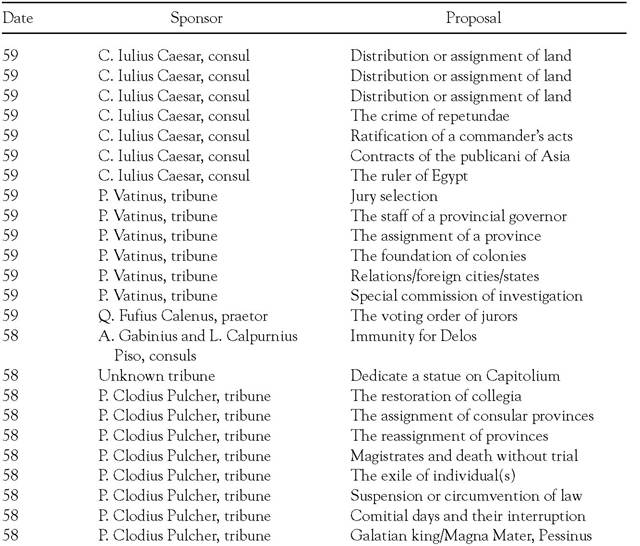
| Date | Sponsor | Proposal |
| 58 | P Clodius Pulcher, tribune | Annexation of Cyprus as a province |
| 58 | P Clodius Pulcher, tribune | Censors’ review of Senate membership |
| 58 | P. Clodius Pulcher, tribune | Quaestorian scribae in trade |
| 58 | P. Clodius Pulcher, tribune | Distribution of grain to citizens |
| 58 | L. Ninnnius Quadratus, tribune | Recall of exile(s) |
| 58 | Unknown tribune | Recall of exile(s) |
Source: See appendixes A and C.
TABLE 9.3 Laws Relating to the Conduct of Assemblies by Year, Latin Name, and
Subject, 350-44
| Year | Latin Name | Subject |
| 339 | Lex Publilia Philone de plebiscitis | The general validity of plebiscites |
| 339 | Lex Publilia Philone de patrum | Announcement of patrum auctoritas in |
| auctoritate | legislative assemblies | |
| (287)a | Lex Maenia de patrum auctoritate | Announcement of patrum auctoritas in electoral assemblies |
| 287 | Lex Hortensia de plebiscitis | The general validity of plebiscites |
| 287 | Lex Hortensia de nundinis | Legal business on market days |
| 181 | Lex Cornelia Baebia de ambitu | The crime of ambitus |
| 159 | Lex Cornelia Fulvia de ambitu | The crime of ambitus |
| (153) | Lex Aelia de modo legum ferendarum | Obnuntiatio in lawmaking assemblies |
| (153) | Lex Fufia de modo legum ferendarum | Obnuntiatio in lawmaking assemblies |
| 139 | Lex Gabinia tabellaria | Voting by written ballot |
| 137 | Lex Cassia tabellaria | Voting by written ballot |
| 130 | Lex Papiria tabellaria | Voting by written ballot |
| 122 | Rogatio Sempronia de suffragiorum | The order of voting in the centuriate |
| confusione | assembly | |
| 119 | Lex Maria de suffragiis ferendis | The pontes used by voters |
| 107 | Lex Caelia tabellaria | Voting by written ballot |
| 98 | Lex Caecilia Didia de modo legum | The trinundinum and unrelated measures in |
| promulgandarum | one proposal | |
| 88 | Lex Cornelia Pompeia de comitiis centuriatis | Enactment of law in the comitia centuriata |
| (70) | Lex Plautia de vi | The crime of vis |
| 62 | Lex lunia Licinia de legum latione | Archiving the law |
| (61) | Lex Pupia de senatu diebus comitialibus non habendo | Senate and comitial meeting days |
| 58 | Lex Clodia de iure et tempore legum rogandarum | Comitial days and their interruption |
| 52 | Lex Pompeia de vi | The crime of vis |
| 46 | Lex Iulia de vi | The crime of vis |
Source: See appendixes A and C.
aDates in parentheses are approximate. See appendix C.
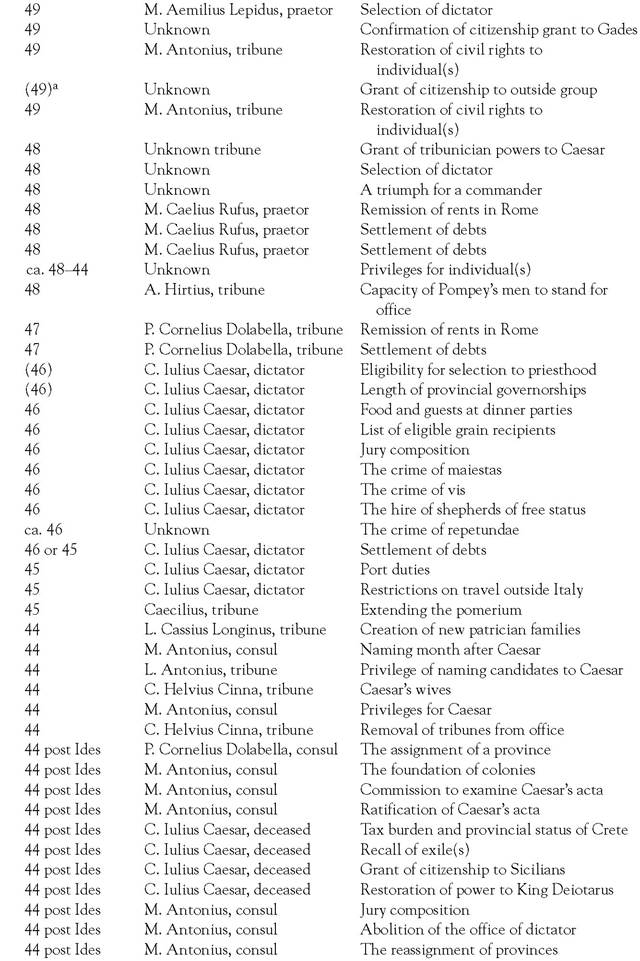

Source: See appendixes A and C.
aDates in parentheses are approximate. See appendix C.
- A e
Notes
1. Cass. Dio 42.32.2; Livy, Epit. 113; Plut., Ant. 9.1; Cic., Att. 11.23.3; Phil. 6. 4. 11.
2. MRR 2.139-40, s.v. Index of Careers. Clodius: see under heading “The Lawmaking of 58.”
3. Effects of civil wars in Italy and Mithridates in encouraging the boldness and organization of the pirates: Plutarch, Pomp. 24. Capture of praetors: Pomp. 24.6.
4. Badian's arguments that Gabinius's association with Pompey commenced when they were both fighting for Sulla in the 80s, that he was a legate of Pompey in Spain until 71, and that he began his political career only on his return to Rome are persuasive: Badian 1959, 87-99. Cf. MRR 3.97, which notes the unresolved date of his quaestorship. On the late date of Gabinius's tribunate see also Wiseman 1971, 166 n. 3 with references. Gabinius, one of Rome's foremost military men, gained a consulship in 58.
5. MRR 1.568. He received the command as praetor and continued as proconsul.
6. Plut., Pomp. 25; Cass. Dio 36.
7. Plut., Pomp. 27.1-2.
8. Cornelius, a little-known member of a many-branched clan, was Pompey's quaestor in Spain: Asc. 57 C. On the date of his quaestorship—no later than 71 (Pompey's return)—see MRR 2.122. Cornelius apparently rose no further in the cursus.
9. Asc. 59.11-12 (Clark) suggests that there may have been more proposals than the four he reports. These would include the lex de ambitu, which Asconius does not report directly; we know of it in some detail from Cass. Dio. My discussion of Cornelius's lawmaking activity and its context follows M. Griffin, “The tribunate of C. Cornelius,” JRS 63 (1973): 196-213, and Wiseman 1994, 329-38. B. Marshall, A historical commentary on Asconius (Columbia, MO, 1985), 215-17, provides a summary of the arguments advanced by Griffin 1973 about the order of Cornelius's measures, based on preferring Asconius's account over Cassius Dio's.
10. Asc. 57-58 C with discussion of Marshall 1985, 215-19.
11. Asc. 57-58 C.
12. Cass. Dio 36.39; Cic., Corn. 1, fr. 5, 27, 30-32; Vat. 5; Asc. 58-59, 71-72 C. Apparently the dispensations in question were granted by the Senate to advantage can- didates—among them Pompey (who did not have an ordinary career pattern) and others, including most recently former senators removed from the list in 70 who were trying to regain their rank through office—for the praetorship or consulship by permitting them to skip the preceding office: Griffin 1973, 200 with n. 32 citing previous bibliography.
13. Until the time of Augustus, there was no fixed and necessary number of senators whose presence constituted a quorum; the number varied depending on the matters at hand: Willems 1885, 2.165-66.
14. Cass. Dio 36.40.2-3. For discussion see A. A. Schiller, Roman law: The mechanisms of its development (New York, The Hague, Paris, 1978), 412-13.
15. Asc., Corn. 66.
16. Cass. Dio 36.38.2.
17. Cass. Dio 36.38.4.
18. Calpurnius was acquitted of the charge. See Alexander 1990, no. 190. On the lawmaking of 67 see especially Wiseman 1994, 331-38.
19. Cass. Dio notes, and Rotondi accepts, also a plebiscite that granted the tribune C. Papirius Carbo the privilege of wearing the insignia of a consul for successfully prosecuting M. Aurelius Cotta, consul in 74, for stealing booty when commander in Bithynia and Pontus between 73 and 70 (Cass. Dio 36. 40.3). This was more likely a privilege given to successful prosecutors under the current law. On the case see Alexander 1990, no. 192. The charge was peculatus or repetundae.
20. Willems 1885, 2.157 n. 1, dates the law to his praetorship in 61.
21. Cic., Att. 5.21.12; 1.1.5, and 2.7. Griffin 1973, 209, argues that this bill succeeded in doing what Cornelius earlier had failed to do with a similar measure. Whether Gabinius proposed this and the preceding measure as tribune or consul is ultimately unknowable, although most think as tribune: cf. Doumont et al. 1980, 48, n. 7.
22. See note 25, this chapter.
23. Cic., Corn, fr. 53P; Plut., Cic. 13.
24. The description and position of these few, but powerful, senators are relayed by Asc. (Clark) 60.19-21, 78.18-22, 79.18-19, and 79. 20-23.
25. The family background of the consul is obscure. He had been praetor in 71 (or 72); he was later proconsul in Cisalpine and Transalpine Gaul, following which Julius Caesar prosecuted him de repetundis: MRR 3.46. On his opposition to Pompey see E. Gruen, “Pompey and the Pisones,” Calif. Stud. Class. Ant. 1 (1968): 156-59; and L. Hayne, “The politics of M'. Glabrio,” CP 69 (1974): 280. Roscius was a new man, perhaps a member of a Latin family that had recently become wealthy through the management of mines in Spain: ILLRP 1262. He was later praetor in 63 (the date is uncertain), when he was revealed to be unpopular with the people (they jeered him at a theatrical performance), because of his sponsorship of the lex Roscia de theatris: for references see Wiseman 1971, 256 (no. 359) and MRR 2.167.
26. For details of the case see Alexander 1990, no. 203, p. 202; Asc., Corn. 58 and 61, Clark; Cic., Vat. 2, 5.
27. Cornelius claimed he was not “reading the law,” legem recitare, but was looking it over, legem recognoscere (Cic., Vat. 2, 5). The action was the same in either case, but the intention was quite different. The phrase legem recitare describes the formal recital. The purpose of “looking over” the law is not clear.
28. Cornelius reportedly drafted a proposal for the tribune Manilius, elected in 67 for 66.
29. Unusual but not unprecedented: cf. commands during the Second Punic War, against Mithridates in 88, and so forth.
30. Plut., Pomp. 28.
31. Plut., Pomp. 30.
32. Cass. Dio 36.42-44.
33. On the connection between this Gabinius and the family of A. Gabinius, tribune in 67, consul in 58, see Badian 1959.
34. P Autronius Paetus was quaestor in 75, legate in 73-72, praetor by 68, and had been candidate for consul in 65 until his candidacy was annulled by a conviction on bribery charges, together with his fellow candidate P. Cornelius Sulla. L. Vargunteius was tried and convicted for bribery in 66 though defended by Hortensius. On these see Cic., Sull. 6; cf. Sall., Cat. 28.1.
35. See chapter 8; cf. Wiseman 1994, 346-58; and R. Stewart, “Catiline and the crisis of 63-60 BC: The Italian perspective,” Lat. 54 (1995): 62-78.
36. Brunt 1971, 449 (table XIV).
37. For grounds and timing (after the elections: Suetonius) see W. Drumann and P Groebe, Geschichte Roms in seinem Übergange von der republikanischen zur monarchischen Verfassung (Berlin, 1899-1929), 3.177-78.
38. The classic discussion is Taylor 1949, esp. 132-39.
39. See chapter 7.
40. On the lex Iulia agraria of 59 (= RS 2 No. 54) see M. H. Crawford, “The lex Iulia agraria,” Ath. 77 (1989): 179-90: the so-called lex Mamilia Roscia Peducaea Alliena Fabia is in fact the lex Iulia Agraria. On the chronology see L. R. Taylor, “On the chronology of Caesar's first consulship,” AJP 62 (1951): 254-68.
41. Cass. Dio 38.2.1-3.3.
42. Appian, B.C. 2.9. Bibulus had been elected with the help of funds from other senators, including Cato, for the purpose of bribing voters in order to offset the effort of Caesar to finance the campaign of the man he wanted as co-consul.
43. See chapter 2.
44. Cass. Dio 38.3.1.
45. Appian, B.C. 2.13. Probably 61. Censors had been elected who revised the list of senators but stepped down before administering census: Cass. Dio 37.46.4. They reportedly leased contracts for tax collection in Asia, which the contractors tried to revise later: Cic., Att. 1.17.9.
46. Reportedly for a sum of money, HS 6,000.
47. RS 2 No. 55. On this and other laws see A. Lintott, “The leges de repetundis and associate measures under the republic,” ZRG 98 (1981): 162-212.
48. Wiseman 1971, no. 467; Taylor i960, 263: his background is based on his tribe, the Sergia, and the fact that his grandfather was not a citizen (not included on the fasti).
49. Earlier he had been legate of C. Cosconius in Spain in 62, and he was quaestor in 63.
50. Cic., Vat. 36.
51. On the scope of the law see A. H. J. Greenidge, The legal procedure of Cicero’s time (Oxford, 1901), 451-52.
52. Cic., Att. 1.14.2-5. Clodius is discussed later in the chapter.
53. Cic., Vat. 29.
54. Suet., Iul. 19: silvae callesque (the “woods and trails”). See Willems 1888, 2.576 n. 5.
55. Cic., Vat. 36.
56. Suet., Iul. 22.
57. Appian, B.C. 2.26. The rights were contested: Taylor i960, 125-26.
58. Suet., Iul. 8.A law of 65 expelling foreigners from Rome who were illegally gaining citizenship was directed at Transpadani.
59. His tribe was the Poblilia: Taylor i960, 215.
60. See under the heading “The Lawmaking of 58.”
61. Cass. Dio 38. 8.1; Greenidge 1901,450.
62. P Clodius Pulcher: W J. Tatum, The Patrician Tribune: Publius Clodius Pulcher (Chapel Hill and London, i999).
63. Membership in Palatina: Taylor i960, 205.
64. On this clientage see E. Rawson, Roman culture and society: Collected papers (Oxford, 1991), 102-24.
65. Cic., Har. Resp. 42; Plut., Luc. 34.1-2; Cass. Dio 36.14.3-4, 17.2. Plutarch explains that Claudius did this because his invidious arrogance led him to believe Lucullus was not showing him enough honor. The troops in question had served initially under Fimbria sixteen years before.
66. In 63 Clodius was sequester for candidates seeking office, which put him into direct contact with the divisores of the tribes. He used his house as a headquarters. Cicero later suggested that Clodius was an associate of Catiline because Clodius, prosecuting Catiline in 65 on a charge of extortion, had helped select a jury favorably disposed to the defendant. Catiline was acquitted by a majority, composed of the equites and tribuni aerarii (the senators voted to convict). On the trial see Alexander 1990, no. 212.
67. They included young nobles, low-status Romans, new citizens, former slaves and some slaves. See further in the chapter.
68. I follow here the analysis of P. Moreau, Clodiana religio: Un proces politique en 61 av. J.-C. (Paris, 1982).
69. On the complicated sequence of events surrounding the Senate's efforts to have the people carry a measure to arrange a special court and procedure for Clodius's trial see Millar i998, ii8-i9.
70. On the nature of the group so organized see H. Benner, Die Politik des P. Clodius Pulcher: Untersuchungen zur Denatierung des Clientelwesens in den ausgehenden romischen Republik (Stuttgart, 1987).
71. This is likely given both the military organization and Clodius's own military experience. In 67 Clodius left his brother-in-law's staff and joined Q. Marcius Rex in Cilicia, where he was captured by pirates. Clodius next served as military tribune on the staff of L. Licinius Murena in Cisalpine and Transalpine Gaul.
72. Cic., Har.Resp. 20. 42. On this see Moreau i982.
73. Moreau identifies the military and civic experiences that provided Clodius's models for “une organisation inspiree de celle de la legion, de celles des colleges et de celles des divisores, et des groupes de combat”: Moreau 1982, 50. In view of their organization, these were not clientes in any traditional Roman sense: Benner i987.
74. On the goals of Clodius's lawmaking activity see Wiseman 1994, 377-81.
75. Sources: MRR 2.196, s.v. Tribunes.
76. Title: S. Accame, “La legislazione romana intorno ai collegi nel Io secolo a.C.,” BullMuslmpi3 (1942): 15-29.
77. The title is given by Asconius; other sources call it frumentaria. See J.-M. Flambard, “Clodius, les collèges, la plèbe et les esclaves,” MEFRA 89.1 (1977): 145.
78. Cicero would have induced the tribune L. Ninnius Quadratus to veto the earlier measures but did not, because Clodius convinced him that he had no intention of presenting any bill against Cicero: Cass. Dio 38.14-17. Reportedly these four measures served to consolidate Clodius's position before the bill to send Cicero into exile, by attracting support from the Senate, equestrians, and people. Cass. Dio 38.13.1 f; Plut., Cic. 30; Drumann-Groebe 1899, 2.203.
79. See note 85, this chapter.
80. See later discussion on Caesar.
81. Badian, “M. Porcius Cato and the Annexation and Early Administration of Cyprus,” JRS 55 (1965): 115.
82. Cic., Fam. 12.25.1 ; Cass. Dio 45.17.3. First he dedicated a statue to Minerva Custos in the Capitoline temple. According to LPPR 393, his right to do so was granted in a plebiscitum de dedicatione simulacri Minervae carried by another tribune in 58. None of the sources reports such a plebiscite. He said himself that he left Rome rather than risk provoking civil war.
83. RS 2 No. 56; P Moreau, “La lex Clodia sur le bannissement de Ciceron,” Ath. n.s. 75 (1987): 465-92.
84. RS 2 No. 57; Moreau i989, i5i-78.
85. Badian 1965, 110-21. Badian argues on constitutional grounds (anything else would violate the lex Caecilia-Didia) that there were three bills involved, one taking Cyprus from Ptolemy, one restoring the Byzantine exiles, and one putting Cato in charge. The sources are vague: Cic., Dom. 20-21, 52-53, and 65; Sest. 56, 57, 59-61; Har. Resp. 59; Livy, Epit. i04.
86. Tatum i999.
87. As indeed had Cornelius, some say.
88. This section draws on Flambard 1977, 115-56; and A. Lintott, Violence in republican Rome (Oxford, 1968).
89. Cic., Mil. i2.33; 32.87; Asc. 52 C; Schol. Bob. p. 346 Or.
90. See discussion accompanying table 7.3 in chapter 7.
91. Political clubs: Taylor 1949, 50-75; and Taylor i960, 122. Effects of an expanded citizen population on campaign bribery and new political uses of collegia and sodalicia: Wiseman 1971, 130-42.
92. Cass. Dio 37.42-44.
93. L. R. Taylor, “Forerunners of the Gracchi,” JRS 52 (1962): 19-27, emphasizes the point.
94. These trials are collected in Alexander i990.
95. Lintott 1999.
96. On the various ways of undoing public laws see RS i.i2-i3. On abrogation see A. Biscardi, “Aper^u historique du problème de l'abrogatio legis,” RIDA 3e sèrie 18 (1971): 449-70; J. Linderski, “The augural law,” ANRW 2.16.3 (1986): 2146-312.
97. A number of laws were presented to the people between 121 and 120 to abrogate select provisions in the statutes carried by C. Sempronius Gracchus. See chapter 7.
98. Cic., Balb. 48, Leg. 2.14. Annulment of laws by the Senate: K. Heikkila, “Lex non iure rogata: Senate and the Annulment of Laws in the Late Republic,” in Vaahtera 1993, 117-42.
99. Cic., Leg. 2.14.
100. Cic., Dom. 41; Leg. 2.14 and 31; Diod. 37.10.3; Val Max. 3.1.2; Vell. Pat. 2.13.2; Asc. 69 C.
101. Cass. Dio 36.42.1-3.
102. Cic., Leg. 2.14. He compares the laws of Appuleius, Titius, and Drusus to the rules that robbers would make or the poisons administered as beneficial drugs by unskilled medical practitioners.
103. Cic., Off. 3. 80-81; Plin., N.H. 33.132, 34.27.
104. Although modern scholars commonly hold this man to have been an impostor, the possibility should not be ruled out that he was indeed the son of C. Marius (consul in 82) and the granddaughter of L. Crassus, who would have inevitably lost everything in Sulla's proscriptions. Cicero's references to this Marius, in letters written in May of 45 (Att. 12.49.2) and April of 44 (Att. 14. 8.1), do not indicate he was not who he said he was despite assertions elsewhere that he was a freedman or runaway slave (Cic., Phil. 1.2.5; Livy, Epit. 116; Val. Max. 9.15.1). His execution by Antonius suggests that Antonius believed he had reason to fear him (Appian, B.C. 3. 3). See S. Weinstock, Divus lulius (Oxford, 1971), 364 ff.
105. Senatus consultum ultimum: Lintott 1999.
106. Censoris fidem legum custodiunto: Cic., Leg. 3.4.11. Cicero commenced writing De Legibus after De Re Publica and before his tenure as governor in Cilicia in 51 and, it is believed, never published the treatise: E. Rawson, “The interpretation of Cicero's de legibus,” in Rawson 1991, 125-29.
107. See the discussion of this episode by M. Bonnefond-Coury, Le senat de la republique romaine (Rome, 1989), 571-73.
108. Plut., Cat. Min. 17.3.
109. Cato's career at this stage: MRR 2.163, 174.
110. Plut., Cat. Min. 21.2-5.
111. F. Miltner, “Porcius,” no. 16, PW 22.1, 205 ff.
112. Schol. Bob. p. 140 Stangl, commenting on Cic., pro Sestio 133.
113. Plutarch, Cat. Min., 21.6.
114. Cic., Vat. 14.33; Phil. 5.3.8; Sest. 64.135; Att. 2.9.1; 4.16.5; Leg. 3.4.11; cf. 20.46; Schol. Bob. p. 140 Stangl.
115. Williamson 1984, 211-24. Posting bills at the Aerarium: E. Badian, “An unrecognized date in Cicero's text?” in Mnemai: Classical studies in memory of Karl K. Hulley, ed. H. D. Evjen (Chico, CA, 1984), 101.
116. Phil. 1.7.16: “quae ille in aes incidit, in quo populi iussa perpetuasque leges esse voluit.” See Williamson 1987, 173 with n. 51.
117. Mil. 32. 87.
118. Williamson 1987.
119. Williamson 1995.
120. Plut., Caes. 35.6-11.
121. A useful compilation and discussion of Caesar's laws and mandates in this period are found in Z. Yavetz, Julius Caesar and His Public Image (Ithaca, NY, 1983), 58-160.
122. Probably rei gerendae causa: MRR 2.256-57. The complicated constitutional arrangements of the years 49-44 are presented in M. Gelzer, Caesar: Politician and Statesman, 6th ed. (Cambridge, MA, 1968), 195-333. See further note 137, this chapter.
123. Cass. Dio 41.36.2-3. Dio does not distinguish between laws enacted in assemblies and mandates of the dictator. The selection of priests to fill vacancies is not related to the lex lulia de sacerdotiis cited by Cicero in a letter to Brutus in 43: see note 145, this chapter.
124. Sources: MRR 2.256-57. Debt: Cass. Dio 41.37.1-3. Gelzer identifies this as a lex data, based on the language in Caesar, B.C., 3.1.2; 20.1 and 2: Gelzer 1968, 221.
125. Cass. Dio 42.51.1-2. Frederiksen places them in late 48, before the proposals of Caelius Rufus: M. W Frederiksen, “Caesar, Cicero, and the problem of debt,” JRS 56 (1966): 133-34. These are included in LPPR and Yavetz 1983 as laws, the lex lulia de mercedibus habitationum annuis and lex lulia de modo credendi possidendique intra Italiam.
126. On Caesar's efforts to resolve the problem of debt, introduced here and continued subsequently, I follow Frederiksen 1966, 134-41.
127. Children of proscribed Romans: Caesar, B.C. 3.1.3-5; Cass. Dio 41.18.2; 44.47.4; Suet., lul. 41; Plut., Caes. 37; Zonar 10.8. Exiles: Cic., Phil. 2.55-56 and 98; Att. 10.4.8; Caes., B.C. 3.1.4; Suet., lul. 41; Plut., Caes. 37; Appian, B.C. 2.48; Cass. Dio 41.36.2; 42.24.2.
128. Cass. Dio 41.24.1-2. See note 143, this chapter.
129. Cass. Dio 41.36.3. The attribution of the law to the praetor of 49, L. Roscius Fabatus (MRR 2.258), is based on the text of the Este fragment, once believed to be the law mentioned by Dio, which refers to a law brought by a magistrate named L. Roscius on 11 March (RS 1 No. 16. l. 13). Crawford argues convincingly that the text on the Este fragment “did not form part of a statute on Gallia Cisalpina,... but was originally of wholly general import.” RS 1.317-18. Crawford also distinguishes between the lex Roscia named in the Este fragment and the lex de Transpadanis.
130. Cass. Dio 42.20.3. Again Dio does not distinguish between honors decreed by the Senate or voted by the people.
131. Cic., Phil. 13.32; cf. Cass. Dio 42.20.1, which places such an enactment in 48, after the Battle of Pharsalus. Various interpretations of the law: Yavetz 1983, 75-76. Tribunate of Hirtius: MRR 2.285 n. 3.
132. Cass. Dio 42.22. 1.
133. His recalcitrance, according to Dio, was inspired by his belief that Caesar had been vanquished by Pompey (Cass. Dio 42.22.1).
134. Caesar, B.C. 3.20-21; Cass. Dio 42.22.4.
135. Surrounding the Curia with soldiers, the consul P. Servilius Isauricus convened the Senate in order to pass a senatus consultum ultimum. The tribunes vetoed the proposals whereupon the consul ordered the removal of the tablets on which they were written, precipitating a fracas involving himself and the praetor Caelius. At length the consul, authorized by the Senate, removed Caelius from office. Caelius left Rome to join Milo, who was organizing an army against Caesar in Campania.
136. Cass. Dio 42.32.2. See note 1, this chapter.
137. Based on epigraphic evidence as well as the evidence of his lawmaking activity and contemporary report he was certainly dictator legibus scribendis et rei publicae constituendae in his third and fourth dictatorships: MRR 3.107-8. In the absence of explicit testimony and because he held the office so briefly in 49 (eleven days), most scholars believe he was dictator rei gerundae causae at other times: MRR 2.285 n. 1; and W. Kunkel, Staatsordnung und Staatspraxis der romischen Republik (Munich, 1995), 712-15. See also Hurlet 1993, 173 with nn. 9 and 10. A. Degrassi, Inscriptores Italiae, vol. 13, Fasti et Elogia, Fasc. 1, Fasti Consulares et Triumphales (Rome, 1947), 133, followed by Broughton, MRR 2.295, posits that he was dictator rei gerendae causa, not rei publicae causa, in 46.
138. Cass. Dio 43.14.3. This was extended to life in 44 (sources in MRR 2.317-18).
139. Sources: MRR 2.286.
140. Frederiksen argues persuasively that the Lex lulia de bonis cedendis was enacted in 46 or 45: Frederiksen 1966, 135-41.
141. Cic., Att. 13.20.1, records that laws had been promulgated de urbe augenda; cf. 33a. 4; 35.1; cf. Cass. Dio 43.49 and Suet., Iul. 44. See MRR 2.307, corrected by MRR 3.35 s.v. Caecilius (or Pomponius).
142. MRR 2.23-24; cf. Yavetz 1983, 126-29.
143. The only law attributed by modern scholars to Caesar's own sponsorship in 49 is the lex de civitate Gaditanorum. None of the ancient sources says that he sponsored this law, however: Cass. Dio 41.24.1; Livy, Epit. 110; Caesar, B.C. 2.20-21.
144. The imprecision of the sources is reflected in MRR 2.293-94 and 305-6.
145. De sacerdotiis: P. Moreau, “Lex Iulia de sacerdotiis,” Ath. n.s. 66 (1988): 365-69; RS 2 No. 58; de provinciis: Yavetz 1983, 108-9; de iudiciaria: Yavetz 1983, 116.
146. Mommsen, History of Rome, trans. of 4th German ed., 4 vols. (New York), 401, as quoted by Frederiksen 1966, 140-41.
More on the topic CHAPTER NINE The Demise of Public Law, 69-44:
- Chapter 4 Public Choice
- Chapter 12 Public/Private: The Boundaries of the State
- 5.4 IMPLICATIONS FOR DOMESTIC PUBLIC LAW AND INTERNATIONAL LAW
- Chapter VI. Public Policy Pathways Beyond USDA for Advancing Climate-Neutral Agriculture
- Public Law in Rome
- 1. The demise of the actio furti
- Diocletian and the Efficacy of Public Law
- The Demise of Popular Legislation
- The Demise of the Western Empire
- At first glance, reducing net agricultural greenhouse gas emissions through public law poses a considerable challenge.
- Private criminal law and public criminal law
- Williamson C.. The laws of the Roman people: public law in the expansion and decline of the Roman Republic. University of Michigan,2005. — 535 p., 2005
- Public choice
- The critique of public choice