The Prerogative of Mercy
New South Wales’ First Charter of Justice, a document that authoВrized the establishment of its criminal courts, determined that every death sentence needed the approval of the Governor himself.[136] Thus, from the earliest days of Australian settlement, it was clear that the Governor (acting as a representative of the British Crown in the terriВtory) was to be the focal point for granting mercy in individual capital cases—whether it was a full pardon being sought or a commutation of a death sentence to a lesser punishment.
After 1825, colonial GoverВnors were assisted by an Executive Council, initially made up by various government officials appointed by the Crown, including the ChiefJustice of the colony.[137] By the latter part of the nineteenth century though, each Executive Council was comprised solely of elected government ministers and presided over by the Governor (i.e. the вЂ?Governor-in- Council’ was a commonly used term).[138] Although the Governor was not compelled to accept the opinion of his Executive Council, it was unusual for him to deviate from their advice—especially once the colony attained responsible government. Unless the case intersected with impeВrial interests or outside jurisdictions, the advice of local ministers was to be heavily weighted.[139] If executive review determined that a remisВsion of the sentence was warranted it was deemed to be an instrument of clemency alone. Altering the sentence did not, by letter of the law, reverse the verdict like a modern court of appeal might.[140] Rarely was a crimВinal ever given an unconditional pardon and released. More commonly the punishment of death was commuted to a period of penal serviВtude—transportation or forms of corporal punishment were also known substitutes for death in earlier times.[141]Despite the decision to execute or commute being determined by the Executive, there were two main ways that the trial judge could influВence the outcome.
In the first instance, a written report was always communicated to the Executive Council prior to its deliberations and, oftentimes, the trial judge or chief justice would attend the meeting in person. They were (among other things) at liberty to review key pieces of evidence, the strength of the prosecution’s case, the criminal history of the condemned and if they had been extended mercy before. The judge then offered his own recommendation as to whether the criminal’s life ought to be spared or not. Illustration 2.1 gives a visual window into these deliberations where a criminal’s life was in the balance. It depicts the Victorian Executive Council discussing the case of the notorious murderer Frederick Bailey Deeming. Present in the ExecuВtive Chamber is the Governor and his Ministers discussing the case with Justice Henry Hodges who presided over Deeming’s trial. On this occaВsion, Deeming was not extended mercy and was executed in accordance with the sentence of the court in May 1892.Another means the judge could influence the Executive Council was made available following the passage of the 1823 Judgement of Death Act in England.[142] In any case short of murder and treason, it created the distinction between вЂ?death recorded’ and вЂ?death pronounced’. As one nineteenth-century dictionary of English phrases noted:
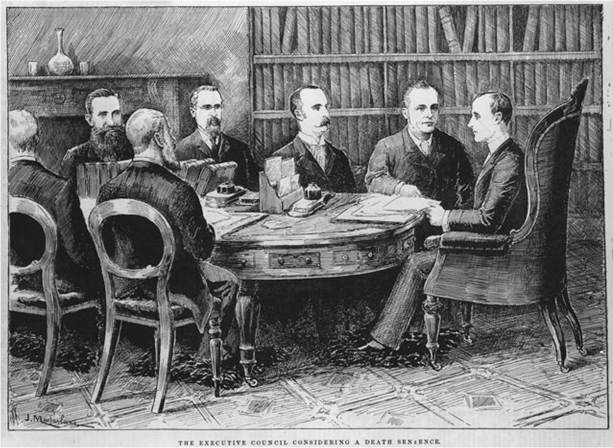
Illustration 2.1 The Executive Council in Victoria discussing the case of Frederick Bailey Deeming in 1892 (Source J. Macfarlane, вЂ?The Executive Council ConsidВering a Death Sentence, 1892', print of a wood engraving, Melbourne: David Syme and Co., held by State Library Victoria)
Death recorded means that the sentence of death is recorded or written by the recorder against the criminal, but not verbally pronounced by the judge. This is done when capital punishment is likely to be remitted. It is the verbal sentence of the judge that is the only sufficient warrant of an execution.[143]
Foreshadowing the remission of a sentence at the very moment it was being delivered may seem odd to modern eyes.
However, the sentence of вЂ?death recorded’ gave the trial judge the flexibility to rule in line with England’s penal code (then replete with over two-hundred capital crimes) while simultaneously signalling from the outset that the prisoner before him was a suitable candidate for clemency. Though the Executive was still free to act as they wished in every case, it was very rare that an execuВtion should follow from a sentence of вЂ?death recorded'.[144] The Australian colonies were known to utilise this now antiquated judicial mechanism when sentencing criminals in the nineteenth century. New South Wales, for example, repealed the English 1823 Act locally in 1883 during a partial consolidation of its criminal law.[145] Other scholars, particularly those working with Tasmanian and Victorian court records, have also noticed its use there.[146]In addition to the judge, the jury also had some levers at their disposal to influence the Executive Council. In the first instance it was in their remit to attach a recommendation of mercy to a guilty verdict in a capital case. In instances where the Executive Council appeared like they might ignore their recommendations for clemency, it was not unheard of for jurors to organise a petition to reiterate their position. This was what happened in the South Australian case of Charles Streitman in 1877 who was, against the wishes of the jury that found him guilty, hanged for fatally stabbing a man.[147] The other means by which jurors might influВence the outcome of a trial was through variations of what Blackstone labelled вЂ?pious perjury'. He noted in his Commentaries that it was a habit of many English juries to deliberately undervalue stolen goods to allow the offender to escape the capital charge and be tried for a lesser offence. Later Blackstone elaborated on how English jurors вЂ?through compasВsion' would often вЂ?forget their oaths' and set the guilty man free.[148] Hobart's Mercury recognised it as a problem in the 1870s: вЂ?The difficulty of getting the typical twelve to convict on the capital charge, though the evidence be as clear as day, has become proverbial'.[149] Moreover, Australian opponents of capital punishment had long complained that the very severity of the death penalty deterred juries from convicting offenders (see Chapter 8).
Regardless, the jury’s opinion on the case mattered a great deal. As the Minister for Justice in New South Wales said in 1896, if a jury happened to recommend mercy in a specific case, it was вЂ?one of the strongest elements which weighed with the Executive in coming to a decision’.[150]Members of the public were also free to voice their opinion on death sentences passed by the colonial courts. The Executive Council was not impermeable to such influence, especially given that it was comprised of elected politicians for large portions of the nineteenth century. Petitions were the most common mechanism through which the general public could formally express their thoughts. For instance, successive capitally convicted Norfolk Island mutineers in the mid-nineteenth century were the subject of petitions for mercy, both large and small, from very diverse sectors of society: religious leaders, social reformers, penal offiВcers, the prisoners themselves, legal counsel, as well as everyday members of the public.[151] It was not unknown for a deputation to accompany the delivery of the physical petition; often organisers were afforded an audience with the Governor to explain their rationale.[152] Newspapers were also leaders of public opinion in many cases. For example, Van Diemen Land’s Daniel Priest, nicknamed вЂ?The Friendly Bushranger’ in some quarters, had the local newspapers to thank for his revised punishВment in 1845. In sentencing the ChiefJustice told Priest that his crime of robbery under arms was a вЂ?shocking outrage not to be tolerated in any civilised country’ and that he would not recommend mercy.[153] The judge’s sentencing remarks were combated by both the Launceston Examiner and the Cornwall Chronicle which reminded readers of Priest’s cooperative conduct while in custody and the lack of violence accompaВnying the crime he was indicted for. In the end the Tasmanian Executive Council went against the wishes of the judge, reducing his sentence of death to life imprisonment.
Although the judge, jury and general public had the means by which they could express their thoughts on the case, the final decision was purely the responsibility of the Executive. And, to return to the intriВcacies of their deliberations, it was a duty they took very seriously—even for the most repugnant criminals.[154] Yet, after responsible government was granted some ambiguity emerged as to the correct decision-making process. One colonial governor was sanctioned for leaving blank (but signed) pardon slips to be used in his absence; another later complained that local ministers did not assist him enough when coming to a deci- sion.[155]9 Successive dispatches between the British Colonial Secretary and the Australian colonies in the 1860s and 1870s confirmed that the decision-making burden was to be shared. Ultimately, ministers were accountable to Parliament for their advice on the case while the Governor was responsible to his British superiors for the decision taken.[156] ExecВutive review always took place in private, away from the public eye; by convention (but not always in practice) the reasons for a decision needed only to be minuted on occasions when the Governor deviated from the Executive Council's advice.[157] For some, the ability of the Executive to override a decision made by an impartial judiciary—often with informaВtion available to them that was not permissible in a court of law—was beyond the pale. As New South Wales MP, Thomas Ewing, described it in 1900: вЂ?Capital punishment is the only portion of the law that is not administered, if I can use the term, in accordance with the law'.[158]
Strange as it may sound, the moment a prisoner was sentenced to death in an Australian courtroom the odds strongly favoured an outcome where they did not end up at the gallows with a rope around their neck. In the context of Tasmania from 1806 to 1946 Mark Finnane and Chris Leppard have concluded that, of the 1469 death sentences handed down, only 545 executions were actually carried out.[159] According to Brian Purdue’s numbers in Western Australia, from 1840 to 1964 a total of 596 people were sentenced to death of which 154 were hanged.[160] In Victoria, Kathy Laster and Roger Douglas found that between 1842 and 1967 a total of 606 people were sentenced to death but only 185 executed.[161] In South Australia, at least for the colonial period (1836—1900), 108 death sentences were handed down of which 46 were carried out.[162] As for New South Wales, between 1788 and 1954 around two-thirds of the 3171 capital offenders were extended some form of clemency according to Macnab, Castle and Kaladelfos’ database.
A key turning point came in 1819 for those sentenced to death in that colony. Before then executions outnumbered commutations in New South Wales but afterwards (barring a brief aberration around the year 1850) the opposite held true.[163] In Queensland, the figures from Mark Finnane and Jonathan Richards show that, between the years 1865 and 1922, a total of 186 people were sentenced to death of which 65 were executed.[164] Shakespeare’s oft-repeated quote from The Merchant of Venice that вЂ?mercy seasons justice’ might be inappropriate in the context of Australian capital cases; mercy was the main dish served up by the patchwork of Executive Councils.Raw commutation and execution numbers are valuable but they can sometimes obscure the whole story. For example, on face value South Australia had a comparatively low commutation rate but that was only because they had just two capital crimes on the statute books after 1876. Contrast that with other jurisdictions that were much slower to reduce their capital code like Victoria which still had nine capital crimes in 1900.119 Criminals there might be sentenced to death for a less serious crime (say, robbery with wounding) where an actual execution was never going to be the likely outcome (and thereby swelling long-term commuВtation rates). Furthermore, if one delves deeper in search of a singular causal factor to account for the extension of mercy, then the variables are so numerous that they are difficult to properly weigh. Take, for example, the following considerations as a starting point: the type of crime (i.e. violent, property-based, sexual); the circumstances around its commisВsion (i.e. impulsive, calculated, aggravated, accidental); location (i.e. urban or country districts); historical periods (i.e. 1790s, 1850s, 1890s); the disposition of key actors (i.e. judges, jurors, executive councillors); and precedent (i.e. how like offenders were treated in the jurisdiction). This is a dizzying array of factors which all played one part or another in the final decision to grant or withhold mercy. The granular details of each separate case also ignores the broader cultural and historical continВgencies prevalent in each jurisdiction. For example, Carolyn Strange argued that the вЂ?snap of the lash and the clang of convict chains' still вЂ?rang in the ears' of the mercy inclined New South Wales' Executive Council as late as the 1890s.120 Here, I will briefly discuss the tendencies of the various Executive Councils as it related to criminals of a particular gender, ethnicity and age to show how these overarching characteristics of the criminal (as opposed to the nature of the crime's commission) could influence outcomes.
To start with gender, female offenders were one group in colonial society who were far less likely to be executed. In the colonial period Victoria executed four females. In Western Australia there were two, [165] [166] while South Australia and Queensland had only one each.[167] InvesВtigations into New South Wales and Tasmania also demonstrate a comparatively small number of females hanged there too.[168] To be sure, colonial women were not as commonly indicted for capital crimes to begin with but, once convicted, they were, to quote Kathy Laster in the Victorian context, вЂ?treated more favourably than men’.[169] Likewise, Plater and Milne have recognised the вЂ?general reluctance’ to carry out the death penalty on women in the colonies.[170] At least one Adelaide newspaper picked up on this trend at the time, commenting in 1860 that female capital offenders вЂ?now almost invariably escape the extreme penalty of the law’.[171] More than in other categories of criminals, the way in which an individual female was stereotyped in the public mind (as either вЂ?virtuous’ or вЂ?vicious’) mattered a great deal to the outcome of the executive review.[172] Political factors could also play a role as in 1890s Melbourne when a panic around infanticide caused a sudden upshot in executions for the crime in that city—despite the offence previously attracting sentences less severe than death.[173] A more obscure reason for granting mercy to females (known in England as the вЂ?benefit of the belly’) was when pregnancy intersected with the law’s wishes. For instance, the first female executed in Australia, Ann Davis in 1789, attempted to avoid the gallows by asserting she was вЂ?quick with child’ but was executed anyway after a physical examination found no evidence to support her claim.[174] Though the reasoning for each female commutaВtion was complex, notions of chivalry (albeit arbitrarily deployed) has been invoked by Laster to try and explain why so many females were extended mercy.[175] Certainlyin arenas other than the gallows, the culturВally informed desire for men to both вЂ?save’ and вЂ?protect’ females was commonplace. Where statistical information is available, it demonstrates that race played a curious role in the application of mercy in the Australian colonies. For all of Western Australia’s history, the commutation rates for capital offenders (i.e. those sentenced to death but not executed), when separated by racial grouping, were as follows according to Purdue: IndigenousAustralians (82.9%); Europeans (64.1%) and Asian (47.7%).[176] For Queensland, the work of Douglas and Finnane show how commutation rates between 1865 and 1922 were arranged in a similar order: Indigenous Australians (79.6%); Melanesians (72.5%); European (57.3%); Chinese (40%) and other (28.6%).[177] Surprisingly, these statistical breakdowns indicate that the most likely recipients of mercy in these jurisdictions were Indigenous Australians. Certainly, in these later settling colonies there was a high frequency of Indigenous hangings but they were often concentrated in the formative years of settlement.[178] As the colonies matured, notions of вЂ?tribal custom’ were often raised in inter se cases (i.e. where the offender and victim were both Indigenous Australians) which often led to a commuted death sentence. In fact, there appears to be a general reluctance by colonial courts to interfere with crimes perpetrated between Indigenous individВuals or groups.[179] As an aside, it has long been suspected that European settlers who committed capital crimes upon Indigenous Australians were unlikely to end up at the gallows. For instance, only one European was executed in South Australian history for murdering an Indigenous person.[180] There is however, in South Australia as elsewhere, extensive evidence of European killings of Indigenous Australians on the fron- tier.[181] Another key finding from Queensland and Western Australia is that criminals of Asian descent (especially Chinese offenders) were less likely than other groups to be extended mercy. One wonders just how pivotal the anti-Asian sentiment that existed in the Australian colonies, from the gold rush and beyond, had on deliberations in their individual cases. More needs to be understood about the relationship between youth and mercy in the Australian colonies than is currently the case. CollecВtions of city-youths were the subject of widespread concern in the coloВnial period—from the various вЂ?pushes’ of Sydney and Melbourne to the вЂ?cabbage-tree mobs’ of the earlier convict era.[182] Yet punishing the young, particularly in capital cases, would always run into thorny questions of criminal responsibility given their age. Tasmania’s Juvenile Offenders Act of 1875 signalled to the judiciary that some discretion for capital offenders under the age of nineteen was warranted. Instead of handing down a sentence of death recorded, the law permitted Tasmanian judges to gaol them and, during their incarceration, mandate that they instead be вЂ?once, twice, or thrice privately whipped’.[183] There is certainly evidence of young people (at least for modern standards) meeting an end at the gallows later in the nineteenth century than one might think. The infamous Mount Rennie gang-rape case in Sydney committed by members of the вЂ?Waterloo Push' during the 1880s involved the execuВtion of multiple perpetrators under the age of twenty.[184] As late as 1892 Francis Horrocks, guilty of murder, was the youngest man to be hanged in Queensland at age seventeen.[185] However, as early as 1872 the perpeВtrator’s age appeared to weigh on the minds of Queensland juries in favour of mercy.[186] According to Ross Barber’s numbers, only 7.4% of those executed after 1859 in Queensland were known to be under the age of 22 at the time of death.[187] For colonies that placed so much hope on its youth and future, their interactions with the criminal law were problematic and confronting. In an abstract sense the prerogative of mercy, as wielded by the ExecВutive in capital cases, was a check and balance upon the majority of the legislature that determined the capital code and the members of the judiciary who adjudicated upon it. In practice, however, it was seen by many as a benevolent вЂ?act of grace’ by an administration not wishing the criminal to experience the severity of the law. Yet, by the late nineteenth century the impulse to codify and rationalise criminal law in Australia was strongly felt.[188] As such, the residual pocket of discretionary decision-making power held by the Executive Council was difficult to countenance for a growing number of colonists. As Carolyn Strange points out, the Executive tried to justify a вЂ?secret, highly discreВtionary process’ as one that was instead вЂ?an opportunity for a considered second thought, free from the passions and prejudices of the courtroom, and receptive to arguments and evidence ruled out by the law’.[189] More recently, legal-minded scholars like David Plater and Sue Milne have noticed that, given the limited appeal options available to Australia’s colonial criminals, the Executive Council functioned imperfectly as the nearest thing there was to a Court of Criminal Appeal.[190] The reasons for intervention, or non-intervention, by the Governor, and later the Governor-in-Council were varied and case-by-case. The raw numbers demonstrate that mercy was the likely outcome in capital cases, though overarching characteristics of the criminal, such as gender, race and age, had the potential to load the dice in favour of a particular outcome. If one takes the long view of Australia’s hanging years, it is a story not of the ascendance of capital punishment but its reverse. Yet, the parameВters of capital punishment in the colonies were always being amended to accord with the shifting contingencies of settlement. After spiking in the 1820s and 1830s during the convict period, execution numbers declined in proportion to a growing population. Moreover, in the first third of the colonial period, all sorts of crimes (including many property offences) would regularly see a person hanged. In the last two-thirds of the colonial period, however, murder was the main crime likely to be associated with a hanged criminal. As for the application of mercy in the colonies, the most striking fact was just how frequently it was handed out. Culturally informed opinions about race, gender and youth all had different impacts on the likelihood or otherwise of capital sentences being carried out. The number of capital crimes on the statute books in the Australian colonies was also on a downward trajectory. As the nineteenth century progressed, colonial lawmakers increasingly restricted the death penalty to only the most severe crimes—though not always at the same pace. Sexual crimes, aggravated forms of burglary, attempted murder and many defence or security-related crimes lingered in Australia as capital offences for longer than in England. Almost always the unique circumstances of settlement were invoked as grounds for their retention—whether it be the gender imbalance, the isolation of the frontier, or the existence of the convict system. Despite the excesses of capital punishment being tempered in the nineteenth century, Australia’s hanging years consisted of generations of colonial lawmakers, judges and administrators who supported the use of death punishments in at least some circumstances. The criminals, crimes and courtrooms may have changed but their sentiment remained the same—for lawbreakers of the deepest dye, only death could deter.