Pacification, Judicial Integration, and Ruler Power
The main incentive for English nobles to attend Parliament, as we have seen, was that all land was held of the crown. This explains why questions of adjudication and legislation were the overriding concern throughout all periods.
Similarly, in Catalonia, much conflict was over jurisdiction, especially between castellan and ecclesiastical seigneurs (Figure 8.2).[948] However, Catalan subjects had a more elementary concern, until at least the middle of the thirteenth century: pacification. They expected countВprinces to impose the Peace and Truce of God (pax et treuga), which was a form of adjudication. This reflected more anarchic local conditions (and hence weaker ruler powers) than in England, where the Peace “barely put in an appearance.”[949] Both forms originated in church efforts to suppress private conflict: the Peace provided a right of asylum and protection of the unarmed in the ambit of a church; the Truce prohibited private wars during periods of religious significance.40 These allowed the count-prince some control over baronial areas.41 Other concerns, for instance, war, succession, taxation, officials, the authority of the Church, coinage, and more, had far lower frequencies in the early period.42Pacification relied on two main institutions, the vicar (veguer) and the practice of the “guard and bailiwick” (guarda i batllia). The vicar was especially important in integrating Catalonia’s urban centers, not least Barcelona. Vicars were not selected from the powerful castellan lineages, so the count-prince could control them better.43 As in all other European cases, we cannot understand the urban efflorescence in Catalonia without acknowledging the integrating effects of the count-prince’s justice. The
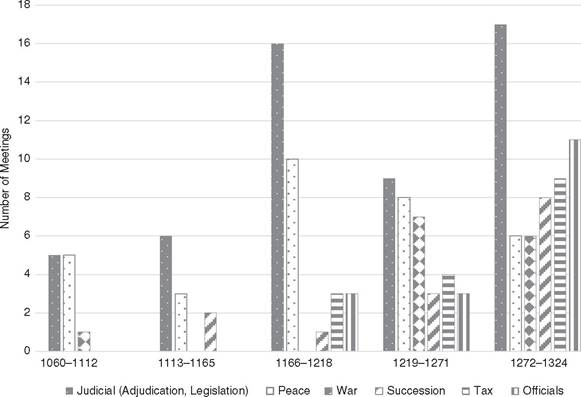
Figure 8.2 Purposes of Catalan Corts meetings, 1060-1327 Source: See Figure 8.1.
revival of the old vicariate system at the assembly of Fondarella in 1173-74 helped unify the judicial system in Catalonia, demonstrating the count-prince’s renewed power, just as Corts meetings increased.[950]
Vicars extended comital power into municipalities. They were originВally appointed by the count-prince to enforce the peace and hold his hearings locally with the bishops. They had authority over the officials heading municipal government, including the counselors that flanked the four keepers of the peace and truce (paciarii) that swore to them and thus, ultimately, to the count-prince.[951] Vicars also integrated the functions of local judicial magistrates, who had been administering justice in some towns with relative autonomy probably since the late 1140s and by the 1200s operated in many major towns.46 However, as early as the 1190s the count’s vicar held “a regularly functioning court” in Barcelona, which now “served as the site where townspeople could come to receive justice from an officer of the sovereign.”47 By 1301, vicariates operated throughВout the kingdom, although seigniorial jurisdiction had also made major gains.[952] Vicars were also important in supervising the urban assemblies found in many towns and composed of “good men” from all orders, the probi homines, representing about 3 percent of the population.[953] A level of legal uniformity was hence achieved over the five different legal systems in the region, though Aragon’s legal system remained distinct.[954]
Through the guarda i batllia, the count-prince offered protection to peasants for an annual fee. Between 1151 and 1198, small proprietors entered under this protection on an extensive scale in Catalonia Vella (old Catalonia, of the east), as seen by the proliferation of contracts. Protection was also offered to travelers, to town inhabitants and especially merchants, and to monastic tenants. But the count-princes still had to compete with other lords, local seigneurs, and military orders, who also offered protection to peasants to assert jurisdiction.[955]
Catalan towns and their municipal institutions, however, formed the “primary base or cell in the organization of the whole of the political society.”[956] This network of interconnected units was not a spontaneous growth; it was institutionalized by charters granted by the early countВprinces. Such charters placed royal towns on a higher level than seigniorВial ones. James I in particular chartered a series of towns after the 1240s, including Barcelona.[957] The municipal structures that were so important in the fourteenth century, as we will see, were predicated on strong ruler capacity to integrate justice across this network in the previous century.
8.4
More on the topic Pacification, Judicial Integration, and Ruler Power:
- Pacification, Judicial Integration, and Ruler Power
- Boucoyannis Deborah. Kings as Judges: Power, Justice, and the Origins of Parliaments. Cambridge University Press,2021. — 400 p., 2021
- The NormativeZEmpirical Inversion