Municipal Organization Endogenous to Comital Strength
Despite this prehistory, the early modern history of Catalonia consolidated the romantic image of a “free” Crown of Aragon versus an “enslaved” Castile, a strong republican regime with its own fueros that valiantly opposed the despotism of the Castilian crown.81 Yet, as the historian Stephen Bensch emphasized, none “of the urban communities...
is known to have clamored for the independent regimes they received from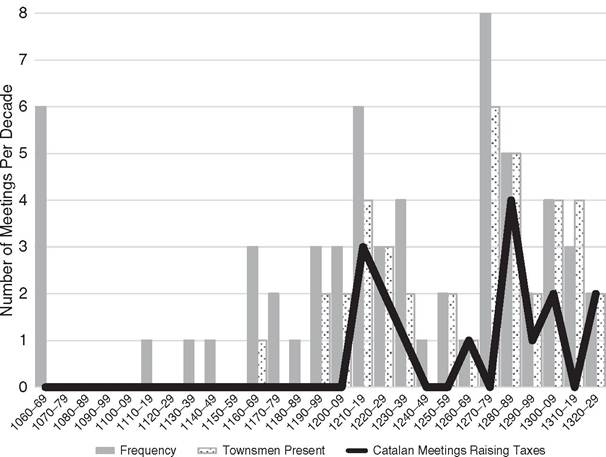
Figure 8.3 Presence of nobles and townsmen and taxes raised in the Cons of Catalonia Sources: See Figure
8.1.1 include taxes incurred to prevent currency debasement and supplement Kagay with Bisson 1986.
the king in the 1240s, for with autonomy came responsibilities, as King Jaume I and his successor would frequently remind the city.”[974]
Barcelona’s strong municipal institutions indeed appear to confirm the narrative of strong commercial interests resisting despotic authority, exchanging rights for taxation in the midst of war, and prevailing only when the ruler was weak. By the 1370s, the Catalan Corts were precoВcious. They were raising taxes for the public good (rei publice) of Catalonia, which was clearly distinguished from the king’s wars.[975] Critically, and as expected from the logic of this book, taxes applied across groups, including the Church and nobility, unlike France and Castile, and to the royal domain.[976] As in England, this state-wide system of taxation emerged after a “profound national sentiment” prevailed in the 1300s.[977] Moreover, taxes were collected and administered by the General Council (Diputacio del General), a committee of the Corts that was also responsible for the laws and liberties of Catalonia since 1365 and which represented the Generalitat, the entire Catalan community.[978] This was indeed a republican constitution closer to Italian city-states and with far greater powers than the English Parliament.
Moreover, war was a constant background to these concessions by a king unable to collect sufficient taxes, and mounting municipal debt was crucial.But once again, the same qualifications raised about city-states apply here. Previous studies typically retrojected the republican character of the fourteenth and fifteenth centuries to the early, formative period.[979] However, between 1150 and 1270 Barcelona was governed as a royal seigniory, offering a long period of institutional learning before independВence was possible.[980] It gained some self-rule by 1300 but not full collegial autonomy until 1370. Justice was key to this institutional learning: magВnates selected by the count-prince already judged cases in the county court of Barcelona since the 1130s. Land held in tenure was a major concern (a third of some surviving cases around 1150 concerned inheritВance, possession, and alienation).[981] The count fostered the urban growth of this period, similarly to Flanders and differentiating the region from Italian patterns; the Catalan count-prince did not relinquish the adminisВtration of justice in the towns.[982]
Some historians have adopted Tilly’s emphasis on war,[983] especially as it initiated the fiscal independence of Barcelona from the count after the municipality obtained the franchise of the questia in 1299.[984] Others, however, such as the historian Font Rius, have noted that the Council of Barcelona originated in the “regularization of... judicial functions” associated with the administration of local life described earlier, including the extensive public works required.[985] Regardless, the count’s jurisdiction was enhanced by both the polity-wide vicariates widely operating by 1300, as we have seen, and the uniform toll system that resembled England’s.[986] Municipal privileges were after all granted to towns that passed from seigniorial to royal control.[987]
However, increasing municipal independence decreased the count’s powers, benefiting landlords as well.
By 1359, the nobility and Church controlled over 60 percent of hearths, as the count alienated large parts of royal property to pursue an imperial policy: by the seventeenth century, only 25 percent of towns and cities were held directly by the count.[988] Given the jurisdictional immunities in place, this continued the exclusion of the lower rural social orders from the Corts. Consequently, Bisson argued, “the exclusion of the lesser knights [from the Corts] consolidated a formidable alliance of landed magnates and urban oligarchs through which a вЂ?pactist’ program hostile to fiscal and agrarian reform was confirmed.”97The oligarchical tendencies observed by Weber and confirmed by Stasavage and others shaped later Catalan history too. The strong Catalan municipal institutions may have allowed precocious commercial expansion (a Mediterranean empire in fact) and resistance to Castilian authority, but they did not prevent civil war and losing the war against John II in 1472, being overshadowed by Castile, or the eventual loss of independence in 1714.98 A stronger ruling capacity might have even enabled Catalan dominance of the other units; minority populations do rule over larger regions with lower institutional integration. But centrifuВgal dynamics were even more intense in Aragon, so although Catalonia overshadowed Aragon institutionally, it was not centralized enough to shape its recalcitrant neighbors.
More on the topic Municipal Organization Endogenous to Comital Strength:
- Municipal Organization Endogenous to Comital Strength
- Boucoyannis Deborah. Kings as Judges: Power, Justice, and the Origins of Parliaments. Cambridge University Press,2021. — 400 p., 2021
- Similarities: Common Origins in Central Power and Justice