A Memorandum on Execution Procedure Arrives from London
In late 1880 a curious circular, not for general publication, arrived in the Australian colonies from London. It was courtesy of John Wodehouse 1st Earl of Kimberley, the then Secretary of State for the Colonies.[192] On the cover letter to the Circular was written the following:
The attention both of my predecessor and myself has been called to cases where, through mismanagement or an adherence to barbarous usages, the execution of criminals has been attended with revolting circumstances, the recurrence of which it is necessary, in the interest both of humanity and decency, to prevent by every possible means.[193]
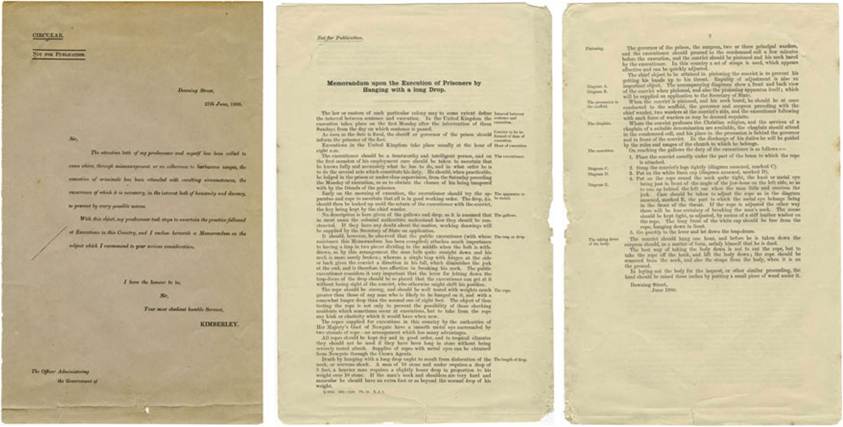
Enclosed was a вЂ?Memorandum’ on the subject of proper execution method using the long drop, a document that was developed in close consultation with the Public Executioner in England.[194] It aimed to stanВdardise execution procedures and thereby prevent the constant bungling of hangings that seemed, from London at least, to be the scourge of most colonial jurisdictions.
From the time of sentencing to the preparation of the dead body for medical inspection, the Memorandum was compreВhensive in its attempt to regulate execution procedure in the colonies. Diagrams of up-to-date equipment and techniques were also included for the benefit of practitioners. Only a few months later a very large, colour-printed, technical drawing of the gallows at London’s Newgate Gaol was sent out as an accompaniment to the Memorandum.[195] By the 1890s a standardised вЂ?Table of Drops’ began appearing in colonial jurisdictions that used a specifically developed formula to calculate the appropriate drop length for each individual criminal.[196] These documents suggest that the kind of guesswork and amateurism that characterised Australian execution procedure for the majority of the colonial period was increasingly replaced by more professional and standardised methods by the time of Federation in 1901.As this chapter concerns the procedure of hangings in colonial Australia, the 1880 Memorandum (full title: вЂ?Memorandum upon the Execution of Prisoners by Hanging with a long Drop’) is used below in an uncommon way. In italics the original document is quoted in full, but in a piecemeal fashion, broken up so that there is a focus on each indiВvidual point in turn (for a copy of this Memorandum see Illustrations 3.1 and 3.2). Juxtaposed to this ideal execution procedure, as conceived by the Colonial Office in 1880, is the historical reality of executions in the Australian colonies up until that point. Only by contrasting the ideal
S. Anderson
Illustration 3.1 The 1880 Memorandum on Execution Procedure (cover letter included) sent to the Australian colonies from the Secretary of State for the Colonies in London, June 1880 (Source 'Memorandum Upon the Execution of Prisoners by Hanging with a Long Drop, June 1880', Queensland State Archives, Series ID 12690, Item ID 1139511)
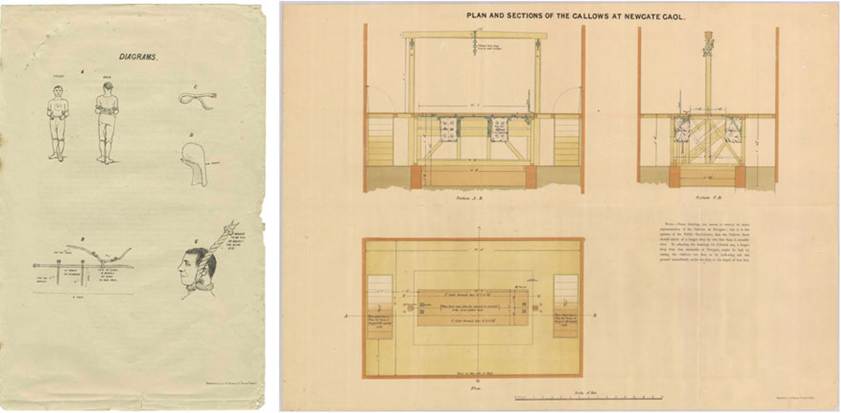
Illustration 3.2 The drawings sent by the Colonial Office in England to the Australian colonies in June and December 1880 regarding new execution equipment and the design of the Newgate gallows in London. (Source 'Memorandum Upon the Execution of Prisoners by Hanging with a Long Drop, June 1880', Queensland State Archives, Series ID 12690, Item ID 1139511; 'Circular from the Secretary of State for the Colonies, with Attached Plan and Section of the Gallows at Newgate Gaol, 28 December 1880', Queensland State Archives, Series ID 12690, Item ID 1839168)
The Ideal and Reality of Execution Procedure
Ul IO
with the reality of executions will the bungling nature of colonial hangВings be fully grasped. Moreover, it is a useful opportunity to provide, for the first time in the historical record, a detailed look at execution procedure in the Australian colonies from sentencing through to burial.
[Interval between sentence and execution.]
The law or custom of each particular colony may to some extent define the interval between sentence and execution. In the United Kingdom the execuВtion takes place on the first Monday after the intervention of three Sundays from the day on which sentence is passed.
The first point made in the 1880 Memorandum is for there to be a regular and predictable interval between the sentence of death and the execution of the criminal. In the earliest days of each colony executions seemed to be carried out in haste, with little chance of appeal on behalf of the condemned. For example, Australia’s first-ever execution of Thomas Barrett on 27 February 1788 was carried out just before sunset on the very same day of his sentencing.[197] Later in the colonial period an interval of a little over a week was common but anything more than a month appears rare. The six-day turn around between the sentencing and execuВtion at South Australia’s first hanging was cause for apprehension as there was legitimate concern that an executioner might not be found in time.[198] As for the day that the execution should be held, there did not appear to be a fixed rule. Guilty persons sentenced at the same criminal sessions were very likely to have the same date of execution but no day of the week was given preference over another or used consistently.
[Convict to be informed of date of execution.]
As soon as the date is fixed, the sheriff or governor of the prison should inform the prisoner of the fact.
Informing the condemned of the execution date gave them the opportuВnity to come to terms with their impending fate and prepare accordingly. An example of this intimate exchange is relayed in the personal diary of John Buckley Castieau who was at one time the Governor at BeechВworth and Melbourne Gaols. After the arrival of a letter from the Chief Secretary’s Office that fixed the date and time for the execution of James Cusack, one of the prisoners under his supervision during his time at Melbourne Gaol, Castieau immediately went to the prisoner’s cell to convey the news.[199] Tying back to the question of the interval between sentencing and execution, Cusack provides a useful case study.
Sentenced to death on 16 August 1870, he was informed of his execution date by Castieau on 22 August and hanged on 30 August—an interval of exactly two weeks between sentencing and execution.[200][Hour of execution.]
Executions in the United Kingdom take place usually at the hour of eight a.m.
Besides exemplary cases like that of Thomas Barrett (described above) who was executed near sunset, Australian executions were always conducted early in the morning. 8 a.m. was the most common time but anywhere from 7 a.m. till 11 a.m. has been mentioned as the hour of execution. For instance, Cusack’s execution occurred at 10 a.m., idenВtical to the time set for the two other men executed at Melbourne Gaol that year.[201] Early morning executions were preferred as it minimised the chance of a rowdy, carnival-like atmosphere developing among the crowd. The general public were welcome to watch the execution so long as they were in the habit of rising early and not oversleeping.
[The executioner.]
The executioner should be a trustworthy and intelligent person, and on the first occasion of his employment care should be taken to ascertain that he knows fully and accurately what he has to do, and in what order he is to do the several acts which constituted his duty. He should, when practicable, be lodged in the prison or under close supervision, from the Saturday preceding the Monday of execution, so as to obviate the chance of his being tampered with by the friends of the prisoner.
The fact that the Memorandum had to state explicitly that the hangman ought to be a dependable individual and competent at the task at hand says something about their previous quality. Extended studies of specific executioners in Australia reveals, among other things, their poor charВacter, rampant alcoholism and bungled handiwork.[202] For the majority of the colonial period hangmen were chosen from among the prisoners themselves. Sometimes they performed the undesirable task in exchange for a reduction of their sentence or a relatively large pecuniary reward.[203]
The position of executioner in colonial Australia was an ignoble one, laden with superstition and social stigma.
It was a fact that led many executioners to don disguises at the colonial gallows. Hangmen with fake beards, goggles, masks, costume dress and faces smeared with various emulsions were seen on the colonial scaffold.[204] When Henry Flude's identity as the hangman of Queensland was revealed he left Brisbane and his successful grocery store behind such was the shame attached to the job.[205] Long-term executioners like Alexander Green in New South Wales and Soloman Blay in Tasmania cared less about protecting their identity, as their vocation and status was already well known in the colony. Other executioners even tried to distance themselves from the act of killing itself. Robert Howard, or вЂ?Nosey Bob' as he was known, was the public executioner of New South Wales but delegated to an assistant the task of putting the rope around the neck of the victim and activating the drop.[206] вЂ?It's not a fact that I ever hung a man — never, sir, never' he told The Bulletin in 1880.[207]A willingness to do the job was the only prerequisite of the colonial hangman; aptitude for the task was a secondary concern. For instance, the convict who had agreed to play hangman for the first-ever execuВtion in 1788 was so reluctant to perform his duty that he complied only once the Provost Marshal and others had threatened to shoot him.[208] The non-existence of formal training left any shortcomings in technique uncorrected until either intuition or experience told them to adjust their methods. Knowledge of proper execution method was, for the most part, hard-won through trial and error. By 1876 the Sheriff of New South Wales, Charles Cowper, was tired of the lack of professionalism among executioners. In writing a letter to the Department of Justice he demanded an increase in their salary and an end to employing crimiВnals for the job. He was, to quote from the letter, вЂ?daily beset' by the nuisance of previous executioners under his service.[209] Their addiction to drink, lack of respectable attire and need for a personal handler when attending a regional execution was particularly irritating to the Sheriff.
Sheriff Cowper would have been pleased to hear that in colonies like Queensland the professionalisation of the executioner was not far off. Withholding the name and address of the hangman from the public record combined with the new secrecy of private executions led to a better class of person being appointed to the post of hangman in that colony. In 1886 twenty-six people applied for a publicly advertised vacancy to become the new executioner of Queensland. The successful applicant had no criminal record and even sported a reference from the former Mayor of Brisbane. In 1900 when the same position became available, over one hundred people applied for the job, demonstrating just how much things had changed over the intervening century.[210]
[The apparatus to be tested.]
Early on the morning of execution, the executioner should try the apparatus and rope to ascertain that all is in good working order. The drop, &c. should then be locked up until the return of the executioner with the convict, the key being kept by the chief warder.
Testing the apparatus prior to the actual hanging was a rare event, or at least it does not show up strongly in the historical record. That said, Edmund Finn in The Chronicles of Early Melbourne (1888) tells one story of how the executioner of three condemned criminals in 1842 did indeed put in some prior practice. Earlier in the year the same hangman had horribly blundered an execution in such a way where вЂ?the two poor wretches got jambed [sic.], and twisted and writhed convulsively in a manner that horrified even the most hardened'.[211] Being Victoria's first- ever execution the untested and hastily constructed scaffold, вЂ?only a degree removed from the proverbial “bucket”', was mostly to blame.[212] Finn testifies that the executioner вЂ?was so universally censured' by his first effort that he was вЂ?fearful of losing the “appointment”'.[213] So as to avoid the same mistakes and in the hope of вЂ?making his post a permaВnency' the hangman вЂ?procured the straw effigy of a human figure, and upon this model was in the habit of taking frequent private rehearsals'.[214] Practice, as the saying goes, makes perfect. The three men died вЂ?without a struggle' when the drop was activated for the second time in Victoria's history.[215]
[The gallows.]
No description is here given of the gallows and drop, as it is assumed that in most cases the colonial authorities understand how they should be constructed. Ifthey have any doubt about the matter, working drawings will be supplied by the Secretary of State on application.
At the earliest executions in each colony, particularly the very first, the gallows were primitive constructions. The five executions that occurred in 1788 in Sydney appeared to have been conducted on a tree with the help of a ladder that was quickly pulled away.[216] At South Australia's first execution in 1838 the culprit was hanged using an overhanging tree branch and a cart that was slowly removed from under him by a horse. Performed and prepared by an amateur hangman of no experience it was, unsurprisingly, horribly botched.[217] The first execution in Moreton Bay was at the convict barracks but the second in 1841 occurred atop a windmill in the heart of the settlement that had been refitted for the occasion.[218] These early executions were very likely to be bungled since there was little technical expertise on hand to direct the build and, more to the point, an all too hasty turnaround time between sentence and execution.
After these initial hangings each colony soon developed the approВpriate infrastructure to deal with the execution of criminals. In QueensВland, a trusty set of portable gallows—ten feet long, six feet wide and ten feet high—could hang up to three criminals at a time and were in use for many years at the Petrie Terrace Gaol.[219] These were later replaced by a cellblock gallows at Boggo Road Gaol. A similar set of portable gallows was erected out the front of Adelaide Gaol and then within the gaol yard after the introduction of private executions. A permanent drop was constructed in the вЂ?A’ wing of the Adelaide Gaol in the 1890s before a вЂ?hanging tower’ was constructed in the 1950s.[220] The same portable gallows that were used at the George Street Gaol in Sydney for many years were transferred to the yard at Darlinghurst Gaol after it opened in the early 1840s. During the year 1844 a new permanent drop was commissioned at Darlinghurst whereby the prisoner mounted the scafВfold from a ladder inside the prison walls but emerged above the drop outside its walls. In full view of the crowd, the criminal fell into the space below the entranceway on the given signal.[221]
When public executions were abolished (see Chapter 7), many hasty alterations were made to these long-standing structures across the colonies. In November 1855 the colony of Victoria had its first private execution, a triple hanging at Melbourne Gaol, where such an alteration was made. вЂ?The machine of death remains in the place it formerly occuВpied’, wrote The Argus, вЂ?but having been roofed in, the condemned are enclosed from public view’[222]. At the first private execution in QueensВland in 1857 a thick black cloth was wrapped around the top half of the scaffold to prevent people from seeing the platform from over the low lying walls.[223] At Western Australia’s first private execution in Perth Gaol in 1871, the gallows remained in the same location inside the gaol yard but it was simply erected at a lesser height so that it could no longer be seen over the walls.[224] A similar tact was taken inside the prison yard of the Murray Street Gaol in Hobart. The long wooden legs of the scaffold were all but removed while a large hole was dug to the depth of seven feet and the trap placed above it.[225] The once proud gallows, soaring over the prison walls, now became invisible to the world outside the prison through a variety of hasty alterations made in accordance with the spirit of the Private Execution Acts.
[The trap or drop.]
It should, however, be observed that the public executioner (with whose assisВtance this Memorandum has been compiled) attaches much importance to having a trap in two pieces dividing in the middle when the bolt is withВdrawn, as by this arrangement the man falls quite straight down and his neck is more surely broken; whereas a single trap with hinges at the side or back gives the convict a direction in his fall, which diminishes, the jerk at the end, and is therefore less effective in breaking his neck. The public executioner considers it very important that the lever for letting down the trap-doors of the drop should be so placed that the executioner can get at it without losing sight of the convict, who otherwise might shift his position.
The specific design aspects of the construction of the trap door are best explained by reprinting the technical drawing of the Newgate Gallows sent to the Australian colonies in December 1880 (see Illustration 3.2). This document was not included in the original Memorandum from the Colonial Office dated June 1880. As noted by the Secretary of State for the Colonies, copies were arranged and dispatched only after �numerous applications’ were received from the colonies regarding the �Working drawings of a Gallows and Drop’.[226] The technical drawing clearly details the trap being made from two pieces that part in the middle as suggested by the Memorandum. When the stop pin was removed the floor very quickly gave way. A sudden drop and a clean death should result, providing the drop length was calculated properly and the knot fixed in the appropriate position.
Given there was no central directive on the question of gallows construction until after this document was sent out in 1880 the design of the apparatus varied in the Australian colonies. Still, descriptions of drops designed later in the nineteenth century give the impression of a much more efficient and reliable apparatus that was far superior to earlier incarnations. In 1896 one Melbourne writer wrote of�springs, bolts, and [a] pulley' when describing the gallows at Melbourne Gaol.[227] Even an �India-rubber tube' was strategically placed below the drop with the aim of �deadening any noisy slam'.[228] The Boggo Road gallows in Brisbane constructed in the early 1880s was similarly complex and had a pulley system that could gently lower the criminal's body to the ground after the execution was complete.[229] Some of these late colonial constructions reference aspects of the Newgate drop in their design but to state with confidence that they could trace their lineage directly to this drawing sent out in 1880 is difficult to determine.
[The rope.]
The rope should be strong, and should be well tested with weights much greater than those of any man who is likely to be hanged on it, and with a somewhat longer drop than the normal one of eight feet. The object of thus testing the rope is not only to prevent the possibility of those shocking accidents which sometimes occur at executions, but to take from the rope any kink or elasticity which it would have when new.
The ropes supplied for executions in this country by the authorities of Her Majesty’s Gaol of Newgate have a smooth metal eye surrounded by two strands of rope — an arrangement which has many advantages.
All ropes should be kept dry and in good order, and in tropical climates they should not be used if they have been long in store without being severely tested afresh. Supplies of ropes with metal eyes can be obtained from Newgate through the Crown Agents.
Some executioners took pride in the rope and knot they were capable of producing. In New South Wales, Robert Elliot reportedly spent many hours вЂ?manipulating the rope with grease to make it soft and pliable' before every execution.[230] Grease, or a similar lubricant, was always applied to the rope to make the knot slide over itself more easily. If approВpriate care was not taken with the rope it could stretch or even snap in two at the crucial moment. For example, when a government party travВelled to the Coorong from Adelaide in 1840 to hang the perpetrators of the вЂ?Maria Massacre' the rope was not hung with weights prior to the summary execution. The result was that it stretched well beyond its resting length. The sand had to be cleared away from under the feet of the two condemned men before a second attempt on their lives could be made.[231]
Unwanted stretching was one thing but a clean snap of the rope could be just as harrowing and certainly more painful. It even engenВdered the possibility of the condemned being extended mercy because of the trauma involved. In 1803 Joseph Samuels mounted the Sydney gallows three times over. On the first attempt the rope broke in a вЂ?singular manner', on the second attempt вЂ?the cord unrove at the fastening' and on the third attempt the вЂ?cord again snapped in twain'.[232] Each time Samuels slammed to the ground from the height of the platform. When the rope failed a third time the Provost Marshal rode to the Governor and вЂ?feelingly represented these extraordinary circumstances’ to him.[233] The Governor, in response, granted Samuels a reprieve from the penalty of death. On another occasion in 1826 William Curtin received a commuВtation of his death sentence after a problem with the rope caused him to fall to the ground from a вЂ?considerable height’ and receive heavy injuries.[234] Mercy was not always forthcoming, however, as William Johnson found out in 1828. He too fell to the earth after the rope snapped so the Sheriff took leave from the execution scene to inquire into the possibility of Johnson being granted mercy. It was a вЂ?trying moment’, according to the Australian, where the criminal sat on his coffin for almost an hour вЂ?painfully vibrating between hope of mercy, and doubt, and fear’.[235] Unfortunately for Johnson, the Sheriff returned and announced that вЂ?the law shall take its course’.[236]
The traditional вЂ?hangman’s knot’ was tied with varying degrees of success in the colonies. One journalist who witnessed the hanging of the perpetrators of the Mount Rennie rape case at Darlinghurst Gaol in 1887 stated how the knot that pressed against the neck of the condemned men approached the вЂ?size of an ordinary quart bottle, if not larger’.[237] Not only did the rope reek of freshly applied tar that вЂ?permeated the whole building’, it was also вЂ?stout’ enough to tie a вЂ?steamer up to a wharf’.[238] The correspondent called these arrangements вЂ?barbarous in the extreme’ because he thought it caused prolonged strangulation rather than the immediate dislocation of the neck. A poorly tied knot was also a point of concern. At one of the executions presided over by Alexander Green in 1853 a faulty knot he had tied around the neck of one criminal caused him to fall to the ground from a reported height of twenty feet. ParalВysed but still living the criminal was, limp-limbed, carried up to the drop once more to be hanged a second time.[239]
The rope used for hangings was an object of fascination to many colonists. Robert Elliot, the aforementioned hangman who took great pride in preparing his rope for executions, appeared before a MagisВtrate for drunkenness in 1857. It was revealed in court that he became unsociably drunk after being given free вЂ?nobblers’ by publicans around Sydney for exhibiting to excited patrons the two lengths of rope he had used at a recent double execution.[240] After the death of Solomon Blay, the long-term Tasmanian executioner, one newspaper claimed that two- hundred pieces of rope were found among his personal effects. Housed in a box they were said to be labelled and ticketed with the details of each of his executions.[241] Sometimes the rope was profitably sold off as a relic of the hanging. The rope used to hang a man named Thomas Griffin in Queensland was later cut up and sold at one shilling each. вЂ?The genuineness of this rope was doubted’, wrote one settler in his published recollections, вЂ?but the buyers were satisfied’.[242] The existence of such stories and an unwanted fascination with the rope led, in Queensland at least, for it to be burnt by prison authorities immediately following executions conducted after the 1860s.[243]
[The length of drop.]
Death by hanging with a long drop ought to result from dislocation of the neck, or nervous shock. A man of 10 stone and under requires a drop of 8 feet, a heavier man requires a slightly lesser drop in proportion to his weight over 10 stone. Ifthe mans neck and shoulders are very hard and muscular he should have an extra foot or so beyond the normal drop of his weight.
The correct drop length, calculated with reference to the weight of the prisoner, would result in a quick dislocation of the neck and an immediate death. A decade after this Memorandum appeared giving general estimates of appropriate drop length a much more precise �Table of Drops’ began appearing in the colonies, sent out as a �confidential circular'.[244] The table itself is dated April 1892 and has two columns �weight of the prisoner in his clothes' and �length of drop'.[245] The hangman and sheriff could easily refer to these corresponding columns on the day of execution. In rare circumstances, where an abnormally heavy or light prisoner was in their care, they could even calculate the drop length themselves since the specific formula underpinning these standard drop lengths was also included.
According to the Table of Drops anywhere from four to eight feet was acceptable but anything beyond these parameters could be disasВtrous. Set the drop too short and extended strangulation would result, too long and decapitation was a very real risk. John Hatton, QueensВland's longest serving executioner who plied his trade from 1862 to 1885, was in the habit of setting the drop length far too long. When Patrick Collins was hanged in 1872, Hatton set an enormous drop length of 12 feet. A вЂ?fearful gash' was thereby made to Collins' neck that nearly took off his head; вЂ?blood spurted forth violently, deluging the clothes he wore, and pouring down over his trousers on to the ground underneath his feet'.[246] Solomon Blay in Tasmania was at the opposite end of the spectrum hanging every criminal regardless of weight with a drop of 1.5 metres, or just under five feet.[247] Light-framed criminals would therefore be choked over many minutes rather than a clean break of the neck being made. The insufficient drop length that Blay persisted with in Tasmania was even raised repeatedly by one MP at the 1884 Select Committee into Gaol Discipline.[248] Though dislocation of the neck was the intenВtion, it was no sure thing in the colonial era. Such informative guides as the Table of Drops and the 1880 Memorandum provided welcome instruction to tenured hangmen who did not appear to be quick learners.
[Pinioning.]
The governor of the prison, the surgeon, two or three principal warders, and the executioner should proceed to the condemned cell a few minutes before the execution, and the convict should be pinioned and his neck bared by the executioner. In this country a set of straps is used, which appears effective and can be quickly adjusted.
The chief object to be attained in pinioning the convict is to prevent his getting his hands up to his throat. Rapidity of adjustment is also an important object. The accompanying diagrams show a front and back view of the convict when pinioned, and also the pinioning apparatus itself; which will be supplied on application to the Secretary of State.
Executioners who were either forgetful or untrained in the necessities of pinioning paid a price for their negligence. At the hanging of Charles Streitman at Adelaide Gaol for example, the executioner forgot to strap the prisoner’s legs together beforehand. Owing to the drop length being a mere three feet, Streitman managed to raise his legs to the platform above but they were soon kicked back into the drop. вЂ?His chest heaved and fell at long intervals in the attempt to breathe’, wrote one observer, вЂ?It was not until twenty-two or twenty-three dragging minutes had passed that all signs of life had ceased’.[249] At Darlinghurst Gaol in 1863 Henry Manns’ untied arms, вЂ?repeatedly rose and fell, and finally, with one of his hands, the unfortunate man gripped the rope as if to tear the pressure from his head, a loud guttural noise... proceeding from his throat and lungs, while blood gushed from his nostrils, and stained the cap with which his face was covered’.[250] The whole scene lasted over 10 minutes according to the reporter. Pinioning the limbs of the criminal ought to be one of the easiest things to control on the day of execution. The impreciВsion of drop lengths, uncertainties over the type of rope and placement of the knot, were much harder to get right. Still, many executioners either completely forgot to do so, or remembered but failed to do it properly.
[Theprocession to the scaffold.]
When the convict is pinioned, and his neck bared, he should be at once conducted to the scaffold, the governor and surgeon preceding with the chief warder, two warders at the convict’s side, and the executioner following with such force of warders as may be deemed requisite.
In the earliest days of each colony, when the place of confinement and the execution site could be spread out across town, there was something of a procession for the public to witness. In early Port Phillip there were three separate processions of the вЂ?death cart' (as one writer called it) in 1842— at the execution ofвЂ?Bob' and вЂ?Jack’ in January, DanielJepps, Charles Ellis and Martin Fogarty in June, and finally, of вЂ?Roger’ in September.[251] A watercolour, painted by W F. E. Liardet, depicts the start of the very first procession that took place in the settlement.[252] A bullock team pulls the cart conveying the two Indigenous criminals away from waiting officials, there are military guards in tow while a crowd is visible walking adjaВcent to the cart. The procession travelled down Collins Street, William Street, Lonsdale Street and Swanston Street to the site chosen for the execution.[253] On the second occasion the route taken to Swanston Street was only very slightly altered but, this time, the cart had been loaded with three coffins which the condemned bushrangers were required to sit atop.[254] On both occasions crowds lined portions of the streets to see it pass by. Less is known about particulars of the procession of an IndigeВnous male nicknamed вЂ?Roger’ in September, though one writer from the time notes that one did indeed take place.[255]
In Adelaide and Launceston a similar horse and cart procession is recorded at one time or another but only very early on in the history of each settlement.[256] In none of the colonies did it come close to the scale, formality or carnival atmosphere that was detectable at London's вЂ?Tyburn Processional'. In fact, processions ceased immediately following the main gaol being built in each colony. For instance, Port Phillip's processions stopped after the Melbourne Gaol opened in 1845. ThereВafter the вЂ?procession' to the scaffold consisted of nothing more than collecting the criminal from his/her cell to wherever the gallows had been erected within the gaol precinct.
[The chaplain.]
Where the convict professes the Christian religion, and the services of a chapВlain of a suitable denomination are available, the chaplain should attend in the condemned cell, and his place in the procession is behind the governor and in front of the convict. In the discharge of his duties he will be guided by the rules and usages of the church to which he belongs.
Religion was an important part of the execution ritual, clergymen time and again helped guide the condemned criminal both at the execution itself and in the days leading up to it (see Chapter 4). The overwhelming majority of criminals received some variety of Christian comfort in their final moments. For many subsections of colonial society the importance of religion was heightened as it functioned as a key marker of their identity in an adopted home. For example, Irish Catholics came to the Australian colonies in large numbers, either as convicts or free settlers, and were particularly diligent in expressing their faith on the scaffold. There are repeated references across the colonies to Catholics, someВtimes but not always, being dressed in pure white with a large black cross emblazoned across their chest, back or cap.[257] Rosaries and cruciВfixes were also a common sight on the scaffold among many Catholics sentenced to death. Although most criminals mounted the scaffold empty-handed, objects like flowers or the Bible did sometimes appear across the denominational divide.
The narrow definition of Christian attention suggested in the MemoВrandum was sometimes exchanged for spiritual advisors of religious minorities. At the execution of Edward Davies, a bushranger of Jewish heritage, he was assisted by a reader at the Sydney Synagogue throughout proceedings and later buried in the Jewish portion of the DevonВshire Street Cemetery.[258] At the execution of an Afghan Muslim named Goulam Mahomet in Western Australia his spiritual advisor passed the Quran over his chest, traced the words of a holy prayer on his foreВhead and told him to recite that same prayer as the drop fell. After his execution he was buried with вЂ?Mohammedan rites', as it was labelled by the newspaper, outside the walls of Fremantle Prison by twenty of his fellow countrymen.[259] Some sheriffs also respected the wishes of IndigeВnous criminals in death. Wera Meldera was executed at Adelaide Gaol in 1845 and wanted no white man to touch him in death or at the burial—a request that was вЂ?strictly complied with' according to the South Australian Register. After his hanging a collection of local Aborigines вЂ?received him in their arms, placed him in the coffin, and buried him in the gaol yard by the side of the other murderers'.[260] Only very rarely was spiritual advice refused entirely as in the case of Arthur Buck, an atheist executed at Melbourne Gaol in 1895. He вЂ?respectfully received' the prison chaplain but was most unusual in his request for the вЂ?usual prayers and devotional exercises' not to be carried out in his final moments.[261]
[The execution.]
On reaching the gallows the duty of the executioner is as follows: —
1. Place the convict exactly under the part of the beam to which the rope is attached.
2.Strap the convict’s legs tightly (diagram annexed, marked C).
3.Put on the white linen cap (diagram annexed, marked D).
4. Put on the rope round the neck quite tight, the knot of metal eye being just in front of the angle of the jaw-bone on the left side, so as to run up behind the left ear when the man falls and receives the jerk. Care should be taken to adjust the rope as in the diagram annexed, marked E, the part to which the metal eye belongs being [sic.] in the front of the throat. If the rope is adjusted the other way there will be less certainty of breaking the mans neck. The noose should be kept tight, as adjusted, by means of a stiff leather washer on the rope. The long front of the white cap should be free from the rope, hanging down in front.
5. Go quickly to the lever and let down the trap-doors.
Once the preparation was made and the knot accurately adjusted under the neck, the procedure was rather straightforward. Rather than talk through these points one by one it is much easier to see how they pair with the illustrations included in the 1880 Memorandum (see Illustration 3.2). The equipment and technique drawn in these diagrams were seen by the executioner in England as being most appropriate for the job at hand. Buckled leather straps replaced plain lengths of rope for ease of adjustment and quick use. A newly fashioned hood replaced the rather nondescript calico bag that was usually placed over the heads of dying criminals. It kept the back and sides of the neck clear for the precise positioning of the rope while the plunging flap extending down near the chest of the culprit made it an even more remote possibility that the contortions of the face would be visible to the onlookers. To be sure that this execution equipment was used in the proper fashion additional diagrams were included. Clarification on how to fix the leather pinioning straps onto the upper body of the criminal was also demonstrated for the benefit of practical application. The new method employed by the English hangman of a metal washer instead of the �hangman's knot' is drawn very clearly. So too is the positioning of the washer in relation to the criminal's neck.
An illustrated account published in The Bulletin of an execution conducted in the months prior to the circulation of the 1880 MemoВrandum (and therefore in the absence of these new techniques) depicts the hanging of Andrew George Scott (known as вЂ?Captain Moonlite') and Thomas Rogan at Darlinghurst Gaol on 20 January 1880. The вЂ?hangman's knot' was still in use as are the rather nondescript calico bags placed over the criminal’s faces, their hands appear to be pinioned but the legs left free. вЂ?Nosey Bob’, the executioner of New South Wales, confidently stands cross-armed to the left of a reliable platform that was purpose-built for such an occasion. Even without explicit guidВance from England like that contained in the 1880 Memorandum, by the final decades of the nineteenth century the basics of hangings were being performed well when a competent executioner was on hand. Visually, at least, the Australian gallows were similar to elsewhere and the suggestions of the Memorandum appear to be sometimes small, obvious or incidental. However, critical mistakes were frequently made in regards to technique. As documented above, even very minor overВsights could produce a variety of very painful outcomes for the criminal involved. Fortunately for Scott and Rogan, вЂ?Nosey Bob’ performed his task admirably on this occasion with skill and judgment derived from years of first-hand experience. As far as Australian colonial executions are concerned, both men died as well as could be hoped.
[The taking down of the body.]
The convict should hang one hour, and before he is taken down the surgeon should, as a matter of form, satisfy himself that he is dead.
The best way of taking the body down is not to cut the rope, but to take the rope off the hook, and lift the body down; the rope should be removed from the neck, and also the straps from the body, when it is on the ground.
In laying out the body for the inquest, or other similar proceeding the head should be raised three inches by putting a small piece of wood under it.
These instructions on how to deal with the criminal’s body in death are the final procedural guidelines included in the 1880 Memorandum. Historically criminals were always left hanging for at least one hour following their execution to ensure that, without any doubt, death had run its course. In the era of private executions sometimes this length of time was shortened. Either because the surgeon could quickly confirm the death or since the execution was so horribly botched that it was quite clear that the criminal was deceased. For example, at an execuВtion in Brisbane in 1901, the criminal was only left hanging for a mere 10 minutes after death—a motionless body, expired pulse and a blood- soaked cap caused by the fall was more than enough confirmation for those present.[262] The Private Execution Acts passed during the 1850s did not specify a period of time for the body to be left hanging and it was, therefore, a proviso that was open to interpretation.
The display of the body for any more than an hour would only occur in the rare decision that it should be �hung in chains'. This practice was certainly not the norm at colonial executions and it was only prevalent in the very early annals of New South Wales and Tasmanian history. On such occasions, the dead criminal's body could be left hanging for months, standing as a lasting warning for visitors to the district. Frances Morgan, for instance, was hung in chains on a small island in the middle of Sydney Harbour. According to one early chronicler, the �clothes shaking in the wind, and the creaking of his irons' reminded local Indigenous Australians of the supernatural and therefore presented a �much greater terror to the natives, than to the white people, many of whom were more inclined to make jest of it'.[263] �Hunter's Island' was the place to gibbet dead criminals in Hobart until the year 1816 when the Lieutenant-Governor of Van Diemen's Land, Thomas Davey, ordered these �Objects of Disgust' to be moved elsewhere.[264] Following the example of the British Parliament in 1834, the practice of hanging in chains was abolished by New South Wales and Van Diemen's Land in 1837.[265]
Dissection was another indignity that could be imposed upon the early Australian criminal before burial. When John Fenlow was executed in early Sydney his body was, pursuant to his sentence, turned over to a surgeon for dissection. David Collins, the first Judge Advocate of the infant colony, described what happened when Fenlow's post-dissection body was able to be inspected by the general public: �[T]hey had no sooner signified that a body was ready for inspection, than the hospital was filled with people, men, women, and children, to the number of several hundreds'.[266] Collins says these spectators consisted of the �lower class' and lamented how none �appeared moved with pity for his fate, or in the least degree admonished by the sad spectacle before their eyes'.[267] Dissection was commonly recorded at very early executions, though the degree of publicity given to Fenlow's executed body in 1796 stands out as a rare occurrence.[268] Dissection was finally abolished in the two oldest Australian colonies of New South Wales and Van Diemen's Land in 1837 by the same legislative instrument that outlawed hanging in chains.
The taking down of the body was only occasionally documented by witnesses to the execution as it was viewed as ephemeral to the central drama of the event. At the private execution of Thomas Williams and Charles Montgomery one unnamed journalist writing in The Bird O’ Freedom did, however, give an extended personal account of what it was like to stay behind and witness this part of the scene. It was stated that the executioner's assistant held the body while вЂ?Nosey Bob', the hangman, cut through the noose using a sharp knife, lowering the bodies gently into a prepositioned basket. What was most вЂ?repulsive' to the journalist was when he spotted the executioner, вЂ?coolly wiping the grease of the rope from his hands with a towel' before moving onto the second body.[269] Once dissection was outlawed, the inspecВtion of the body following death by medical practitioners was a much more passive exercise. The bodies of Williams and Montgomery were carried away individually in the large basket to the gaol morgue. The doctor then assessed each body for the exact cause of death and noted it down—suffocation for Williams and the dislocation of the neck in the case of Montgomery.[270] Victoria has an unusually thorough record of these medical examinations of executed criminals, at least from 1894 onwards.[271]
These instructions on what to do with the criminal’s body after the execution was the last detail in a long list of procedural elements outlined in the 1880 Memorandum. In addition to the Memorandum itself, the technical drawings of the gallows at Newgate Prison and the Table of Drops was the extent of the documents sent out by the Colonial Office regarding execution procedure to the Australian colonies. All of these efforts were made to ensure that a previously haphazard practice might become standardised and error-free in the future. Yet it was not the last contact the Colonial Office in London had with the Australian colonies pursuant to this correspondence. Recipients were encouraged to procure helpful equipment from the Colonial Office—�ropes with metal eyes’ and the �pinioning apparatus’ are mentioned as examples.