Introduction: Thinking About Punishment OverTime
Consider the execution of John Knatchbull in 1844 outside Sydney's Darlinghurst Gaol (Illustration 1.1) compared to that of Ned Kelly in 1880 at the Old Melbourne Gaol (Illustration 1.2).
Both were notoВrious figures in Australian criminal history during their lifetime except that the former was sentenced to a public execution while the latter underwent a private execution. The sketch of Knatchbull, a convicted murderer of aristocratic birth, does well to capture the atmosphere of public executions.[1] To the far right, horses mounted with late spectaВtors are in full stride, rushing to join the throng of an estimated 10,000 Sydneysiders present. In the foreground male, female, and child specВtators are all visible in a crowd that swells the closer it comes to the towering image of the scaffold. A dozen mounted military personnel stand guard at the base of the structure. Following the steps upward are two clergymen attending to Knatchbull while the executioner makes the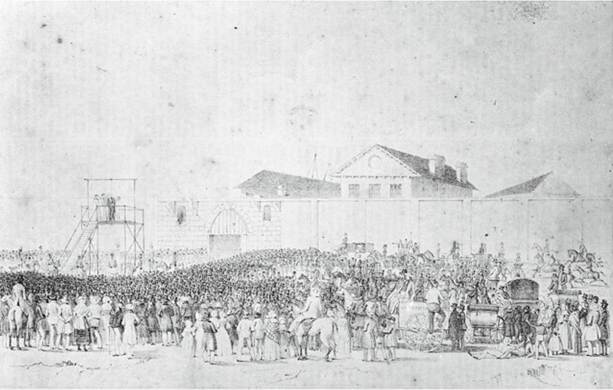
Illustration 1.1 The execution of John Knatchbull outside Sydney's Darlinghurst Gaol on 13 February 1844 (Source 'Woolloomooloo Gaol, Execution of John Knatchbull', Government Printing Office, Glass Negative 1-21799, held by State Archives and Records Authority of NSW)
final adjustments to the rope around his neck. The jutting architecture of Darlinghurst Gaol informs the background of the work but the drama is soon to be played out on the tongue of the entrance gate. One imagВines that, as Knatchbull fell into the cavity below, the static image of the prison was secondary to the screams, gasps and jolts of Sydneysiders gathered shoulder to shoulder.
The image of Ned Kelly’s hanging gives the opposing perspective of a private execution. The ten thousand itching, impatient spectaВtors at Knatchbull’s feet are exchanged for the cold interior walls of Melbourne Gaol.
In the absence of the distracting public, legal funcВtionaries and religious advisors enclose him while the symbol of the cross is held steadily over his head. The white cap would soon be pulled over Kelly’s face, hiding the grotesque contortions that always occur the moment the noose jabs at the neck. Though not depicted in the sketch, contemporary newspaper reports attest to the fact that there was a small crowd watching the hanging in the cellblock itself but not one was a curious onlooker. Each of the twenty-three spectators was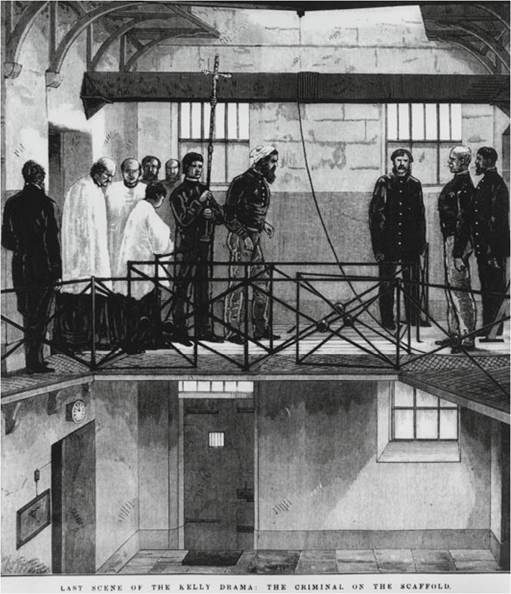
Illustration 1.2 The execution of Ned Kelly inside Melbourne Gaol on 11 November 1880 (Source 'Sketch of Ned Kelly at the Gallows, Melbourne Gaol, 11 November 1888', copied and digitised from an image appearing in the Australasian Sketcher, 20 November 1880, p. 185, John Oxley Library, State Library of Queensland, record number: 187795)
present in a professional capacity—mostly journalists and government officials. They recorded their names and occupations as a matter of legal necessity.[2] To the newspapermen who would publish their accounts, the powerful architecture of the prison was all around them, inhabited by them, inescapable no matter where their eyes looked. From the perspecВtive of Ned Kelly, looking outwards from the drop at Melbourne Gaol, the distractions had been removed; all that was staring back at him was the blank faces of officialdom and the dreary walls of the prison block.
Between the execution of John Knatchbull in 1844 and Ned Kelly in 1880 the Australian colonial parliaments—commencing with New South Wales in 1853—passed legislation to abolish public executions. It irrevocably changed the way hangings were carried out on the contiВnent. However, a closer look at the subject of capital punishment in the Australian colonies reveals a host of other, subtler shifts occurring— not all strictly related to the practice of executions.
To begin with the number of available capital crimes were being whittled down. When European settlement took hold at Sydney Cove, a dizzying array of offences could see a person hang—its early penal regime was, after all, a child of England's notorious вЂ?bloody code'. Yet, at the conclusion of the nineteenth century no colony had more than a dozen capital offences on their statute books. Mercy appeared to be dispensed more freely as the years passed. For those sentenced to death in New South Wales between 1788 and 1798 only 28% were extended mercy, compared to a commuВtation rate of 67.1% between 1890 and 1900.[3] Moreover, after spiking around the highpoint of the convict era in the 1820s and 1830s, execuВtion numbers in Australia steadily declined in proportion to a growing population. Eventually only criminals of the deepest dye were considВered a problem for the hangman to solve—the rest were usually left for the prison warden to sort out. When all things are considered, a forensic examination of the Australian death penalty reveals a punishment never settled or fixed, but one subject to constant debate and revision.The history of the Australian continent was transformed the moment the British decided to colonize the land to ease the congestion of its own penal system. New South Wales, intended first as a penal settlement, was the first colony established by Britain in 1788. The legal fiction of Terra Nullius, meanwhile, was invoked to deprive traditional owners the control of land occupied by their forefathers. The eastern colonies of Tasmania (formerly known as Van Diemen's Land), Victoria and Queensland were carved out from the vast tract originally designated for New South Wales. Western Australia and South Australia were estabВlished from the outset as separate colonies. It is easy to look back at the six Australian colonies as a homogenous whole but it is important to remember that each one eventually developed its own administration, judiciary and legal system.
As such each individual colony's experience of capital punishment, though evolving in a similar direction, often moved to slightly different time signatures. This similar but separate trajectory was continued even after the six colonies federated to form the new nation of Australia on 1 January 1901. Capital punishment itself was first abolished in Queensland in 1922 while the remaining jurisdictions waited until the latter half of the twentieth century to do the same.[4]Throughout the nineteenth century, the вЂ?lesson' of the gallows was a phrase used often in the Australian colonies. It alludes to the idea that communication is essential to the practice of punishment. Embedded within any execution was a host of messages, the most obvious being strictly penal in nature. In the words of Samuel Frederick Milford in 1866, Judge of the Supreme Court of New South Wales: вЂ?The object of capital punishment is to alarm and deter persons predisposed to crime from committing it'.[5] Those administering punishment always looked for strategies to best communicate that fact to the onlooker. For instance, some Australian jurisdictions thought it necessary to hang Indigenous offenders on a gallows mounted at the very spot where their crime was committed, preferably in front of the wrongdoer's own people. Only then, the authorities believed, could the consequences of transgressing settler law be fully understood. However, the intended lesson of the gallows was often subject to a number of unwanted and unforeseen distractions—even at run-of-the-mill executions of European criminals. An unruly scaffold crowd, a botched hanging, the misbehaving crimВinal, a punishment too severe for the crime—all of these factors had the potential to derail the example. In the blink of an eye, a just punishВment could morph into an unruly exhibition that meant all the wrong things. It is no consequence then that all of these distractions, slowly but surely, were removed by the time of Federation.
Hangings were hidden inside the prison, the list of capital crimes was narrowed and the post of hangman was professionalised. Executions became, for most people, only accessible through the reportage of journalists. I argue throughout this monograph that safeguarding the lesson of an execution in the midst of changing cultural beliefs and popular memory is what shaped the evolution of capital punishment over time in Australia.Chapter 2 sets the scene by providing an overview of Australia’s вЂ?hanging years’. The colonial period was, after all, where the vast majority of executions took place. It expands upon the existing historiography of capital punishment in Australia to give a basic picture in each of the six colonies of execution numbers, the frequency of mercy and the type of offences that were capital. A variety of factors extrinsic to the penal system ended up intersecting with the operation of the gallows. For example, norms around gender, race and age impacted decisions around mercy. As for what crimes should remain capital, the gender imbalance, the bushranger problem and the isolation of the frontier all had a role to play in the decisions made. There were small but consisВtent alterations allowing for the parameters of capital punishment to sit comfortably within colonial society over time. In the end it is clear that capital punishment was not a penalty on the rise but one slowly receding in prominence. As Federation neared, it was a punishment used mostly as a last resort—there only to check crimes of the severest type.
Chapter 3 explores the execution procedure in colonial Australia between 1788 and 1900 from sentencing all the way through to when the hanged body was examined by medical professionals. A set of circuВlars sent out by the Colonial Office in England to the Australian colonies in 1880 are used for this purpose and demonstrate the gap between the ideal and the reality of execution procedure in the colonial period. What becomes apparent is that there was an evergrowing sensitivity among colonists towards the sight of unnecessary pain and suffering in criminals.
The constant bungling of the execution procedure, both major and minor, distracted from the example of the punishment. In the name of вЂ?decency’ and вЂ?humanity’ the execution was transformed from an amateur undertaking to a standardised and professionalised practice by the time of Federation. Though aware of other modes of execution developing abroad—like electrocution in America or the guillotine in France—hanging remained the only official means through which death was meted out.The ability for the condemned criminal to actively shape the meaning of their punishment in his or her final moments is the subject of Chapter 4. A penitent criminal underlined the justice of the sentence but a misbehaving one left open the possibility of other interpretations. When the criminal mounted the scaffold there was the popular cultural expectation that they вЂ?die game’ or, in other words, with a degree of courage, pluckiness and bravado. It encouraged many criminals to misbeВhave and hide away any feelings of contrition for the crime that had been committed. The role of the executioner, clergymen and sheriff was to shepherd criminals into thinking that penitence was the only option available to them. However, the case of Ned Kelly is invoked to demonВstrate just how difficult it was for the state to control the narrative of an execution—even when everything went exactly according to plan.
Chapter 5 deals with the changing way that onlookers interacted with executions in the colonies. The perception was that the lower classes were attracted to the foot of the public scaffold while it was also trouВbling that women and children were known to attend. This concerned middle and upper class colonists who were convinced that witnessing the gory spectacle of hangings only served to demoralise the onlooker and acclimatise them to violence. It also conflicted with the idealised role of these groups that existed within the colonial culture—as disciplined workers, moral guardians of the home or the virtuous next generation. When public executions were abolished colonial sheriffs were put in charge of determining who was able to view the private hanging. At these new executions an exceedingly small and select number of citizens were admitted into the gaol on the day of the hanging, complemented by the usual number of prison officials, journalists and medical men. The crowd, once seen as guardians of due process in earlier epochs, was now considered a distraction from the execution itself.
Nothing did more to change the character of capital punishment in the colonial period than the abolition of public executions. Chapter 6 focuses on the practical measures that were necessary to introduce private executions in colonial Australia. The contents of the various Private Execution Acts are examined as are the lengthy processes that New South Wales and Victoria went through to have the legislation approved by England. The parliamentary debates and the reaction of the colonial newspapers underline the long-term issues regarding public executions, especially surrounding the behaviour of the crowd and the attitude of the dying criminal. It is argued that the trigger for the transition to private executions was the cultural legacy of convictism and a desire for the older penal colonies to appear �civilised’ to the outside world. It was a unique trigger that caused them to enact this penal reform comparatively early in the context of the British Empire.
Indigenous executions in South Australia and Western Australia were an exception to the trend to greater seclusion when hanging crimiВnals but one that makes sense when properly contextualised. Chapter 7 demonstrates how these two jurisdictions reprised public executions for Indigenous Australian offenders only a handful of years after they had abolished the practice completely. It was grounded in a disparaging cultural construction of Indigenous intellect, temperament and habit as rendered by the colonial authorities. Despite their partial reinstatement, the public execution of an Indigenous offender was a rare occurrence after the amendments were passed. The experience of New South Wales, Tasmania, Victoria and Queensland in regards to Indigenous executions is also touched upon. Just as it influenced many other areas of colonial life and governance, ideas of race intersected with the operation of the Australian gallows in fascinating ways.
Though capital punishment always enjoyed the majority support of colonial lawmakers, Chapter 8 documents the vocal minority pushing for the abolition of capital punishment altogether. Prominent aboliВtionist voices emerged after the middle of the nineteenth century. They brought arguments from religion and jurisprudence but also expressed a want to keep pace with the вЂ?civilized’ world abroad. Colonial parliaВments witnessed a series of abolitionist bills, particularly in New South Wales, but none were ever passed into law. Abolitionists never united to form a coherent movement to exact prolonged pressure for change. It was an idea pursued intermittently with only short bursts of coherent agitaВtion. Australian abolitionists are to be credited with creating a political and cultural environment where reform was feasible. Yet, in the end, an explanation for the changes the gallows underwent in the colonial period must go deeper than an examination of these attempts at abolition.
The move away from the public, deliberately painful, bodily punishВment towards private, sanitised and institutionalised forms of punishВment was one replicated many times over in the west—albeit on different timelines. The impact this trend had upon capital punishВment (particularly in the nineteenth century) is a feature of impressive book-length historical studies found in prominent jurisdictions like England, Germany, France, the Netherlands and The United States.[6] More recently, there has been a welcome shift to round out our underВstanding of the history of the death penalty in jurisdictions once considered вЂ?peripheral’—like Canada and Scotland for example—which also contain references to this pattern.[7] The sociology of punishment is a field that has emerged in part to better understand transforming penal systems—the death penalty included. In fact, anyone acquainted with this sociological literature might already find some of the concepВtual points made above familiar. David Garland and Philip Smith are two scholars in particular whom many, myself included, owe a large debt for systematically theorising the relationship between punishment and culture in recent times. The usefulness of their ideas comes in the ability for a historical study such as this one to be produced. Still, to justify the importance of culture and communication against other possible candidates, it is necessary to briefly explore some of the founВdational touchstones for understanding punishment—from вЂ?traditional’ approaches of penal change to Foucault, the Marxists and those following the example of Norbert Elias. It is a tour that will force us to leave the safety of Australian shores for just a moment, but a necessary journey should we desire to know why punishment changes over time.
What might be labelled a вЂ?traditional’ approach to understanding the evolution of punishment will often privilege the agency of individual figures, groups of reformers, or intellectuals who were close to the levers of government. Leon Radzinowicz’s monumental five volume History of the English Criminal Law and Its Administration from 1750 (published between 1948 and 1986) is often pointed to as an example of such an approach.[8] Present in his work is a belief in progress, a trust in the benevВolence of humanitarians and the confidence that British penal reform arrived at a noble terminus. Many have noted the tone of a Whig history looming over Radzinowicz’s analysis of the criminal law. In the opening lines of Volume 1 he confirms his belief that: вЂ?Lord Macaulay’s generalВisation that the history of England is the history of progress is as true of the criminal law of this country as of the other social institutions of which it is a part’.[9] For Radzinowicz, the flowering nineteenth-century humanitarian impulse left an indelible mark upon capital punishment in England. His opinion expressed in Volume 4 of his History was that public executions were abolished because of вЂ?the improvement of morals and manners [and] the growth of humanity’.[10] As for the aggravated penalties that accompanied death in earlier ages—torture, dissection, hanging in chains, drawing and quartering—these too were abandoned because a вЂ?growing sense of humanity had made them increasingly repugnant'.[11] Yet, the willingness of scholars like Radzinowicz to alloy freewheeling individual agency with ideas of penal вЂ?progress' was trouВblesome to the critical evaluation of penal history that gathered pace in the 1970s.
The French thinker Michel Foucault has proved to be the most dominant theoretical touchstone for studies of punishment since the publication of his book Discipline and Punish: The Birth of the Prison in 1975 (translated into English in 1977). To understand the intricacies of Foucault's argument, one must first recognise his idea that punishment in every age is about the accumulation of power and control. UnderВneath the outward justifications of benevolent reformers, power was his вЂ?timeless origin' that organised human behaviour.[12] For Foucault the reason for the evolution of punishment through time was simple—the punishing authority found better ways to punish which rendered public and violent penalties directed at the body obsolete. In earlier times (like France's Ancien Pegime) punishment was spectacle—the body wore the penalty, it was public, the extent of the punishment was unlimited and arbitrarily applied to the offender who was seen as a personal enemy of the sovereign. Foucault is quick to observe that the nature of the punishing authority's power was both temporal and explicit, an вЂ?irregВular terrorism' enacted top-down by the King onto his subjects.[13] All this changed in the late eighteenth and early nineteenth century when the state learnt to punish more effectively by hijacking the technoloВgies of modernity and adopting the omnipresent tools of discipline and surveillance. Thus conceived, the hidden rationale of penal evolution is a restless authority seeking to maximise its control over society: вЂ?[N]ot to punish less but to punish better; to punish with an attenuated severity perhaps, but in order to punish with more universality and necessity; to insert the power to punish more deeply into the social body'.[14] The panopticon prison design was, famously, the purest physical manifestaВtion of modern state power according to Foucault. It made visible a set of disciplinary mechanisms that were not only forced upon captive prison populations but upon civil society more generally: in schools, workshops, monasteries and hospitals.
Karl Marx himself had little to say about punishment but many histoВrians have since drawn upon the nexus of class, labour and changing modes of production to explain why punishment took on various forms across the centuries.[15] Georg Rusche and Otto Kirchheimer, both connected to the Frankfurt School, showed how the economic base directly impacted upon choices of punishment over the long term.[16] They called it вЂ?self-evident’ that вЂ?enslavement as a form of punishment is impossible without a slave economy, that prison labor is impossible without manufacture or industry, that monetary fines for all classes of society are impossible without a money economy’.[17] Beyond studying the influence of the mode of production on penal choices, class dynamics came into focus during the 1970s for those working on English history. E.P. Thompson demonstrated in Whigs and Hunters (1975) that defiВnitions of criminality (such as the capital offences labelled in the вЂ?Black Act’ of 1723) were intimately linked to broader class and economic interВests.[18] In Douglas Hay’s famous essay, published in Albions Fatal Tree (1975), the eighteenth-century criminal law was deemed to be the вЂ?chief ideological instrument’ of the ruling class.[19] The drama of the courtroom and the paternalism of judges were crucial while the execution itself was the вЂ?climactic emotional point of the criminal law — the moment of terror around which the system revolved'.[20] Similarly, Peter Linebaugh stated in The London Hanged (2003) that if hangings are to be considered theatre, executions teach a simple lesson: вЂ?Respect Private Property'.[21]
From the 1980s, the ideas of the German-born sociologist Norbert Elias, as presented in The Civilizing Process (1939), had started to enter the fray. For Elias, the вЂ?motor of civilization' was the growing interdeВpendency of the upper classes—something he tied to the increasingly complex way that state functions (say, tax collection or servicing an army) were being administered.[22] In Elias' words, these interdependent social structures encouraged вЂ?a constraint on the affects, a self-discipline and self-control, a peculiarly courtly rationality' that gave the вЂ?common stamp' to Western civilisation.[23] Given Elias did not address the issue of penal evolution in his analysis, Pieter Spierenburg was the first to realise its explanatory potential with the publication of The Spectacle of Suffering (1984).[24]4 Tighter webs of social interdependence present in emergent social structures like the nation-state fostered a growth in empathy towards the dying criminal. This upshot in вЂ?mutual identifiВcation', as Spierenburg called it, made many onlookers uncomfortable with the violence of more arcane forms of punishment.[25] Thus, the gradual abolition of public punishments in Amsterdam (the focus of his study) was the вЂ?political conclusion' to a much longer term change in the вЂ?sensibilities' of Dutch elites.[26] Moreover, Spierenburg contends that spectacular and cruel punishments were no longer necessary in jurisdictions where the monopoly on violence had been secured by the sovereign—authorities could вЂ?afford to show a milder and more liberal face' under such circumstances he writes.[27] John Pratt and John McGuire are two others who have recently utilised Elias framework in a penal context.[28] The latter even called Elias' concepts a вЂ?useful explanatory tool' when applied to the history of capital punishment in Australia.[29]
By the 1990s many criticisms had built up within and between these existing schools of thought. Radzinowicz's history and others like it were instructive and comprehensive but ultimately naive. To someone like Foucault the progress of modernity was questionable, the freedoms of the Enlightenment suspect and the motivations of humanitarian reformers duplicitous. Meanwhile, Marxists were perplexed that the rational accuВmulation of power and control in Foucault's world appeared detached from any sort of coherent social goal. One Marxist historian used to making class the fulcrum of his analysis, labelled it вЂ?bizarre' that there is power everywhere but apparently concentrated nowhere and, by extenВsion, put to no greater purpose.[30] In turn, many well worn criticisms of material histories were levelled at Marxist penal analyses—concerns about individual agency being subsumed by economic structures or that intellectual developments were being ignored. For example, where does the work of key Enlightenment thinkers, like Cesare Beccaria's revolutionary ideas on proportionality and certainty, fit into Marxist discussions on penal change? As for Elias, many have wondered about the validity of making assumptions about вЂ?unobservable' psychic restraints and emotional dispositions of historical actors considering these types of investigations are hard enough to accomplish in the modern laboratory.[31] Tying patterns of state formation and interdependence to penal reform also had its issues regarding the timing of reform. Take the fact that the sparsely populated Australian colonies had abolished public executions in the 1850s while France (a model of the Civilizing Process to Elias) still had public guillotining on the streets of Paris as late as 1939.
David Garland's masterly Punishment and Modern Society (1990) was vital in surveying the different analyses on punishment that then existed. It was also a work that helped establish cultural approaches as a viable way to solve some of the shortcomings that had built up in existing schools of thought. He recognised that choices of punishment which may appear on the surface to be the result of economic efficiencies, bureaucratic prerogatives or the objectives of crime control are first prediВcated upon a normative judgement of what is acceptable or unacceptable within a given social context. Put another way, possible candidates of action are always vetted by the values and norms operating from outside of the strict parameters of the penal sphere.[32] He also articulates the active role punishment has to help organise meaning within culture— to make intelligible to the onlooker the nature of state authority or the role of an individual within society, for example. More subtly, ideas about race, gender and age can be understood by the way they are treated in the penal space.[33] Punishment, for Garland in this work, is a вЂ?complex cultural artefact' of a specific time and place.[34] It is an account that favoured local contingencies as agents of causal import rather than large, and sometimes ahistorical, structural forces.
When the technical vocabulary of sociologists about the relationВship between punishment and culture is put to one side it is clear that historians were also noticing this connection around the same time as Garland. A buttoned-up historical study like Louis P Masur's Rites of Execution (1989) is a good example. For Masur, America's antebellum executions could be studied like a вЂ?text' to provide a вЂ?window onto ideological assumptions, social relations, and collective fictions'.[35] ReliВgiosity, republican values and middle-class sensibilities were some of the cultural beliefs coded into the very design of public executions to form a coherent message that could be вЂ?viewed, heard and read' by the throng of onlookers.[36] An offshoot of cultural history—the history of emotions— started to gather momentum as well. VA.C. Gatrell's The Hanging Tree (1994) did much to push emotions, or at least a far more nuanced underВstanding of them, into the debate around capital punishment in England. For instance, the squeamishness of English elites towards the gallows was judged not to be a form of sympathy but of cowardice—a means to psychologically distance and avoid confronting the reality of another's pain.[37] More recently, emotions, culture and punishment have all been pollinating in new ways across different international contexts.[38]
To return to the sociological literature, Philip Smith provided a welcome foray into the debate with Punishment and Culture (2008), a work that expanded upon many of Garland's earlier thoughts. It also provides much of the conceptual scaffolding for the ideas around penal change presented here. Smith takes punishment to be a kind of вЂ?speech act' encoded by the authorities in material signs and symbols, which is then sent out and decoded by the onlooker.[39] The problem for authorВities is that their carefully designed punishments can вЂ?take on new, unsavoury meanings' due to their interaction with culture.[40] As just one example, Smith describes how the prison chain gang working on the side of the road in the American South came irksomely close to the вЂ?poisoned iconography of slavery', eventually leading to its reduced usage.[41] He uses terms like вЂ?genre-shift' or вЂ?re-narration' to describe when the official meaning of punishment has been unhelpfully contaminated by wider cultural norms. If the message is not being received appropriately then the punishment becomes vulnerable to alteration. Penal reform is simply вЂ?repair work' by the authorities so that the troublesome punishment can match up with the existing conceptions of вЂ?appropriate’ punishment that pre-exist within the civil discourse.[42]
So why is punishment вЂ?misread’ by the onlooker? What makes one particular punishment sit better than another within the prevailing cultural setting? For Smith there are clear bedrocks for cultural meaning and production that should never be transgressed. The work of Emile Durkheim and his followers are of special relevance in this regard. The sacred—profane divide, purity—pollution divide and ideas of the вЂ?left sacred’ all come in and out of Smith’s analysis to explain why punishВment is read in counterproductive ways. As an example of how this works in practice, Bentham’s panopticon is reimagined by Smith as a puriВfying machine that aligns with Durkheimian boundaries—not the site emblematic of social control as Foucault would posit. Regulating bodily functions, sanitising bad smells, keeping clean the inmates and their cells, these were Bentham’s real aims for the panopticon as interpreted by Smith.[43] Though Smith’s ideas on the production and reception of penal messages are central to the framework of penal change pursued in this book, I do not follow him down this path. Doing so would get in the way of producing a truly localised study, nimble enough to respond to the spontaneous combustions of local cultural forces found in the Australian colonies.[44]
The source of developing cultural norms and memory that came to interfere with capital punishment in Australia should always be closely linked to the historical contingencies of settlement. Take, just as a starting point, the fact that Britain established penal settlements all over the continent to accommodate its bulging convict population. There was, it should be noted, a profoundly English tone to the standards of conduct and mental outlook in the colonial period. Yet, these influences were constantly being filtered through the practical necessities of living a new life on the other side of the world.[45] Aspects of colonial culture may be comparable to other societies around the globe but their unique blend on the continent is, naturally, one of a kind. The core mechanism of penal messaging and reception driving penal change is still a dynamic that ought to be justified by reference to other candidates of analysis like those presented by Foucault, Elias, the Marxists and more conventional accounts of �penal progress' found elsewhere. It encourages the historian to look upon capital punishment in Australia with fresh eyes, alert to the impact that culture and popular memory can have on penal practice. In fact, sometimes the most random of factors could align on the gallows stage to be made visible for all to see.