Colonial Parliaments and the Push for Abolition
All this talk about the efficacy of capital punishment that existed in the public sphere mattered little unless action was taken on the floor of colonial parliaments. Once responsible government was granted to the Australian colonies in the 1850s (though Western Australia waited until 1890) the abolition of capital punishment was, theoretically, made more possible than ever before.
It finally tilted the lawmaking power of each colony away from the appointed Governors and toward elected representatives. The appetite for abolition could be tested in parliaments in different ways. Motions and questions probing the Members' posiВtion on the topic were common across all jurisdictions. In Tasmania, for instance, one MP moved a motion (later withdrawn) to encourage the government to abandon death punishments. The 1876 motion read: вЂ?[T]hat the almighty having an interest in every human life, in the opinion of this Honourable House, the death sentence is unwarВrantable by any earthly tribunal'.[759] Victorian MPs around the same time were active during the sittings of 1861, 1876 and 1879 when specific criminal cases provoked different MPs to ask whether abolition was on the government's legislative agenda.[760] During the 1890s South Australian MPs—Cohen, Solomon, Brooker and Wood, respectively— moved multiple motions in favour of abolition that inquired into the government's position on the issue.[761]Outside of these passing discussions on the issue, it is telling that the vast majority of colonial parliaments in the era of responsible government—in fact, every jurisdiction barring New South Wales— did not witness a fully fledged abolitionist bill pass a first reading. The closest moment occurred during the years 1861 and 1862 when Louis Lawrence Smith twice attempted to introduce a bill into the Victorian Parliament.[762] During his first attempt, in November 1861, Smith was chastised by the then Chief Secretary of the colony who complained that it would be a вЂ?waste of money to have the bill printed' and accused Smith of misreading the вЂ?temper of the House and the country' in relation to the issue.[763] The follow-up attempt made by Smith in January 1862 was again opposed by a government who believed the measure would вЂ?imperil the well-being of society' citing problems вЂ?unknown in older countries' like bushranging and relatively isolated townships.[764] As hinted at above New South Wales is the exception when talking about abolitionist legisВlation.
In contrast to the other colonial jurisdictions, clusters of bills aiming to completely abolish capital punishment received a first reading and one (in 1896) even made it past the committee stage. In fact, one can identify three different waves of legislative attempts in New South Wales that are worth exploring further—1859 to 1862, 1870 to 1873, and a decade long effort from 1889 to 1900.The first wave of abolitionist bills in New South Wales Parliament was led by Terence Aubrey Murray. He introduced a bill that explicitly advocated for complete abolition in 1859, four years following responВsible government being granted to the colony in 1855. In Murray's brief speech he told his fellow lawmakers that it was high time colonial parliaВments discussed an issue that had occupied their British counterparts for many years.[765] A first reading was permitted but the second reading was repeatedly postponed until the formal parliamentary sitting had ended.[766] Over the following two years (1860 and 1861) Henry Parkes, the вЂ?Founding Father' of Federation as he is now known to schoolchilВdren, introduced an identical measure to Parliament. Parkes stated in his 1860 address that this effort was nothing more than an attempt to revive Murray's ignored bill from the previous year.[767] However, yet again, Parliament finished sitting without turning its attention to the matter.
Henry Parkes' second attempt in 1861 made more headway than the previous attempts. In fact, a lengthy parliamentary debate was sparked as to whether it should be given a second reading. Parkes began the discusВsion by stating how the taking of life by the state was a matter of the вЂ?highest interest' in civil society.[768] An older Member of the House was quick to point out that New South Wales was full of men who had once escaped the English gallows. These men had вЂ?completely reformed' and вЂ?became exemplary citizens' he argued.[769] Others who supported Parkes' bill followed a line of argumentation not dissimilar to those found in the writings of Frederick Lee and Alfred Taylor outlined above.
Retentionist MPs offered a spirited defence of their position during the proceedings. To narrow the focus to just one parliamentarian alone, Charles Cowper argued that the most hardened criminals could not reform and the threat of death, for such offenders, was still the best deterrent. Although the вЂ?mother parliament' had discussed the issue for many years, continued Cowper, they had never concluded that it was the right course of action. Safeguards were always in place to prevent miscarriages of justice— whether it took the form of the judge, jury, executive or the prying eyes of the general public. He also noted that private executions were working just as Parliament had intended. In uttering the following stateВment, Cowper was reflecting the dominant view of the legislature at the time:[T]he time had not yet arrived when this alteration of the law ought to take place. (Hear, hear.) It was quite true that this colony had been in advance of the mother-country in legislation on more than one occasion. This was perhaps to our credit, but he thought that before we determined to make any alteration in so important a branch of our jurisprudence as this we ought to feel that we were proceeding on safe grounds and consider well the conclusions at which we might arrive.[770]
For a legislature that had taken the bold decision to abolish public executions a handful of years earlier, the abolition of capital punishВment entirely was simply a step too far. The vote to approve the second reading was eventually lost by Parkes—16 votes to 25.[771] Though a well-known abolitionist throughout his career (Parkes had a local aboliВtionist pamphlet dedicated to him as late as 1880) he never acted on his conviction as a matter of government business in his successive stints as Premier.[772] Later that year a different MP, Samuel Gray, tried again to push ahead with an abolitionist bill but quickly saw there was no appetite for further discussion in the aftermath of the debate Parkes had inspired.
Gray withdrew the bill before a first reading was even moved.[773]A decade passed in the New South Wales legislature before another wave of abolitionist bills were proposed, likely sparked by the antiВcapital punishment Society that Frederick Lee was involved in at the time. William Brookes led the charge in 1870 with a new abolition bill. With the public furore over O’Farrell’s attack on the Duke of EdinВburgh so recent in their minds, one senior MP said to Brookes that these вЂ?periodical addresses’ on the ills of capital punishment were interВfering with government business.[774] Henry Parkes defended Brookes’ measure saying that the merits of the death penalty were discussed year on year in England and therefore it should not be вЂ?pooh-poohed’ out of the House.[775] Though the bill was introduced, Brookes eventually dropped it soon afterwards. In the next parliamentary sitting which straddled 1870 and 1871, Brookes again tried to introduce the same bill but it too was a non-starter.[776] On each of these occasions in the early 1870s, many MPs foreshadowed their opposition to the bill should it proceed any further through Parliament. This second wave of failed abolitionist legislation came to a close at the 1872—1873 sitting when the newspaperman-cum-MP Edward Grenville introduced yet another aboliВtion bill. The second reading debate, however, was repeatedly postponed until Parliament ran out of sitting days.
The final wave of abolitionist legislation occurred in New South Wales around the 1890s. Two abolition bills were moved in Parliament by Thomas Walker, in 1889 and 1890, respectively though neither were granted a first reading (nor did they generate any substantial commenВtary in the House).[777] However, John Haynes’ attempts to do the same in 1895, 1896, 1898, 1899 and 1900 were altogether different.[778] Haynes, a former newspaper journalist and proprietor, proved to be an astute politician—enjoying nearly three decades as a sitting Member.[779] The progress these abolition bills made were, in large part, due to Haynes’ political tact.
Haynes, outwardly at least, always appeared willing to compromise on the final outcome of his abolition legislation—perhaps the result could be a simple reduction of the capital code that everyone could agree upon. However, through his actions, it was clear that Haynes would steadfastly refuse anything less than total abolition. His 1896 bill to abolish capital punishment was, in particular, a landmark moment for Australian abolitionists. It was the first time an abolition bill successfully passed its second reading to continue to be considered clause by clause in the committee stage. I will spare the reader a tedious account of the other bills from the 1890s and now discuss the 1896 attempt in depth given its relative importance.While introducing his 1896 abolition Bill, Haynes encouraged MPs, rather than to simply dismiss it out of hand, to discuss it clause by clause in committee instead. Only that way, he argued, could a pragВmatic bargain be struck between committed abolitionists (like himself) and those who supported the whittling of the capital code to just the bare minimum. Haynes' speeches in support of abolition articulated a desire for New South Wales to keep up with the march of вЂ?civilisation' and try out an вЂ?experiment' with the radical reform. Consider this extract from Haynes where he took aim at the supposed piety of his fellow legislators:
I cannot understand that men claiming to have, living in themselves, a personage who was the model of life, and whose every word was charity and forgiveness, being the last to give up their attachment to this barbaric practice — while they raise their voices to God, crying aloud still for the slash of the lash on the backs of unfortunate men; crying aloud still for the vengeance of the executioner. The day has come in New South Wales when we may deliberately make an experiment. If it should be attended with this result, that murder is on the increase it will be easy for us to go back... We have established the case, I think, beyond dispute when we can legitimately ask for an experiment.
Surely it is a thing which no man can object to on behalf of humanity.[780]To encourage action Haynes, throughout his speech, compared the penal code of New South Wales to countries that were supposedly lower down on the scale of civilization. вЂ?The time has arrived', Haynes claimed, вЂ?when we ought to say that New South Wales is not on all-fours with Persia, Abyssinia, China, and other countries which have little regard for human life'.[781] Members should not hold onto such вЂ?cast-iron principles’ adopted by other countries and instead be proud to show that вЂ?we have given up the barbaric principle of hanging people’.[782] Other abolitionist MPs supported Haynes in his position. One said that the colony, by hanging its criminals, was engaging in something which was вЂ?not credВitable to us’.[783] One of the last Members to speak suggested that should the bill become law that he would feel as though New South Wales вЂ?had at last made a step out of the old bloodthirsty days’.[784] Haynes himself was confident in the bill: вЂ?From what I can see it is going to be carried, and it will be one of the grandest accomplishments ever achieved by the House. We cannot do very much wrong by making an experiment in this direction’.[785]
The other colonies were, once again, caught looking at the New South Wales example regarding capital punishment. For example, around the time of this debate a cartoon was published in The Free Lance, a short-lived periodical from Melbourne, about New South Wales’ efforts (see Illustration 8.1). It depicts a determined woman (representing New South Wales) taking an axe to the gallows while �Nosey Bob’ (the colony’s long-time executioner) is drying his eyes in the background. In the caption it mentions how a judge, fond of handing out the death sentence, had recently retired. Moreover, the memory of convictism was again raised as a motivating factor. The Free Lance wrote of how �the baleful shadow of Botany Bay has a chance of at last being lifted from that too long-tainted mother province’. The publication did, however, wrongly report that the bill had managed to pass through the House of Assembly. In fact, a flock of MPs were determined to argue fiercely with Haynes on these key ideas and the others forwarded by the abolitionists. Under no circumstances did they want to see this radical idea made into a legal reality.
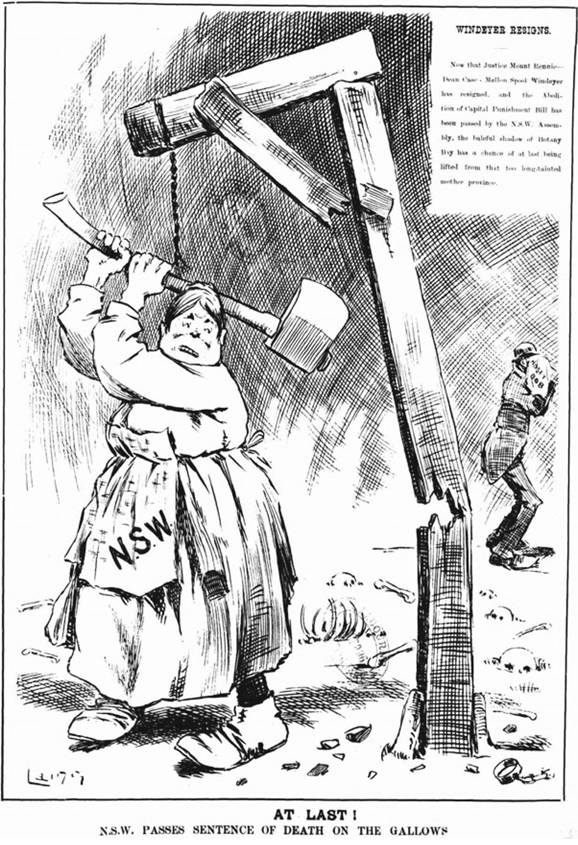
Illustration 8.1 An 1896 cartoon in Melbourne's The Free Lance related to the push to abolish capital punishment in New South Wales (Source The Free Lance, 12 September 1896, p. 9, held by the National Library of Australia)
The MPs who led the defence of capital punishment in 1896 were Albert Gould, Thomas Waddell and Henry Copeland. Gould, the Minister for Justice at the time, believed in limiting the capital code to murder and rape alone, but would go no further than that. The scaremongering around innocent men being hanged was ill-founded in his view; Gould's personal experience on the Executive Council was evidence enough for him that the reexamination of each capital case was undertaken thoroughly. His other concern was that lifetime incarВceration without hope of release was detrimental to the ends of reform. It would make a вЂ?brute of him' and create a prison inmate infinitely more difficult to вЂ?control'.[786] Waddell was another MP who believed strongly in the merits of capital punishment. He restated that the вЂ?funcВtion of parliament' was to вЂ?interpret, as nearly as possible, the feelings of the people'.[787] Yet, he did not see an overwhelming groundswell of support for the measure—despite the claims of the abolitionists to the contrary. Moreover, by trying to вЂ?save life in one way' abolitionist MPs were actually вЂ?sacrificing life in other ways' since no deterrent to crime was as effective as the hangman's noose.[788] Waddell also took a swipe at the supposed humanitarianism of abolitionist MPs. The law should not be altered вЂ?simply because a few sentimental, soft-hearted, well-meaning people clamour for it'.[789] He claimed that the вЂ?maudlin sympathy' of abolitionists was with the perpetrators, not the victims or bystanders. The final vocal opponent was Henry Copeland, someone who proved obstructive throughout the entire debate. Copeland was a military man and suspicious of the glowing statistics quoted to him by abolitionists. These statistics could be вЂ?read in all manner of ways' he grumbled.[790]
Common to Gould, Waddell and Copeland's arguments was that New South Wales was simply not the right place to try out the �experiment' Haynes wished for. The example of death was necessary, they believed, in a colony that had a pattern of settlement very different from that of Europe where abolitionists drew their inspiration. Since the colony was only sparsely settled, the gallows was the only protector of the men, women and children that bravely populated the interior. As Copeland put it: �In a comparatively thinly-populated country like this, where men in thousands of instances had to leave their homes and their wives and daughters unprotected in the bush, it was absolutely necessary that we should have some punishment that would act as a deterrent'.[791] The death penalty was �absolutely essential' according to Gould since the �chastity and purity of our women' needed safeguarding.[792] For Waddell, women and children were certainly part of his consideration but not the only people in need of protection. The itinerant bushman was, to his mind, also in desperate need of security:
[I]t was the nomadic class in this colony who were most liable to be murdered — men who had the least protection, owning to their manner of life. This was a measure to withdraw the protection that now existed to human life in the scattered districts of the colony. The great proportion of the murders committed occurred in the far interior among the poorer classes.[793]
After providing a series of examples from the press that supported the above assertion, Waddell concluded that it was precisely these men who �ran the most risk from the assassin's knife and bullet'.[794] Waddell and Copeland could speak from some personal experience on the matter of crime in the interior since both had financial interests in country districts either in the mining or pastoral industries.[795] Gould, meanwhile,
gained his experience of criminal cases as a lawyer.[796] Abolitionists, however, rebutted this key point by claiming that crime was actually an urban problem, not a country one.
As both sides of the debate continued their discussion, the 1896 aboliВtion bill progressed steadily through the New South Wales Parliament. The first reading on 19 May was followed by a successful vote at the second reading on 9 June. At the committee stage (discussed on 7 July and then 21 October) the abolitionists stared down an amendment from retentionists that would have maintained murder and rape as capital offences in the colony.[797] The bill had emerged from the committee stage with its central goal to completely abolish capital punishment still intact. However, it was at this point that Parliament chose to drag its feet. With just over a week left on the sitting calendar for the year a vote was needed in the lower house to adopt the committee’s report and proceed to a third reading. As it turns out Henry Copeland was the one who took it upon himself to filibuster any further discussion on the bill. Rather than proceed smoothly to a vote, Copeland interrupted with a twenty-minute speech where he, eventually, moved for it to return to the committee for yet further discussion on its individual clauses. Haynes did his best to hurry Copeland during the speech. At first he did so through heckling, and later, by moving that Copeland no longer be heard. Other abolitionВists also tried to shout him down—challenging him to take the vote on the committee’s report if he was so confident that the will of Parliament was against the measure. Copeland’s long-winded speech continued right until the clock struck 8 p.m. and the Speaker directed the House that the time had come to handle government business. It was the last time this iteration of Haynes’ bill was discussed before Parliament was dissolved again.
Even though the vote on the committee’s report was never taken due to Copeland’s obstruction, it is hard to tell whether it would have passed. The earlier debates on the 1896 abolition bill quoted above occurred late at night after busy sitting days, with only a very small number of interested Members present. In fact, less than thirty MPs were in the chamber when the 1896 bill was being discussed in committee. It was the last matter of business before the Legislative Assembly was adjourned just before 2 a.m.[798] Given it would have been reviewed and debated in the upper house, it was a long way from being welcomed as law in New South Wales. Still, Haynes did not give up his fight. Prior to FederaВtion, the same bill was introduced in 1898, 1899 and 1900. Copeland, however, was always on standby to prevent Haynes from achieving his dream of a colony free from the death penalty. For example, Copeland insisted that an amendment be made to insert the words вЂ?in certain cases' into the title of Haynes 1898 вЂ?Capital Punishment Abolition Bill'.[799] Though debates ensued, familiar arguments were heard, and the same people came to support their side, none of these subsequent efforts would make it as far through Parliament as the 1896 attempt.
When Australian historians remember the great movements of the coloВnial period, female suffrage and trade unionism will be high on their list; perhaps they will place the anti-transportation movement and the desire for Federation on the same plane with them. However, the push to abolish capital punishment does not register in these same discussions. And, in the final analysis, that conclusion is not an unfair one to reach. Abolitionist figures like Alfred Taylor in Tasmania and Frederick Lee in New South Wales did their best to try and create a groundswell of oppoВsition to the gallows. Chatter in the columns of newspapers and among community groups was a constant feature of the colonial period, espeВcially in the second half of the nineteenth century. Dedicated abolitionist вЂ?societies' emerged in Adelaide in the 1840s and in Sydney in the late 1860s which aimed to formally organise opposition. Yet, these groups were short-lived and ultimately ineffectual in achieving their central goal. Indeed to call it an anti-capital punishment вЂ?movement' is something of a misnomer since that label implies a continuity of effort and something that threatened to gain mainstream acceptance. Rather, agitation against capital punishment tended to come in fits and spurts and differed in strength from colony to colony. The degree of action and effort was intiВmately linked to the enthusiasm of a single person, or a small group of people, in a specific time and place. Despite the progress of John Haynes' 1896 abolition bill, the majority of colonial lawmakers were simply unwilling to вЂ?experiment' with a society that only locked up— rather than hanged—its worst criminals. When it came to parliamentary action, it was those who wanted to retain the death penalty that had the loudest voice and the last say. It would have to wait until the twentieth century for committed abolitionists to finally win over the majority of lawmakers to their side of the debate.