Capital Mobility, the English Wool Trade, and the Links to Representation
9.1.1 Taxes on Mobile Capital not the Key for Representation
Mobile capital is variously conceived in the literature. It typically means either the capital connected to the wool trade that produced indirect taxation or movable goods that constituted the wealth of taxpayers and were taxed directly.8 Neither, however, can be tied to representation through a bargaining logic.
Two types of indirect taxation were charged on wool, customs and subsidies. None of these taxes, however, can explain a regular demand for Parliament. Customs were duties on imports and exports of wool and other commodities and the “largest item of regular income” around 1300 and still in 1433.[996] They were called customs because of their customary nature, “consuetudines,”[997] meaning that after they were granted they were not negotiated again.[998] They were thus ordinary, i.e. not bargained for, royal income until the seventeenth century.[999] The custom of 1275 was indeed granted by Parliament; however, though merchant towns had possibly the highest representation in that session before 1500, they were not called again for almost a decade. The next custom of 1303 was raised from foreign merchants and “became permanent without ever being confirmed by Parliament” after 1322.[1000]
Medieval “subsidies” on the other hand were financial aid provided by subjects to the ruler, originally for emergencies, though some later became regular.[1001] However, extraordinary wool subsidies, such as the maltolt (bad tax), were also not granted by Parliament initially but by the merchants. Parliament took de facto control of wool subsidies after prolonged conflict in the 1330s and 1340s and de jure after the 1360s.[1002] Yet Parliament was fully formed since 1295, as we have seen.[1003] Further, the wool trade was already declining by this point,17 so some historians argue that revenue decline, rather than royal weakness, allowed the king to cede control over it.18 Negotiations over wool taxes therefore did not contribute to the emergence of representative institutions or rights in England, though they were intertwined with their growth.
The association of representation and indirect taxes on commercial wealth is additionally challenged by aggregate data. These show that, in the early period of institutional origins in England, direct taxes were the main source of income, often dwarfing revenue from trade. It was not until the 1330s that indirect taxation began to rival direct forms and as I argue elsewhere,19 the later period also saw backsliding in some key dimensions of interest in this account, especially the growth of local powers that could more effectively resist taxation, undermining the regime (Figure 9.1).
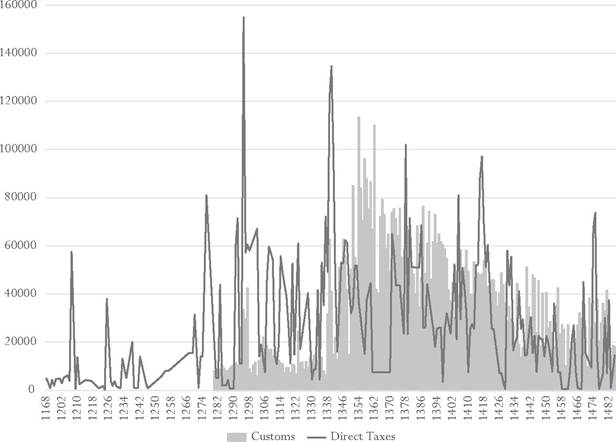
Figure 9.1 Direct taxation and customs in England, in £, 1168-1482 Source: Mark Ormrod, European State Finance Database, available at www.esfdb.org/table.aspx?resourceid=11689
Direct taxes, by contrast, were raised on “movable property,” namely a core English tax base of “cows, oxen, grain, household goods,” as Bates and Lien note. This was wealth which they claim “could be hidden,”[1004] thus endowing its holders with bargaining powers tied to representative outcomes. Taxes on movables indeed helped establish “national” taxation based on consent and were decided in Parliament. However, it was effective state compellence in such tax extraction that mobilized social demands against the king in the early period more so than any bargaining advantage of the taxpayers. In fact, tax assessments were carried out by the sworn inquest of neighbors up to the 1350s.[1005] Enforcement was initially strong: for instance, officials simply seized cattle to force even earls to pay.[1006] This explains the phenomenal yield of direct taxes in some years: it was systematically around or well over 90 percent between 1290 and 1346.23 When
Endogeneity of Trade: English Wool Trade and Castilian Mesta 199 the capacity to hide wealth through undervaluation spread after the 1330s,24 parliament was already established.
Such “bargaining power” did not help the institution emerge; if anything, it weakened it (a point taken up in the Conclusion and supported by the Continental cases).9.1.2 Bargains over Taxes on Mobile Capital: Sectoral Privileges,
not Constitutional Rights
Even if bargaining powers of social groups had been strong, why should we assume they would be used to claim common rights rather than sectoral privileges? The empirical record from the developing world suggests the latter, as Bates and Lien noted,[1007] [1008] especially in the literature on clientelism and neopatrimonialism.[1009]6 In Haber, Maurer, and Razo’s study of Mexico, for instance, economic actors do not demand public goods; “first and foremost [they] care about the sanctity of their property rights.”[1010] This is not simply a modern non-Western pathology. Historian Sheilagh Ogilvie has argued similarly in her analysis of medieval guilds;[1011] I show it is also the dynamic in the English wool trade.
When trade groups granted taxes in England in the period of parliamentary emergence, no constitutional bargain was involved, just a sectoral one. Merchants would exchange taxes for commercial quid pro quos: the 1275 “Ancient Custom” was granted for the resumption of open trade with Flanders that the crown had stopped.[1012] The 1303 “New Custom” was granted by foreign merchants in exchange for the Carta Mercatoria that secured them free trade.[1013] It was “accepted as the price of royal protection,” primarily for travel by sea.[1014] In 1336-37, with the Hundred Years War starting, merchants granted taxes in exchange for a monopoly on the export of wool through compulsory staples - ports designated to control exports - in the Low Countries, established with royal support. In 1363, a small group of traders obtained such a monopoly, the Staple at Calais (then under English control).32 When the king offered nothing, English merchants rejected tax demands.33
Parliament itself did extract political concessions when it acquired the right to approve wool taxes by the 1370s,34 but this often did not generate
a constitutional gain, only a positional one.
Members had “clearly recognised that unless Parliament was prepared to continue the subsidy it would be obliged to vote the king larger and more frequent amounts of direct taxation. On the whole the former course of action was preferred... History was to prove that a higher rate of wool subsidy was a lesser evil than the poll tax.”[1015] Parliament was thus not exchanging taxes with rights but avoiding a direct tax on all with an indirect one on wool. This does imply greater bargaining power on the part of certain groups in Parliament. However, this power moved the tax regime into an increasingly regressive direction by the 1400s.[1016] It also reflected the weakening power of the crown and the increased power of nobles in the localities, which, as discussed in the Conclusion, contributed to the greater political instability of the period of “bastard” feudalism.[1017]Moreover, we cannot assume that merchant interests aligned with the public welfare. Merchants selling wool on the Continent granted taxes to the king easily because, as a result of their monopoly powers, “they were able to pass on a good deal of the tax... [either] in the form of higher prices to the continental purchaser... [or] in the form of lower payments to the English grower.”[1018] Mercantile interests, themselves divided, had constitutional effects through a logic diametrically opposed to the capital mobility model. Wool merchant concessions often generated a “solidarity of interests” in groups opposed to them in Parliament: “the lay and ecclesiastical magnates and the knights of the shire. They were wool growers - the former the large producers... and the latter the small ones.”[1019]
Some historians have argued that no inherent antagonism between domestic social groups existed, but Harriss, for instance, still concedes that it was the threat of royal favor towards merchant monopolies that galvanized Parliament to demand a role in these negotiations after 1330.[1020] Critics have also shown that merchant groups did not have convergent interests either under Edward III;[1021] but if they lacked common interests, we cannot assume they acted effectively to achieve constitutional effects either.
Urban preferences are revealed in petitions to be diverse.[1022] Just as in Robert Brenner’s seventeenth-century account, it was the lesser merchants threatened by elite monopolies who sided with Parliament.43 Outsider status rather than mercantile interest per se wasEndogeneity of Trade: English Wool Trade and Castilian Mesta 201 the critical mechanism. Moreover, and crucially, Parliament was the already-present arena in which these conflicts unfolded.
This divergence of interest should be unsurprising. Adam Smith emphasized that the interests of “those who live by profit,” of the merchants and manufacturers, are not naturally aligned with those of the community and that parliaments should never accept their demands, except after prolonged consideration and critique.44 The conventional view, of a natural, rather than context-specific, affinity between mercantile interests and constitutionalism stems from nineteenth-century bourgeois historiography and cannot be projected to the period of origins.45
9.1.3 Mercantile Interests and Collective Action Endogenous to State
Capacity
Finally, the claim that parliaments are “a consequence of urban strength”46 must show that urban, commercial groups acquired the capacity to act collectively in pursuit of their goals before parliaments were constituted. How whole groups of people are placed in “similar positions vis-a-vis the flow of resources” is a fundamental question.47 Merchants were summoned by the crown on the same basis as Parliament since 1275 (up to 1327 through the sheriff) in the separate assembly of the merchants, though informal meetings also occurred.48 The king’s capacity to do so constituted merchants into a politically organized group in the first place. “The key to the king’s control over [the merchants] was his right to stop overseas trade at will”49 - and especially his capacity to do so.
He controlled the staples and enforced trade-enhancing ordinances. These were remarkable feats for a medieval monarch, ones critical for the trajectory of the English trade (though it did not stem its decline).50This capacity had multiple implications. It was both constitutive and limiting of mercantile power. By forcing merchants to bargain with him collectively through the Estate of Merchants, the king endowed them with an institutional presence. At the same time, the monopoly privileges to trade through a single Staple, such as Calais, consolidated their economic power in the international market. In short, the state gave a corporate identity to the very class of people - here, wool merchants - who are
of town and countryside against the crown that was consequential. My account explains why such convergence, to the degree it occurred, was possible.
44 Smith [1776] 1981b,I.xi.p.10.
45 Guizot 1851. Stasavage 2011 posits such an affinity under certain conditions, but assemblies are an independent variable in his account, unlike here.
46 Boix 2015, 204. 47 Mahoney 2010, 20; PeterA. Hall 1986, 19.
48 Power 1942, 39-40. 49 Lloyd 1977, 174. 50 Lloyd 1977, 101-102.
claimed to have induced the state to concede representation and limits to its power.[1023] Merchant capacity to act in a coordinated manner cannot be assumed to be exogenous to the state - it depended on one that could penalize defectors.
9.2
More on the topic Capital Mobility, the English Wool Trade, and the Links to Representation:
- Capital Mobility, the English Wool Trade, and the Links to Representation
- Boucoyannis Deborah. Kings as Judges: Power, Justice, and the Origins of Parliaments. Cambridge University Press,2021. — 400 p., 2021