Value of Everything
All this focus on cost is, ultimately, limiting for in-house legal teams. If in-house lawyers are to “run legal as a business” they need to change the perception of what they do as being a cost and instead look at it as an investment, which is driving value for the business.
In order to achieve that, they have to be able to articulate, target and measure legal value. To assess the investment in legal, we have to better understand the value of legal. How can it be measured? Where should investment be made?To understand this better, we first have to ask why do businesses buy legal. Businesses buy legal for two reasons:
1. to help ensure that money doesn't go out of the business—value leakage; or
2. to help secure money comes into the business—value realization
Ultimately all efforts of legal should be directed to help ensure that the business prevents value leakage and secures value realization.
So, we have identified a value metric that legal can be measured by, but where does this value come from?
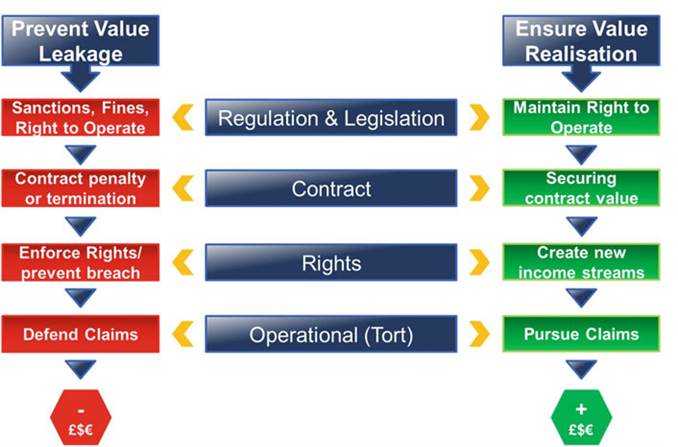
Fig. 2 LexFuturus 2014
Legal's role is to protect the business from risk. We often talk about legal risk, but when running legal as a business and looking at our role as creating legal value, we shouldn't be focused on “legal risk”. Instead, the focus should be on what the risks of the business are and how they are crystallized in law.
As set out below, business risk is crystallized in law in four ways (Fig. 2):
1. Business Risk can be crystallized in Regulation and Legislation. Value can be lost through the business' failure to observe its obligations—as a consequence of which it could find itself fined, its operations limited, or its right to operate lost.
2. Contracts crystallize obligations which, if not met, could lead to penalties or termination, but they also enshrine rights that need to be secured in order to realize value.
3. Rights need to be enforced and breaches prevented.
4. Things happen, operationally, within all businesses and claims need to be both, defended and pursued.
Therein lies the challenge for the in-house legal team. Whilst there are business risks crystallized in law, and the responsibility for remedying failure sits with legal—these risks materialize within the operational parts of the business.
Things that trigger a risk event rarely go wrong in legal. Typically, a breach of contract occurs based on acts or omissions in the business, while the contract itself might be perfectly legally sound. Equally, the business may breach a policy or
Fig. 3 LexFuturus 2012
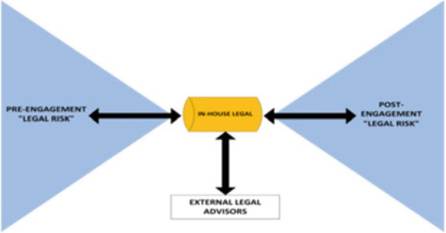
regulation even though legal has highlighted that risk in a policy manual or during training.
These risks are realized before legal is involved—(“Pre-Engagement Legal Risk”); or after legal has been involved (“Post-Engagement Legal Risk”) (Fig. 3).
In relative terms, the impact of value leakage or value realization on the profit and loss of an organization is higher than the cost of legal.
2.1 Running Legal as a Business
Therefore, if we are to run legal as a business, we need to start looking at the value impact legal can have. Companies need to be able to prioritize where they invest (“legal spend”) and then look at the return on investment that it provides for the business.
This may mean that companies no longer look at how we reduce expenditure on legal cost from $100 to say $90 but, instead, they will look at what return on investment spending $100 delivers to the business and what the impact of increasing or decreasing expenditure may have on legal value realized. Would spending $90 still deliver the same return or would spending $110 deliver exponentially more?
What if legal were to measure and report the amount of legal value realized instead of how much was spent on costs?
If legal were able to measure, report and make decisions on where to “invest” legal spend, based on legal value realized, then they would be operating as a business.
2.1.1 MeasuringLegalValue
So, all that is left now is how to measure legal value?
There are two ways to do this. One is to adopt a lawyerly approach by trying to identify the direct impact of the legal involvement in any outcome. To do this, you need to be able to calculate the value outcome to the business, had legal not been engaged (the “but for legal” question) and then be able to demonstrate that either
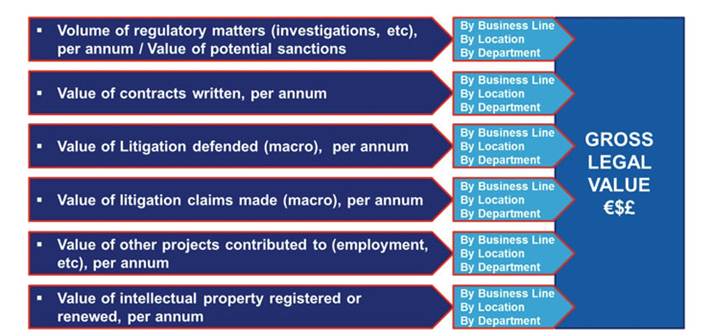
Fig. 4 LexFuturus 2015
Value Leakage would have occurred or Value Realization would not have been ensured, if had the legal team not been involved.
To do this, it is necessary to map the sources of legal demand, benchmark the outcomes and then repurpose the legal function to drive the outcomes that directly delivered value—i.e. ensure that “value in” happens and that “value out” doesn't happen.
This is a method that requires a large investment in time and systems to track. It is also a level of measurement that the rest of the business does not go into.
We can learn here from how marketing, procurement, finance or any other area of the business articulate their contribution. By adopting such an approach, legal can demonstrate the contribution it had made towards business outcomes.
To identify this value, it is necessary to collate data relevant to your business, an example of which is set out below (Fig. 4).
As this table sets out, gross legal value can be assessed through: recording and articulating the value of regulatory matters worked on (in terms of fines or sanctions); or the value of contracts written by legal; the value of litigation defended or pursued.
Recording this information by business line, and/or location, and/or department will aid the quality of data collected.
3