Costs Are, Currently, Everything
As our industry stands today, there remains an unblinking focus on the cost of legal services. There are many reasons for this:
J. G. Meents (*)
DLA Piper UK LLP, MaximilianstraBe 2, 80539 Munich, Germany
e-mail: jan.meents@dlapiper.com
S.
AllenLexFuturus, London, UK
e-mail: Stephen@lexfuturus.com
© Springer International Publishing AG 2017 227
K. Jacob et al. (eds.), Liquid Legal, Management for Professionals,
DOI 10.1007/978-3-319-45868-7_15
1.1 Perception(VersusReality)
The “cost” of lawyers has been, in equal part, a source of humor and frustration for many business people. However, if we take a step back and look at legal cost compared to other areas of business expenditure, we will see that it does not represent a major area of cost, for most organizations. A survey by PwC in 2013 revealed that, on average, cost of legal (both the cost of the in-house legal team and the fees paid to external legal advisors) was just less than 1 % of revenue. This figure rises to almost 2 % for highly regulated businesses but drops to around 0.3 % of revenue for simpler business models, such as retailers.
By comparison, as a percentage of revenue (Table 1).
So why is the cost of legal seemingly such an issue?
1.2 HistoricalPrejudice
Although not the case today, historically in-house legal teams have been seen as “the department that likes to say no”. Many avoid going to legal for this reason. We all know this view was unfair then and is wildly out of line with the reality of what most in-house lawyers offer today. However, the perception does remain amongst many in business, unjustly.
Those who do go to legal, and then engage external lawyers, have found the lack of precision when agreeing on the potential fee a reason for unease. Further frustration is created through the wide spectrum of fees charged for work of a similar type.
If someone's livelihood is based on the number of hours they spend and the pages they fill—then are they not going to have more meetings and write more letters? Again, this is a case of perception versus reality. Lawyers work incredibly hard for their clients and in most cases, will self-regulate the amount of time spent that is added to the final bill—generally applying further discounts before issuing it.
1.3 Modernizing the Production Process But...
The issue of cost is continually cited by many market commentators as a need for lawyers to modernize (most strikingly by Professor Susskind in a number of books, including “The End of Lawyers?”). Industry “gurus” claim that applying new
Table 1 LexFuturus
Research—Support
Department Costs—v—
Revenue, 2015
| Area | % of revenue |
| Information technology | 3.4 |
| Marketing | 2.8 |
| Finance function | 2.7 |
| Legal | 0.9 |
business concepts—such as “lean six sigma”, technology, project management or even artificial intelligence—would drive down the cost of production.
However, here again the “dictate of the hourly rate” holds the industry back. New ways of working will require investment, some of which will be significant. If, however, “hours worked” remains the sole metric of choice—such investment is difficult to justify.
In order to encourage the investment needed to ultimately reduce the cost of production, legal services must be bought and sold differently. But how?
1.4 The Great Procurement Experiment
In recent years we have seen a growing number of procurement departments getting involved in buying legal services. For want of a universal metric, procurement professionals have resorted to comparing hourly rates and discounting as a means to drive down cost.
Most law firms have trimmed or, in some cases, even eradicated margins to meet the criteria necessary to continuing working for some clients. The suppliers have, by and large, met the challenge thus far but little margin remains for this to continue.1.5 Now Adding the Global Financial Crisis to the Mix
Post the Global Financial Crisis (GFC), we have seen further pressure on “legal cost”. Whilst, comparatively, legal remains a small area of business expenditure for most organizations, it has come under much greater scrutiny post the GFC.
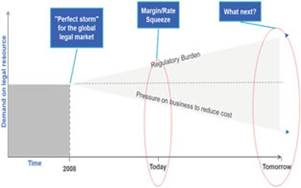
There are two main drivers for this: regulatory burden, and pressure on business to reduce cost (Fig. 1).
Post the GFC, all businesses have focused even more keenly on cost, and the target for potential further areas of cost reduction has fallen on legal. Having already looked at applying process, technology or outsourcing efficiencies to other support functions—such as finance, marketing, IT and HR—legal had been largely left alone, not only because it was a comparatively small area of business expenditure, but also due to the fact that legal cost (unlike HR, Finance and IT) is only partly spent internally, while an equal percentage spent on external lawyers.
Fig. 1 LexFuturus 2015
Savings gained by putting finance or HR teams into shared service centers were not available when looking at the legal team, and therefore those teams were left largely untouched.
The second reason why legal has risen up the agenda is that the burden of regulation has burgeoned since the GFC. Companies just have more law and regulation to deal with than before and this trend is set to continue. Examples would be the great volume of financial market regulation on banks, anti-bribery and anti-corruption laws or additional and renewed data protection regulation. The impact of the increase in regulation is further compounded by the requirements it places on organizations in complying with it.
Further, it is no longer sufficient to have policies in place to set out how the business is to comply with the regulations. Adopting the model established by Sarbanes-Oxley, organizations now need to be able to demonstrative “active compliance”—tracking policy, documentation, adherence and deviation. The expense and effort of compliance is far greater than it was previously, adding cost and even further scrutiny.
However, as every in house lawyer knows, the penalties for non-compliance are far greater than before the GFC. The fines are no longer symbolic and are ever more punitive. The maximum fine in the UK for a data protection breach used to be £5000—it can be up to 4 % of annual global revenue under the new General Data Protection Regulation (GDPR). The penalties for directors now include the threat of custodial sentences. Being non-compliant is not an option. The burden of risk escalates at the very same time when the need to reduce legal cost increases.
So what is next? What should in-house lawyers be focusing on?
2