Traditional Contracting Versus Business-Friendly Contracting
The chart below depicts the “10 Pitfalls” that IACCM identifies as snaring practitioners into traditional contracting practices. Collectively, the pitfalls reflect what IACCM annual surveys of its members prove: that negotiators all over the world spend much of their time preparing for failure rather than securing success and opportunity.[193] (See IACCM 2014a, 2015b; Bergman 2015) Year after year, limitation of liability and indemnification clauses have retained their top positions in the most negotiated contract terms.
Yet instead of providing the desired security and certainty, this focus may actually lead to lost opportunity, value erosion, and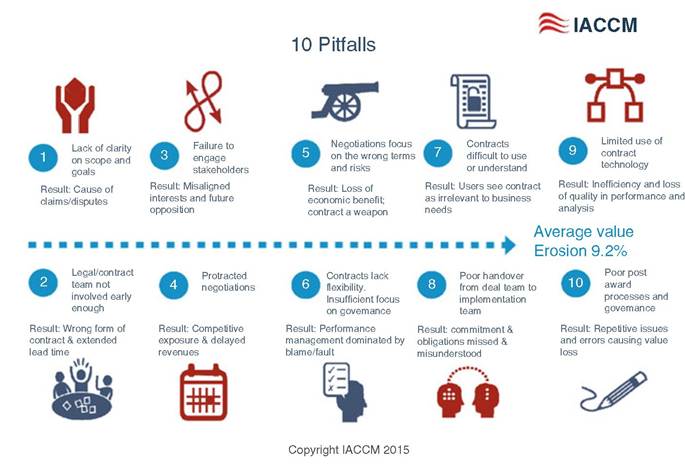
Fig. 1 10 Pitfalls (Cummins 2015). Copyright IACCM 2015. Used with permission
conflict. Time and money are being spent on lengthy negotiations over legal issues, when the focus should be on business issues and how the parties can succeed together—goals that this chapter hopes to further. Figure 1 shows IACCM's description of the 10 Pitfalls.
Noting that the pitfalls lead to average value erosion of over 9 %,[194] IACCM seeks the transformation of each pitfall into a positive “Attribute” of successful contracting. Figure 2 is IACCM's depiction of the completed transformation of Pitfalls to Attributes.
This chapter fully shares the goal of transforming contract Pitfalls to contract Attributes. But how can that be accomplished? We explore in Sect. 2.2 below how PPL methods and mentality can help to achieve this evolution from traditional to what we term business-friendly contracting. First, however, we will identify common themes among the Pitfalls, describing the dysfunctional cycle that can come to characterize traditional contracting.
2.1 The Need for Simplified Language and Fewer Self-Protective Clauses
We first enter the traditional contracting cycle through a combination of Pitfall #7, that “contracts [are] difficult to use or understand,” resulting in “users see[ing]
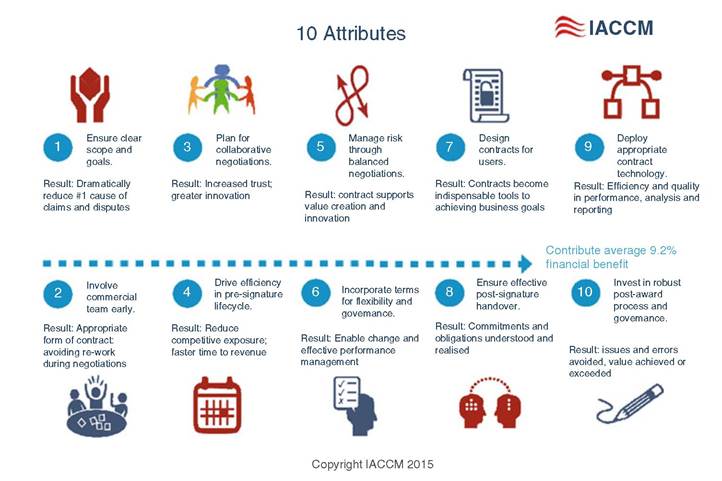
Fig.
2 Pitfalls to Attributes (Cummins 2015). Copyright IACCM 2015. Used with permissioncontracts as irrelevant to business needs;” and Pitfall #5, that “negotiations focus on the wrong terms and risks,” resulting in “loss of economic benefit” and turning contracts into “a weapon.” Pitfall #7 (difficult to use) and Pitfall #5 (too aggressive and adversarial) stem from the same root causes: an exaggerated concern among lawyers for the security of the transaction, and a failure to imagine that transactional security can actually be more strongly enhanced by using different methods than burdening the document with overly-elaborated legal language focusing on failure, disputes, and remedies.
Lawyers and business managers alike should realize the destructive impacts of jargon-laden, self-protective contract language. Such language can: (1) impair implementation of the contract; and (2) lead eventually to missed value and opportunities in the economic exchange itself (Cummins 2015). The way in which concern for security is addressed, in other words, ends up undermining opportunity. This opposition between security and opportunity, however, is not inherent or necessary. It can be transcended through simplification, visualization, and better-integrated communication between business and legal—as well as among all parts of a business and its contractual partners.
2.1.1 Impaired Functionality; Challenges in Contract Implementation The business functionality of contracts can be impaired when their drafters use language that pays too much attention to legal functionality. Difficult language and self-protective content go hand in hand in this privileging of legal needs over business needs. When lawyers draft contracts, they often focus too strongly on imagined courtroom settings, rather than the far more immediate business settings. Their attention is too often directed on whether their language would prevail in court if its meaning were disputed by other lawyers. So lawyers tend to write contract terms for other legal professionals, not for the delivery teams and project managers who need documents they can easily work with and act upon.
As a consequence, the contract implementers may create their own “translations” of those contracts, widening the gap between what the contract says (what Stewart Macaulay calls the “paper deal”) and what the original business planners and negotiators mean for the exchange (the “real deal”) (Macaulay 2003).That disjuncture of language between the paper deal and the real deal can lead to confusion and possible contract breaches. Worse, it may legalize the resolution of problems that otherwise might have been dealt with through business flexibility and compromise. Because the paper deal elaborates legal language and concepts, Pitfall #6 is commonplace: contracts’ “lack of flexibility” with an “insufficient focus on governance.” As a result, “performance management [becomes] dominated by blame/fault” that characterizes legal outcomes. Once a problem arises, if business practice does not accord with the legal interpretation of the contract document, then the contract has the potential of being turned into a courtroom weapon by one party or the other. To guard against such courtroom losses, however, both sides “weaponize” the contract even further through Pitfall #5: they insert the self- protective substantive provisions of disclaimers, indemnities, and liquidated damages.
2.1.1 Missed Value and Opportunities
The exaggerated focus on legal needs at the expense of business needs is reflected in Pitfall #4: “protracted negotiations” leading to the dangers of “competitive exposure and delayed revenues.” Those lengthy negotiations and missed opportunities again often stem from the difficult language that is routinely used in contracts. The language can needlessly isolate lawyers and business negotiators from one another, because business negotiators cannot readily participate fully in creating the legal agreements that should be memorializing the discussions among contracting parties.[195] Pitfall #1 is the ironic result: a “lack of clarity on scope and goals,” causing claims and disputes.
The contract is both overwritten (with self-protective clauses) and underwritten (lacking sufficient attention to the core terms of the actual economic exchange). At least in part, the complexity of contract language drives a wedge between legal and business functions, which is reflected in Pitfalls #2 and #3: the legal/contract team is not involved early enough, and vital stakeholders are not sufficiently engaged.Engaging stakeholders and broadening the use of contracts is difficult, however, so long as contracts are burdened by language that is largely decipherable only by legal and contracts experts. Poor communication and integration at the front end then may be repeated both at implementation and when business conditions require a change in the contract terms. Adding to the challenges is the limited use of contract technology, Pitfall #9, resulting in “inefficiency and loss of quality in performance and analysis”. The consequences include Pitfall #8, “poor handover from deal team to implementation team,” resulting in “commitment and obligations missed and misunderstood;” and Pitfall #10, “poor post-award processes and governance,” leading to “repetitive issues and errors causing value loss.”
2.2 Transitioning to Business-Friendly Contracting
The end-result of the traditional contracting cycle—repetitive errors and losses and considerable value erosion—serves well to introduce the ideas of PPL. PPL is comprised of two main components, namely “Preventive Law” and “Proactive Law.” Preventive Law focuses on dysfunctional cycles that generate recurring losses. It seeks to identify and understand the conflicting elements of a system, as we have done above, that, unless somehow resolved, will continue to generate problems.[196] Proactive Law adds a focus to achieving positive goals and value.[197] Together, PPL can alter mentalities and harness tools toward smoother operations and successful outcomes.
2.2.1 Preventive Law
Traditionally, the focus in the legal field has been on the past, mainly on failures and how to react to them through legal proceedings, remedies to force compliance, sanctions, punishment, fines, and so on.
Preventive Law promotes a different approach: one where the focus is on the future and on using the law and legal skills to prevent disputes and eliminate causes of problems (Barton 2007). In doing so, Preventive Law has similarities with preventive medicine, a branch of medical science dealing with methods of preventing the occurrence of disease—here, the “disease” of legal trouble, disputes, and litigation. Preventive Law thus emphasizes the lawyer's role as a planner, advisor, or problem solver. In the words of Dauer (1988): “Litigation law is mostly law. Preventive law is mostly facts. And the critical time for preventive lawyering is when those facts are first being born. As a lawyer speaking to business people, I would have one request of them: Please let us be involved in the making of those facts.”Table 1 illustrates the shift of mindset and focus that the proponents of Preventive Law have proposed since the 1950s.
Table 1 Preventive law: shifting focus from the past to the future (Haapio 2013b, p. 39)
| Focus away from | Focus toward |
| • the past • minimizing cost • winning in court • lawyers as fighters | • the future • eliminating causes • preventing litigation • lawyers as advisors, planners and problem-solvers |
2.2.2 Proactive Law and Proactive Contracting
With the development of what is now known as the Proactive Law approach, a new dimension was added to Preventive Law. In addition to minimizing problems and risk, the proactive approach focuses on enabling success and enhancing opportunities. Using the medical analogy, in the proactive approach the focus is not just on preventing problems or “legal ill-health”. The goal is to promote “legal well-being”: embedding legal knowledge and skills in corporate culture, strategy and everyday actions to actively promote success, ensure desired outcomes, balance risk with reward, and prevent problems.
(Haapio 2013b, p. 39).The approaches specifically called Proactive Contracting and Proactive Law emerged in the Nordic countries, initiated by a small team of Finnish researchers and practitioners (one of this chapter's authors being among them) in the late 1990s and early 2000s.6 In the context of contracting, the pioneers of the approach merged quality and risk management principles with Preventive Law, thereby adding the promotive dimension to the preventive dimension. This laid the conceptual foundation for a new way of thinking: “proactivity=prevention plus”[198] [199]. The goal of Proactive Contracting, according to Soile Pohjonen (2002, p. v), is that the contracting parties achieve the goal of their collaboration in accordance with their will. This requires, Pohjonen continues, above all, a careful investigation of their goal and will, and the skill to create a clear and legally robust framework for their implementation. Table 2 Proactive law: shifting focus from prevention to promotion (Haapio 2013b, p. 41) • minimizing risks, problems, disputes, losses • preventing causes of failure and negative effects • lawyers as advisors, practicing preventive law; the law office as a preventive law laboratory (See Brown 1956) • maximizing opportunities, desired outcomes, benefits • promoting drivers of success and positive effects • lawyers as designers and coaches, working with clients as part of cross-professional teams (See Haapio 2006, p. 30) Table 2 illustrates the shift of mindset and focus that the proponents of Proactive Law have proposed. Proactive Law literature has addressed extensively the reasons and objectives of its call for a paradigm shift; less addressed is how to make it happen (Berger- Walliser 2012, p. 31).[200] [201] This chapter represents a step toward effecting the paradigm shift: turning Proactive Law into practice. The promotive dimension of the proactive approach has a positive and constructive emphasis. It involves using contracts to enable the parties to reach their business objectives. In order to do so, contracts must be usable and well suited for their purposes. For business, the contract itself is not the goal: its successful implementation is the goal (See Haapio 2013b; Ertel 2004, p. 62).9 2.2.3 Moving Away from Traditional Contracting The diagnosis of the Pitfalls of traditional contracting identifies an ongoing dynamic of personnel who fail to communicate early enough, and with enough shared vocabulary, to align contracting documents well enough with the real aims of the parties. The elements of the traditional contracting system speak different languages, and focus on different goals. Such diversity of function is not necessarily bad: division of labor is efficiency-enhancing so long as the various parts of the system can communicate well with one another. But that does not happen fully in traditional contracting. The language used in contracts artificially raises information costs. The vocabulary is so specialized, and the text is so packed with legal concepts rather than business language, that the contract cannot effectively speak to many people on the business side who are in charge of planning, pricing, negotiating, or implementing the agreement or passing its terms on to sub-contractors. According to IACCM research, more than 9 out of 10 managers admit that they find contracts difficult to read or understand (IACCM 2015a, p. 6). Furthermore, the felt need to produce traditional legal language in contracts diverts drafters' attention away from the needed integration among those who construct the business transaction, and those who must carry it out. The proactive suggestions for remedying this dysfunction are several. In this chapter, we focus on three of them: simplification of contract language and design; visualization; and collaborative contracting. Each of these methods reduces the barriers to effective communications within an organization, and between contracting parties. They make concepts and ideas more accessible, and they prompt stronger cooperation and flexibility. Section 3 will summarize each of these three methods; together, they are important parts of a broader PPL-inspired move toward business-friendly contracting. Section 4 will offer examples where business-friendly approaches have been implemented. 3
Focus not just on Focus also on • rules, legal tools: helping the parties to comply with the rules • goals, managerial tools: enabling the parties to reach their objectives