Business-Friendly Tools: Simplification, Visualization, and Collaboration
If your company's current contracts are complex, you are not alone. Many top managers recognize a growing problem that contracting processes and documents are complex—too complex for companies' own personnel as well as customers and suppliers to handle.
This is especially true for small and medium sized enterprises (SMEs).[202] On the sell-side, the consequence can be fewer winning bids, lost sales, and value erosion during implementation. On the buy-side, if the bidding process or documents seem too complicated or time consuming, there will be no SME bidders. Further, if the bidders do not understand the contracts they enter into, misunderstanding easily leads to a breakdown in relationships, and poor or late delivery. According to surveys conducted by the IACCM, major areas of weaknesses include:• disagreements over contract scope;
• performance failures due to over-commitment or disagreement over what was committed; and
• inappropriate contract structures (See IACCM 2014a, 2015b; Bergman 2015).
As surveyed below, the tools of simplification, visualization, and collaboration can begin to address these weaknesses by clarifying terms, and by improving communication among contract negotiators, drafters, and implementers.
3.1 Simplification
Most of us have probably been told that our contracts are not simple; they are too long, too complex, and hard to work with. If we want to prevent misunderstanding, disagreements, and other pitfalls, what can we do to simplify our contracts?11
To begin with, we can start to see ourselves and contracts differently: ourselves as designers and contracts as business tools. Contracts contain vital business information, not just legal provisions. They are also about roles, responsibilities, and requirements that need to be translated into action and procedures and timelines that need to be followed.
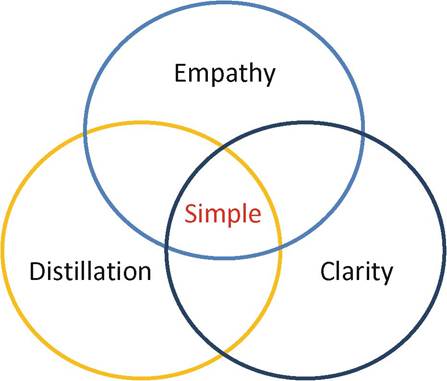
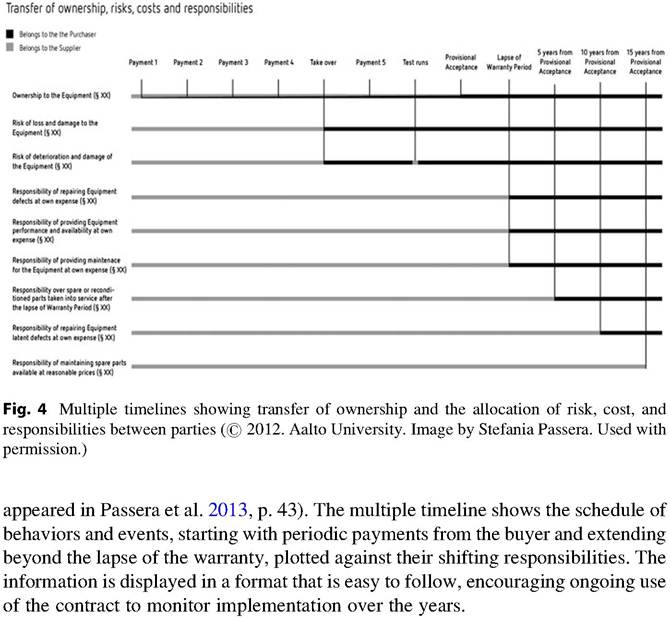
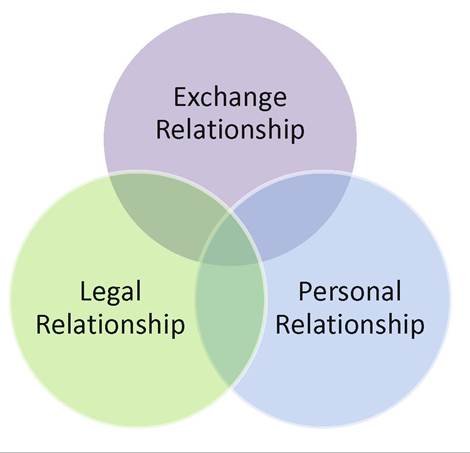
When we see the role of contracts as communication tools, it becomes obvious that contracts need to be designed, not just drafted.In our previous work, we have looked into what business lawyers can learn from design thinking (Haapio 2013a; Berger-Walliser et al. 2017) in general and information designers (Haapio and Passera 2013)[203] [204] in particular. In the following, we will look into some tools and methods that we can borrow from the designers’ toolbox. In any (re)design project, the designer takes the user’s situation as the point of departure. Irrespective of what one seeks to simplify, the effort needs to start with the users. A simple contract is one that is considered simple by its intended users. Different users have different backgrounds, skills, competencies, needs, and expectations. Contracts offer themselves as a particularly interesting field of simplification, because of their two quite different audiences: business users and legal users. Traditionally, the focus of contract crafters has been on the needs and expectations of the legal users, such as courts and arbitrators who may be asked to interpret the contract in case of a dispute. In this chapter, our focus is not primarily on such users; it is on those users who are not lawyers or contracts professionals. For them, any contract, even one that may seem simple and familiar to an expert, may be too complex and intimidating. And let’s admit it: most contracts today are not simple even for the experts. A systematic approach to contract simplification can be based on three key building blocks developed by Siegel and Etzkorn (2013) in their book Simple: (1) empathy with the users’ needs and expectations; (2) clarity through the use of both plain language and design; and (3) distillation of the communication, boiling it down to its essence. These three key requirements are illustrated in Fig. 3. Fig. 3 The three building blocks of simplicity (The idea of the image is adapted from Siegel and Etzkorn 2013, p.49) To simplify business users' experience of contracts, two approaches predominate: either hiding complexity by providing a better “user interface;” or changing contracts themselves to make them less complex. Layering is a particularly useful method for contracts, as it allows adaptation to multiple user needs. As the term suggests, layering creates alternative strata of information that vary in depth or style: in the context of contracts, one layer might include the text of the contract as is; another the headings or keywords of each clause; and a layer between these two might show in laymen's terms what the clause means. Layering responds not only to differing needs of different users, but also to the needs of one user at different times, when either careful study may be needed, or just a quick reminder of some general points. It also can express information in different formats—for example icons or images versus words (For practical examples, see e.g., Waller 2015, pp. 13-16). Creative Commons (http://creativecommons.org) is perhaps the best-known example: their copyright licenses incorporate a three-layer design seeking to ensure that both the creators of works and their users can understand their rights.[205] Clicking on the icons reveals a plain-language version of the license terms: the icons inform users about the possibilities and limitations of, for instance, sharing or remixing the licensed content.[206] If additional information is required, the full text is also available just one click away. There is the so-called Legal Code (the “lawyer readable” version, the full license), the Commons Deed (the “human readable” version), and the “machine readable” version of the license, with the Commons Deed acting “as a user-friendly interface to the Legal Code beneath” (See Creative Commons 2015). 3.2 Visualization “Visualization” builds on the goals and methods of simplification, by employing visual images to supplement textual language. Graphs, charts, timelines, diagrams, flowcharts, decision-trees—all of these and more can depict information in easily digested formats (Barton et al. 2013; See also Passera et al. 2013; Passera and Haapio 2013a, b; Haapio and Passera 2013). “Such techniques could be used directly in a contract, as part of the drafting process. Or visualization can be about a contract, a separate document that assists all those who are involved in the planning, review, or approval of a contract or in monitoring or implementing its terms.” (Barton et al. 2013, p. 48) The aims of visualization have been summarized as follows: 1. Clarifying what written language does not manage to fully explain; 2. Making the logic and structure of the documents more visible; 3. Giving both overview and insight into complex terms and processes; 4. Supporting evidence, analysis, explanation, and reasoning in complex settings; 5. Providing an alternative access structure to the contents, especially to the non-experts working with the document; 6. Helping the parties articulate tacit assumptions and clarify and align expectations; and 7. Engaging stakeholders who have been alienated by the conventional look and feel of contracts. (Passera et al. 2013) Like the tools available in simplification, one need not be professionally trained in design to make helpful use of visualization methods. Even simple charts or diagrams can further the goals of more easily understood documents, and prompt better communication. For more complex relationships, working with a professional information designer can be especially helpful. Depicted below is one example of such a successful collaboration (Barton et al. 2015). Figure 4 illustrates the gradual transfer of ownership—together with particular business and legal risks, rights, and duties—over a 15 year contractual relationship between a supplier and purchaser of equipment (This figure first 3.3 Collaboration “Collaboration” in contracting is the simple idea that parties to a contract are better off thinking of themselves and working as partners, rather than as adversaries (Mosten 2009. Collaboration explicitly recognizes that contracting embraces personal relationships, as well as legal and economic ties. As depicted below in Fig. 5, contracting should be thought of as three overlapping spheres that work together. As suggested above in this chapter, various barriers can drive apart the “legal” and “business” spheres. Perhaps in part because of that lack of integration, neither lawyers nor business managers typically acknowledge fully the human relationships that importantly accompany the negotiation and implementation of a deal (Barton 2012). Collaborative contracting consciously reflects on those ties, and Fig. 5 The three relationships of contracting (This diagram also appears in Barton et al. 2015, p. 17.) attempts to reunite the legal, economic, and personal relational spheres toward mutual benefit. Should collaborative intentions and expected practices be part of the actual contract documents? The advantages of doing so were emphasized by Jacqui Crawford of Rolls-Royce: the parties disclose from the outset their respective interests, their baseline expectations, and a process for addressing and managing the changes that will inevitably occur over the life of a long term contract (Cummins and Crawford 2010). Revealing underlying interests advances both the economic exchange perspective and the relational perspective. It also promotes finding win-win solutions where problems emerge. In drafting the document, the parties can express both the general intentions they have worked out during the planning/negotiation stage, and also include as much detail as possible about the process that they have devised for periodic communication. These norm expectations could include any or all of the following: to share more information about underlying interests; to work toward sharing risks in a balanced way, so as to satisfy both sides of those party interests; to hold periodic meetings following contract formation, so as to monitor performance quality; and to be open to one another's needs for flexibility in meeting commitments (Barton 2012). Jennejohn (2008) has researched specific examples of collaboration, extracted from contracts between parties like Cisco & KMPG, Coca-Cola & Synomyx, and Intel & Phoenix Technologies. These companies adopted communication enhancing measures like interacting teams, exchange of on-site personnel, and creation of a joint research steering committee. To measure the success of these efforts, they included general benchmarking clauses with specific metrics. Finally, they established helpful feedback loops to improve long-term performance. Would such collaborative terms be warranted in every contract? Not necessarily: importantly, collaborative terms can be used selectively. Some of the provisions above are more demanding of time, money, and organizational coordination than others (Barton 2012). As we have written before, successful collaboration is more than just good intentions. It involves a mentality and skills that may be relatively unfamiliar or even uncomfortable. For lawyers, it means that they address more than the language in contracting documents: Healthy economic and personal relationships need not rely solely on legal rights. Where lawyers work toward making the economic and personal relationships stronger, therefore, the burden of dealing with risks does not fall exclusively on airtight legal language in the contract. Lawyers should therefore embrace the value of non-legal communication. That in turn requires that the lawyers learn much more about the economic exchanges that are the subject of the contracts. They should treat their clients more like partners who are capable of contributing significantly to the success of the lawyer's efforts. (Barton et al. 2015, p. 19) As to managers, “collaboration requires first that they not abdicate too much responsibility for formal contract processes to their lawyers” (Barton et al. 2015, p. 19). Furthermore: Managers should also understand the worlds of their employees and any subcontractors. Managers should flatten hierarchies that, for example, prevent production or sales personnel from making suggestions about the terms of prospective contracts or the implementation of existing contracts. Finally, managers should invest time in talking with contractual counterparts about contract goals, risks, and implementation. In many cases managers should not be reluctant to share information about the economic or strategic interests that prompt willingness to enter into a contract. The underlying interests of a company do not give away negotiation strategies—it does not mean that a manager invites exploitation. Instead, managers should explain the broader interests of their company as a prelude to negotiating the contract. (Barton et al. 2015, pp. 19-20) These ideas can be startling, and resisted, because they seem to contradict so much conventional wisdom about proper negotiating style and the power that is assumed to flow from possessing secret information. True, one should not normally disclose the “reservation point” below which one would terminate negotiations. But sharing one's interests and basic goals with a contracting counterpart is virtually a precondition to discovering “win-win” possibilities. All value in exchange flows from learning that another person values something more highly than we are able and willing to supply. Unless people communicate what they want, those needs and possible value-enhancing exchanges may never become visible. Further, unless the deeper interests are disclosed, parties may never consider unconventional ways— contract terms apart from price—by which both parties may emerge even more satisfied with the transaction. The mutual exchange of information is thus a precursor to immediate value-creation, but also to longer-term relationships. How does one convince a skeptical contracting counterpart of the wisdom of this approach? The unilateral disclosure of one's own underlying interests, coupled with an offer to listen to the interests of a contracting counterpart, is an important step toward realizing hidden value and better relationships. In Sect. 4 below, we offer some examples in which the tools of business-friendly contracting have been effectively used. 4