4.8 Lawyer as Friend. Lawyer as Listener
A third model that can structure the lawyer-client relationship is lawyer as friend. This section first describes some of its underlying assumptions to this model. Second, it looks at what techniques the lawyer might use in counseling the client.
Finally, it describes some of its uses, benefits, and risks of this model. 4.8.1 Some Underlying AssumptionsMany have argued that the previous two models for the lawyer-client relationship are inadequate, and unduly constrain the relationship.5 The criticisms are basically three-fold:
1. the earlier models assume that the client is unable to make decisions by himself because neither lawyer nor client can truly understand each other’s motives;
2. the earlier models overly distrust the opposing party; and
3. the earlier models underestimate the client’s altruistic motives.
But how does thinking of yourself as your client’s friend, rather than his lawyer and agent problem solver, help to resolve some of these difficulties? To answer that question takes some imagination, and some new assumptions. Let’s see where they might lead
First, imagine yourself in need of a listener, not a problem solver. Imagine that you have a moral or ethical dilemma, and you want someone to be your mirror or sounding board for you to clarify your own thinking about a particular problem. Imagine that there are no laws that constrain your behavior. Imagine instead that you could make out your own solutions to your dilemma, once you had thought comprehensively about it, and informed yourself fully about the matter.
1. Getting/Listening. Psychiatrist Tom Rusk contends that the skill of listening is essential to ethical counseling.6 The issue is whether listening can be taught.
The first thing to do is persuade the lawyer that listening is of vital importance to reaching an understanding of the client’s situation, and that reaching an understanding of another’s point of view is crucial to friendship.
There are a number of reasons why listening is important. First, it may be your most important tool for showing your intelligence. A leadership project at Stanford indicates that study participants correlated most highly a leader’s ability to listen with their intelligence.7 This makes sense, in a narcissistic way—that we would believe someone else was intelligent who listened to what we had to say and considered it valuable. Think how flattered you are when a teacher remembers, in class, something you said or wrote. Similarly, your ability to demonstrate that you have listened carefully to what the client said implies that you have some wise characteristics: You gather information before you rush to judgment, think comprehensively before you risk expressing an opinion, and manage your own emotional reactions and focus carefully on the task at hand. In other words, you exhibit wisdom.In addition, listening serves a client relationship purpose. It allows for catharsis. It respects the problem-solving abilities of the speaker. It shares the responsibility for the problem with the one who owns it.
It is important to analyze what gets in the way of listening. Our tendency is to blame the speaker or teacher for our failure. At times, the responsibility does reside with the client speaker, but major problems also lie with the listener. They can be summarized as “self-consciousness.” Most important is the fear of failure. We are afraid we will not be able to help, or that our incompetence will be discovered. Additionally, we deal with personal distractions, conflicts of interest and value conflicts, perceived irrelevancies, case threat, ego threat, etiquette barriers, and role expectations.
One way to deal with these distractions is for the lawyer to reorient him or herself about who owns the problem, at the counseling/interviewing stage. Consider how differently you would feel if the client simply said, “Look, what I want is for you to just listen. I don’t want your advice.
I don’t want you to solve my problem for me. All I want is for you to act as my mirror. Help me hear back what I think, and how I feel about my situation. You can do this best by simply listening to what I have to say.”Of course, many clients do not want this, in the end. But many do, and most do in the initial stages of their relationship with you. Clients are often unsure about what they should do, and that comes from their lack of knowledge about the legal system, and from their lack of knowledge about themselves as part of the legal problem with which they are dealing.
Consider your own vulnerability when you go to make a major purchase; for example a home or a car. What do you want? What do you need? What is the difference between these two? What role does your view of yourself and all its complexity play in your answer to these questions? If the decision is truly yours to make, think what little help you need from the real estate agent, the car salesman, or even the doctor, at least in that part of the decision which involves what to do.
If the problem-solving role is removed, what listening characteristics start to surface? First, the listener can better quiet fears of inadequacy. After all, the problem is not his to solve. The listener need attend only to whether the speaker is clear, consistent, specific, or conflicted, and attend to how he is feeling about the matter. It is often within the emotional responses that information which the client will need most help in sorting out is found.
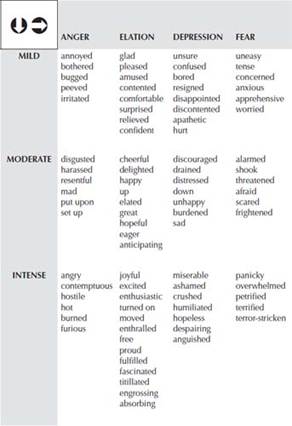
Think of the range of emotions clients might have concerning their various legal problems. How might their different emotional states affect the direction they might take in resolving their particular problems? The following chart is taken from Madelyn Burly-Allen’s work, Listening, The Forgotten Skill, 2d Ed. p.131 (1995).8
Here, we encounter Advanced empathy. In order to hear, see, and feel these emotions in others, lawyers need to be skilled in:
Quieting the self
Being attentive
Listening with ears, eyes, and insides
Clarifying
Restating
Reflecting
Summarizing
Validating
Encouraging
They need to resist the temptation to take over, and problem solve by:
Turning off the filters
Not agreeing
Not advising
Not arguing
Not correcting
Not questioning
What does this mean during a counseling session? The psychiatrist, Dr. Tom Rusk argues that the ability to listen is the key to reaching an ethical understanding with another person.9 Friends seek ethical understanding from each other.
Rusk suggests that you confine yourself strictly to the following tasks:1. Establish that your immediate goal is mutual understanding, not problem solving.
2. Elicit the other person’s thoughts, feelings, and desires about the subject at hand.
3. Ask for the other person’s help in understanding him or her. Try not to defend or disagree.
4. Repeat the other person’s position in your own words to show you understand.
5. Ask the other person to correct your understanding, and keep restating his position.
6. Refer back to your position only to keep things going.
7. Repeat steps 1–6 until the other person unreservedly agrees that you understand his or her position.
2. Give. The next part of the friendship model is for the friend to care enough to give his or her perspective on the problem. This model is different from the standard objective presentation of alternatives and consequences. It requires instead subjective input on the part of the lawyer. It requires that the lawyer “care” whether the client reaches the “right” decision for the client.
What exactly is the “care perspective” and what are its benefits? Care perspective is a moral orientation and a mode of moral thinking that stands in contrast to the justice orientation. The language of the care perspective is still evolving and is admittedly fuzzy. A succinct description comes from A.L. Carse, who says,
[T]he justice orientation construes the moral point of view as (1) an impartial point of view, (2) which understands particular moral judgments as derived from abstract and universal principles, (3) which sees moral judgment as essentially dispassionate rather than passionate, and (4) it emphasizes individual rights and norms of formal equality and reciprocity in modeling our moral relationships.
By contrast, the care orientation (1) rejects impartiality as an essential mark of the moral, (2) understands moral judgments as situation-attuned perceptions sensitive to others’ needs and to the dynamics of particular relationships, (3) construes moral reasoning as involving empathy and concern, and (4) emphasizes norms of responsiveness and responsibility in our relationships with others.
What would a decision-making process that is modeled on care look like, and how would such a process resist the constraints that arise from the role playing hierarchical model? An individual approaching the previous case from the care perspective would proceed as follows.
First, the provider would identify the persons involved in interdependent relationships in this situation. For the legal practitioner, it violates an exclusive focus on the client. The opinions of all persons in significant relationships with the one cared for are considered. The lawyer’s opinion is also included, because he’s also in a significant relationship by virtue of his involvement with the client.
The second step of the friend/decision-making process is the most radical. It identifies the central issue of care, and addresses what caring demands in this particular situation, with these particular persons, to strengthen (or at least maintain) their primary relationships and avoid hurt and harm. This step can only be taken after identifying the interdependent parties and their primary relationships. One then considers the view of both the client and those in the other relationships: customers, employees, suppliers, shareholders, family, or friends.
These steps provide for the subjectivity that friendship requires. It allows for moral self-expression. It necessitates a true understanding of, and reflection upon, the feelings of others, yet doesn’t designate to one individual or another, the moral responsibility for the decision. The role taken by the lawyer is more of a facilitator of the discussion, or consensus builder, than problem solver.
3. Merge. Third, a friend should discuss and think through all possible alternative activities to determine which are “loving and just” to those who are involved. He should ask how the action will affect each person’s life, including their shared life. The perspective of the friend arises from this attempt to enter into and understand the context of the situation.
The friend enters the situation and participates as one caring, whose view is to be communicated to the parties involved and carefully considered. Again, any actions proposed, and the consequences of proposed alternatives, are evaluated in terms of whether they are “loving and just” for the individuals and their shared life.10A friend and counselor does not necessarily go along with the client’s decision. In this model, the friend takes moral responsibility for whether he joins the client’s decision. If he cannot, then he withdraws from the partnership. The friendship model protects the lawyer from necessarily joining in every client’s ventures. It allows for the moral self to discuss, and disagree, on courses of action.
4. Go. Finally, assuming a successful merger has been reached, the involved parties jointly should select an acceptable alternative, anticipate objections and answer them, and devise a workable plan for carrying out the proposed solution.11 After the decision is carried out, it is also helpful to evaluate its adequacy. The friendship model assumes that this “Listen, Give, Merge, Go” model will create more meaningful lawyer-client relationships, which will better represent the holistic client and build more shared decision making. The aim is that both the practice of law and client satisfaction will be more enhanced.