3.2 Factual Theory
Not only must the lawyer have a legal theory, she must also have a factual theory before the client can reach a decision about how the suit will be resolved. Certainly no later than the start of trial, facts and proof become paramount, but the pressure today is to have such theories in hand in order to determine whether to negotiate or mediate a solution.
The factual theory is the means by which the lawyer will tell a cogent factual story that will persuade the opposition, or the trier of fact, that her client has an excellent chance of prevailing.One might question the need for a factual theory before this time. Won’t having a factual theory too early in a case blind the lawyer to contrary information, or suggest too strongly to the client and principal witnesses that the lawyer does not really want to know the truth about what happened, but only what fits his factual theory?
These are important concerns, primarily answered by knowing that at some point the lawyer will need a factual theory. Initially the lawyer’s job is to find out what happened. Even so, the lawyer has to have some notion of for what he is looking. Otherwise, the lawyer’s fact investigation is haphazard and inefficient. Just as scientist know the importance of having a tentative hypothesis to guide efficient learning, it is better to start a learning project having a tentative hypothesis than to go in like a blank slate. As long as the learner is careful to keep his factual theory tentative, he will be better able to learn what really happened than if he is without any preconceived notions of what to look for in discovery.
How should the lawyer initially decide on a tentative factual theory? There are a number of devices that can start the investigator on her way. 3.2.1 Time lines2
Early in a lawsuit, (maybe as early as before the client first leaves the office) the lawyer should try to sketch out a time line of the key events.
For example a time line in a commercial case involving the purchase and coverage of an excess insurance policy might look like this: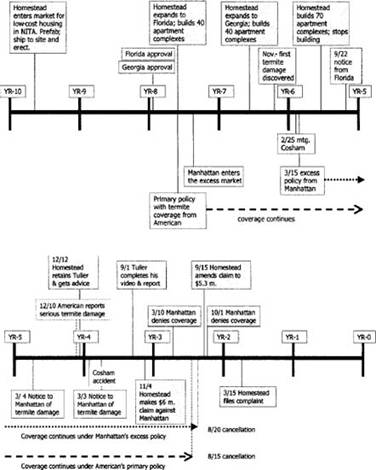
Look at the time line and start asking some questions. Is the first event listed really the first event that is relevant to the case? Often the litigator needs to back up the time line and ask what event(s) led up to the first listed event, giving the story listener a better sense of setting and context than what he has from the first event on the time line.
For example, in a standard car wreck, the time line often starts with where the cars left from on the day of the wreck. But as an earlier matter, what did the drivers have to eat or drink during their meals before the accident? What had they done the day or even days leading up to the accident? Regarding matters of credibility, who are these people and what virtues or character traits have they evidenced over the past years?
In an additional setting—in a commercial case, preceding the signing of the contract for insurance that may in dispute—what events led up to the signing? Was the contract a standard form, with boiler plate language, or was the disputed clause specially negotiated? If specially negotiated, what events required its special negotiation? Who contacted whom and why was the contact made? What events led up to buyer to need an excess liability policy? How did the buyer settle on the particular insurer? Why was insurer soliciting this buyer?
One of the greatest dangers then from using a time line is narrowing focus too much to the events immediately surrounding the dispute. Yet the time line stimulates a starting point for discovery and the lawyer can then structure his discovery to proceed chronologically. It is the way most of us learn. We learn by “starting” and then discovering what events followed.
Moving forward on the time line, a number of questions will immediately be raised.
While you know that a meeting occurred, or an accident happened, you don’t know what was going on in people’s minds at the time they were acting. What were their motivations for meeting when and where they met? What communications, thoughts, ideas, feelings, and or emotions led up to those meetings? Why were they meeting at that point? Why were they on the road at that particular time of day?In addition, the time line produces another set of questions. What policies or procedures govern the behavior at the time of the key events? Were there any notes taken at the key meetings? Was there a secretary present? Were the meetings recorded? Was a follow up memo or e-mail written? Do the parties keep telephone logs of their conversations? Do the individuals have standard ways of dealing with certain matters? If they do, how did they get trained about the procedures?
Another matter that the time line will not show is the things the parties did not do, people they did not call or talk to, or precautions they did not take. Moving down the time line, the litigator must start to look for key nonevents. These nonevents can be key to establishing negligence, especially where there are policies and procedures supposedly to protect against the nonevent happening.
Time lines are useful not because they answer questions, but because they cause the lawyer to focus and start to raise questions about what happened. Time lines are great for discovery planning because they force the litigator to look hard at the gaps between the key events in a known time line. They can spur the lawyer’s curiosity in trying to discover the why and wherefore of the client’s story, which can lead to all kinds of useful information. 3.2.2 Story Outlines3
A second discovery planning device that can be very useful to fact investigators involves imagining that they are about to have to perform the act of telling of a persuasive interesting story. Preparing a story outline can start the litigator on the path to becoming more imaginative and creative about what they might be looking for.
Ask yourself, for example, “What would I love to be able to say about the opposing party if I were free to make it up?” Imagining the darker side of a person’s story can spur the imagination of fact investigators to look for those facts. It spurs questions such as: “I wonder if the other side’s key witness ever got into any trouble? I wonder if they ever got caught lying or cheating or stealing? I wonder if they are biased in any way? I wonder who they know and whether they are at all beholden to the people they know? What skeletons are in those witnesses’ closets?”
In addition, the lawyer must be creative and imaginative about looking for good in their witnesses. What appealing things have they done with their lives? What social causes have they furthered, and what people have they helped?
The point is that human nature is often neither as objective and neutral, nor as evil and selfish as it seems. It is job of the lawyer to accentuate his witnesses’ good sides and emphasize bad in the other’s. This process is greatly aided by imaginative stereotyping and characterizing of both sides’ witnesses.
Some experienced lawyers recommend that the litigator put down in writing brief, two or three paragraph story outlines both for the overall story that he might tell, and for the stories of the prospective witnesses. They then use these story outlines to seek out motivations, policies and procedures, and nonevents these story outlines might overlook.