6.3 An unpublished textbook on Roman law
One of Koschaker’s last works appeared in 1951, a review of a well-known textbook on Roman law by Paul Jörs, revised by Wolfgang Kunkel.[912] The content of the review is particularly interesting.
Koschaker praised Kunkel’s textbook, defined as an opus novum and not simply a new edition of Jörs’s work. Koschaker considered Kunkel’s Römisches Privatrecht to be the best textbook written by a German Romanist; it was a learned work analysing many sources in depth and numerous references to scholarly debates were presented in the footnotes. Koschaker added, however, that it would have been beneficial to publish an easier and more affordable textbook for German law students, since most students were not well off.[913] With this in mind, Koschaker wrote, he had decided to publish the text of the lectures he held in Ankara translated only into Turkish. He would not, however, publish them in a major European language, because publishing such a work primarily intended for students and lacking in refinement might have ruined his scholarly reputation in his opinion.[914]At the Library of the Law Faculty in Ankara, however, there is a copy of a manuscript by Koschaker, a textbook on Roman law, entitled Grundzuege des roemischen Privatrechts als Einfuehrung in das moderne Privatrecht.[915] The Turkish version of Koschaker’s textbook was thus the translation of this unpublished manuscript in German.[916] This work could be considered as a sort of concrete legacy by Koschaker which allows us to have a precise idea on the approach he adopted to Roman law classes and their content.
The German manuscript, containing typing errors, mistakes and corrections, is 417 pages long and without a bibliography, list of sources or footnotes and references. It is clear, from the initial pages of the manuscript Koschaker used to address Turkish students, that he was referring to this work in his review of Kunkel’s textbook and that this was the text Koschaker used for his lectures, held in German, but simultaneoulsy translated into Turkish by an interpreter in Ankara.
A glimpse at the table of contents and at the chapters of the book immediately displays a structure of the work consistent with Koschaker’s convictions on the need for an Aktualisierung of Roman law teaching.[917] He devoted the first chapter to the meaning of Roman law for Europe and the world, to the role of Roman jurists and a history of Roman law from Justinian up to the present.
In the second chapter he dealt with the Corpus iuris and the different partitions of law in ancient Rome: ius civile, ius gentium, ius honorarium, to conclude eventually with a paragraph describing the Private law system. In the latter paragraph Koschaker stressed the nature of Roman private law, considered as a system - and not as a simple set of rules - based on the tripartition res, personae and actiones used in the Institutes of Gaius.
After these first two chapters, Koschaker organised his work into six “books”, each “book” dealing with a main argument and divided into numerous chapters.[918] The structure of the textbook in these six “books” is based on the typical systematic of the PandectВscience’s textbooks; in this sense, there is no difference from the common Lehrbuch of Roman law institutions usually written by the pandectists, which Koschaker himself used to study this subject matter. The interesting aspect, on the contrary, consists in the references to the BGB and the ABGB or, more generally, to modern law. The manuscript is thus an actual example of Koschaker’s Aktualisierung of Roman law teaching in which the author concretely applied his new method and in which he used Roman law as an introduction to the study of modern private law. Yet, it should be noted that these references to modern laws are not as frequent as one might perhaps expect from a manuscript written for teaching purposes by Koschaker. Quite surprisingly, there are other examples of textbooks on Roman law, such as the work by Korosec, whose first edition was published in 1938, in which the method of the Aktualisierung found a more radical application.[919] The same article by Koschaker, L'alienazione della cosa legata, appears to be a closer application of the Aktualisierung of Roman law than his textbook.[920]
Ultimately, Koschaker’s manuscript mostly belongs to the German tradition of textbooks on Roman law, with the real novelty lying in its emphasis on the connections between the latter and current legislation, and through the references made to modern private laws, and to German and Austrian civil codes, in particular.
Furthermore, the structure of Koschaker’s textbooks is similar to that of the manuscript of his System des rГ¶mischen Privatrechts of 1933, preserved at the Library of the Max-Planck-Institut für Europäische Rechtsgeschichte, which also exemplifies Koschaker’s scientific continuity in his approach to Roman law teaching.[921]In this respect, however, Koschaker’s innovative contribution cannot be considered so significant, because it is once again reminiscent of the pandectist approach, albeit updated (aktualisiert) to the changed situation in Germany, where the Civil Code had been enacted in 1900. In this respect, Koschaker’s approach could be considered, at least in part, as a recovery of the methods of the Pandectists and laying down a bridge to the German tradition preceding 1900.
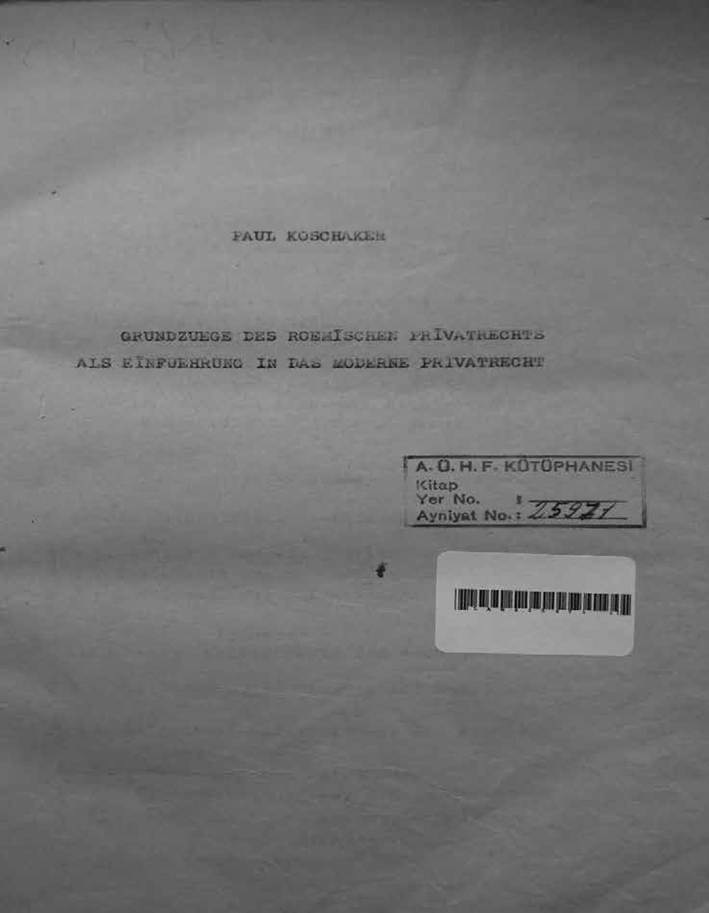
Picture nr. 6: Koschaker: Grundzuege des roemischen Privatrechts als Einfuehrung in das moderne Privatrecht.
Cover page (library of the Law Faculty - University of Ankara, Ayniyat: No. 25971)
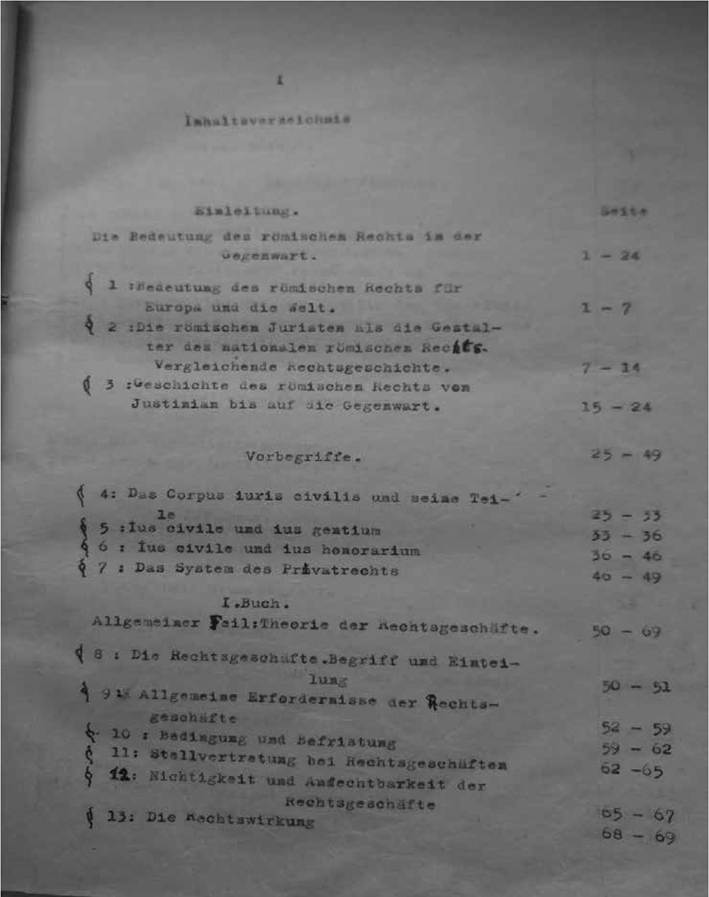
Picture nr. 7: Koschaker: Grundzuege des roemischen Privatrechts als Einfuehrung in das moderne Privatrecht First page of the Table of Contents
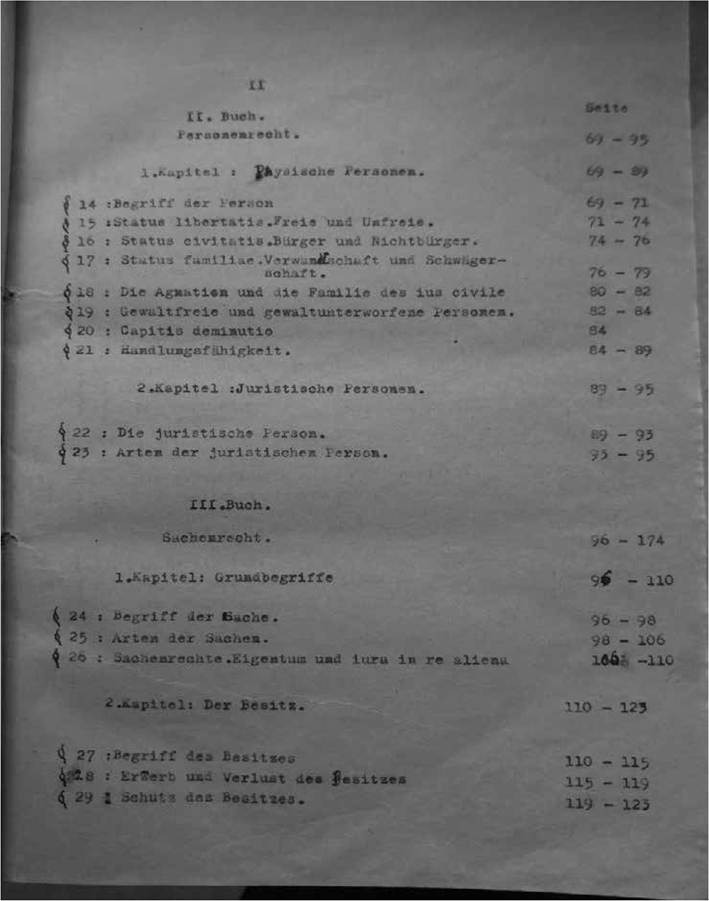
Picture nr. 8: Koschaker: Grundzuege des roemischen Privatrechts als Einfuehrung in das moderne Privatrecht Second page of the Table of Contents
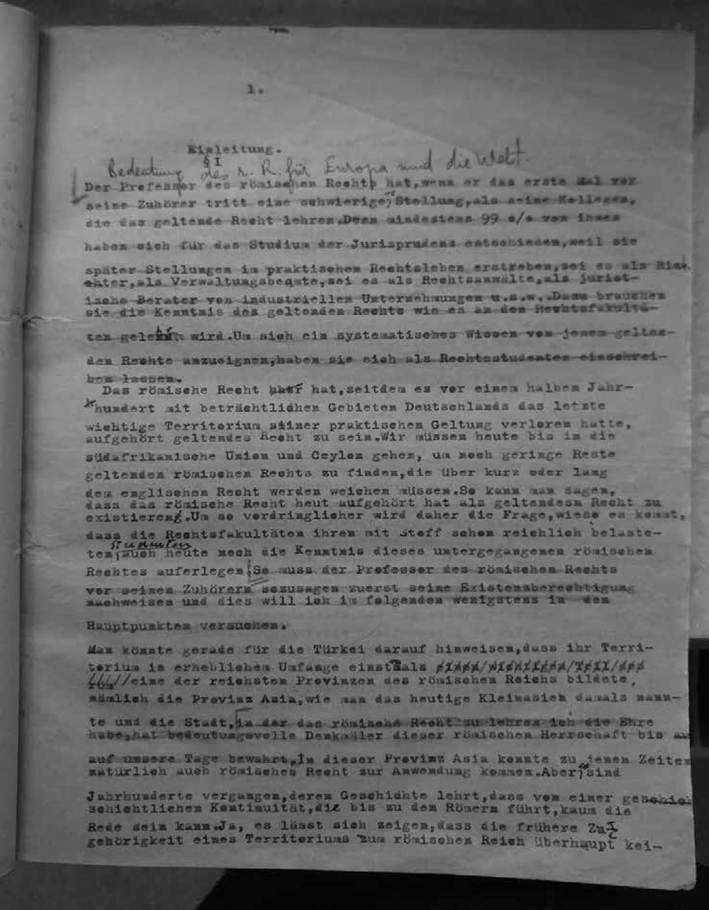
Picture nr. 9: Koschaker: Grundzuege des roemischen Privatrechts als Einfuehrung in das moderne Privatrecht First page of the manuscript
7
More on the topic 6.3 An unpublished textbook on Roman law:
- Roman Law Codes and the Roman Legal Tradition
- This Roman Law of Obligations comprises notes of lectures given at the University of Edinburgh in 1982 by Peter Birks, who was then ProВfessor of Civil Law in the Scottish capital.
- 5.3 Koschaker’s criticism of the Historisierung of Roman law
- Roman Law Terms with Letters L
- Birks Peter. Roman Law of Obligations. Oxford University Press,2014. — 303 p., 2014
- Roman Law Terms with Letters G
- Differentiation: Where do Obligations Fit in the Roman View of the Law?
- Berger Adolf. Encyclopedic Dictionary of Roman Law. Philadelphia: The American philosophical Society,1953. — 479 p., 1953
- Roman Law Terms with Letters P
- Roman Law Terms with Letters F
- Roman Law Terms with Letters M
- Roman Law Terms with Letters V
- Roman Law Terms with Letters B