The Time Factor
The discussion thus far has not fully established the claim that responses to judgments striking down legislation in India and responses to decВlarations of incompatibility in the UK are equally difficult.
In order to establish this claim, it is also necessary, recalling what was said in Chapter 1, to examine the 'time factor' cited by Tushnet and other scholars as a key benefit of the new commonwealth model over judiВcial supremacy. The new commonwealth model, scholars have argued, is superior to judicial supremacy because it enables the legislature to revise judicial understanding of rights in the short run, rather than in the long run.[563] If we were to accept that political responses to declaraВtions of incompatibility and political responses to judgments striking down legislation are equally difficult, can it be still be argued that the model of rights protection under the HRA is nevertheless superior because the Westminster Parliament can revise judicial understandings of rights more swiftly than the Indian Parliament? Political practice simply fails to hold up this claim.Months
Paschimbanga
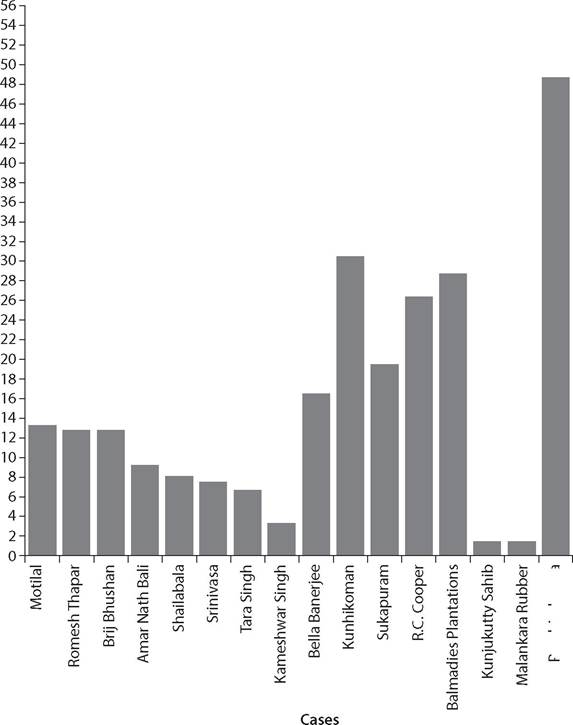
Figure 3.1 Speed of Political Responses to Strike-downs in India
Figure 3.1 shows the time taken by the Indian Parliament to respond to judgments striking down primary legislation through fundamental rights amendments and Ninth Schedule amendments.
On an average, the Indian Parliament has taken 15 months to resВpond to judgments striking down primary legislation. Within this samВple, there are, of course, examples of responses that are much swifter and slower than this. For instance, the Ninth Schedule amendment following the Supreme Court's judgments in Malankara Rubber[564] and Kunjukutty Sahib[565] took barely one and a half months to enact.
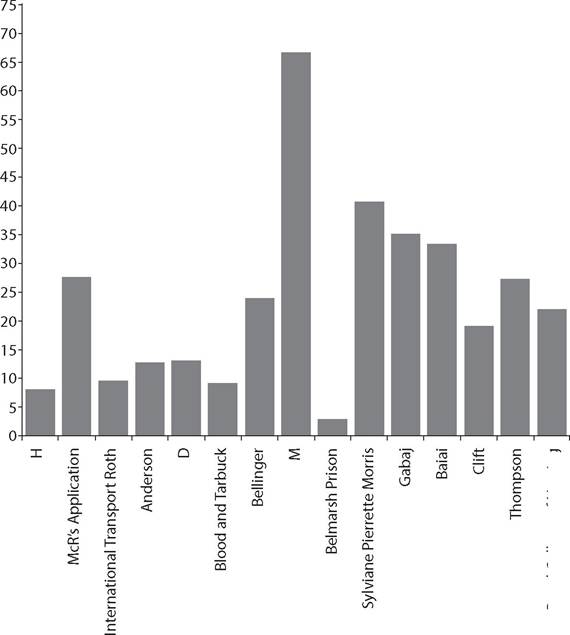
The explanation for the prompt parliamentary response to these cases was that a high court judgment[566] that formed the subject of appeal in one of the cases was delivered more than 20 months before the Supreme Court judgment, enabling the government of the day to prepare the ground for the Ninth Schedule amendment even before the case reached the corridors of the Supreme Court. On the other hand, it took Parliament over two and a half years to reject the Supreme Court's judgment in Kunhikoman v. State of Kerala[567] (striking down parts of the Kerala Agrarian Relations Act, 1961) through a fundamental rights amendment, and over four years to reject the judgment in Paschimbanga v. State of West Bengal,[568] through a Ninth Schedule amendment.As Figure 3.2 demonstrates, Westminster Parliament's responses to declarations of incompatibility have been slower.
In the early years following the enactment of the HRA, the expectaВtion was that Parliament would not only positively address declarations of incompatibility, but would do so quite swiftly.[569] When it comes to addressing declarations of incompatibility, time is particularly of the essence because litigants secure no direct or immediate benefit when such a declaration is made. In other words, a violation of rights—such as in the case of a prisoner who is incarcerated based on statutory provisions that are held to be incompatible with Convention rights— endures despite the declaration. The first declaration of incompatibility that survived appeal was in respect of provisions of the Mental Health Act, 1983 that placed a reverse burden of proof on patients applying to a review tribunal to be discharged from detention in hospital.[570] The
Months
Royal College of Nursing
Cases
Figure 3.2 Speed of Political Responses to Declarations of Incompatibility in the UK
to
government took a few months to respond, prompting some peers voice dissatisfaction with its failure to do so promptly.
One of them said:[571]Whether it was the ordinary or the urgent [remedial order] procedure it seems rather a slow process. The court decided on the case in March. Yet, here we are a year later faced with an order of this kind. In the meantime,
we do not know but it may well be that patients have been prejudiced.... Some response is required about future earnest as to whether or not in the future this can be achieved rather more quickly, as a year seems to be rather excessive for what was then regarded as a fairly urgent matter.
Similar concerns were articulated in Parliament in the aftermath of Anderson,[572] in which the House of Lords declared that the secretary of state's statutory power to set the tariff (how long a convicted murderer should actually spend in prison, given the aims of retribution and deterrence) for mandatory life sentence prisoners was incompatible with Art. 6 of the Convention. As one MP noted, 'There are about 600 prisoners who have been convicted but have not yet received a tariff, so as a result of the Anderson judgment, this substantial number must be dealt with quickly and efficiently.'[573]
Ironically, the responses to the declarations of incompatibility in these cases turned out to be amongst the swiftest since the HRA was enacted. The average response time in the UK has been 23 months,[574] compared to 15 months in India—as indicated in Figure 3.3.
There are outliers on both ends of the spectrum in the UK as well. For instance, it took Parliament only three months to address the declaration of incompatibility made in the Belmarsh Prison case. But Parliament took as long as five-and-a-half years to address the declaraВtion of incompatibility made by the Administrative Court in respect of sections 26 and 29 of the Mental Health Act, 1983 in R (M) v. Secretary of State for Health.[575]
Once again, the declaration of incompatibility made in the prisoner voting rights litigation,[576] over which Parliament has dragged its feet for
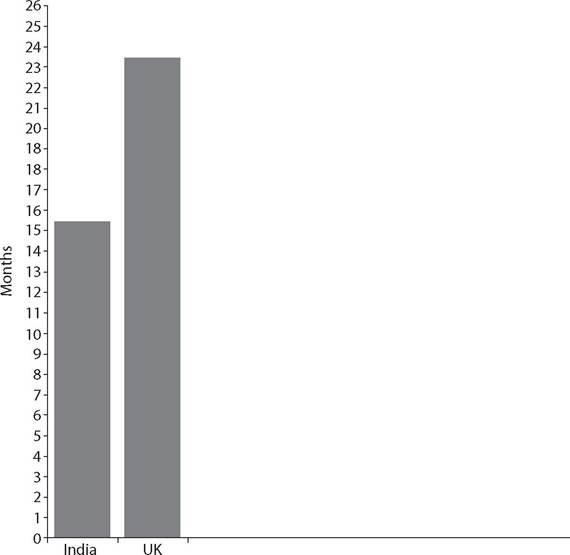
Figure 3.3 Comparison of Speed of Political Responses in India and the UK
over eight[577] years, presents a challenge. On account of the way in which burdens of inertia are distributed following a declaration of incomВpatibility, the case is one which is hard to classify.
Messages from the government about whether the declaration will be addressed have been mixed, leaving open many possibilities—that the declaration will be addressed in some way, that it may be expressly rejected, or that it will, as far as possible, be ignored. If we were to argue that the declaration of incompatibility has still not been responded to properly and the time taken by the government to respond (considered up to 1 June 2015) should be taken into account, the UK's average response time increases from 23 months to 28 months.A more sceptical reading of the prisoner voting rights litigation is possible: it might be suggested that, given the institutional bite of the HRA (a matter examined in Chapter 5), seeking to reject outright a declaration of incompatibility takes a much longer time than comВplying with a declaration of incompatibility, even if it means doing so in a minimalist way or in a manner that does not fully comport with the court's reasoning. However, this would probably amount to drawing too much inference from a single case. Future declarations of incompatibility in respect of which outright rejection is a sustained and serious option would provide us with further insights on this question.
Once we move beyond the form of the remedies and examine the political practice, it is not hard to understand why the Indian Parliament's response time is slightly quicker than the Westminster Parliament's response time. Governments in Britain may not consider it such a bad thing for responses to declarations of incompatibility to be delayed. So long as the status quo is maintained, the law originally enacted by Parliament and declared incompatible by the court conВtinues to remain in force. Coupled with the fact that the beneficiaries of declarations of incompatibility are often from 'discrete and insuВlar minorities'[578]—terrorist suspects, former sexual offenders, and the like—it becomes increasingly easy to explain the delays in addressing such declarations.
This is the reason why, when the HRA was being debated in Parliament, some MPs proposed the introduction of a statuВtory timetable for addressing declarations of incompatibility[579]—an idea that was shot down by the Home Secretary at the time on the basis that it would impinge upon Parliament's sovereignty.[580]In contrast, an Indian government which commands the political dominance to be able to respond to judgments through fundamental rights amendments or Ninth Schedule amendments is likely to want to do so quickly, since the judicial decision would have effectively halted the implementation of the relevant statute with immediate effect. Moreover, declarations of incompatibility are responded to in every case, whereas fundamental rights amendments and Ninth Schedule amendments are invoked in India in only a small fraction of the cases in which primary legislation is struck down for violating fundamental rights.
We should, therefore, remember that the most common reaction of the Indian Parliament and government to a judgment striking down primary legislation is to do nothing at all (whether in acceptance of the judgment, or disagreement without the political capacity or will to act, or indifference). Other factors—such as the level of publicity of the judgment, reputational ramifications for the government, and capacity of the issue to capture the public imagination—are also likely to influВence governments in both jurisdictions to hasten or delay the response, as the case may be.
Thus, the claim that the Westminster Parliament is able to revise judiВcial understandings of rights more quickly than the Indian Parliament is belied by political practice. Available evidence suggests that when it wishes to do so, the Indian Parliament responds more swiftly to judgments striking down legislation than the Westminster Parliament responds to declarations of incompatibility.
***
This chapter concludes the negative claim made in the book.
Although a bare comparison of the scholarship in both jurisdictions suggests otherwise, a careful study of the case law and political practice reflects that the Westminster Parliament and the Indian Parliament have a very similar degree of space in responding to declarations of incompatibility and exercises of the power to strike down legislation, respectively. In other words, the Westminster Parliament holds no advantage over the Indian Parliament in being able to assert its conception of rights followВing judicial review. This holds true of decisional space—or the ability to reject altogether judicial rights reasoning, and remedial space—the ability to fashion responses to exercises of judicial review.Parliamentary debates confirm that MPs in the UK do not enjoy the kind of rights-assertive role vis-a-vis declarations of incompatibility that new model scholars might have expected, and correspondingly, that MPs from India have sometimes taken the opportunity to offer interpretations of rights that differ from those of courts. The time factor, which was expected to weigh in favour of the Westminster Parliament, since it can respond to declarations of incompatibility through ordinary legislative procedures, does not fall in its favour in practice. Even though they require greater than simple parliamentary majorities, responses to judgments striking down legislation in India have been faster than responses to declarations of incompatibility in the UK.