Solutions to the Problem of Regularity: Functional Layering and Institutional Fusion
Polity-wide representative institutions became regular when they needed to involve functions that had greater inherent regularity and bottom-up demand. Justice, not taxation, fulfilled that role.
The result was a layering of functions, which echoes a form of emergence in historical institutionalist literature, institutional layering.117 In institutional layering, change occurs when new institutions are superimposed over pre-existing structures, combining new arrangements on pre-existing structures. It is a form of path-dependent institutional change that typically does not rely on increasing returns.118 Instead, it generally emerges when actors seek to subvert the status quo because they are not strong enough to radically change it. This often results in antagonistic relations between institutional layers.[194]A slightly different logic and terminology is displayed in this account, which distinguishes between the institution and its functions. When an institution dispenses functions that generate weak incentives towards regularization (e.g. the top-down demand for taxation), other functions (e.g. the bottom-up demand for regular dispensation of justice) may compensate, enabling the institution to combine different functions and become regular. Functional layering generated institutional fusion. When rulers dispensed justice centrally and were able to enforce attendance and service across the most powerful social group, as in England, they had a regular forum available to make fiscal and political demands. As Chapter 3 will show, strong royal powers were necessary for such fusion to occur.
The insight remains relevant because in conditions of low political development, institutional autonomy may impede growth rather than secure it. This is one more case of the normative/empirical inversion identified throughout the book.
Norms that appear fundamental for a political order may be directly contrary to the conditions of its emergence. In the following section, I present the empirical context in more detail.2.3.1 The Regularization of the English and French Parlements:
Paths of Functional Layering and Institutional Fusion
Though the Paris Parlement is known as a judicial institution, the English Parliament was also England’s “High Court of Parliament” (remaining so until 20 05).[195] In fact, both institutions are connected to the judicial functions of the king’s court, the curia regis, known as the King’s Council, which included a small group of magnates and officials that helped the king govern.[196] Both institutions initially had political, i.e. consultative, administrative, and fiscal functions.[197] Decisions on war and peace were taken at the court, where powerful subjects were obliged to give “counsel and aid” due to their “dependent tenure.”[198] The Parlement even issued incessant diplomatic missions to European crowns and mediated disputes between French kings and feudal vassals or foreign rulers.[199] The “parallels between the development of [the English Parliament] and the growth of the French king’s parlement are unmistakable. ”[200]
Yet, the two institutions diverged. To explain why, first I present the empirical evidence on regularity of judicial functions, showing how fiscal functions were separated from judicial ones in the French case, whereas they overlapped in the English institution. Then I show that nobles had common incentives to attend Parliament in both cases, flowing from the administration of legislation and justice delivered by the crown. But as Chapter 3 will show, it was English nobles that were present at higher rates, because the crown was able to compel them, thus endowing the institution with greater regularity.
2.3.2 Regularity and Taxation?
The bellicist logic assumes that war pressures necessitated taxes, forcing rulers to grant parliaments. If so, taxation should account for institutional regularity early on. Despite its prevalence, the assumption has not been empirically tested. Doing so shows taxation to be very irregular. Parliament is considered to have its fully-fledged form in 1295, including all three orders. Yet only about 24 percent of the sessions of the English Parliament dealt with taxation between 1216 and 1300 and about 5 percent additional sessions on war matters without taxes considered.[201] The period that saw the introduction of the third estate, between 1260 and 1290, had the lowest rate of tax-related parliaments, 15 percent (Figure 2.1). In the earlier period between 1235 and 1257, dominated by the nobility alone, 31 percent (17) dealt with taxation.[202]
Similarly, the French Estates-General, which lacked a judicial function, had very low frequency.[203] In fact, purely fiscal meetings were even fewer: only 12 out of its 22 meetings over a full century (1300-1399) raised taxes - the rest dealt with domestic policy (Figure 2.2). The Estates-General were suppressed between 1484 and 1560 and also from 1614 until the French Revolution, making the regime absolutist. If the English Parliament had had a primarily fiscal purpose, its frequency would likely have been similar to that of the Estates-General. As we will see, in none of the cases in this book was taxation a regular feature of early
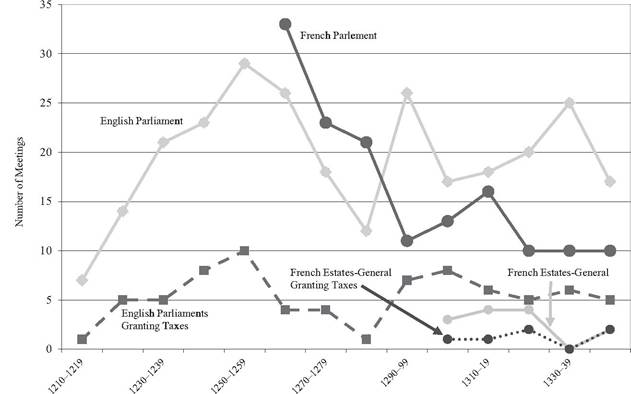
Figure 2.1 Meeting frequency per decade of the English Parliament, English Parliament sessions granting taxation, French Estates-General, and Paris Parlement
Sources: Fryde 1996; Maddicott 1994; Bradford 2007, 133; Actes du Parlement de Paris 1863; Furgeot 1920; Soule 1968; Hervieu 1879; Desjardins 1871. Fryde 1996 was supplemented by Matthew Paris 1853 for tax grants, though further primary sources should improve this assessment.
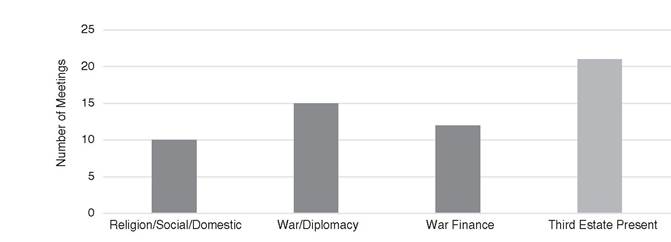
Figure 2.2 NumberofFrenchEstates-Generalbypurpose, 1302-1399 (total meetings: 22).
Sources: Hervieu 1879; Desjardins 1871; Taylor 1954; Bisson 1972; Strayer and Taylor 1939.
representation. The Parlements frequency, however, rivaled that of the English Parliament.
This is not to say that taxation was inconsequential; its role in the expansion of representation will be examined in Part II. But it was not regular enough to produce a regular institution. Accordingly, in the remaining sections I examine the constant, overwhelming, and universal need for law, justice, and peace, first among the nobility, then in the broader population. This judicial interaction was regularized where nobles were more systematically compelled to serve in different capacities.
2.3.3 Royal Legislation: Incentives to Attend
Nobles had great incentives to seek out the king's court since legislation was passed there. The legislative role of Parliament could be easily overlooked, as ever since the seventeenth century English common law is widely conceived as the product of custom and judge-made precedent. As Hayek stated, it was not “the product of anyone’s will but rather as a barrier to all power, including that of the king.”[204] Ironically, more evidence exists of deliberate polity-wide rule and law creation by English kings (writs, assizes, statutes, or charters), some of which continue to shape English law, than by their French counterparts in this period.[205] This was the case with the major reforms under Henry II (1154-89),[206] [207] [208] “when it first becomes possible to recognize the existence of an English 132 133
â€?common law.’” Common law was mostly land law originally, which was “common” because it could be applied only in royal courts.
Social scientists North, Wallis, and Weingast projected a contractual logic on this process.
In their account, English land law spread because “the dominant coalition” within the elite “manipulate[d] the economy to provide the incentives for powerful individuals not to use violence.”134 But the emerging land law of the king did not (just) provide incentives for powerful individuals; it sharply restricted their powers.Nobles indeed were affected by royal legislation because Henry II asserted jurisdiction over all serious crimes and most land disputes held by free tenure (through the Assizes of Clarendon in 1166 and Northampton in 1176).135 But this meant that cases were removed from local courts where noble lords were too powerful for tenants to accuse. Two immensely popular legal forms of action on property, novel disseisin and mort d, ancestor, could only be tried with a royal writ in a royal court.[209] [210] They protected the rights of weak tenant heirs by enabling them to act against powerful lords, a “remarkable fact.”[211] When royal justice was made available to all free men, it effectively undermined honorial lordship.[212] It gave free sub-tenants far more security than ten- ants-in-chief,[213] whilst subjecting the nobility often to more onerous impositions.[214] Indeed, at least after the 1150s tenure was more commonly disrupted at the top of society.[215] The institution that regulated these relations was the king’s court originally and eventually Parliament.
Did war/fiscal pressures motivate royal legislation? As Besley and Persson point out, fiscal and legal capacity were complementary.[216] But precise links are more precarious. According to political scientists Blaydes and Paik, mobilization for the Crusades between 1092 and 1272 spearheaded institutional development. Though the Crusades strongly impacted society before 1150, no institution emerged then.
The Saladin Tithe was indeed raised for a Crusade in 1188 and was polity-wide,[217] but its success depended on Henry II’s major legislative reforms - the latter, moreover, occurred during relative peace and no Crusades. War encouraged royal judicial expansion thereafter at points, as in the 1240s[218] or around the Crusade of 1271-72. But such war pressures afflicted French rulers equally, as well as many of their European counterparts; they translated into wide, public taxation only in England however, as historian Mark Ormrod pointed out.145Magnates benefited from some new rules. They could now bequeath land across generations by using entails, through the Statute of Westminster II (1285).146 They also improved their position, as Max Weber noted,147 when a royal statute barred their tenants from creating sub-tenants, a practice called subinfeudation (QuiaEmptores in 1290).148 However, this also reduced the number of intermediate tenants of the crown, strengthening royal control. The same year, all lords had to confirm with what warrant (Quo Warranto) they held their lands and jurisdictional rights - such country-wide royal inquests were pursued by rulers across Europe,[219] but English kings could better implement them.
Incentives for broader social strata to attend also increased under Edward I, when common law greatly expanded. Many civil, criminal, and administrative matters, from debt to slander, extortion, murder, rape, and the timing of assizes, were regulated through the Statute of Westminster Iin 1275. Attendance was unusually high, maybe even eight hundred county and borough representatives may have been present, who then disseminated the information locally through the county courts.[220] The Statute “marked the growing importance of [Parliament] as a focal point for reform and contact between king and subjects.”[221] However, law itself generally “was the work of assemblies to which the commons were not summoned,” as Stubbs noted.[222] Only after the 1320s were the Commons integral to this process.[223]
French legislation, by contrast, was hampered by relative royal weakness. When law on property was passed, as on the succession of fiefs, it was limited to the royal domain. Legislation was not a royal monopoly; the king “could not place the ban in the land of a baron without his consent,” as attested in the Etablissements of Saint Louis, a legal compilation of 1272-73.[224] In England, by contrast, the Assize of Northampton in 1176 was enforced in thirty-four out of thirty-seven counties.[225] The French nobility legislated in their own domains instead.[226] Royal legislation typically affirmed local customs.[227] This meant that the Parlements activities incentivized the French nobility much less than its English counterpart. Regional boundaries were only occasionally transcended, as with the ordinances on Jews; records suggest no more than twenty-six barons as witnesses.[228]8 Towns, however, accepted royal legislation, for instance on town government corruption and incompetence - some resisted, but the crown helped towns counteract the nobility.[229] This jurisdictional variation eventually shaped representation in the Estates, as we will see. The nobility was not effectively integrated, and the third estate only involved towns: the “enormous mass” of peasants had no representation.[230]
Jurisdictional weakness probably also encouraged the French crown to assert absolute rights of legislation, challenging the imperial prerogative. This trend forged the notion of the state and legitimized its extractive claims: edictal power underlay the power to tax. The canonist rediscovery of Roman law was instrumental in this, as was the Aristotelian idea of the common good or pourfit (profit), which royal legislation had to serve.[231] Although by the 1280s the legist Beaumanoir could declare that legislation also required deliberation “par tres grant conseil,”[232] these developments were not institutionalized through the Parlement. Instead, the Parlements legislative role consisted of registering royal letters and ordinances, eventually developing the right of remonstrance: a royal act was only valid when registered through the Parlement.[233] These powers obliged the king to respond if the Parlement refused registration, but they were limited.[234] With less power to impose legislation on matters directly affecting the nobility, the crown's capacity to incentivize it via legislation was constrained.
2.3.4 Demands for Justice: Incentives to Attend
The definitive function of medieval kings, however, was judging.[235] Both rulers and subjects had incentives to interact over justice; kings established control over populations, whilst subjects had common grievances, typically concerning titles to land, official corruption, and crime. Judging was also more regular than legislation, which was occasional.[236]
The English royal court was so popular as an adjudication center after Henry II extended it beyond the “great men” that “suitors paid money to the king to have their cases tried there,” in fact large amounts “for writs, for pleas, for trials, for judgment, for expedition, or for delay.”[237] By the late 1100s, eligible cases in England were already diverted from local courts to the king’s courts, the King’s Bench and the Court of Common Pleas.[238]
Parliament initially consisted of sessions of the royal court where kings dispensed extraordinary justice “on a very large scale.”[239] They heard cases on land leases, fines, disputes between nobles, bishops, and laity, city franchises, reprisals against foreign enemies, corruption of judges and royal officials and more.[240] The cases heard concerned magnates or the king himself or they involved “grave questions of public law” or the king’s equity.[241] By 1290, Parliament’s role was acknowledged in legal literature: “doubts are determined there regarding judgment, new remedies are devised for wrongs newly brought to light, and there also justice is dispensed to everyone according to his deserts.”[242]
As Stubbs noted, judicial functions also excluded the Commons initially; only nobles, lay and clerical, participated.[243] Nobles attended court because major property disputes were decided there and they were personally tried there,[244] especially after the law of treason expanded from the mid-fourteenth century.[245] The Parliament that tried the last native Prince of Wales, in 1283, attracted the highest number of nobles known to have been summoned, 110.[246] The next chapter shows how high these numbers were compared to France.
Yet, the French king’s essential role was also that of “grand justicier,” widely attested in contemporary sources[247] and already extensive under Philip Augustus (1180-1223).[248] Louis IX (1226-70) judging under the oak tree at Vincennes is a classic image from the chronicles.179 His reign was instrumental in consolidating the Parlement as an institution: the term was applied to the judicial sessions of his court’s meetings after it ceased to be itinerant in 1248.180 The Paris Parlement also focused on conditional landholding. From the 1250s, many of the Parlements judgments were “enforcements of the king’s rights to homage and jurisdiction in the fiefs of his tenants-in-chief; or the punishment of unlicensed alienations of royal fiefs, especially into the â€?dead hand’ of the Church (churches never died, so their fiefs never escheated to the king),”[249] just as in England. When royal judgments affected broad groups of tenants, decisions amounted to legislation.[250] Broader demand for Parlement intervention was so high that eligibility to be heard was regulated: for instance, actions to recover land seized (the same act of novel disseisin that helped spread the common law in English royal courts) were sent to the local tribunals of the baillis and senechaux instead (the bailiffs of north and south, respectively).
All groups were affected by the Parlements jurisdictional expansion, but to varying degrees, according to their power. Nobles could be tried in the royal Court, including the dukes of Normandy, Burgundy, Aquitaine, as well as the counts of Flanders or Champagne or the king of England. But these were vassals who competed with the French king in strength and holdings - an internal power balance English kings never faced. Edward I forfeited Gascony by not appearing in the Parlement, for instance, triggering the Anglo-French wars between 1294 and 13 03.[251] Noble resistance was strong, especially as the crown sought to abolish the privilege of judicial duel.[252] Yet nobles, whether counts or dukes, sometimes brought their own disputes to court. The Parlement was also where the peers (Pairs de France) were judged by the king.[253] But seigneurial conflict remained rampant locally, suggesting the limits of royal jurisdiction.[254]
The communes, however, pursued justice at the royal court.[255] The towns' alliance with the crown was the lynchpin of political scientist Hendrik Spruyt’s account of state emergence.[256] It was through their courts that towns “were fitted into the scheme of royal government.”189 They needed royal support of their own growing jurisdiction vis-a-vis the lords, especially regarding markets. The Parlement adjudicated in conflicts, often splitting jurisdiction across litigants.190 Ecclesiastics also complained of noble incursions, and the king had a duty to protect them.191 The increasing calls for justice even under “weak kings,” from Louis VII (1137-80) to Charles VI (1380-1422), demonstrates that the demand for justice itself was genuinely bottom-up, not one predicated on the crown's organizational powers.192
Since nobles were not obligated to attend, the Parlement never became an effective body for the king to raise tax demands and different bodies needed to be called, either locally or at the polity-level. Tax concerns, however, were raised there; judicial courts, including the Parlement after especially 1270, often negotiated taxation. “Parliamentary investigations of right [on taxation issues] became, in effect... negotiations for payments.” For instance, the Parlement of 1271 rejected the pleas of three cities and imposed assessments on them, but others succeeded.[257] As we will also see in the Ottoman Empire, judicial processes handled some functions of representative institutions. A lack of the latter did not mean arbitrary government.
2.3.5 Petitions: Bottom-Up Incentives to Attend
One specific form of adjudication was to play a central role in both institutions: petitions. It is these that allowed the people to contribute to government, since counsel and consent were confined to the magnates, as Stubbs noted for England.[258] Rulers had a duty to address petitions,[259] one that echoed the practice of the Pope, to whom tens of thousands of petitions survive from this period.[260]
A slow trickle in England in the twelfth century became an unstoppable flood in the late thirteenth due to a “momentous innovation,” in Maddicott’s words:[261] “for the first time the voice of the aggrieved and of the socially insignificant could be heard at the centre of government,” as petitions became accessible across social orders from the 1270s.[262] Originally complaints required purchasing a writ from Chancery in London, which was expensive and remote.[263] However, expanding on precedents from the 1250s, oral complaints were accepted locally (“in eyre”) and transcribed into written “bills” that were sent to the center, thus institutionally connecting local grievance to governmental response.[264] The language was even changed from Latin to the more common French.[265]
Parliament became the focal point for submitting petitions from the 1270s to the 1290s, when the institution congealed (Figure 2.3).[266] Similar developments occurred in France, as well as throughout Europe, from Spain, to Germany, Flanders, and later Poland, Russia,
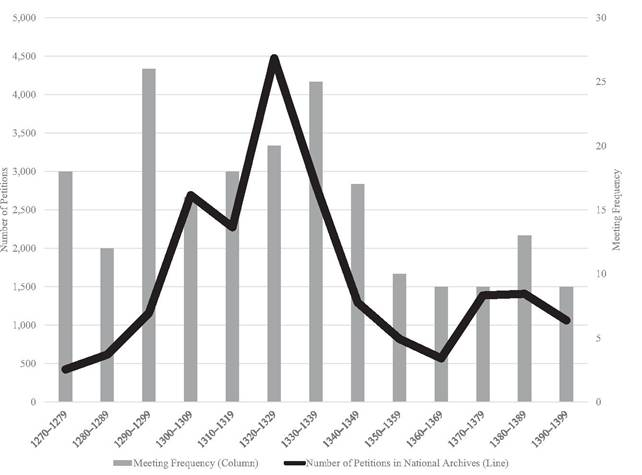
Figure 2.3 Surviving petitions and parliamentary frequency, England, 1270-1399
Sources: Ancient Petitions (SC8), National Archives. These are simply surviving petitions (Ormrod 2009, 5). The more complete records for 1305 suggest more than 360 petitions, so these figures probably underestimate totals; Brand 2004; Maitland 1893. Historians Dodd and Ormrod have now digitized this massive corpus, sparking extensive scholarship on the topic; Ormrod et al. 2017, 1.
and elsewhere, as we will see. However, the level of organization varied across cases, as did the institutional effects of this demand.[267] Although war surely enhanced the ruler’s incentives to call Parliament, especially in times of crisis like the 1290s, it cannot explain bottom-up demand for regularization; such requests for justice can. And maybe war would not have been embarked upon, if resources could not be effectively tapped.
The Paris Parlement was even less propelled by war, but its regularity was similar to that of the English Parliament. War (with England) had ended in 1243, when the French crown ushered its own “bill revolution” with the great inquest (enquete) of 1247. Until then, “only aggrieved churches and substantial landowners” could access the king.[268] After
that, oral complaints against the king and his officers could be accepted from across the population, as they were submitted to the local clergy who could transcribe them.
Petitioning was pervasive in both cases: in England, “in the late Middle Ages assiduous petitioners sought out the king in all manner of locations and occasions, and by the seventeenth century it was necessary to provide the monarch with a special bodyguard on state days specifically to prevent unwanted (and unwashed) supplicants from thrusting petitions into his hand.”[269] French kings had clerks (juges de la porte) following them around the country to handle petitions submitted to them personally.[270]
What kinds of concerns were transmitted to the center? Were petitioners asking for rights? The term “rights” invokes an abstract tradition of high-minded principle, of the sort claimed to place Europe apart. However, the tradition stemmed from mundane concerns, which differed little from cases beyond Europe. Claims only gained abstractness, as we will see, by eventually being framed in general terms - a process that would have been impossible absent the institutional organization described here which depended on royal strength (the advanced learning of the law, especially in the Church, was of course also crucial).
Petitions were typically extra-judicial, i.e. they were used where regular law offered no remedy or where court decisions conflicted; they appealed to royal grace.[271] In England, nobles would press claims to lands, franchises, and money. County and borough communities would petition to challenge the crown’s fiscal claims or to make “requests for keeping roads and bridges in repair and complaints of the abuse of tolls, the privileges of the stannaries, or the inconvenient situation of a county gaol.”[272] The gentry would seek redress from intimidation or other miscarriage of justice. Free tenants and villeins would petition against the exercise of lordship, as did communities or “estates of men, for instance, the tin- miners in Cornwall or the king’s clerks in chancery.”[273] Very common and serious were grievances about abuses and corruption of royal officials (about a third of a county total in the early period),[274] uncompensated purveyance (levies of war supplies imposed by the king),211 but also rampant crime and wrongdoing.212
Complaints were no different in France: they often targeted the crown’s local representatives wielding judicial, military, fiscal, and administrative powers, the baillis, the senechaux, and others. They could range from a bailli favoring the rich over the poor or extorting money from a prisoner, to the king not heating the banal-oven in a village (as obligated qua feudal lord).[275] Crime was also pervasive, as were claims against other subjects. Such petitions, especially by the Church, spread royal justice.[276]
All kings had incentives to encourage petitioning. Just as in communist China today,[277] authorities learned about provincial conditions and official corruption this way. Kings would also seek information through formal inquests or informal requests.[278] Petitions also allowed rulers to enforce their jurisdiction, including in outlying territories such as Gascony, which had no direct representation, and Scotland, and to “reinforce military conquest.”[279]
Petitions had a profound impact: they increasingly generated legislation.[280] They were the basis of legislative bills; the earliest entry for “bill” in the OED defines it as “a written petition.” “As Stubbs said long ago, nearly all the legislation of the fourteenth century is based upon parliamentary petitions.”[281] This is, after all, the definitional function of parliament: popularly-based legislation. No account of representative origins can be complete if it does not explain how local grievances transformed into governmental action.
This process was more encompassing in England. Petitions were originally mostly private,[282] but they increasingly aggregated demands at a supra-local level, leading to the “common petition.”[283] This was a gradual process, however, as petitions claiming to represent the “community of England” were initially presented by the barons. Knights and burgesses, eventually termed the Commons, lacked a “collective voice.”[284] Only after the 1310s did the “public and frequent complaint of middling people”[285] secure legislation in response to demands, for instance against lords subverting justice.[286] By the 1320s, the Commons even had an “agenda for legislation.”225 After this time, common petitions aggregated demands from both counties and boroughs, i.e. both rural and urban populations, into generalizable requests.[287] By the 1340s, the Commons were the conduit for popularly supplied legislation in Parliament.[288] By 1377, the full Parliament had to assent to statutes.[289] By 1450, the Commons were not only presenting the issues via petitions; they were proposing the remedy that became legislation.[290] Petitions were thus the mechanism that generated representative, inclusive governance.
Grievances also led to legislation in France, as with the “etablissement general” of Louis the Pious in 1254.[291] The reforming ordinances of the fourteenth and fifteenth centuries responded to public petitions, for instance the provincial charters of 1315.[292] More well known from later history are the cahiers de doleances (lists of grievances), associated with the Estates-General or delivered to the king,[293] which were similar in purpose. The French trajectory splintered their submission process, however, between the Royal Council, the Parlement, and the Estates-General, weakening the institutional mechanisms of centralization. Nor do we see the supra-local organization observable in England in common petitions.
This difference is also reflected in the king’s presence. This was soon considered central to the English Parliament. “It was widely accepted that the king had a responsibility to provide answers to all petitions before a parliament closed.”[294] Edward I thus had to request, in 1280 and 1293, that the “flooding” of petitions reaching perhaps hundreds per session be regulated because they distracted him from the “great business of his realm.”[295] When petition hearing declined, public reaction was sharp. The anonymous Mirror of Justices, from the early 1300s, protested that “it is an abuse that whereas parliaments ought to be held for the salvation of the souls of trespassers, twice a year and in London, they are now held but rarely and at the king’s will for the purpose of obtaining aids and collection of treasure.”[296] Moreover, Parliament could not normally be convoked without the king (except by his representatives). Strikingly, between 1275 and 1399, English kings were absent from perhaps 12 out of 154 parliaments,[297] although they could occasionally go rowing whilst appointing nobles to supervise the hearing of petitions.[298] In France, by contrast, the king’s presence was “extraordinary” in the Parlement by 1290;[299] he would attend only for high-stakes cases (called lits de justice).239 The next chapter explores why that came to be.
*
In this chapter, after more precisely defining the main necessary conditions and the dependent variable of this account, I showed how existing theoretical perspectives either suffer from empirical problems or fail to explain how regularity, collective action, and territorial anchoring are achieved. I then explained the first feature, institutional regularity, through the constant polity-wide demand for royal justice or grace. This was common to the two cases (as it was throughout Europe and beyond, as later chapters show). Rulers in both cases were asking for taxation, sometimes under pressure from war, and subjects were uniformly asking for redress of wrongs. Yet only England displayed the functional layering and institutional fusion that was critical for a polity-wide representative institution. What follows probes the comparison with France to show how power differentials explain much of this variation.