Sexual Behavior and Moral Prescriptions in the Penitentials
Penitentials, a new genre of Christian moral literature, grew increasingly influential in shaping Catholic sexual doctrine between the end of the sixth century and the beginning of the eleventh century.[611] The handbooks of penance written in this period provided guidance for confessors in dealing with sinners who wished to be reconciled with God and to make their peace with the Church.
The advice offered by the penitential authors was grounded on their practical experience as confessors, as well as on their reading in spiritual and doctrinal literature.[612] The penitentials, accordingly, focused primarily on pastoral concerns, on the means by which those who had offended God and the Christian community might make reparation for their sinful thoughts, words, and deeds.Sexual offenses constituted the largest single category of behavior that the penitentials treated. Prominent among sexual problems were offenses against marital fidelity, failure to pay the conjugal debt, and sexual activities that were believed to offend God, whether they injured anyone else or not. The penitentials also sought to inculcate proper methods for channeling and controlling sexual impulses, so that the sinner might adopt a morally acceptable way of life.[613] The emphasis of the penitentials fell more heavily upon reparation for past offenses than upon reformation of future behavior, but penitential authors clearly hoped that the prescribed penances would change later conduct. In general the penitentials more commonly dealt with fornication, adultery, masturbation, and the like than with purely marital problems.[614] ι
The penitentials comprise a large and complex body of literature. The earliest ones are of Irish origin. The genre spread from Ireland in the late sixth century to England in the seventh century and thence to the Continent during the eighth century.
Table 4.1 in the Appendix shows a classified list of the principal early medieval handbooks.[615] The growth in popularity of these handbooks paralleled the spread of a new type of penitential practice. The older discipline of the Church on the Continent had featured public acknowledgment of sins by the offender, followed by the imposition of public penance, in which the penitent was excluded from participation in the Eucharist and other sacramental functions. The guilty person regularly appeared clad in a rough penitential gown, at the entrance of the church, to beg forgiveness from the community for his or her offenses against the Christian moral code. In addition, public penitents often had to undertake prolonged and severe fasts, to abstain from sexual relations with their spouses, and sometimes to submit to public whippings and other acts of expiation prior to readmission to communion.The new style of penance introduced by the Celtic Church featured private confession by the offender to a priest, followed by private acts of reparation.127 The penitentials sought to guide confessors in assigning appropriate penances for different categories of sins; many of these handbooks consisted of elaborately detailed lists of offenses that the priest might expect to encounter in the confessional, together with tariffs of penances appropriate to each sin. In addition many sins, particularly those that were secret and known only to the sinner and the confessor, might be atoned for by “redemption” or “commutation,” that is by the substitution of a money payment or other act that could be performed privately in place of the fasts or public acts of reparation stipulated in the penitential. A tenth-century English penitential, for example, allowed one day’s fast to be replaced by the offering of one penny or the recitation of a few prayers, while a year’s fast might be redeemed either by a payment of thirty shillings or by thirty masses.
Similar schemes of commutation, some of them very fanciful, were common.128Marital Sex
The penitentials by and large took a gloomy view of the sexual proclivities of both men and women. Many of their authors no doubt shared Pseudo-Gregorys belief that even in marriage sex is always pleasurable, always impure, and always sinful.129 Marital sex was a concession, they believed: God allowed mar-
127John T. McNeill, A History of the Cure of Souls (New York: Harper Brothers, 1951; repr. HarperTorchbooks, 1965), pp. 112-35; Oscar D. Watkins, A History of Penance, 2 vols. (London: Longmans, Green & Co., 1920; repr. New York: Ben Franklin, 1961) 2:536—49, 603-31, 643-44, 688—92; Lea, History OfAuricular Confession 1:20-49, 179—97, 2:73—114; but cf. Kate Dooley, “From Pcnancc to Confession: The Celtic Contribution,” Bijdragen: Tijdschrift Voorfilosofie en theologie (Louvain, 1982) 390411. Confession of sins is a common and widespread feature of ancient and primitive religions. The practice is well represented in the religious institutions of every part of the world, but is especially prominent in the early religious systems of North America and Africa. In Mexico and Peru, confession goes back into the pre-Aztec and pre-Inca periods. In Egypt there is evidence for confession of sins as early as the XIX Dynasty (13th century B.C.). The sins confessed in ancient religions were almost exclusively sexual ones, with adultery playing a prominent role. See R. Pettazzoni, “La confession des peches dans Thistoire generale des religions,” in Melanges Franz Cumont, 2 vols. (Brussels: Secretariat de Tlnstitut, 1936) 2:893-96.
128Pseudo-Edgar, Leges ecclesiasticae, De poenitentia 18 and De magnatibus 2, in PL 138:512; Egbert, Penitentiale 13.11, in Schmitz 1:585-87; Irish Canons 2.1-12 and OldIrish Table of Commutations, in Bieler, pp. 162-67, 278-82; Boswell, CSTAH, p. 181.
lwResponsa Gregorii in Gregory I, Registrum 11.56a, Paul Ewald and Ludwig Har- mann, eds., in MGH, Epist.
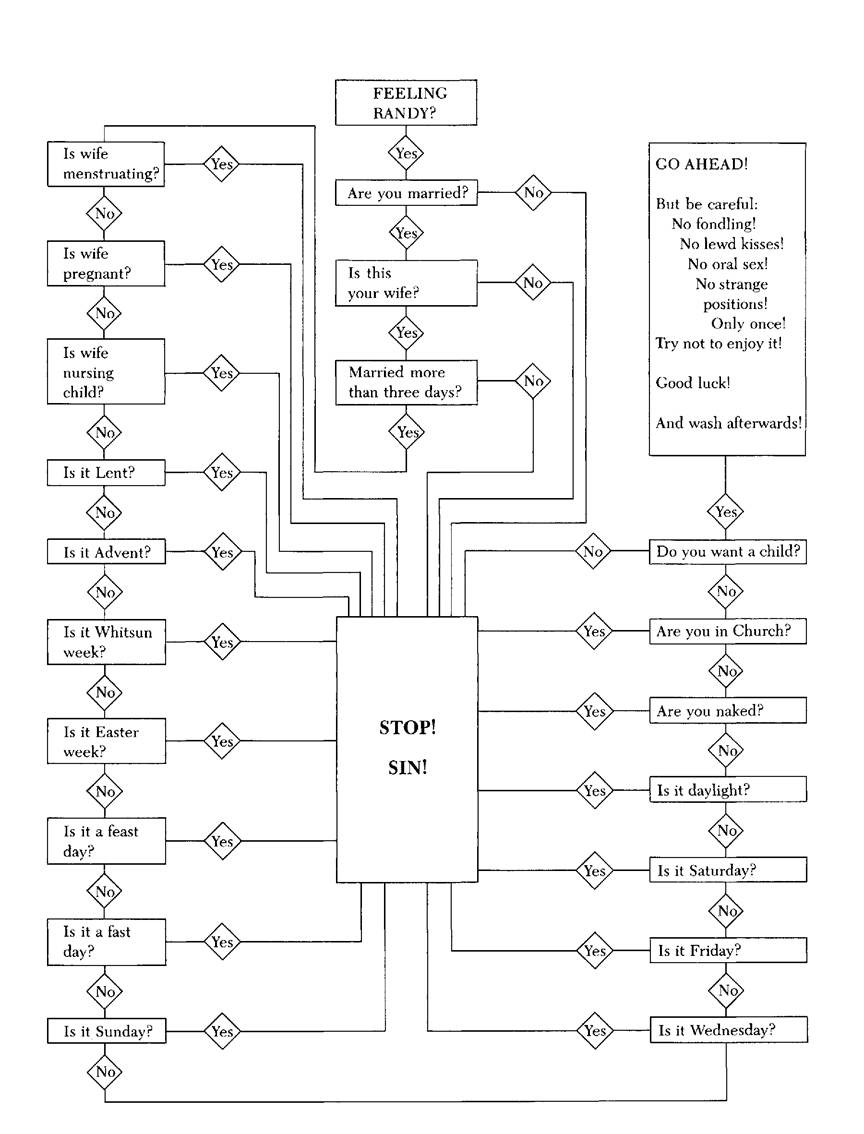
2/1:340: “Non haec dicentes culpam deputamus esse con- iugium. Sed quia ipsa licita admixtio carnis sine voluptate carnis fieri non potest, a sacro loco ingressu abstinendum est, quia voluptas ipsa esse sine culpa non potest.” ried persons to have sex only for procreation, never for pleasure. This opinion was consistent with the predominant teaching among the Fathers.[616]Since marital sex was a concession, not a right, and since pleasure was an ever present incitement to lust, penitential writers maintained that sex in marriage must he strictly scheduled and closely monitored. Without periodic abstinence from sex, according to the Penitential of St. Finnian (written ca. 525-550), marriage itself lacked legitimacy and degenerated into sin.[617] Periodic sexual abstinence appears in the sixth- and seventh-century penitentials as a virtue. But while penitential writers of this period warned that married couples who failed to observe continence at certain seasons would feel God’s wrath, they did not often prescribe specific penances for those who failed to heed these admonitions. By the end of the seventh century, however, married couples who failed to practice periodical sexual abstinence increasingly found themselves subject to penance; by the beginning of the eleventh century, periodic abstinence seems to have become common practice among conscientious couples.[618] Scheduled abstinence from sex, according to one authority, marked an essential difference between married sex and fornication. Moreover, children born ofintercourse during forbidden periods were bastards in God’s eyes, if not in human law.[619]
The penitentials usually specified the times when married people were expected to refrain from sexual relations according to two kinds of criteria: they defined some abstinence periods in terms of events in the wife’s physiological cycle (see Appendix, Table 4.3); seasons in the Church’s liturgical calendar determined most of the others (see Appendix, Table 4.4).[620] A few miscellaneous abstinence periods were defined by other criteria.
The major events in the female biological cycle that required married couples to practice continence included the menstrual period, pregnancy, childbirth, and lactation. Most penitential collections prohibited couples from having sexual relations while the wife was experiencing her menstrual flow. Those who broke this restriction were usually subject to a forty-day penance, though a few authors prescribed much shorter penances for this offense.[621] [622] This prohibition was based on the purity rules of the Mosaic law, perhaps augmented by a belief in the terrifying physical effects of contact with menstrual fluid described in the Natural History of the elder Pliny.13β Some early medieval writers believed that marital abstinence during menstruation was further justified because a child conceived during the menstrual period would be hideously deformed at birth. This notion may be original with Christian writers; it does not appear either in the Hebrew Scriptures or in the writings of ancient anatomists and biologists.[623] Penitentials frequently prohibited sexual relations during pregnancy. The proscribed period usually ran from the first evidence of pregnancy to the birth of the child. This prohibition had no scriptural precedents either and probably represents another example of the influence of Greco-Roman views on sexual propriety during the early medieval period.[624] Some writers apparently believed that any sort of contact with a pregnant woman, whether unwitting or not, imparted ritual impurity. The Bigotianum insists, for example, that a cleric who came into contact with a pregnant woman must fast for forty days on bread and water; this clearly implies that ritual defilement was involved. Presumably the impurity resulted from the fact that pregnancy originated in a sex act and a belief that the resultant impurity remained contagious, so to speak, throughout pregnancy.[625] Once a child was born, the penitentials required that the parents continue to abstain from sex for a substantial postpartum period.[626] The birth process itself—as well, perhaps, as normal postpartum bleeding—apparently induced ritual pollution. Once pregnancy was over, the child was born, and the postpartum continence period had passed, couples were still forbidden to have sexual intercourse, according to the Responsa Gregorii, until after the child had been weaned. Well-to-do women could avoid this prohibition, however, since they usually entrusted their infants to wet nurses shortly after birth—but the Responsa denounced that practice as immoral.[628] In addition to ordaining abstinence periods linked to the female physiological cycle, the penitentials prescribed numerous and extensive periods of sexual continence required by the liturgical cycle. Early medieval Christians, to judge from the penitentials, seem almost to have been obsessed by a need to tie moral and behavioral prescriptions to liturgical events. This is scarcely surprising, since many societies, particularly rural ones, regulated their activities according to a calendar cycle linked to their cultic systems.[629] Virtually all of the major penitentials required married couples to abstain from sex on Sundays; a substantial number of them prescribed sexual abstinence on Wednesdays and Fridays as well. A few added to this a requirement of continence on Saturdays.[630] Different rationales underlay these prescriptions. Wednesdays and Fridays were traditional days of penance, hence sexual abstinence on those days fitted into a regime of fasting and self-denial. Sundays, by contrast, were days of rejoicing—so much so that fasting and other penitential acts were often forbidden on Sundays. But as Christians were expected to participate in liturgical services on Sundays, and as sexual relations created ritual pollution which made the individual unfit to participate in divine worship, abstinence was not so much a penitential practice as a guarantee of ritual purity. This interpretation is borne out by the fact that some authors deemed the Sunday abstinence period to run only through the daylight hours, thus allowing married couples to have sex after sunset on Sunday evenings.[631] In addition to these weekly periods of sexual abstinence, married couples were required to forego carnal relations during the so-called three Lents each year.[632] The first Lent consisted of the weeks prior to Easter, although the precise duration of this season varied considerably: in some communities Lent began as early as Septuagesima Sunday, while in others it commenced only on Ash Wednesday. Lenten fasting did not extend to Sundays, when fasting was in principle forbidden; but sexual abstinence during Lent was demanded on Sundays as well as on weekdays. Thus the period of sexual abstinence during Lent was substantially longer than the period of fasting. It might last as long as sixty-two days (where Lent began on Septuagesima) or it might be as short as forty-seven days (where Lent began on Ash Wednesday). The second Lent referred to the season of Advent, that is the weeks immediately before Christmas. Here again various regions defined the period differently: some communities began Advent observances as early as St. Martin’s Day (ιι November), which meant forty-four days of sexual abstinence, while others postponed the beginning of Advent to the fourth Sunday before Christmas, which resulted in sexual abstinence for somewhere between twenty-two and thirty-five days.[633] The third Lent was more variable still. This Lent centered on the feast of Pentecost: in some places the third Lent ran for up to forty days after Pentecost, while elswhere it comprised anything from seven to forty days before Pentecost. [634] Authorities who required sexual abstinence prior to Pentecost in effect prohibited marital relations for an extraordinarily long time indeed: if Lent began approximately four-and-a-half weeks before Easter, if couples were required (as they often were) to continue to abstain from sex during the week after Easter, and if they also had to abstain for forty days before Pentecost (which falls fifty days after Easter), this foreclosed marital relations for somewhere between eleven and thirteen weeks in the spring of each year. Nor was this all. A good many penitentials also demanded sexual abstinence on all major feast days, the vigils of major feasts, and the quarterly ember days.[635] In addition, some penitentials required abstinence from sex for a period of time—usually three days—before receiving communion, although a few demanded as much as seven days of sexual abstinence prior to communion and a further seven days following it.[636] The abstinence in connection with communion may not have worked additional hardship on married couples during the early Middle Ages, however, because it was common practice at that time for laymen to communicate only at Christmas and Easter (the Lent and Advent penitential observances would in any case have prohibited sexual relations during the days immediately before receiving the Eucharist). As it became common to receive the sacrament more often—this began to happen after the Carolingian period—the sexual continence associated with communion imposed still further limitations on the sex life of married couples. Moreover, persons who performed penance for non-sexual sins were often required to abstain from marital intercourse throughout much or all of the period of penance—which for grievous sins might involve many years.[637] There were still further limitations on marital sex. Newly married couples were strenuously enjoined to refrain from any sexual activity immediately following their marriage: the periods prescribed for postponement of consummation varied from one day to three or more. During this initial period of marriage the couple were advised to heed the admonitions given by the Angel Raphael to the Old Testament teacher, Tobias, and thus to spend their time in prayer and other penitential exercises.[638] Archbishop Theodores Penitential required newlyweds to stay away from the church for thirty days following their marriage. Following that period, presumably dedicated to sexual exploration and delectation, they were to do penance for forty days, after which they could return to regular Church attendance.[639] These prescriptions, too, reflect the conviction that sexual relations, even in marriage, were irretrievably tinged with impurity and perhaps with sin as well. Accordingly after a short period of frolic immediately following marriage, sex should play a minimal role in the marital relationship. The mandatory periods of sexual abstinence prescribed in varying combinations by virtually all penitentials had the result for those who obeyed them scrupulously of reducing the frequency of marital intercourse to remarkably low levels. Since many factors are involved—the woman’s menstrual cycle (which varies widely in frequency and duration), fertility, the age of infants at the time of weaning, and the liturgical seasons (which also varied considerably)—it is difficult to estimate precisely the number of days denied to sex, as well as the impact that these recommended limitations may have had on the married population as a whole, even assuming that people were generally aware of and made serious attempts to follow the prescriptions of the penitentials. Flandrin has attempted to arrive at such an estimate, however, using statistical models that produce a reasonable approximation of a range of results for hypothetical couples. One model assumes a scrupulously observant couple who had intercourse at every available opportunity. The model further assumes that the woman had an absolutely regular cycle of menstruation and ovulation, and that she was maximally fertile, since pregnancy and childbirth would increase the length of the abstinence periods. Based on these assumptions and calculating results over a three-year period, the model shows that such a couple would have had sexual relations on an average slightly more than forty-four times a year, or in other words slightly less than four times per month. Using a more realistic model that assumes less than maximal fertility, a couple might have managed to have sexual relations a bit more frequently—slightly more than once a week, on average, over a three-year period. A fertile couple who seriously attempted to follow the penitential prescriptions on marital abstinence would rarely have been able to make love more than five times per month during their years of maximum sexual activity. Modern populations whose sexual habits have been investigated shows much higher levels of marital sex among couples between the ages of twenty and thirty-five. In industrialized nations the mean frequency of marital intercourse in this age category runs close to three times the figures that Flandrihs models project. If the strictures on marital intercourse in the penitentials were generally known and observed, therefore, they would have had the effect of diminishing marital sexual activity to an extremely low level, without at the same time radically decreasing the possibilities of conception and thus the birth rate, [640] On the basis of Flandrins calculations, the penitentials seem to have mandated an effective strategy for achieving the results that doctrinal writers favored: a reduction of sexual activity to a minimum in order to avoid its sinful consequences, while at the same time leaving unimpaired the reproductive function that would presumably populate heaven with saints. The influence of the penitentials’ prescriptions for sexual abstinence in marriage remains conjectural, for this depended on the degree of compliance. This variable is difficult to gauge. Flandrin argues, on the basis of admittedly tenuous evidence, that by the end of the tenth century many couples had begun to accept the periodic bans on marital sex advised in the penitentials.[641] Beyond demographic considerations, the psychological impact of the prohibitions and sanctions attached to marital sex is even more difficult to measure. Certainly any couple who paid close attention to the rules outlined in the peni- tentials would have found the process of deciding whether or not they could in good conscience have intercourse at any given moment a complex, perhaps even frightening, process. Figure 4.1 displays in flow-chart form a schematic outline of the decision process, using criteria from a number of penitentials. Any conscientious and moderately well-informed couple might well have approached their sexual encounters under such a scheme as serious, even solemn, occasions that required considerable deliberation and forethought. This regime seems well devised to rob marital sex of spontaneity and perhaps of joy. Those who stopped to examine all the contingencies involved in the decision to have sexual relations would presumably have been sobered by the process. Those who blithely ignored the complex web of prohibitions and sanctions might well have been prey to fear, apprehension, qualms of conscience, and guilt in the aftermath. Aside from requiring periodic abstinence from sexual relations, the penitentials imposed numerous other limitations on marital intercourse. The handbooks encouraged couples to have sexual relations only at night and then to do so while at least partially clothed. One penitential stipulated that a husband should never see his wife naked.[642] The positions that couples assumed during their sexual relations were also regulated. Penitential texts repeatedly insisted that intercourse must not take place “from the rear.”[643] Variations in the formulation of this prohibition suggest that it was intended to ban both vaginal intercourse from the rear and anal intercourse as well.[644] The penitentials had little to say about heterosexual fellatio: only one of them mentioned it explicitly, although several dealt with oral sex between persons of the same gender.[645] The restrictions on marital sexual relations in nonstandard positions or employing unorthodox techniques may have been motivated by a desire to discourage sexual practices that were thought to hinder Figure 4.1. The sexual decision-making process according to the penitentials procreation (or, in the case of oral and anal sex, made it impossible). More likely, however, these bans registered a suspicion that unorthodox variations and techniques involved the pursuit of more intense sexual pleasure.160 Whatever the position and whatever the technique, the penitentials clearly considered marital relations, and all sexual activities for that matter, a source of spiritual pollution. Symptomatic of this fear of spiritual taint was the requirement that persons who had engaged in sexual relations must wash themselves before entering a church or participating in religious services.161 Both the notion that sex caused defilement and the belief that washing would restore purity have Old Testament sources.162 Aside from their treatment of sexual relations, the penitentials generally had little to say about marriage. The penitentials of Halitgar and Burchard forbade women to marry men to whom they had not been betrothed,163 while the penitential of Rabanus Maurus repeated the First Council of Toledo’s injunction that married men must not keep concubines.164 Several penitential handbooks treated incest in considerable detail. Discussions of incest in the early penitentials tended to be less extensive than those in doctrinal treatises, however, and they usually banned sex only with close blood relatives: mother, father, brother, and sister are most often mentioned.163 The later and more systematic handbooks, however, detailed a considerably wider range of relationships.166 A few ““Payer, “Early Medieval Regulations,” pp. 359, 371. Noonan, Contraception, p. 163, hazarded a guess (his word) that the ban on intercourse in anything but the so- called missionary position sprang from a belief that this position was the most favorable one for conception. While that rationale does appear in a few later treatments of the subject, the context of the prohibition in the penitentials suggests that the authors linked nonstandard coital positions, particularly the rear-penetration position, with bestiality rather than with contraception or abortion. See generally James A. Brundage, “Let Me Count the Ways: Canonists and Theologians Contemplate Coital Positions,” JMH 10 (1984) 81-93. 161Theodore 2.12.29, in Schmitz 1:547; Canones Gregorii 182, in Wasserschleben, p. 179. References to sex as pollution occur in papal documents as early as 404, in a letter of Pope Innocent I, PIj 20:476, J E 286. The notion was developed at length in the Responsa Gregorii-, see Gregory I, Reg. 11.56a.8, in MGH, Epist. 2/1:340. 162Lcv. 15:16-18. Early Christian doctrinal writers also allude to the theme occasionally; e.g., Lactantius, Div. inst. 6.23, ed. Brandtin CSEL 19:567. lraHalitgar 4.18, in PL 105:684; Burchard, Decretum 8. ιg, in PL 140:795. The objective of this prohibition was to assure that parents and families gave prior approval to marriage arrangements; Kottje, “Ehe und Eheverstandnis," p. 37. lfrfRabanus Maurus, Poenitentiale IDribttldi 28, in PL 110:490-91, citing 1 Toledo (397 ~ 4∞) c∙ 17> in Vives, Concilios υisigoticos, p. 24. 165Cummean 2.7, in Bieler, p. 114; Bigotianum 2.3.1-2, in Bieler, p. 220; Sangallen- sis tripartita 1.6, in Schmitz 2:180; Theodore 2.12.24-28, in Haddan and Stubbs 3:201, extends the range of prohibitions to the fourth or even the fifth degree. "16Regino 2.184-85, 262, in PL 132:319-20, 334; Burchard, Decretum 7.1-6, 17-18; 17.1-26; 19.5, in PL 140:779-82, 919-24, 965-67; Burchard, Corrector 48, 95-96, 99-102, in WasserschIeben, pp. 641-42, 650-51. penitentials, most of them from the Anglo-Saxon group, dealt with the problem of the impotent husband whose wife wished to remarry.[646] Only one penitential, the Capitula indiciorum of Pseudo-Cummean, took up the problem of the sterile marriage; this handbook forbade infertile couples to separate, much less to remarry, on this account.[647] Several manuals condemned divorce and remarriage as sins that required the imposition of lengthy penances: seven years was frequently recommended as an appropriate term.[648] But some penitential writers were willing to countenance divorce and to permit remarriage without penalty when the grounds seemed adequate. Archbishop Theodore s Penitential, for example, permitted a man whose wife had committed adultery to divorce her and marry another. The woman whose husband committed adultery, however, might divorce him only if she then entered a convent; she must not under any circumstances remarry.[649] Desertion constituted another acceptable reason for divorce according to some writers, and a few of them permitted remarriage in these cases, too.[650] The woman whose husband was missing in action, captured by enemies, or enslaved, could also remarry, according to Theodore.[651] He dealt more severely, however, with widows and widowers who wished to remarry. Although Theodore conceded their right to do so, he advised confessors to require remarried persons to abstain from meat on Wednesdays and Fridays for a year. A person who remarried for a third or subsequent time was subject to the same penance for seven years.[652] Nonmarital Sex As one might expect in view of their strict limits on marital sex, penitential writers penalized nonmarital sex severely. They classified as sinful any sort of activity that might lead to sexual intimacy between unmarried persons. Bathing in mixed company thus called for a year of fasting according to the author of the St. Hubert penitential.[653] Simple fornication, where neither person was married, required a moderately heavy penance—two years of fasting according to St. Columban, one year according to Theodore—but this might be increased or decreased depending on other factors.[654] The penance was halved, for example, in the case of a free man who bedded a servant girl; it increased to seven years, according to Cummean, if the man was in holy orders and climbed to twelve years if he was a bishop.[655] Where one party to a nonmarital sexual relationship was married, the penance was significantly greater than that for simple fornication. The St. Gall penitential, for example, laid out a scale of penalties for adultery with a married woman, ranging from twelve years (three of them on bread and water) for adultery committed by a bishop, to ten years (three on bread and water, again) for a priest, and seven years for a monk. A layman or cleric in minor orders, however, must fast for five years (two of them on bread and water) for the same offense.[656] The husband whose wife took part in an adulterous affair was required by some authorities to divorce his unfaithful spouse; should he fail to do so, he also fell subject to penance, which involved fasting for' two days each week for two years and complete abstinence from sexual relations until his wife completed the much longer penance required of her.[657] The penalties assigned for rape (either in the sense of forcible sexual assault or elopement without parental consent) were roughly equivalent to those meted out for fornication.[658] Masturbation The penitentials, unlike earlier Christian commentaries on sexual morals, devoted great attention to masturbation. This emphasis presumably reflected the experience that many penitential authors had as confessors to communities of clerics and religious. Penances assigned for solitary sex acts varied considerably—thirty days of fasting for boys and forty for young men, according to Theodore; the Bigotianum, however, increased the penance to a hundred days for a first offender and a full year for repeated offenders.[659] Inconsistently, however, the Bigotianum in another passage imposed a mere three-wcck penance for masturbation by a priest.[660] St. Columban wished to see masturbation punished on the same scale as intercourse with animals and thought that nothing less than two years of fasting for laymen and three for clerics would constitute adequate reparation.[661] Mutual masturbation required increased penalties, as did femoral intercourse.[662] Even involuntary ejaculation during sleep called for penance, although the nature of the punishments assigned—often the recitation of psalms and a short fast—probably indicates that ritual defilement, rather than sin, was the underlying issue.[663] Homosexuality and Bestiality Many handbooks of penance dealt in detail with homosexual relations. This contrasts strikingly with the cursory attention these received from earlier moral writers. The increased attention to homosexuality presumably means that confessors felt a need for practical guidance in dealing with these particular penitents. The homosexual practice that the penitentials condemned most often was anal intercourse, which they usually described as sodomy. This offense was sometimes linked to femoral intercourse as well. A good many handbooks prescribed a sliding scale of penances for anal sex, depending both on the age and the status of the penitent and on the frequency with which he indulged in the practice. Finnian, for example, prescribed two years of penance for boys who experimented with anal sex, three years for adult men, but seven years for those who made it a habit.[664] The Old-Irish Penitential, by contrast, assigned only two years of penance for the same act committed by grown men, but St. Columban in one passage called for ten years of penance and in another for seven for the same offense.[665] Columban also described the details of the penalties in greater detail than other authors—the first three years involved fasting on bread, water, salt, and dried vegetables, while the last four years of the punishment required merely abstaining from meat and wine.[666] Theodore of Canterbury provided a range of alternatives for dealing with penitent homosexuals. He assigned fifteen years, ten years, and seven years for habitual adult offenders, four for those who offended but once; young habitual offenders merited four years of penance, while a first offense by a boy brought a pcnancc of two years. Femoral intercourse, when treated as an offense separate from anal sex, generally received a considerably lighter penance—one or two years as a rule.[667] [668] Incestuous relations between brothers ranked as an aggravated offense with correspondingly harsh penance.180 Oral sex, either homosexual or heterosexual, merited greater severity than anal intercourse. “Let him who puts semen in the mouth do penance for seven years,” declared Theodore, for “this is the worst evil.”[669] He added that other confessors would be far more severe and require lifelong penance (some say twenty-two years) for fellatio. Finnian and his compatriots were less harsh and judged fellatio or cunnilingus to deserve about the same penitential treatment as anal sex.[670] [671] [672] A few writers viewed sexual experimentation among boys as a relatively trivial offense, to be punished by brief periods of fasting or by corporal punishment.102 The penitentials occasionally mentioned female autoeroticism and lesbianism. They treated female masturbation in much the same way as the male act, although they were more censorious of female sexual play that involved dildos and other mechanical aids than they were of male use of mechanical devices in masturbation. Lesbian relationships, to judge from the few explicit treatments of the subject, seem to have been considered slightly less serious than male homosexual relationships.103 The comparative frequency with which penitential writers referred to sexual activity involving animals presumably reflected the rural character of early medieval society, where opportunities for sex play with domesticated animals were commonplace, while sexual opportunities with human partners were restricted. Some early penitentials, particularly the Irish ones, treated bestiality as a rather minor offense, and frequently linked it with masturbation.[673] The later collections, particularly those from the Continent, tended to associate bestiality with homosexuality and accordingly punished it with greater severity.[674] The length of the fasts and other penitential acts for individual sexual sins prescribed by the penitential authors presumably reflected each authors assessment of the relative seriousness of offenses. A comparison of the punishments set down for each category of sin, therefore, outlines a rough hierarchy of sexual transgressions. Table 4.2 in the Appendix shows the penances attached to six types of sexual offense in ten penitentials. A comparison of these penances shows that virtually all of the authors represented in Table 4.2 ranked masturbation as the least grievous offense. In order of increasing seriousness, masturbation was followed by fornication between unmarried persons (considerably aggravated, however, if the man was in holy orders), then adultery, bestiality, anal intercourse, and oral sex. This analysis of sexual sins in the penitentials furnishes some insight into the ways that early medieval Churchmen applied the theories of patristic and doctrinal writers to the realities of human behavior. The penitentials were intended primarily as pastoral guidance for confessors in evaluating the private revelations made by penitents. Confession not only represented personal spiritual counseling, but also counted as a quasi-judicial act: the penitent admitted his guilty deeds to the confessor, who judged their seriousness and, in light of his knowledge of the circumstances (enlarged where necessary by supplemental interrogation of the penitent), pronounced judgment in the form of a prescribed regime of penance. Much like a criminal sentence, penance involved both reparation for past wrongs and modification of future behavior. Penance was believed to be simultaneously curative and reformative. The prescriptions compounded by confessors were calculated to make reparation for past offenses and thus to cure the penitent of the spiritual ills that resulted from his sinful behavior. The penitential regime also aimed to have a prophylactic action. In theory, at least, the penitent was supposed to emerge from the process chastened and prepared to avoid in future the activities that had infected him with spiritual illness in the past. The authors of penitential manuals furnished explicit details about sexual practices in order to enable confessors to differentiate the degrees of seriousness involved in the wide range of transgressions that they encountered in confession. By the same token, however, these handbooks posed potential dangers, since they might suggest previously unexplored temptations to prurient readers. Hence, Pope Nicholas I (858-867) cautioned Bulgarian church authorities to see that penitential handbooks were kept out of the hands of laymen, who had no business perusing them.196 While written primarily for the instruction of confessors in administering private penance, the penitentials embodied rules and guidelines that had wider and more public import. Precisely because they formulated for the first time detailed advice concerning the relative seriousness of many offenses that Church authorities classed as canonical crimes as well as sins, the penitentials soon came to be used not only as pastoral guides but also as legal manuals. Prescriptions drawn from the penitentials quickly infiltrated collections of canon law and penitential writers came to rank as canonical authorities.