Frequency of Meetings
As Bisson has argued, the origins of the Catalan Corts should be placed after the 1160s. They averaged almost four per decade in the 1200s.[927] These are lower frequencies than in England, where twenty parliamentary meetings were held on average per decade until 1300.
As discussed,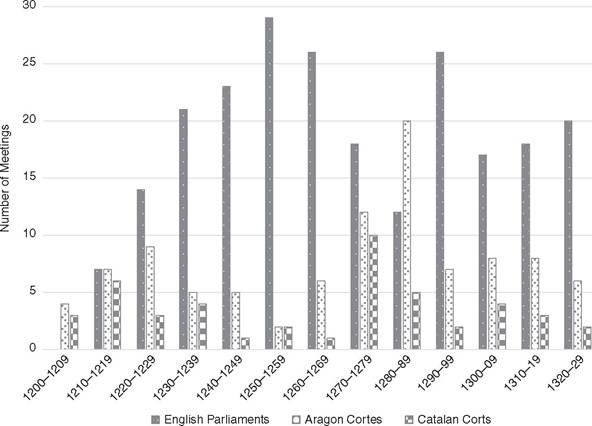
Figure 8.1 Comparative frequency of parliamentary meetings, England, Aragon, and Catalonia per decade, 1200-1329.
Source: Cortes de Cataluna 1896; Kagay 1981. Catalan and Aragonese figures include all meetings, even when towns were absent. As Bisson 1996, 45 has argued, it “is useless to speak of �pre-parliaments’” in Catalonia, as early meetings performed the same functions, so I draw no distinction.
frequency does not necessarily measure the strength of social interests: it was the Corts that requested that they be reduced to once every three years in 1301, as opposed to yearly as set in 1283.[928] Moreover, Catalan repreВsentatives were formally as obligated to come with specified powers as English ones.[929] Yet Catalan frequency was lower than Aragonese, even though the Catalan nobility was taxed but the Aragonese was not (Figure 8.1).15 Frequency only informs about regularity; inferences about power or consent must be derived in conjunction with other factors.
Frequency is not necessarily determined by the count-prince’s strength either. For instance, a meeting was held almost every year after James the Conqueror (1213-76) ascended to the throne at the age of five. However,
previous strong rulers had set the stage for this pattern, as analyzed further down. Nonetheless, his powerful rule did lead to more frequent meetings for the whole of Aragon, when he conquered new territories during the campaigns of the 1220s and 1240s, including the kingdom of Valencia by 1244.[930] Meetings sharply declined in the 1250s, when serious rivalries with France were dealt with diplomatic concessions instead of war, sugВgesting weakness. Meetings were held about every three years into the 1300s[931]7 just as territorial gains again accumulated,[932] suggesting greater military activity was related to assembly frequency.[933] As we will see next, however, these fluctuations reflect variation in the infrastructural strength and homogeneity that eventually allowed municipal institutions to flourВish in the fourteenth century.
8.2