BASIC FEATURES OF THE KOREAN CIVIL PROCEDURE ACT
1. History
A. Pre-modern era
Korean history dates back to B.C. 2333, when the first state, Kojoseon, was established. The judicial tradition of Korea is as old as this, for Kojoseon had its own statutory law.[5] Ever since, Korea has developed its own judicial system.
During the Chosun dynasty that lasted until 1910, it was governmenВtal officials who were in charge of adjudicating civil law suits. The distinction between civil and criminal procedure was not clear-cut. Appeals were allowed, and the case could go as high as to the King. There were no full-time judges, not to mention a separate judicial branch. It was not until 1894 that the first modern system separating the judiciary from other branches of the state was initially introduced, when King Kojong introduced the 14 Articles of Hongbum. Based on this, the first court in a modern context was established in Seoul in 1895.B. Japanese colonization period
In the wake of imperialism’s grip over the world, Japan forcefully annexed Korea in 1910. This colonization period lasted until 1945, the year the Second World War was put to an end. During this period, Japanese laws were in force according to a Japanese government decree. Since the Japanese legal system was strongly rooted in the continental civil law system, Korea was also influВenced by this tradition. Thus, the Korean civil procedure is said to be based on the continental law system as well.
Civil procedure law was no exception to this. From the perspective of comparative law, the Japanese civil procedure code was influenced by the German civil procedure Act of 1877. This inevitably left indelible footprints on the Korean civil procedure law. It is no wonder that a substantial portion of legal academia on civil procedure still consults German literature when handling domestic issues.
C. The enactment of the Korean Civil Procedure Act
After regaining independence from Japan in 1945, the law of the former occuВpying country needed to be replaced with a new one.
The Constitution of the Republic of Korea was promulgated on 17 July 1948. Shortly after, a newly formed commission began to work on drafting various Acts including a civil procedure Act. After many twists and turns, the Korean Civil Procedure Act (hereinafter �the KCPA') was first enacted as of 1 July 1960. Japanese civil procedure law had to remain tentatively in force until the enactment of the new code. Since the enactment of the KCPA, it has been amended 14 times. The most dramatic reform in the civil procedure was made in the year 2002, emphasizing the pre-trial phase and the concentration of the trial for the sake of efficiency as well as separating the civil execution part from the code.The KCPA is the most significant body of law that primarily governs the civil procedure in Korea.[6] The Rules of Civil Procedure (hereinafter �the RCP') has been promulgated by the Supreme Court of Korea, and serves as supplemental rules to the KCPA. As mentioned above, the Civil Execution Act has been enacted as of 2002 to govern the area of enforcement. Procedures regarding family litigation are regulated by the Family Litigation Act. Likewise, bankruptcy and restructuring proceedings are governed by the Bankruptcy and Rehabilitation Act.
2. Guiding Principles
As Article 1 of the KCPA puts it, the court should strive to enhance fairness, swiftness and efficiency in civil proceedings. This summarizes the guiding principles that permeate the whole process.
A. Fairness
Fairness is the essence of civil procedure. To find out the truth in a just way is the ultimate purpose of the procedure. It is no exaggeration to say that nearly every provision incorporated in the KCPA is directed at attaining fairness.
Substantive fairness - finding out the truth and drawing a just conclusion - is the first type of fairness to be achieved in the civil procedure. To make this goal feasible, parties are allowed to submit every possible argument and evidence to clarify the facts.
Moreover, the law obliges the court to acquire information from parties firsthand (Article 204).[7] Whenever it is necessary to clarify facts or the point of pleading, a presiding judge may take suitable measures such as asking questions or urging parties to clarify obscure things (Article 136). Appeals are another means by which true fact-finding and a just conclusion can be secured.Procedural fairness - observing neutrality and treating parties equally - is another type of fairness to be considered. The principal objective of procedure law is to give parties an equal and fair opportunity to present their cases to a non-prejudiced tribunal. In this context, Korean civil procedure is based on an adversarial model, as opposed to an inquisitorial model. The parties play a primary role in the process, while the judge plays only a passive role. The court should stay neutral and is not allowed to step in and side with one of the parties. It is also a procedural reflection of self-determination. It is the party who determines the beginning, subject-matter, and the termination of the proceedings. It is also the party who presents facts and submits relevant evidence. Parties should be given the same degree of protection and access to the process.
There is delicacy between these two notions of fairness. Tipping toward procedural fairness might harm the goal of finding out truth, especially when a party is not capable enough to perform procedural acts properly by himself. Tipping toward substantial fairness might be helpful in drawing a right concluВsion, but might endanger procedural fairness when the court aggressively intervenes in the proceedings to reach what it considers a right conclusion. The KCPAArticle 136, the clause that provides a basis for the intervention of the court to clarify pleadings by parties as well as setting forth its limitation, is a sort of an equilibrium balancing these two values.
B. Swiftness and efficiency
Justice delayed is justice denied.
Article 27 of the Constitution of Korea clearly declares that citizens shall have the right to a speedy trial. This idea is implemented throughout civil procedure. Parties bear responsibility of timely presentation of pleadings (Article 146). Failure to make pleadings or appear on the date of pleadings may result in disadvantageous treatments (Articles 146, 150, 268). The KCPA also prescribes a certain period for the rendering of the judgment (Article 199).[8]Efficiency is another value to be pursued. Although efficiency sometimes needs to be balanced against fairness, reducing the administrative cost of adjuВdication is arguably one of the most significant ideals to be pursued. The most notable feature of Korean civil procedure in the context of efficiency is the Small Claims Trial Act, which features an expeditious and convenient process.[9] This process was first introduced in 1973, mainly to remove the delays, complexities and costliness of regular trials by providing people with an accessible, simple, speedy and inexpensive mechanism for minor dispute resolutions.[10] In a small claims trial, the plaintiff can institute an action by making an oral statement to the court clerk instead of filing a written petition to the court. Once it is filed, the court may first render a decision recomВmending the defendant to perform her obligation based on the complaint, withВout waiting for the response of the defendant. If the defendant does not want to accept the recommendation as it is, she may raise an objection to the deciВsion. Practically speaking, a great portion of small claims cases are resolved at the stage of recommendation. Arestriction on the legal representative is eased, allowing persons in certain family relations with the party to represent her without the permission of the court. Evidence rules are less stringent. Although the judge must give a written judgment at the end of a hearing, she is not required to state the reasons in writing.
The grounds for final appeal are strictly limited. Also worth noting are the amendments of the KCPA in 2002, focusing on streamlining the whole process. The new case management model which has been introduced by the amendment focuses on enhancing efficiency by requiring timely measures by the party at each phase of the proceedings and minimizing the number of hearing dates supported by substantial pre-trial pleadings.3. Judicial System
Indispensable to an understanding of a civil procedure is familiarity with the judicial system in which the civil procedure fits. Below are the basic features of the Korean judicial system, focusing on a court system and judges.[11]
A. Court system
According to Article 101 of the Constitution of Korea, courts are endowed with power to adjudicate all legal disputes.[12] To perform this mission, the Court Organization Act of Korea sets forth the basic structure of the court system. According to this Act, the courts operate in a three-tier system.
At the root level is the district court. Currently, there are 13 district courts nationwide, each of which represents their respective geographical area. Branch courts, family branch courts, and municipal courts are established under the district courts upon necessity. Family courts and administrative courts are also on the level of District Courts. District courts are the courts of first instance, exercising general original jurisdiction. In principle, a single judge presides over a case. However, a panel of three judges is in charge of cases when the sums in dispute exceed 100 million Korean won[13] or if the money involved is incalculable.
At the appellate level is the High Court. The high court serves as the court of appeal. Five high courts are located in major cities of Korea - Seoul, Busan, Daegu, Gwangju and Daejon.[14] However, it should be noted that high courts are not the only appellate courts in the Korean system. The High Courts hear all the appeals from judgments by a panel of three judges, and the appeals from judgments by a single judge when the amount in dispute exceeds 50 million Korean won.
Yet appeals from other judgments that have been rendered by a single judge will be heard by an appellate panel in district courts. In this sense, appellate jurisdiction in civil cases is divided among high courts and district courts.At the highest level is the Supreme Court. It serves as the court of last resort. The Supreme Court is comprised of 13 Justices, including the Chief Justice. This court hears appeals from the High Courts and the Patent Court. It also hears appeals from District Courts or Family Courts when they adjudicate as courts of appeals. The grounds for appeal to the Supreme Court are limited by the law.[15] If the appeal does not contain the cause enumerated by law, the
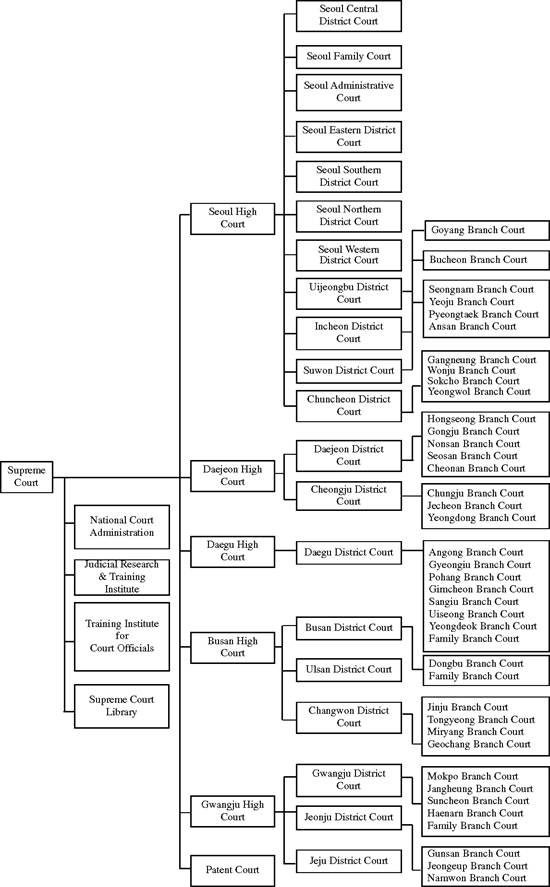
Source: This image is available on the official website of the Supreme Court of Korea at http://eng.scourt.go.kr/eng/judiciary/introduction.jsp#03
Figure 1.1 Court organization chart (as of July 2008) court dismisses the appeal without further examining the case. Generally, a case is assigned to a petty bench composed of four Justices. A case is decided by the Petty Bench unless it falls within one of the following categories; (i) the Justices fail to reach a consensus on the case, or (ii) any order, rule, or regulaВtion is in violation of the Constitution or Statutes, or (iii) it is deemed necessary to change the former opinion of the Supreme Court regarding the interpretation and implementation of the Constitution, laws, orders, rules, or regulations, or, (iv) when it is deemed that adjudication by a Petty Bench is not appropriate.
Notably, Korean courts do not have the common-law concept of stare deciВsis. In reality, however, the Supreme Court decisions tend to strongly influence decisions by lower courts in similar cases.
B. Judge
At the delegation of the Constitution, the Court Organization Act provides for the judiciary’s qualifications. According to Article 42 of the Act, persons who have passed the National Judicial Examination and have completed the two- year training program at the Judicial Research Training Institute or those who have obtained qualifications as lawyers are eligible to become judges. In pracВtice, the common pool of newly appointed judges was the group of elites among the trainees at the Judicial Research Training Institute. Some judges were selected Irom the pool of practitioners. However, the number of the second group was relatively small compared to the first group. This method of selection is likely to change in the near future due to the newly introduced lawВschool system. According to the new system, the U.S. style law school will be established by 2009 and the National Judicial Examination will be replaced by a bar examination. Consequently, the current two-year training program by the Judicial Research Training Institute will be abolished. The most significant feature of the new system is that it is intended to allow most law school gradВuates to become lawyers after three years of intensive and practical training by a law school. It remains to be seen how the appointment of new judges will change in response to this radical change.
Judges are appointed by the Chief Justice with the consent of the Council of Supreme Court Justices. Judges have a ten-year service term and can be reappointed. In practice, most of the judges are reappointed upon the lapse of ten years. The retirement age is 63.[16] [17] No judges shall be removed from office except by impeachment or a sentence of imprisonment without prison labor or heavier punishment. They are not subject to suspension from office, and subject to a reduction in remuneration or other unfavorable treatment except by disciplinary measures. III.