Putting It All on the Scale
Now, this is where it gets interesting. The key observations you have collected about project Deal Performance in the areas of Vision, Dissatisfaction, First Steps and Resistance must be put on the virtual scale.
Will the R(esistance) outweigh the combined value of V*D*F?Having discussed Gleicher’s formula with a wide population of managers over the years, this is where we always end up in a bit of debate. Overly simplified, I divide them into the “Engineering School” and the “Lawyering School” of legal team managers. Those trending towards the “Engineering School” just cannot help themselves adding numerical values to the items on the scale. Sometimes, they would even weigh the items, which surely complicate the process of comparing vision, dissatisfaction and first steps with resistance items. I am not a big fan of adding numerical values to the identified items, and I will openly admit that I belong to the second school, recognizing that the items identified under V, D, F and
Fig. 2 An illustration of initial assessment, with missing first steps
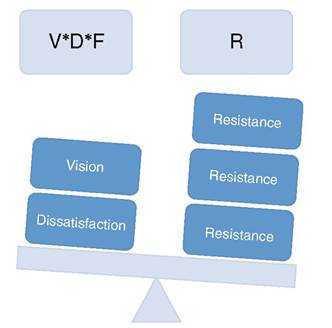
R are not all apples and cannot be directly compared 1:1, nor “weighed”, in a natural science manner. Rather, I will argue that comparing “apples and oranges” arguments—that are all relevant but carry different weight—lies at the core of classic legal training, and is something legally trained managers are actually quite good at. In legal method terms we sometimes refer to this step in legal reasoning as a “concrete evaluation of the specific facts of the case” or “holistic assessment of all the relevant facts” or something similar. My point is that this is core to legal method in most jurisdictions and whereas lawyers are not well trained on change management the step of putting all relevant items on the scale is right in the sweet spot for most lawyer managers.
Nevertheless, balancing the combined value of V*D*F against R has some challenges, and there are some pitfalls. The first pitfall is not realizing that the formula reads V*D*F on purpose, and it is definitely not V + D + F. The difference being that if either of the factors equals zero you are in trouble. That is, no matter how much Dissatisfaction you have or which well-planned First steps you can offer, you will fail if there is no Vision. And same logic, if there is zero dissatisfaction or no first steps. Gleicher's formula basically warns you that if either of the V, D of F factors are zero you will to fail (Fig. 2).
Let's try it with the Deal Performance example:
| V*D*F | R |
| Vision • Deal Performance will show who is supporting which deal and make it easier for the managers to allocate workload among team members. • Proper allocation of workload will improve utilization of the team member's available time. • Deal Performance will identify deals where negotiations are taking a long time, and | Resistance • Most deal supporting lawyers do not see the value in using the sharepoint, because they are on top of the deals they are working on and can always find the executed documents from their local hard drives whenever anyone asks for them. • All deal supporting lawyers claims they work as hard and fast as they can and blame slow negotiations on customer or internal business |
support pro-active manager intervention to drive difficult deals to closure.
• The repository function will help Finance find the executed documents.
Dissatisfaction
• Legal management is dissatisfied with not knowing who supports which deals.
• Legal management and sales management are not happy about deal velocity in the priority market.
• Finance are unhappy with the fragmented storage of executed contracts.
First steps
• None.
clients for slow closing deals.
• Some deal supporting lawyers share that they are uncomfortable with having management reading their redlined documents.
• Most deal supporting lawyers explain that they are usually deeply engaged in the next deal by the time the first deal closes, so uploading executed documents to the sharepoint is considered an unnecessary administrative burden.
• Most deal supporting lawyers express some “big brother” concerns that management will use workflow data points to monitor their performance in an overly simplified way that does not recognize the uniqueness/complexity of each negotiation.
So what to make of this? The first observation is that having no first steps is a problem. Better deal with that immediately. As you think through the implementation project, two potential first steps come to mind:
1. you can enforce the uploading of executed contracts to the Sharepoint while waiting for the Deal Performance solution to be implemented, or
2. you can set up a generic emailbox (e.g. contracts@yourcompany.com) and tell the deal supporting lawyers to simply copy/forward this generic emailbox when they deal with executed documents at the final stage of the deal support.
Your concern with #1 is that it will not be popular with the deal support team and you first think the second option is less controversial (but also less useful as it will be more work migrating executed contracts from the generic emailbox to the new system than from the Sharepoint). However, discussing your findings with your creative resource, you realize that option #1 has an interesting double effect, because it both, serves as first steps, and may increase the dissatisfaction with the current situation—which can be a good thing in terms of Gleicher's formula. You are still uncertain whether increasing dissatisfaction is needed, and you are a bit concerned it can be perceived as too “Machiavellian”, so you would really prefer option #2 for first steps.
On the other hand, the sum of the resistance items is really quite substantial, and you doubt that the combined value of your VDF factors outweigh the resistance factors.You re-consult the creative resource, who quickly points out that not only do the resistance items seem to outweigh the VDF items, but additionally there seems to be an imbalance when it comes to whom the issues concern. Your creative resource illustrate it like this:
| Category | bgcolor=white>IssueTeam member concern? | Mgmt concern? | |
| Vision | Deal Performance will show who is supporting which deal and make it easier for the managers to allocate workload among team members. | X | |
| Vision | Deal Performance will show who is supporting which deal and make it easier for the managers to allocate workload among team members. | X | |
| Vision | Deal Performance will identify deals where negotiations are taking long time, and support pro-active manager intervention to drive difficult deals to closure. | X | |
| Vision | The repository function will help Finance find the executed documents. | X | |
| Dissatisfaction | Legal management is dissatisfied with not knowing who supports which deals. | X | |
| Dissatisfaction | Legal management and sales management are not happy about deal velocity in the priority market. | X | |
| Dissatisfaction | Finance are unhappy with the fragmented storage of executed contracts. | X | |
| First steps | Generic emailbox. | X | |
| Resistance | Most deal supporting lawyers do not see the value in using the sharepoint, because they are on top of the deals they are working on and can always find the executed documents from their local hard drives whenever anyone asks for them. | X | |
| Resistance | All deal supporting lawyers claims they work as hard and fast as they can and blame slow negotiations on customer or internal business clients for slow closing deals. | X | |
| Resistance | Some deal supporting lawyers share that they are uncomfortable with having management reading their redlined documents. | X | |
| Resistance | Most deal supporting lawyers explain that they are usually deeply engaged in the next deal by the time the first deal close, so uploading executed documents to the sharepoint is considered an unnecessary administrative burden. | X | |
| Resistance | Most deal supporting lawyers express some “big brother” concerns that management will use workflow data points to monitor their performance in an overly simplified way that does not recognize the uniqueness/complexity of each negotiation. | X |
Some changes are just like this, that all of the resistance comes from the team or individuals most affected by the change, while the vision, dissatisfaction and first steps focus on the need of the management, owners or other pan-organizational stakeholders.
And the risk with this constellation is that the entire change projects ends up in a “us” vs “them” battle where the change agent ends up in the middle— relying solely on the managements will and ability to force or “marshal” the change on the affected team. Your creative resource suggest that you try adding weight to the VDF side and that you consider if there are VDF items concerning the team members that you may have overlooked (i.e. not only think about VDF from the management perspective).4.6