Law Firm Perspective: The Global Mandate
Large law firms, so-called global law firms, are relatively recent globalizers and remain less global than their major client corporations. For example, Unilever opened its international operations over a century ago, and sells its products in 190 countries.
Its arch US rival, Procter & Gamble, began to internationalize after the Second World War, and is less international with operations in 80 countries, touching the lives of people in 180 countries. Compared to this, the most global of law firms, Baker & MacKenzie, had 77 offices in 47 countries in 2015.8 The English “magic circle” law firms, Allen & Overy and Freshfields, have 32 and 28 international offices respectively. These figures indicate that law firms are not as global in their physical presence, even compared to other professional service firms. For instance, in audit and accounting, PwC employed 208,000 people in 157 countries, whilst EY similarly had 211,450 employees at 700 offices in 150 countries in 2015.Law firms at the top of the ranking aspire to become more global, and consider such “global mandate” as a no brainer for continued success and survival. A word of caution against this mindset comes from a principle in Strategy, which states that firms should enter new national markets only if such entry enhances the overall profit of the firm. Evidence from the Global 100 law firms indicate that this management principle is not taken seriously amongst top law firms. As Fig. 1 shows, greater international presence does not lead to higher profits. In fact, an overwhelming majority of Global 100 law firms have less than 15 % of their lawyers outside the home country. The most international, as measured by the percentage of lawyers working outside the firm's home country, is Baker & MacKenzie which employs just over 80 % of its lawyers outside the United States.
By contrast, the least international, is Wachtell, Lipton, Rosen & Katz, with one office in New York City, making profit per equity partner of $4.5 million, which is three times that of Baker & MacKenzie. (Note that Wachtell's corporate clients are global themselves.) Whilst this is an extreme comparison, it helps to make the point that operating internationally is highly challenging for law firms.Major law firms think that they have to increase their global presence in order to serve their global corporate clients. This might seem to make a lot of sense, but only if law firms themselves develop their capacity to manage their strategy and operations at a global level, rather than have a federation of national offices that do not create synergy for the overall enterprise. From the perspective of corporate
8The American Lawyer, “Special Report: The 2015 Global 100”, 28 September 2015.
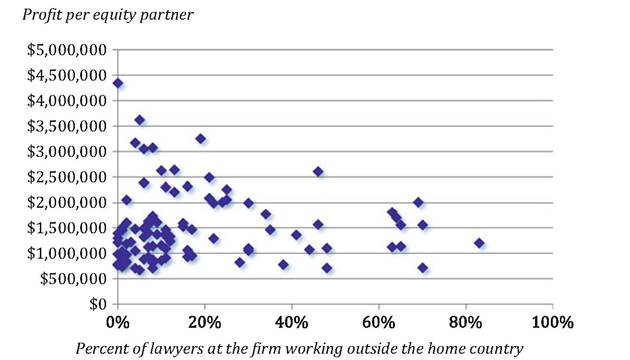
Fig. 1 Internationalization and profit per partner at large (Global 100) law firms in 2011. Source: Global 100 in 2011, www.law.com
clients that have implemented “convergence” (i.e. a reduction in the number of law firms retained) during panel reviews, some general counsel note the problem of false aggregation. According to one general counsel interviewed for the General Counsel with Power? study:
When we focus on a very small number of (law) firms, those firms in turn go out and hire local counsel anyway. So it looks like it is aggregated, but it truly always is not.
More traditional forms of managing law firms internationally, including a Swiss verein form or an international network (such as Lex Mundi (http://www.lexmundi. com/) and Multilaw (https://www.multilaw.com/)) and “best friends” arrangements, continue to exist for a good reason. The jury is still out on whether a global law firm or a federation of law firms would better serve globalizing corporate clients, especially as those clients look increasingly to new high-risk emerging markets in Africa, Asia, and Latin America.
5