Financial Benefits of the Managed Services Model
Switching from a traditional hourly based billing model to a managed legal services model yields business benefits for both sides of the engagement. One benefit that immediately comes to mind is the predictability of a recurring monthly billing.
A flat fee for services eliminates the peaks and troughs of normal hourly billing, making forecasting easier and more reliable for both parties. In Fig. 2, we examined our monthly invoices for legal services over the course of 2014.One can see that there is no discernable pattern to the hourly billing, in stark contrast to the flat rate scenario. To be sure, the nature of flat fee pricing means that at times one party will see financial favorability, since fee setting is not always an exact science. For instance, in the example above, a managed services provider would have come out of the year more favorably than we would have, as the total flat fee for the year would have exceeded the total we paid under traditional billing. However, our full year variance would have been within 15 % of the flat fee, and we would have had the benefit of being able to forecast accurately if we had a flat fee model, so it still would have been a win-win for both sides of the engagement.
Law firms moving to a managed services model can also see a windfall resulting from the base fee calculations. If the fees are based on total hours of anticipated work, typically a blended rate will be used to calculate the annual fee. Blended rates are often calculated as the average rate of all legal staff who are expected to provide
Billing Cadence
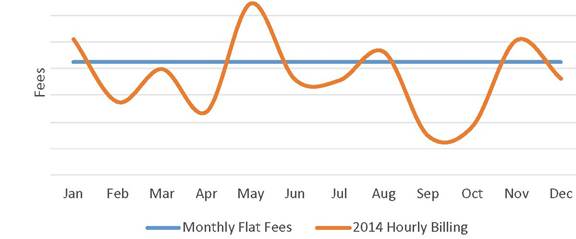
Fig. 2 Billing Cadence
Sample Blended Rate Scenario
| Legal/Non-Legal | Position | Hourly Rate | Number of Resources | Total Cost | ||
| Legal | Partner | $ | 550 | 2 | $ | 1,100 |
| Legal | Associate | $ | 350 | 5 | $ | 1,750 |
| Legal | Paralegal | $ | 200 | 3 | $ | 600 |
| Legal | Contractor | $ | 150 | 5 | $ | 750 |
| Non-Legal | Project Management | $ | 85 | 1 | $ | 85 |
| Non-Legal | Administrative | $ | 50 | 1 | $ | 50 |
| Non-Legal | Technical | $ | 75 | 1 | $ | 75 |
| Legal I Total | $ 280 Blended Rate | 15 | $ | 4,200 | ||
| Non-Legal | Total | $ 70 Blended Rate | 3 | $ | 210 | |
| Combined Total | $ 245 Blended Rate | 18 | $ | 4,410 | ||
| Delta in Hourly Rate | $ | 35 | ||||
Fig.
3 Blended rates
services. This can run the gamut from contractors and paralegals up to partner level attorneys. There are a couple of financial benefits that a managed services firm can realize from this. For one, this calculation sets aside non-legal personnel who are required for a managed services model to run smoothly. Project managers, administrative staff, and technical staff are all critical to start up, manage, and improve the outsourcing program. By excluding non-legal staff, blended rates end up higher than they would be otherwise. In the hypothetical scenario below, a $35 per hour windfall is built in to the blended rate. While it may seem small, a large scale arrangement will magnify that favorability over the course of the work (Fig. 3).
Another benefit of the blended rate is that it assumes that some number of senior level resources will be required. Early assumptions about the level of senior level involvement may shift, however, as the law firm gains familiarity with the client and the incoming matters. The initial start-up period may indeed require the expertise of senior level resources, but over time, the law firm should be able to assign the work to less costly resources, all while billing under the pre-set fees that
Workload Rebalancing
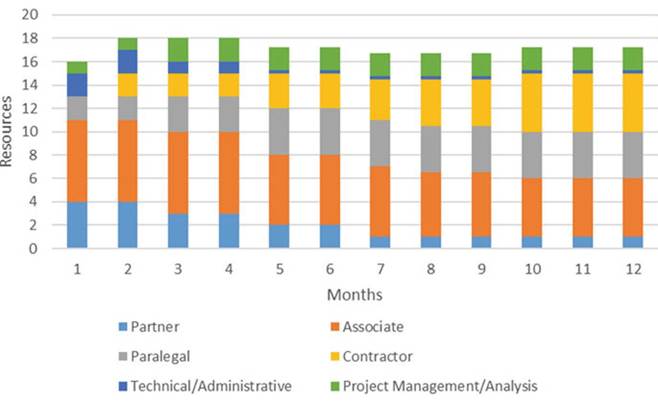
Fig. 4 Workload balancing
were based on the blended rate. Per the sample above, the client still has access to all levels of resources, but the balance of work should evolve so that the bulk of the work can be provided by lower cost resources (Fig. 4).
Since the commodity purchased by the client is the managed service, it does not matter what level of resource is providing the service, provided the quality meets the designated service levels. This allows the law firm to have scalability and be better able to handle a client's varying flow of work without overly relying on a handful of resources.
For these reasons, it behooves the managed services firm to aim for a higher margin by quickly ramping up and distributing the work to less costly resources.We should note here that an increase in a law firm's efficiency is made possible with data collection and analysis, two key components of a well-run managed services program. While business intelligence, or BI, may seem to be a buzzword more apt for other industries, it is a concept that is well suited for the legal services industry. Data can surface information such as how much time a transaction takes from start to close, what level of resources are used, what types of contracts are most common, which contractual provisions are consistently problematic, and so on. This type of data can inform the law firm and the client where there might be room for improvements, or even demonstrate the success of the program. BI has also quantitatively shown the benefits of our program. For example, in the chart below, we have data showing that our outsourcing partner was able to increase volumes per resource while decreasing escalations back to our in-house staff (Fig. 5).
The overall improved efficiencies shown above give us more confidence in the service and the value that the outsource partner provides. The more efficient the
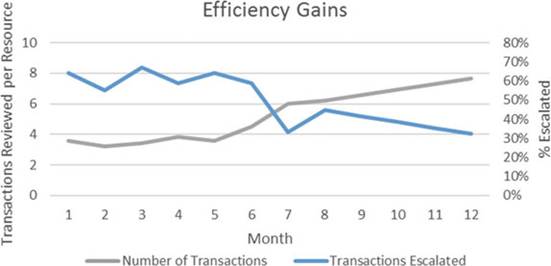
Fig. 5 Efficiency gains
program is, the more likely it is that we will send a larger quantity of matters into the program, even if the matter would not have previously risen to the level of sending it to outside counsel. Increases in volume can increase revenue for the law firm, so efficiency gains are a win for all.
Whether the fees are built on annual transactional volume or annual hours, the managed services model provides business advantages for both the client and the law firm. The new client-firm relationship is not just about the law firm providing more for less; it is the intersection where predictability, positive efficiency incentives, scalability, and smart use of the client's limited resources drives a mutually beneficial relationship.
6